In your book, you cover a lot of battles in a lot of places over an extremely long period of time. What did you ultimately conclude?
This is my fifth, and as with all the books I’ve written, it’s not exactly the one I started out writing. Generally, I do people- and story-led books, which relates to two or three of my choices that we’re going to talk about.
This was a diversion. Most historians who are in the genre want to do a book like this because it’s almost like exercising your chops. How much do I know? What are the theories behind it? So I always wanted to do it. You don’t get narrowed down to just one war or battle and 3,000 years of history—that’s exciting.
What I discovered was, the more research I did—whether it was ancient history, medieval, Tudor, Napoleonic, World War Two—that while the tactics and technology have changed radically, the human dimension is always the same. It’s about human beings.
Whether it’s the commanders, or the line officers on the ground, or the soldiers, they’ve all got the same frailties you and I have got. It doesn’t matter whether they’re a Greek hoplite, a Tudor English sailor, or a Ukrainian soldier on the front line today, you’re still scared. It’s about how you react under pressure. If you’re a commander, it’s about the timing, about how you deal with sudden events.
That hasn’t changed ever, and writing this book over this whole timeline really confirmed that to me.
How much research did you do to cover that many periods?
I’ve edited history books for more than three decades, and military history has been a constant thread throughout my career. Some subjects stay with you. Even when I’m not working on a particular project, I’m always collecting material, whether in notebooks, voice memos, or on my laptop. Over the years I’ve built up tens of thousands of notes on battles, commanders and campaigns. So, when I was asked what I wanted to write, I already had a vast reservoir of research to draw on.
That wasn’t the end of it. For this book I read well over a hundred additional works and revisited many of the battlefields themselves. I’ve walked Civil War sites in Virginia, explored battlefields across Britain, and spent time on key locations in Europe, Russia, Vietnam and Japan. There’s no substitute for standing on the ground, seeing the distances, the terrain and the decisions that commanders had to make.
People often ask how I find the time. The truth is that publishing is already all-consuming; I edit twenty or more books a year. But after enough years, you learn to trust the process. Research accumulates steadily, often unnoticed, until one day you realise you’ve spent decades preparing to write the book that was in your head all along.
OK, so you’ve mentioned reading over 100 books, including all the ones you’ve read over the years. How did you choose these particular five? What were your criteria?
Some were whether they affected how I thought history should be told. I’d say front of that cab rank is John Keegan’s The Face of Battle. It’s probably had more of an influence on me than anything else. A couple of these books are seminal, and I would argue that your readers should definitely go out and read them. Others, like, for instance, With the Old Breed, which we’ll talk about by E.B. Sledge, has got the human factor that I just find gripping. It’s just such a brilliant, raw, emotive, visceral book. It’s not even a memoir—it’s almost like he’s taken it as therapy. It really moved me. Then there are other books that shine a light on aspects of big battles people know about, but hadn’t really thought of them in that way.
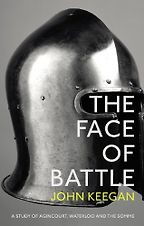
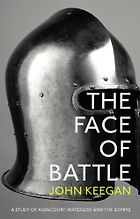
Let’s go through each of them and tell me about them, bearing in mind that not everyone may have read them. Let’s start with The Face of Battle (1976) by John Keegan, which covers three battles. Tell me a bit more about the book and and and why it’s so seminal.
John Keegan’s The Face of Battle is arguably the most influential work of military history written in the last fifty years. It radically altered the next generation of published historians coming through.
Before Keegan—and I’ve read a lot of books that came out before—it was always about the great people, generally men of military history. You’re looking at warfare or the battle itself from the top down. You learn about the great strategist who might have won or lost the battle, but not what life was like on the front line for the ordinary person doing the fighting. That’s what Keegan brings to it.
He does it by examining three of the most important battles (from a British perspective) you would want to know about: Agincourt in 1415, Waterloo in 1815, and then the Somme in 1916. These are battles that resonate in every household across Great Britain and further afield. Keegan gives you the background and the context, but he captures them from the ordinary person’s perspective.
What I loved about it when I read it in my early twenties was the fact that it was just so accessible. I thought, ‘He’s writing this for me. This is the way I would like to read history.’ I’ve got dozens of books on my shelf that are very important but they’re very dry—whereas he’s bringing it to life. I mean, in the process of writing my new book, I must have gone back to John’s book at least ten times, because it’s just so good. It’s like a breath of fresh air. I read it again just to get inspired.
With a medieval battle like Agincourt, how do you get the on-the-ground view? There must be a lot more information about the leaders.
With the leaders, you’ve got a lot of material from the time. Then, maybe decades afterwards, you can read about the commanders of the period on both sides, and records showing the casualties.
It’s not that the first-hand material is super scant, but if there’s not much around, you then spread the net slightly wider, and you look at other key battles in the period and how the fighting has been recorded. It’s completely accurate and fair to then add that to whatever work you’re doing.
He’s obviously gone to these places. He’s giving you a bird’s-eye view of the terrain and the weather and what the terrain would be like in that weather.
It gives you an insider’s idea and appreciation of what they were facing. How ferocious was the fighting? Did the tactics work? Did they fail? Was the weather that big of a factor? Was the longbow that big a factor? He brings it to the page in the way that someone like Bernard Cornwell would do in fiction. He really brings it alive, and you want to find out what’s happened to this person he’s writing about, or that unit. That’s what I’ve always found captivating.
One of my colleagues interviewed Antony Beevor about World War Two. She asked him which historian inspired him, and he also mentioned John Keegan, The Face of Battle.
I think if you interviewed any current military historian/author right now, they would say the same thing. There’s no argument. It’s a seminal book. It came out decades ago, but it’s still very much in print.
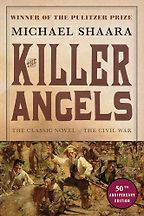
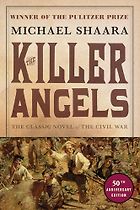
Let’s turn to your next choice, The Killer Angels (1974) by Michael Shaara. This is set during the American Civil War, and it is actually a novel, is that right?
Yes, it is, but I definitely wanted to bring it in because it’s had just as big of an effect on me as John Keegan’s work has. I am a huge American Civil War researcher and author. I’ve been to quite a few of the battlegrounds in the eastern theatre in Virginia, Maryland and Pennsylvania. I’ve even written a book about it, U.S. Civil War: Battle by Battle.
The Killer Angels is perfect in that Michael Shaara takes Gettysburg, the pivotal battle of the American Civil War, if not in modern American military history, and brings it to life. You can tell he’s done the research because of the way he talks about the units on the move and the planning. The fighting itself at Gettysburg is very, very accurate. The man’s done his homework, but he’s just got that fictional writer’s skill. He just brings to life the drama of the human experience.
You can understand why countless Hollywood producers and directors have read The Killer Angels. At the same time, they’re reading nonfiction books that enable them to picture whatever scene they want to: whether it’s the first, second, or final day of fighting at Gettysburg in July 1863, such as ‘Pickett’s Charge’.
That’s why I think the book is important. You need someone like Michael Shaara because he takes what you might think of as, ‘oh, it’s just military history ’ and he opens it up to a much wider audience. He pulls in a general readership to then study what you could argue are serious nonfiction works about Gettysburg and the wider American Civil War. So, it works on lots of levels.
I was just reading the beginning about the scout checking out where the troops are. It’s very gripping, isn’t it?
Yes. Also, as an editor, what I liked about the book is that he avoids caricatures. He’s writing about the people, the main participants, but he’s not throwing a big bucket of clichés on them. That makes it more believable.
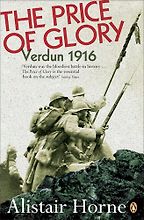
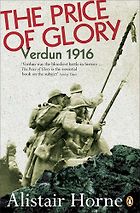
Let’s go to the next book about a battle, which takes us to World War I and Verdun. This is a big favourite in our family. What can you tell me about The Price of Glory (1962) by Alistair Horne?
I’m a recent convert. I was a history lecturer and guide on a cruise around Japan and South Korea in June. I was giving quite a few lectures on Japanese history, which made me realise I wanted to read something that completely took me away from that area, so I could relax. I bought The Price of Glory—I told you I was a military history geek! I thought l’d be having too much of a good time to read the book properly, but I did. I read it cover to cover in six nights.
Can you say a bit about the Battle of Verdun for those who may not be as familiar with it?
The Battle of Verdun was a ten-month-long ordeal in which France and Germany sacrificed hundreds of thousands of men for a few miles of devastated ground. It’s why the Battle of the Somme was necessary to the north, as we, the British, were trying to relieve the pressure on Verdun, which lay to the southeast of our own trenchlines.
Verdun was more than a battlefield. For France, it was a symbol of national survival: a ring of great forts strung across the landscape, long regarded as impregnable. Far from the fighting in Belgium, the sector had been relatively quiet, which was precisely why the Germans chose it. Their aim was not simply to seize ground, but to destroy France’s will to continue the war. As one German commander put it, they would ‘bleed France white’.
The battle opened on 21 February 1916 with one of the heaviest bombardments the world had yet seen. Around a million shells crashed onto French positions on the first day alone. For weeks the Germans seemed unstoppable. Fort after fort came under attack, French units were hurled into the line and shattered by artillery fire, and Verdun became an industrialised slaughterhouse on a scale scarcely imaginable. By the spring of 1916, it appeared possible that the Germans might break through altogether.
Yet Verdun produced the opposite result from the one Berlin expected. Instead of crushing French morale, it hardened it. The battle became a rallying cry for a nation under siege, a test of endurance that France refused to fail. Like the Somme in British memory, Verdun is remembered for its terrible losses, but in France it also carries the meaning of sacrifice, resilience and national defiance. It remains, perhaps more than any other battlefield, part of the military soul of the nation.
In The Price of Glory, Alistair Horne really brings to the page the ordinary human experience of Verdun. It’s just hell on earth. It’s this dystopian, mad landscape of destruction. And I think if John Keegan, in The Face of War, explains what battle feels like, this book explains how entire societies are pulled in to try and win what looks like a hopeless situation. Because that’s what happens. It’s what happens with the Soviet Union at Stalingrad in the Second World War. You manage to rouse the nation by declaring, ‘This is an existential threat. We could lose the country and be overrun if we are defeated.’
Verdun is, I think, the turning point for France. It saved the country in the Great War.
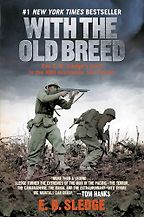
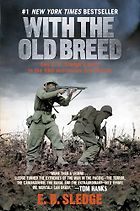
Let’s go on to the Pacific in World War II now, and you’ve chosen a memoir. This is With the Old Breed by E.B. Sledge.
This book is captured in the TV series The Pacific. It’s the Pacific version of Band of Brothers. A few years ago, I wrote a book called The Hiroshima Men, about the war in the Pacific and the race for the atomic bomb. To explain to my readers why you would drop an atom bomb on a city of human beings, I chart the progress of the war over three years and showcase how brutal it was – for the military as well as civilians. There was no quarter given, and no weapon off the table for either side.
The main character in the HBO series, Eugene Sledge, was a young U.S. Marine who doesn’t even enter the fighting until September 1944, but he’s then in some of the most vicious combat as American naval forces ‘island hop’ through the South and Central Pacific to establish bases close enough to bomb Japanese cities and ultimately invade the country. Equally, Japan knows that they must not allow this to happen or it will be unconditional surrender. That’s where the ferocity of their defence turns suicidal and casualties mount on both sides. American forces lost more men in the final year of the war than in the previous three years combined. That’s where Sledge’s memoir begins.
‘The Old Breed’ is a term given to veteran U.S. Marines, but these young, raw recruits like Sledge soon learn the art of war because of the brutality of the fighting on Okinawa and the fact the veterans already serving in their unit are being killed. It becomes about survival.
What I found emotive and why I chose it is that this book—above most other World War Two memoirs—is just incredible for capturing the psychological damage of being on the front line. It’s visceral. You can see why Tom Hanks’s production company based half the HBO series just on this single piece of biography, because the things Sledge witnesses, the fighting he experiences, his friends dying, the sheer waste of it all are perfectly captured in this memoir.
Sledge couldn’t write it when he came home. He was too damaged. It took him years to distil it, to then be ready to write down his epic tale. Most of the best World War Two memoirs, from an American perspective, started to come out in the mid-1950s because by then they could think, ‘I’m ready to put pen to paper.’ With the Old Breed is the standard against which you’d measure current memoirs. Are they as good as his? Because his is just extraordinary. And who knew? And I think it surprised him too. He’s such a gifted writer.
He went on to become a biology professor, I believe.
I’ve interviewed veterans from the Second World War on all sides in the process of writing my last two books, and there were quite a few who went on to have outstanding, stellar academic careers. There was one who was about to turn 100 when I spoke to him, he’s a professor at Colorado University. He was on Iwo Jima for three weeks and survived. He saw most of his friends killed and he said he jumped for joy when he realised they’d used the atomic bomb on Hiroshima. It took him years to understand just how terrible a decision that was. He said, ‘I regret it now but, at the time, I was 20 and I just wanted to live.’
A few months ago, I interviewed someone whose dad had been on the Burma Railway, and she’d just published his diary. She recommended the E.B. Sledge book as well, but I haven’t read it yet. I’m a bit scared to get to it.
You could watch the HBO series instead. It’s ten episodes and he’s in half of it. I honestly think the series really does capture the book because it’s so visual.
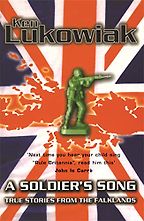
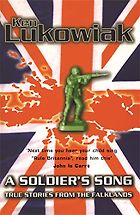
Let’s turn to your last book, A Soldier’s Song (1992) by Ken Lukowiak, which is about the Falklands War.
I was a young teenager when the Falklands War was on. I began my career in publishing in 1992, at a big London-based publisher. It was my first job and my degree was in history. I was surrounded by books and people would say ‘Just take one.’ You think, ‘Wow, it’s like Christmas!’ The publisher I was working for had just published this book.
A Soldier’s Song by Ken Lukowiak tells the story of what it was like to fight and survive down in the Falklands with the British forces. Lukowiak is an elite soldier, serving with 2nd Para. He’s been trained and highly conditioned to kill, and they did. They were very, very effective in the Falklands: arguably the best-performing unit.
It’s a bit like Sledge’s book, With the Old Breed, in that Lukowiak is adept at describing the fighting. But then it becomes almost like a novel from the 1960s where you’re finding the tragicomedy from Vietnam. Lukowiak’s candour and his humour are allied with emotional intelligence.
It paints a picture of what it’s like to switch from being bored for days on end because nothing’s happening, and then all of a sudden—bam!—you’re in the thick of the fighting. Bullets are flying around you in the dark and there is tracer fire everywhere. Your friends are dropping left and right. He captures that effectively, which is surprising because he’s not a trained writer, he’s a squaddie. Also, like Sledge, he wrote it years after the event. It’s about having the ability to put your mind back to that period you probably don’t want to revisit and bring it back to life.
At the time, I don’t think A Soldier’s Song was a bestseller. I have mentioned it a few times to people over the years, and they don’t know it. It’s still available secondhand on Amazon. It’s fantastic, and I’ve still got a copy that’s 30 years old at least. I see it as one of the most important books on the British side to come out of the Falklands campaign because, again, in a Keeganesque way, it’s talking about the ordinary soldier’s experience.
I haven’t read any books about the Falklands, and like you, I was pretty young at the time. What’s the story he’s telling?
The Falklands War began when Argentina’s military junta seized the islands in April 1982. Margaret Thatcher’s government rejected any suggestion of accepting the occupation and instead dispatched a naval task force to retake them. At the heart of the campaign were units such as the Royal Marines, the Parachute Regiment and the Guards, who faced the formidable task of advancing across difficult terrain towards Port Stanley.
Among them was Vincent Bramley Lukowiak of 2 Para, a battalion that found itself confronting well-armed Argentine forces entrenched on the high ground surrounding the capital. The British landed far from the main Argentine positions and had to march for days across bleak, windswept ground before assaulting a series of heavily defended objectives. The odds were often daunting, and while the British eventually prevailed, the victories came at a cost.
What makes Lukowiak’s memoir so powerful is that it strips away the patriotic headlines and triumphalism that followed the war. He takes the reader onto the battlefield itself: the freezing rain, the sodden peat bogs, the exhaustion, fear and uncertainty of combat. His story is not simply about military success, but about the human experience of war and the lasting physical and psychological burden carried by those who fought it.
Interview by Sophie Roell, Editor
September 27, 2026. Updated: October 14, 2026
Five Books aims to keep its book recommendations and interviews up to date. If you are the interviewee and would like to update your choice of books (or even just what you say about them) please email us at [email protected]
Five Books interviews are expensive to produce. If you've enjoyed this interview, please support us by donating a small amount.