Sewing is a creative outlet, and gives you the freedom to create your own style. Alison Smith MBE gives her five top sewing books for a beginner, chosen from her collection of four- or five- hundred. With guidance on textiles, techniques, patterns and equipment, these provide a comprehensive guide for the new and not-so-new sewer.
In a world where we can buy all the fabric goods we could want, why are people learning to sew?
That is a good question. You want things to fit. You want things that not everybody else has got. You want your own style. You don’t necessarily want what’s in the stores at the moment. There’s nothing worse than walking down the street and seeing somebody in the same chain store jumper that you’ve got, and thinking, “Oh my God. Does mine look as bad as that?” And also, it’s a creative outlet for people.
Not everybody will get that. Sewing isn’t for everybody. Some people just don’t get it, because you do need to be able to see from 2D into 3D and not everybody has got that concept. But it’s a life skill, and I think that everybody should know the basics, even if it’s how to fix a zip and sew a button on. And it’s just not taught anymore.
How did you begin choosing for this list?
I’ve gone for a cross section of books, old and new. I’ve probably got four- or five-hundred books on sewing; if a new book comes out I get it, because every book will teach you something. And some of the best books are still the oldest.
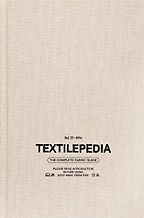
To begin at the beginning, then: before you get around to sewing, you’ve got to pick out your fabric. So your first choice for today is the Textilepedia from Fashionary. Tell us about this one.
Fashionary does a whole range of books, and they’re all brilliant. The thing about sewing is you need to understand your fabric, and so many people don’t know the difference between acetate, polyester, linen, bamboo, etc. You need to understand what a fibre is and how the fabric was constructed, because if you know that, then you’ve got some idea of how it’s going to behave.
This is a relatively new book. It’s well illustrated, and it’s not too wordy; it tells you quite quickly what you’re looking for, with common applications for the fabric and how to sew it. That’s all you need. But it’s got some really nice bits about construction as well, especially when you get onto knits –warp knits and weft knits and circular knits. People haven’t got a clue, and you need to know.
It’s just a great little book. I’ve got all the series of these Fashionary ones, and they’re brilliant, all of them.
Most people could probably manage heavyweight or lightweight – what are the other major factors?
For example, satin isn’t a fabric. Satin is a weave. So you can get satin in all the different fibres. Satin’s the weave of the fabric, so what’s the fibre content? Is it polyester satin, silk satin, cotton satin…?
The more you get into sewing, the more you need to know how different weaves behave when you’re cutting them out. When you get onto twill weaves and, say, you’re cutting your pair of jeans out, you need to cut one leg one way and one leg the other way because the fabric behaves better that way. Same with bias cut: you need all your sections either on the warp or the weft grain, not some on warp, some on weft, because then they start to twist. But that’s getting quite technical.
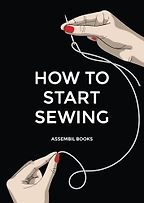
A great place to start, then. Let’s move on to the next step. Having purchased our fabric, you have the boldly titled How to Start Sewing. Tell us about this one.
This one’s very wordy. There is a lot of text in it, a lot of reading. The illustrations are very clear, and it goes into things in a lot of detail. For a beginner, it’s a really good book because the graphics are good, and it assumes you know nothing.
If you are a beginner, I would say just pick this up. Don’t try and read it as a book. – but it’s really got the basics in it that you need to know.
It’s big.
Yes, it’s big, it’s heavy.
It has a whole section on hand-sewing garments, then another on machine-sewing. That’s heartening for those of us intimidated by machines. Is hand-sewing common?
For heritage, if you’re into role-playing and dressing up in certain periods, a lot of those would be hand-sewn. I know if you go to Fredericksburg in America, where it’s a Civil War village, those garments are all hand-sewn. And you do get the occasional person who will hand-sew a garment from start to finish – I wouldn’t. But I do encourage people to hand finish things rather than machine finish them because they’re just nicer.
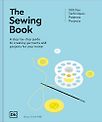
You’ve also written a comprehensive guide, The Sewing Book. It goes right from choosing the fabrics and the equipment, through understanding patterns and adjustments, on to techniques, and then has some projects at the end. So really comprehensive. Have you taught beginners much, and did that shape the content of the book?
When I taught in school, I was teaching children who didn’t even know what a sewing machine was. But as I’ve gone through my career, I tend to now teach intermediate professional people who want to do couture techniques, corsetry and tailoring – that’s a lot of hand sewing.
When you work with DK as a publisher, they are amazing to work with, they’ve got a very clear idea of what they want in their books. So we work closely together on the content. This has got all the basics in, but in a different format to the previous book: my book is photographic sewing steps, and I’ve tried to give projects that reflect the techniques we’ve used in the book.
Could you tell us a bit about the projects at the end? What can people make?
I’ll have to check, because I’ve just done the update of The Dressmaking Book which has twenty new garments, and there’s The Tailoring Book too, so I have to make sure I get the right projects in the right book…. Ah yes, we’ve got a nice tote bag, and that is super easy. And the other one in here that I really like, and I make loads and loads of these, is the toiletries bag. If you’ve just got scraps of fabric these are great – you don’t always want garments, you might want a crafty thing. And there’s a dress in here which is really nice, and still one of my go-to patterns. I’ve made that up so many times. There’s a kimono-style unisex dressing gown that’s super easy; a sweatshirt; a hoodie… So there’s all sorts. There’s a kiddies’ raincoat. One of the Sewing Bee contestants a couple of years ago did that, and I thought, “Oh, that’s one of mine.”
You mentioned it all being photo illustrated. Every technique is photo illustrated – that must be an epic task.
Yes. Take this random page – there are eighteen steps. That means eighteen pieces of fabric: you do step one, put it to one side, then do step two, which is step one plus the next bit, then step three… Then send all the samples off to be photographed. I’ve still got two great big boxes of samples under my desk here.
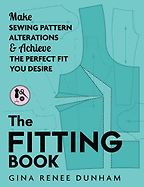
That’s a huge task. Wow. Ok, let’s talk about your third choice. We come now to adjusting patterns: tell us about The Fitting Book by Gina Renee Dunham.
If you’re going to sew for yourself, you need to be able to fit. There are lots of books out there on fitting, but I think this book is one of the clearest. It’s almost simplistic: she’s just got diagrams. In some books you see the garments on people, but when they’ve photographed an issue on a person, you tend to look at the person rather than the issue. Whereas this is all illustration. And her techniques work.
People new to sewing might assume fit is just a matter of measuring yourself and then measuring the fabric, but skimming down her contents page, I see we need to know about ease, and fabric type again… Could you talk a bit about the main considerations?
I think you have to be honest about your figure shape; you really do need to stand and look in the mirror. You need to be able to say: I have got a tummy, or one shoulder is higher than the other, or I have got a rounded back or a big bust. One of the issues that I find with a lot of students is they don’t wear a good fitting bra, because that will make a lot of difference. When you get into bra cup size and patterns, it gets exceedingly complicated – lots of people will tell you to go by your upper bust measurement, but this measurement’s a waste of time. You haven’t got a bust there unless you’re about thirteen, you know. You need to understand your back width measurement, your front width measurement. And you need to adjust your pattern accordingly – or learn how to pattern draft, which takes us onto the next book.
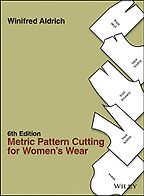
It does, yes. This is Winifred Aldrich’s Metric Pattern Cutting for Women’s Wear – and she’s also got Metric Pattern Cutting for Men’s Wear, right?
Yes, and for children’s wear. There’s a whole range. These books have been around for ages, and it’s the book that’s still used in all the universities and colleges that I’ve ever taught in. It’s the bible for pattern cutting in this country. Other drafting books are available, but I think hers is by far the best, and it’s the one that a lot of other things are based on.
You’re not going to suddenly start off by drafting your own pattern, I don’t think. But if you want to alter a neckline, she tells you how to do it. If you want to draft a collar to go on, perhaps for a top that you’ve made before, she shows how to do it. And then when you get more advanced, you might think, “You know what? I’m going to try drafting a block.” A skirt is easy – just start with the skirt, and then you think, “I can do this.” If you want to get into drafting, this is the book to go for.
Wonderful. Is “metric pattern cutting” a particular technique?
We are metric in the UK, but Americans do it totally differently. They make a moulage, and they draft a sloper. That’s all done in inches, and only goes down to the nearest eighth of an inch, which is not precise enough.
So it’s the whole approach, not just the measurement unit?
Yes, so Winifred drafts with ease included in the draft. Quite often in America you draft what’s known as a moulage with no ease in it, and then you start adding the ease on.
Could you define ease?
It’s the difference between your body measurement and the finished measurement of the garment – so that you can move in it. If there’s no ease, you won’t be able to raise your arms or sit down in your trousers. Usually, ease on a hip measurement is around two inches, and for your bust, it can be anything from around two inches to around ten for a coat.
Great. Let’s talk about your last choice. This involves the most technical equipment you’ve recommended so far: The New Sewing with a Serger. Could you tell us about this one?
Yes. They call it a serger because it’s an American book – this is an overlocker.
Can we quickly explain what that is?
It’s a separate sewing machine, and does the neatening that you see in a shop-bought garment on the edge, where it looks like a fancy zigzag stitch. It cuts and sews at the same time. The majority of sewers, once they get into dressmaking or craft or whatever they’re doing, will get themselves an overlocker. Overlockers do so much more than just neatening the edge of the fabric.
There’s a whole library of these Singer reference books, and I think this is a really good one. Again, it’s quite clear, the illustrations in it are clear. There are some interesting examples of things that they’ve used it on, and there are lots of different methods for the same process, which is good.
For anybody intimidated by an overlocker: are they difficult to use? Should we be intimidated?
People are intimidated by them – it’s a very love-hate relationship. But get to know it. Make it your best friend because they are invaluable machines.
Five Books aims to keep its book recommendations and interviews up to date. If you are the interviewee and would like to update your choice of books (or even just what you say about them) please email us at [email protected]
Five Books interviews are expensive to produce. If you've enjoyed this interview, please support us by donating a small amount.
Alison Smith
Alison Smith is the author of several sewing titles including The Sewing Book, The Dressmaking Book and The Tailoring Book. She is the first person to be awarded an MBE for services to sewing and corsetry. She teaches dressmaking, tailoring, corsetry and couture techniques.
Alison Smith is the author of several sewing titles including The Sewing Book, The Dressmaking Book and The Tailoring Book. She is the first person to be awarded an MBE for services to sewing and corsetry. She teaches dressmaking, tailoring, corsetry and couture techniques.