Best New Science Books for Children: Royal Society Young People’s Book Prize 2026
recommended by Cristina Lazzeroni
The Royal Society Young People's Book Prize recognises the best new science books for kids, books that combine scientific accuracy with originality. Professor Cristina Lazzeroni, physicist and chair of the 2026 judging panel, introduces the exceptional titles on this year’s shortlist, and explains why they will inspire children to read about science.
For those who haven’t come across the Royal Society Young People’s Book Prize before, can you introduce it and explain what kinds of books you are looking for?
The Royal Society Young People’s Book Prize recognises the best science writing for children under fourteen. The aim is to promote science literacy in young people, and to inspire them to read about science. The shortlist is selected by an adult panel, but the thing that makes this prize special is that the winner is voted by judging panels of young people, at schools, science centres, and community groups across the United Kingdom. Last year, votes were cast by over 11,000 young people, making up around 600 judging panels.
There are so many excellent science books today written for young people. What we look for in the books is that they combine accurate science with originality. For example, that they introduce an unusual topic, bring a novel perspective to a topic, or have an imaginative approach.
You are the Chair of the judging panel this year. Can you briefly introduce your own work and the background of the rest of the judging panel?
I’m a particle physicist. My research is based on experiments of very high precision, with the aim to enhance our understanding of physics at the smallest distances. I like the fact that it links to mathematics and to fundamental concepts, for example symmetries, which are everywhere.
The shortlisting panel consisted of four people in addition to me. They are: Andrew Blair, who is a primary school teacher and science subject leader; Dr Joshua Kestel, a Royal Society Newton International Fellow, who studies the relation between plants and pollinators; Hiba Noor Khan, who is an award-winning children’s book author and a former teacher of physics; and Ken Wilson-Max, who is also an award-winning children’s book author, and is an illustrator and publisher. We worked well together because we had different perspectives, different areas of expertise, and broad ranges of experience in engaging with children and with the public in general. For example, Joshua and I cover very different areas of science; Hiba and Ken could highlight key features of illustrations, with insights from having produced books themselves; and Andrew often commented on the qualities of a book that would appeal to children in classes that he’d taught.
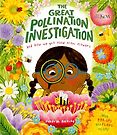
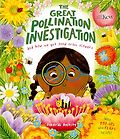
Let’s go through the books that have been shortlisted for the 2026 Royal Society Young People’s Book Prize. Shall we start with the one for the youngest readers, The Great Pollination Investigation, by Deborah Hocking?
This is such a beautiful book, and the illustrations are magnificent. There are lots of interactive surprises, things that unfold. The 3D elements are excellent, and there is a bit of a collage style, which is a nice touch. The text font is large enough for a young audience, and the science is introduced in a way that makes it easy to follow. It keeps its interest from beginning to end.
It is very lovely. I saw that it’s fact-checked by the Royal Botanic Gardens at Kew, which is a good seal of approval. There is no upper age limit for this book, is there?
There is absolutely no upper age limit. I enjoyed The Great Pollination Investigation enormously. I’d say that there’s no age limit either side for any of the books shortlisted.
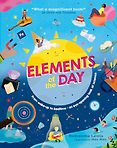
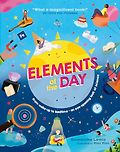
Next up of the shortlisted science books for kids is Elements of the Day by Samantha Lewis, illustrated by Hao Hao. Can you introduce it?
The concept of this book is great. It links everyday experiences to the periodic table of elements — something that most children encounter at some stage, but often in a quite abstract way. Elements of the Day makes the periodic table tangible and approachable. It’s fast paced and there’s a fair amount of humour and bizarreness peppered through the book, helping keep it interesting. It has a good mix of visuals and text, and is really accessible. It can encourage even the most-reluctant pupils to engage with the periodic table, helping them see the amazing role that it has outside of school.
It’s a great concept. I saw that a companion volume has just come out called Forces of the Day.
That’s good! Hopefully, it will be a candidate for next year’s Royal Society Young People’s Book Prize.
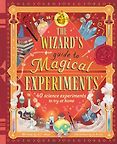
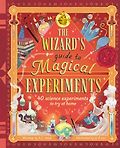
It really is. Again, this is a cool concept, introducing science with the help of magic. This can be a route into science for children who might initially be a bit put off by the subject. The collection of experiments is fantastic — I want to do them all! The committee could see children picking up this book because of the magic, then engaging with the science, reflecting on why the experiments work the way they do, and investigating further by themselves. They can try different experiments on different days, working through them at their own pace. They could try some of the experiments at school, or in a different environment, to explore further the science behind them. The book can work in many ways.
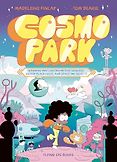
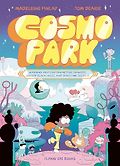
Let’s move on to Cosmo Park, which is illustrated by Tom Dearie and written by Madeleine Finlay, who has been shortlisted for this prize before, with Beetles for Breakfast.
Cosmo Park has a different feel to it. It is a science book about cosmology and astrophysics, written as a comic book. This was a unique approach among the books that we looked at. It has a fair amount of science in it, delivered skilfully, but the story is not just a way to convey information; it holds up on its own.
Yes, it’s an adventure story about a girl called Kara and her cat, who get a tour of the hot topics in astrophysics, right?
Yes, exactly. The cartoons are brilliant and fun to read, and the illustrations are wonderful. We thought that this book could also appeal to children who prefer a more visual form of storytelling.
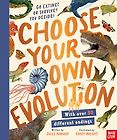
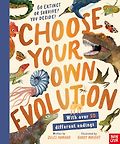
Next on the list is Choose Your Own Evolution. This is such a great idea! It’s written by Jules Howard, a zoologist who is clearly passionate about wildlife conservation, with art by Gordy Wright, who has illustrated many books about the natural world.
I agree, such a great idea! The approach here is that you choose your own adventure, taking control of where you want to go; you build your own journey through the history of evolution. You can become extinct quite rapidly, but you can also survive for millennia; it’s highly interactive. The narrative is also good, engaging with the story of each of the animals. This will clearly appeal to the dinosaur enthusiast, but I think it will also appeal to many others. I expect it to raise lively discussion in the young people’s judging panels.
It’s very engagingly written, and has already won a couple of awards this year.
Elements of this book are fictionalised. It makes the story quite personal for each of the animals, and I related to this. I must admit, I became extinct a few times, then went back and started again. The last two pages show the tree of evolution, so you can follow how different creatures evolved, rather than building a path yourself. It’s simplified, but it still gives a good idea.
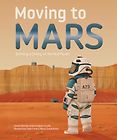
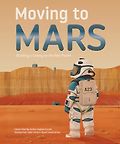
I really, really like Moving to Mars. There are so many different things to consider when exploring the idea of moving to Mars. At the end of the book the idea is more approachable than it was at the beginning, because you feel you’ve considered carefully and scientifically so many aspects.
So after reading this book, do you feel it’s only matter of time before we colonise Mars?
Exactly, it might not be soon, but eventually I think that humans will start moving to Mars! There’s a good amount of science in the book, it’s confidently written, and it’s well organised throughout. I also like the visuals, which have a retro style, a clever contrast to the very idea of moving to Mars. There’s a variety of visual elements, with good use of graphics and sketches. It’s a book that you can read in one go from start to finish, or you can dip in and out, and look at different aspects at different times. This makes the book very readable, and I enjoyed it a lot.
I really liked this book, too. You can learn a lot of science and engineering from it, but it’s also genuinely very exciting.
I agree! It’s excellent!
A whole team of scientists and science writers and illustrators worked on it, and they have another book coming out this month called Moving to the Moon.
Which is closer, in many ways!
I was really blown away by how fun all the shortlisted books are, filled to the brim with illustrations, and great for learning about science. I also thought that they’re remarkably well produced, with the publishers involving science communicators and specialist science writers for children.
Yes, indeed. Great care with presentation was taken across almost all of the books submitted. In the best, text and illustration work extremely well together, and this is something we paid attention to.
Are there any fields of science that you wish had been better covered by the books submitted for the Royal Society Young People’s Book Prize this year?
Yes, this year there were definitely some branches of science that were less represented than others. For example, my particle physics, but also computer science, quantum mechanics, and condensed matter. It would be good to find a way to encourage more accessible books in these areas.
Can you talk a bit about your own work in communicating science to children?
I’m passionate about sharing my enthusiasm for particle physics with a broad audience of all ages. I’ve taken part in interactive events across England, and I’ve produced resources for schools. I’m especially proud of a project called Particle Physics for Primary Schools. Young children can be refreshingly open to new ideas, and can ask the most brilliant questions. They make you think. Trying to explain things from the basics, while keeping them engaging, is a good way of discovering what you yourself are able to convey, or not. It’s an interesting challenge.
I’ve also been an expert consultant on the Britannica All New Children’s Encyclopedia. It was a great experience to be part of creating a book, and very different from staging in-person activities.
Do you have anything to add about your experience of being on the judging panel?
I realised as a child that books were a way to experience many lives in parallel and many ideas all at once. Reading was a way for me to multiply what I could do and what I could experience. I was reminded of this by many of the books submitted for the Royal Society Young People’s Book Prize, and especially by our shortlisted books.
Even though there were so many excellent submissions, arriving at the shortlist was less challenging that I’d anticipated, because of how well panel members worked together. It was hard to eliminate books at the beginning, because there was so much variety and quality that our favourites included almost the entire longlist. But when we went through each book in detail together, and all panellists presented their opinions, it was illuminating. We could see people’s various experiences coming into action, with each person presenting points overlooked by others. Consensus was reached through exchanges of ideas, so that we arrived at a clear idea of our favourites of favourites, and by the end of the meeting we had our shortlist of six.
Being Chair of the judging panel for the 2026 Royal Society Young People’s Book Prize, and having the chance to read all the books that were submitted, has been an absolute pleasure for me. I’ve always loved books. When I was a child, I was a super-avid reader and I disliked anyone telling me that I shouldn’t read a particular book because it was too advanced, and unsuitable for me. In this competition, I liked very much that there was such a variety of books, that they can be understood at different levels, and that the authors and illustrators haven’t underestimated their young audiences. The books here are for everybody.
I’ll be thrilled to discover the book that the children’s judging panels choose as their winner. I loved all of the books. I’m glad not to have to choose the best from the six books shortlisted, because I’d find this extremely difficult.
Five Books aims to keep its book recommendations and interviews up to date. If you are the interviewee and would like to update your choice of books (or even just what you say about them) please email us at [email protected]
Five Books interviews are expensive to produce. If you've enjoyed this interview, please support us by donating a small amount.
Cristina Lazzeroni
Cristina Lazzeroni is an experimental particle physicist who has had lead roles in kaon physics experiments at CERN. She also leads initiatives to make contemporary particle physics accessible to the wider public, and has been awarded the Lise Meitner Medal of the Institute of Physics for contributions to public engagement. She is Professor of Particle Physics, School of Physics and Astronomy, at the University of Birmingham, UK, and a Fellow of the Royal Society. She has published over 100 papers in international scientific journals.
Cristina Lazzeroni is an experimental particle physicist who has had lead roles in kaon physics experiments at CERN. She also leads initiatives to make contemporary particle physics accessible to the wider public, and has been awarded the Lise Meitner Medal of the Institute of Physics for contributions to public engagement. She is Professor of Particle Physics, School of Physics and Astronomy, at the University of Birmingham, UK, and a Fellow of the Royal Society. She has published over 100 papers in international scientific journals.