Knitting is hugely popular. In a world where we can buy all the knitted goods we want, why take up knitting?
Number one, it’s really fun! The world is very digital, very screen based, and knitting is an incredible thing you can do that doesn’t require a screen. It’s very slow, and that is one of the good things about it! Once you’ve knitted a scarf or a jumper or even a little square, you realise how long it would take to make a jumper that you’d buy in a shop, and you get this incredible instant appreciation for creativity, for labour, for clothing… Knitting opens your eyes to a whole world. And it’s fun, and you get to play with colour and shapes and creativity, and it’s meditative – and it’s the best, basically.
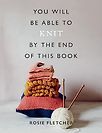
Great. I thought we’d say a little about your own book first, since this is a book for the very beginning: You Will Be Able To Knit By The End Of This Book.
I often say the title is not legally binding! The idea of this book is that you can start here, from having never touched knitting needles before. The first half is how to do it, from literally what needles are, and how you match your wool with your needles; and it takes you through to actually knitting, adding more complicated steps. Then there are 16 patterns for projects in there that build you up from the most basic thing you could make, to still-super-accessible but more elaborate things.
Amazing! Do you teach people to knit, yourself?
Yes, one of my main jobs is I’m a knitting teacher. It’s really fun. At the start of the class, one thing I always say is: you’re not allowed to not enjoy it! Or if you don’t enjoy knitting, you’ve got to wait ’til you leave the shop to tell…
I’ve taught loads of people. I’ve been teaching for about seven years, and I teach all sorts of things, absolute beginners and more advanced stuff. The beginners class is three hours, and the first hour can be summarised by the fact that fifty per-cent of the time, at least one person says, ‘I thought this was meant to be relaxing.’ The second hour is when everyone gets it, but they’re very quiet: there’s a lot of concentration. And then by the third hour, everyone’s knitting away and chatting. I can almost set my watch by it.
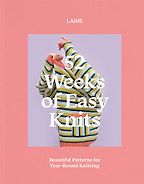
Great! So our imagined knitter can now knit. They can pick up the first of your five choices: 52 Weeks Of Easy Knits.
This is part of a whole series from Laine called ’52 Weeks’.
Picking five books was not an easy task for me – there are a lot of knitting books, and it’s quite a personal thing – but I went for books that I thought would be generally very useful. A lot of people learn to knit, and they maybe make a scarf, then think: Now I’ve got the basics, where do I begin? And they’ll pick up a really complicated cable jumper pattern… Maybe there should be a step between the scarf and the fisherman’s sweater.
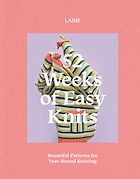
I love this book. It has 52 patterns for that stage: now you’ve learnt the basics, where to go from there? The jumper on the front is basically four squares of knit – I don’t think you even have to purl…
For any readers who don’t know, there are two basic knitting stitches, right?
Yes. There is what’s called ‘knit’ or ‘plain’, and ‘purl.’ They are basically the same stitch, looking from different sides. My analogy is always that if I were writing on a window so that you could read it from the outside, I’d have to write the letter backwards: that’s what a purl is. It’s doing the knit stitch backwards.
When I first saw this book, I thought, “Dang, I want to knit that jumper.” And I don’t need easy knits! It’s really good. They’re really modern, it’s £20, and you get 52 patterns, which is incredible value.
What’s in there?
There are lots of different things: jumpers, hats, scarves… I think there are socks in there. There’s a snood, there’s a hood, there are shawls; there are cardigans and vests and mittens. A range of things!
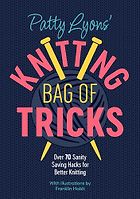
Okay, so our imagined knitter has been working their way through 52 Weeks Of Easy Knits, but they’re coming across problems. So let’s turn to your next choice: Patty Lyons’ Knitting Bag of Tricks.
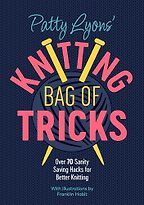
So this is not really a how to knit for beginners, although obviously it will tell you how to do things. It is really about troubleshooting, and that is a huge part of knitting. People get put off when they know enough to know that something’s wrong, but they don’t know why it’s wrong, or what’s wrong, or how it’s wrong, or how to how to fix it. I was trying to divide the five books up: obviously your beginner book will be my book, then easy knit, then troubleshooting.
There are little illustrations explaining, for example, why your knitting is too tight or too loose. If your knitting is too loose, you have to size your needle size down, but it can get a bit like that meme of the woman with the maths around her: you’re counting your stitches, and you’re meant to have twenty stitches in this four-inch section, and you’ve got fifteen… I love that it explains all that in a very accessible, illustrated way. And there’s a sense of humour to it, which I really appreciate.
As a knitting teacher for beginners, people often ask me how I got good. I say, well, I was bad for a very long time. The way you get good is by being bad, but then being able to fix what you did wrong, and I think a book like this is an amazing resource to have on hand.
We’ve mentioned knitting too tight or loose – what are the other most common stumbling blocks for beginner knitters?
The main one is thinking it’s going to be right first time. People in classes will say, ‘Mine doesn’t look like yours!’ – and I say, ‘I hope it doesn’t, because this is my job.’ You’ve got to let it be bad, which is a mindset thing more than a technique thing.
The other is not being able to read what you did in the previous row. That’s when you are doing something where you have to, say, alternate between different stitches, and you put it down and pick it up again, and think, ‘What the heck did I do in the previous row?’ Being able to tell what you did is a really integral thing.
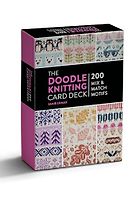
Great. Your next choice is intriguing: tell us about Jamie Lomax’s The Doodle Knitting Card Deck.
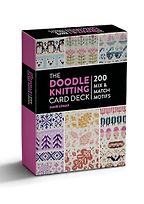
I wanted to include a stitch dictionary of some kind. Stitch dictionaries are what they sound like: they are a collection of different stitches that you might use – because although there are basically only two, the combinations you put them in make all the elaborate patterns you can imagine. High street jumpers are all made up from how you combine very basic stitches.
This is presented as a deck. There’s been a huge trend in the craft world for card decks, which started with the Granny Square Card Deck – I couldn’t include that because it’s crochet, but we have to give a little tip of the hat to that one. The Doodle cards are by the designer Jamie Lomax, and she has been doing these for ages. They are really great colourwork patterns, which are just combinations of different colours to make very cute, fun motifs – she calls them doodles. Each card has the basics: they look like little graphs you could literally use excel to make them, with cells filled in with colour. And on the back, there’s a photo of what it looks like knitted up.
There are loads of different stitch dictionaries: you can get colourwork and you can get texture, and you can combine the two. But this one is very much my style and it’s very on trend.
There are some beautifully elaborate looking ‘doodles.’ They look really impressive.
Yeah, I just like the style! Obviously the content is good, but something about the style and her eye for design, and the colours she uses, are also just very appealing. And how nice to have a little tactile thing, and to rummage through all the little cards to pick out a design.
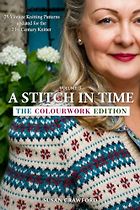
Very appealing. Ok, we’ve come to your fourth choice – the third volume of A Stitch In Time by Sarah Crawford.
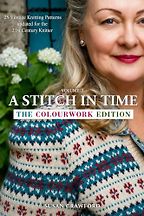
Knitting is hundreds of years old, but people really associate it with mid-twentieth century – the 1920s, 1930s, and 1940s. If I see one more thing saying, ‘knitting is not just for grandmas,’ I will explode, because people have been saying that since the early noughties revival of knitting. The people you were saying that about twenty years ago could be well on their way to being grandmas by now!
Knitting is a very modern thing. But at the same time, I do love that mid-twentieth century knitted look, and I think it draws a lot of people in: they see these styles that you can’t buy on the high street, and there are knitting patterns for clothes that you can’t buy anymore.
Crawford has taken vintage designs and patterns, and made them size inclusive and accessible. If you’ve ever tried to look at an actual knitting pattern from the 1940s, you’ll know it is an A5 piece of paper, and you need a magnifying glass; you will be a size six, that’s the only option; you can follow them, but they’re written in a different way. This book expands those instructions, and also literally expands the sizing, to make these vintage patterns actually accessible to modern knitters.
I can read those old-style knitting patterns, but I do find myself thinking, what if we used a whole word rather than everything being abbreviated?
This blows my mind! The only patterns I have ever tried were my granny’s, and they were all abbreviations. I can have patterns in full English?
Yes! There’s one designer called PetiteKnit who was incredibly popular, with lovely, quite basic ideas that were really well executed. She writes her patterns basically in full sentences. For me that was probably a bit much, but other people love it.
This book is about colourwork. Colourwork is using multiple colours of wool at the same time to make up a pattern. The example I always use is the jumper from The Killing, with the snowflake design – that’s colourwork. Or those classic multicoloured, stripy 1930s and 1940s tank tops, which you can knit from this book – that’s colourwork. It’s often called ‘Fair Isle,’ but I believe it’s a bit like champagne – if it’s not from Fair Isle, itself it’s just sparkling colour work. So this volume is all about using multiple colours to make that really classic vintage look, and I love it.
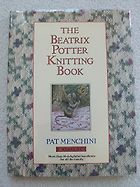
Wonderful. Your last choice sounds like it may be a real best-loved book for you: this is The Beatrix Potter Knitting Book.
This is slightly a stand-in for all charity shop knitting book finds, but this is my all-time favourite of those. We were talking about the history of knitting and how it’s still a very modern craft, but there is something special for people of my age – firmly millennial – about licensed knitting books with beloved characters.
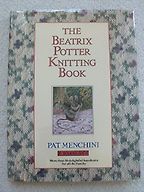
There’s a technique for knitting blocks of colour in your knitting called ‘intarsia’; when people ask what it is, I say, imagine the jumper that has Postman Pat on the front. That’s intarsia – using blocks of colour to make a picture. I found this Beatrix Potter one in a charity shop, and I adore it. It is spectacularly 1980s. You can find these for loads of stuff, these tie-in books, but I think this one’s really good. I was going to say the designs don’t age, but then look at this Edwardian lace girl smock…
I just love this book, and when I find old knitting books in charity shops, I am an absolute sucker for them.
I would wear one item in this, which is the design on the cover, from The Tailor of Gloucester. You know the story, where he’s making a waistcoat for the mayor? They’ve made the design that he’s embroidering in that story into a knitting chart for your colourwork! I might apply that design to a less mid-1980s style, but it’s really fun to find inspiration all over the place with knitting.
Yes – that’s where it can get really creative.
As I said, it’s how you can make clothes that you can’t find in the shops, whether that’s based on the design, the fit, the fibre content – and that gives you an appreciation for what clothing and textiles can be made of. They are not going to sell you these items on the high street. And that’s fair; if your friend was having a baby and you knitted them one of these they would be very touched, but they might also say, ‘Why have you knitted me this Squirrel Nutkin fuzzy hat and coat?’
There’s such a wealth of knowledge in knitting books, and they are also hilariously kitsch. I just love having this on my shelf.
And it’s so great to be able to open up all those clothing styles we’ve just quietly dropped.
I know I’m here to talk about books, but let me be evangelical for a moment about making your own things! I am hugely concerned with the environmental impact of fashion. When you have made something with your hands and you realise how long it takes, and you then remember that all clothing is handmade – they have knitting machines, but the sewing up of things is still done by individuals. Then you go onto the high street and you think: ‘How is that eight pounds?’ If I bought the fibre or the wool for it, it would be more than eight pounds, and then it would take hours to knit it. Obviously if it’s machine knitted that’s faster, but still.
So then you start asking: ‘Who is getting exploited?’ I think it might be everyone at every step of the chain. Then you buy these things and they fall apart, they don’t fit, and they don’t breathe because they’re plastic.
When you make something slowly you can make it in natural fibres, which are more expensive, but I’ve got really into thrifting and using second-hand marketplaces like Vinted, where there are so many knitting and sewing supplies. Plus, projects take forever, so as a cost-per-hour hobby, knitting is incredibly cheap!
Interview by Sylvia Bishop
October 7, 2026. Updated: October 19, 2026
Five Books aims to keep its book recommendations and interviews up to date. If you are the interviewee and would like to update your choice of books (or even just what you say about them) please email us at [email protected]
Five Books interviews are expensive to produce. If you've enjoyed this interview, please support us by donating a small amount.