How did you choose your best books today? My interpretation of ‘best’ is ‘best ways in’ – books that grip you and make you want to read more into Antarctic history. Any history book is a way of living vicariously: instead of taking vitamins and going to the gym, you can lengthen your life by […]
My interpretation of ‘best’ is ‘best ways in’ – books that grip you and make you want to read more into Antarctic history. Any history book is a way of living vicariously: instead of taking vitamins and going to the gym, you can lengthen your life by living many lives at the same time. These are all ways of doing that. That’s what I look for from a book: total immersion, and being taken there.
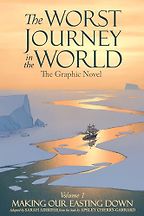
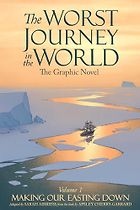
And not having to go to the gym. Although your first choice sounds like it would put a gym session in perspective. Tell us about Sarah Airriess’s The Worst Journey in the World, the graphic novel of Cherry-Garrard’s text.
The graphic novel version is an odd choice, perhaps – I have not read another graphic novel. This is an extraordinary book, and it’s a favourite among polar historians, which tells you how rigorous it is. It is an interpretation of an original autobiography by Apsley Cherry-Garrard, who was on Captain Scott’s Terra Nova expedition, where five of them died coming back from the South Pole. Before they did that journey, they did this side-quest to find emperor penguin eggs.
They wanted the eggs at a stage where they could analyse the embryos, to see whether animals evolved through their embryonic stages, and reverse engineer evolution – this was at the time of Darwin. They were trying to see whether the emperor penguins had scales in their early embryonic film. Three of them went to Cape Crozier, in the Antarctic winter. Nobody had done a winter journey before that, and they were doing this in wool suits under Jaeger windproofs. Apsley Cherry-Garrard wore glasses, and his glasses shattered, and then his teeth: that’s how cold it was. It’s a most extraordinary story, and it’s told with great wit and verve.
And Sarah Airriess took up this story?
Sarah Airriess was formerly a Disney artist. She read Cherry-Garard’s book, and she had a kind of conversion experience, and decided this was the best story in the world. So she gave up her very well-paid job for Disney in America, and moved to a garret in Cambridge to create a graphic novel. She wanted it to have as much integrity as possible, so she researched the personalities – the way they spoke, their gestures, everything about them. She has got it so perfectly that the great-nephew of Dr. Edward Wilson, who led the expedition, commissioned Sarah Airriess to illustrate his most recent book. I’ve spent years researching these people in archives, and I recognise the incredible accuracy. It’s not a children’s comic or a fantasy; it’s history brought to life.
This is only the first volume, called Making Our Easting Down. She’s only got them from Britain down to the Antarctic so far. People keep on kidnapping her to illustrate their books, so she’s just got to have a bit of space to be able to get on with it.
I bought the first edition for my dyslexic nephew, and it is still one of the best presents I’ve ever bought. You don’t read this book; you fall into it. It transports you to the ice, into the polar night as you tramp along with these explorers. She does with her pencil what I try to do with my pen: she takes you there.
Could you tell us a little about Cherry-Garrard? He was a paying tourist, right?
Yes. He was a young Cambridge graduate, and he was very rich. He lived in a huge house called Lamer Park in Berkshire, which now doesn’t exist. He was keen to go to Antarctica, and he knew Dr. Edward Wilson through a contact called Reginald Smith, who had published the book after Scott’s first voyage. So Cherry – he was called Cherry by everybody – knew what he was in for; but he didn’t know it was going to be a winter journey. He thought he would be going in the Austral summer. In order to fund the expedition, Captain Scott took two paying guests. Cherry was one of them, and the other one you’ve probably heard of: Captain Lawrence Oates.
He was a very willing, bright chap, with amazingly dry wit. When they came back, it was the war, so he didn’t write this book immediately. He had to wait till the end of the First World War, and his neighbour happened to be George Bernard Shaw, so he had a very good writing tutor.
One of the things that interests me, because I’m interested in the wives behind these explorers, is that Kathleen Scott absolutely hated this book. It was the first book to give a bit of perspective on Captain Scott, rather than just say that he was the hero of Britain. It gave a couple of slightly critical comments – only slightly critical – and she wanted to stop it being published. It was an amazingly controversial book in polar history.
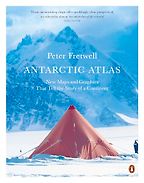
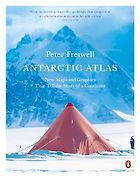
Fascinating. Ok, let’s talk about your second choice. This is Peter Fretwell’s Antarctic Atlas: New Maps and Graphics That Tell the Story of a Continent.
I love this book. I’m not naturally a numbers person, and scientific data can leave me very bewildered. A lot of information you get from the Antarctic is about the science, and that is because of geopolitics – in order to stake a claim in Antarctica, countries send out scientists to have a year-round presence and a justification for being there. These scientists are incredibly important because, unfortunately, Antarctica is the canary in the mine – just as miners once took canaries underground as an early warning of poisonous gas, so too can Antarctica warn us about what’s happening to the planet.
So that’s why we get so much scientific data. But this book gives it to you in graphic form. It covers the history of the first areas to be discovered and mapped, and the first journeys; and then it gives you all the scientific data, but crunched and made into graphics, so that it’s really easy to understand. For each graphic, there are probably just five hundred words, and that explains one whole concept about Antarctica. By the end of this book, I think you would have a very good idea of the story of the continent.
I found your Shortest History helpful for getting a handle on the vague-feeling concerns about sea ice – there’s a specificity to it: that we’ve lost the Larsen Ice Shelf and are now watching the Thwaites Glacier.
Yes, and what will summer do to the warm water underneath the shelf? That’s the problem. He tackles this chronologically as well: he shows you how much ice there was, and how much there is now. He makes the science comprehensible somehow, and that’s a very important skill – you can have top scientists, but how much is the data worth if you can’t understand it?
Antarctica is the testing ground for ideas about the future of the planet. It’s not just about the science. There is an amazing Antarctic Treaty, which was signed in 1959 by twelve nations, including America and the Soviet Union. 1959 was the height of the Cold War, so if you’d said to anybody, ‘Will it ever happen?’ most people would have said, ‘Absolutely not.’ But somehow, Eisenhower and Khrushchev managed to bury the hatchet just temporarily for the good of mankind. It’s an incredible phenomenon, and it’s still going.
One of the sections in the book is on the Antarctic Treaty. There’s a photograph, which is a black-and-white photograph of a lot of men – because it’s a very male story, until recently – around a table, signing this document. It’s not a very exciting photo, but it’s an extremely exciting document and really worth understanding.
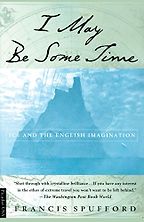
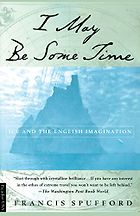
Extraordinary. Your third choice takes us back to the heroic age explorers: please introduce Francis Spufford’s I May Be Some Time.
I don’t know how many of your readers have heard about Francis Spufford, but as a writer, I both admire and envy him. He moves effortlessly between history, fiction, and literary writing. I’m on my fifth copy of this book, over twenty years – the others have fallen apart. His writing is so thought-provoking that sometimes you need to stop reading, put it down, and think about what is said. It’s like a really rich cake that you can’t eat all at once.
And this one is a history book?
It’s a history, but it’s also really philosophy. It’s about Antarctica, but it’s also about life. He also writes bestselling fiction, and I love this because it’s written in such an engaging fictional style. You can open it anywhere, and it is just so absorbing.
He explores not just Antarctica, but how human beings think about Antarctica. For a long time we didn’t know that Antarctica existed. We had a theory that it did – right back to Aristotle, who thought that Antarctica must exist because without a landmass at the bottom of the globe, he thought, the globe would capsize. So it was a theory at first, but it’s still a theory for most of us, because very few people have been to Antarctica. It works on your imagination in a very particular way, and it is absolutely essential. Robert Macfarlane, another writer you might have heard of, has said that it’s really important for him: the idea that there is still a pristine wilderness that humans haven’t completely ruined. That idea is somehow an important part of the human psyche.
This is what Francis Spufford explores, as well as the heroes and the classic stories. He explores how that impacts our idea of heroism, courage, and endurance, and how that translated into the First World War and the Second World War. It’s a fascinating set of historical what-ifs. It’s amazing.
I love this. You opened your book by pointing out that even the name is a negation – not the Arctic. That must be unique in world naming.
Everything is not. You can put ‘not’ in front of most things in Antarctica. It’s the antithesis of so much of the way that we live. That’s why it’s this incredible testing ground for ideas.
One idea that’s being tested at the moment is the idea that Antarctica could have the right to exist as a continent. Rivers have been made into something like beings that have their own rights, like human rights; but this is hopefully going to be a continent that has rights. Everyone said the Antarctic Treaty would never happen. So I think that we should approach the Antarctic Rights Alliance proposal for Antarctica with an open mind.
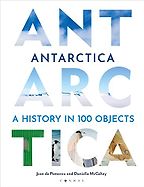
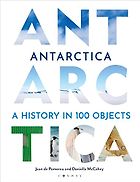
For such a pristine continent, the title of your next choice might seem jarring: tell us about Antarctica: A History in 100 Objects.
This is a lovely visual way into Antarctic history. There’s so much. Antarctica is so big. It’s fifty-seven times as big as the UK, for example. We need to have a couple of lightning rods that fix Antarctica to subjects that we can understand, and this book does it with a hundred objects, which is a genre that started with the British Museum and Neil MacGregor.
This book happened almost by accident. I like stories of how books come to evolve. This one started as a list of objects for an exhibition celebrating the bicentenary of Antarctica’s discovery in 1820. But then that exhibition was cancelled, so the book floated free, as it were.
What sort of objects come from such a remote place?
Readers can jump between objects and travel across centuries. Examples include jars of pickled marine animal specimens from early expeditions, and geolocators attached to the legs of giant albatrosses. So it gives you a way into different parts of the history. Each object is a double-page spread. I think it’s beautiful as an object in itself – a brilliant coffee table book.
Without us knowing more about Antarctica, we can’t protect it; and this gives us particular objects, so we can fix on them and we can protect them. Object 86 is Antarctic krill oil capsules, which are for sale in shops, rather like whale oil margarine used to be. If you think about it, krill is fundamental to the Antarctic ecosystem, and there is still an exponential increase in krill fishing. So this book looks beautiful, but also raises the important question: are we killing the goose that lays the golden egg, or shall we protect it? Do we protect krill so that it can continue to sustain life in the Antarctic? Ordinary objects can reveal extraordinary stories about Antarctica, its history, and its future.
It’s so interesting seeing how the objects have changed. You mention in your book that ‘conservation’ used to mean ‘kill it and bring it home’…
Isn’t it incredible? I use Peter Scott – Captain Scott’s son – as an example of that: he used to shoot geese in the hundreds, but then he started the World Wildlife Fund for Nature halfway through his life, and now that is what conservation means. It’s incredible how fast these things change in a generation, in a lifetime.
Let’s talk about your book next. This is The Shortest History of Antarctica, for which you had 55,000 words to tell all these stories. You divide the human history up into commercial contact, then early explorers, before we get to the heroic age explorers we’ve already touched on – can we say a little about that earlier contact?
Yes. At first, Antarctica was just a theory, with Aristotle and Ptolemy and people saying it must exist. Then it was a place for commercial exploitation, when we used biological oil for industrial machinery. During the Industrial Revolution, machines were lubricated using seal and whale oil. Antarctica was discovered, really, by sealers and whalers – the subantarctic islands, that is, not the continent. The fur seals were decimated both for their oil and fur, and baleen whales for corsets, umbrellas, prams, and suspension on carriages. We talk about the big names with Antarctic history – Shackleton and Scott – but actually there are big names like the Astors in America, and the gentlemen’s outfitters Gieves and Hawkes in London, that are also connected to Antarctica, because they sold fur coats made from Antarctic fur seals. Antarctica came to us before we knew, through these famous names, and on the high street. Then you have the heroic age after that. I wanted to separate that out.
It was quite difficult to separate, though, because a sealer can plant a flag like an explorer and claim a territory, and an explorer can kill a seal. And they did, to sustain themselves. So it’s a difficult separation.
And then after the heroic age, you take in the ‘mechanical age’ and the ‘scientific age’… What was the main challenge, condensing so much history?
So many challenges. I needed to contact lots of experts to do this, but I found very few people were willing to precis the Antarctic Treaty – they are international lawyers, and it’s all about words. And it’s a really critical document, because it’s about international cooperation. So I did feel the pressure of that like crazy.
You’re allowed to do side quests and have boxes on specific topics of interest within the book. I just kept on sending the editor more boxes, because there are endless things you can make into an interesting box. By the end of it, I could just feel him putting his hands against the screen: ‘Please, no more boxes.’
There are some images too that I wish I had managed to include more of. For example, the Discovery ship that Scott took to the Antarctic (which anybody interested should go to see in Dundee – you can walk onto the ship, it’s a fantastic time portal.) later took an aircraft on the front, during what I call ‘the mechanical age’. So there’s an image of a square rigger in Antarctica with icebergs all around it, with an aircraft lashed to the deck. Isn’t that an amazing crossover in technology and time? That’s how the mechanical age started.
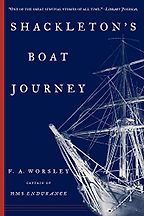
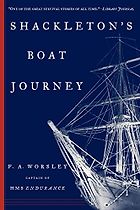
It is. We’ve come to your last choice – back to the ‘heroic age’ once more. Could you tell us about Frank Worsley’s Shackleton’s Boat Journey?
Yes – this is just the most amazing story. I was talking to a polar historian recently who said they should have died a thousand times. It’s phenomenal, it defines jeopardy.
If you buy the copy of Worsley’s book that has an introduction by Sara Wheeler, you will be in for a treat. She wrote the biography of Cherry-Garrard, which I think is one of the best polar biographies ever, and she is an absolutely phenomenal writer. Everybody asks her to write forewords, and in some cases, the warm-up act slightly eclipses the book itself; but not in this situation, because this book is about the most incredible story.
The writer Frank Worsley was the navigator, and I think he’s the hero of the piece. How did he do it? He got small sightings of the sun between massive mountainous cresting waves in mist… How did he know where he was going? It was a magical thing. He claims to have been part Māori, and I think he was part homing pigeon.
Could you tell us a little about the journey?
Here’s the shortest history summary. Shackleton went down to the Antarctic in a boat called the Endurance in 1914. The boat was crushed by ice. They took some lifeboats off onto the sea ice, and they camped on that sea ice – that’s floating ice. They had fires to cook their food on sea ice. After months of drifting around, they eventually decided to set off across the Southern Ocean – an ocean which has no landmass to stop it, so it has the biggest waves in the world. They set off in a couple of small wooden lifeboats to try and find a rock in the middle of the Southern Ocean called Elephant Island. And they got there. It was a miracle that they got there. They thought, ‘Thank God for that, we’re on dry land at last’…
But it is the most inhospitable piece of dry land. Shackleton decided they would die if they stayed there. So while most of the men stayed, with one of the boats turned over and used as a roof, he went on with a few of the chaps to try and get to South Georgia, where there was a whaling station. Seawater was coming over the boat and freezing, so they had to chip the ice off the front of the boat lest it capsized from being top-heavy – that’s the temperature. And they were wearing tweeds. As they were nearing South Georgia, one of them looked up and saw a mountain with snow on the top, and thought, ‘We’re nearly there’… and then they realised that it wasn’t a mountain; it was a rogue wave. The ‘snow’ on the top was the crest of the wave. Imagine what that sea was like.
Somehow they survived, but they landed on the wrong side of South Georgia. Then they had to cross South Georgia, which had never been done before; and then they got to the whaling station. And the irony of it is that when they got there, they said, ‘Do you know what happened with the war? Is it over?’ And they were told, ‘No, it’s not over. It’s 1916, and it’s been going on for two years. It’s a world war.’
Wow. That’s an incredible tale.
It’s the most extraordinary story, it really is. Everything about it is unbelievable. Shackleton had this extraordinary, perhaps blind, optimism. When the Endurance sank, he said, ‘Right, everybody. Now we’re going to go home’ – and they believed him. He was that kind of leader. They just believed that they had to keep on going, and they did all these incredible things.
Shackleton loved quoting Robert Browning, and his message of “Never Say Die.” This is a brilliant message for Antarctica. It is very scary what’s happening to Antarctica, with climate change. But the heroic age explorers have shown us that the word ‘impossible’ is just a challenge. “Difficulties,” as Shackleton said, “are just things to be overcome after all.”
Five Books aims to keep its book recommendations and interviews up to date. If you are the interviewee and would like to update your choice of books (or even just what you say about them) please email us at [email protected]
Five Books interviews are expensive to produce. If you've enjoyed this interview, please support us by donating a small amount.
Katherine MacInnes
Katherine MacInnes is a historian specialising in Antarctica. She is an author, speaker, and drawer. She leads writing workshops, including her London Library masterclass, Reverse Engineering Narrative Nonfiction, interviews fellow authors at book festivals, and gives cruise ship lectures as a registered Compass Speakers presenter. She is also an accredited Arts Society Lecturer.
Katherine MacInnes is a historian specialising in Antarctica. She is an author, speaker, and drawer. She leads writing workshops, including her London Library masterclass, Reverse Engineering Narrative Nonfiction, interviews fellow authors at book festivals, and gives cruise ship lectures as a registered Compass Speakers presenter. She is also an accredited Arts Society Lecturer.