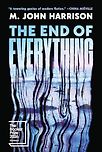
Speculative fiction is often used as a means of exploring contemporary issues through a prism of fantastical or science fictional storytelling. As a result, many of our greatest literary novelists have turned to futuristic or extraterrestrial scenarios in their work. Yet, as Gaby Wood, the Booker Prize’s chief executive, noted, the 2026 winner M. John Harrison is “the first Booker winner to have emerged from the bona fide S.F. world.”
Cult favourite M. John Harrison – at 81, the oldest ever Booker Prize winner – has been writing since the 1960s, and his books are often described as “genre-defying” – reinterpreting or reworking the typical conventions of science fiction. (“A good ground rule for writing in any genre is: start with a form, then undermine its confidence in itself,” as he once told the Guardian. “Ask what it’s afraid of, what it’s trying to hide – then write that.”)
His Booker-winning book, The End of Everything, does just that; set in a near-future Kent, England, it features a beachcomber who discovers a mysterious, apparently intelligent “artifact” on the shoreline, which he must carry into the dystopian hinterlands inland – even as it grows and changes in form and nature. Writing in the Literary Review, Olivia Ho called it “a work of uncanny beauty, tender and terrifying in equal parts.”
Harrison’s science fiction pedigree may be purest, but a number of previous nominees and winners have employed science fictional aspects in their work. For example: Samantha Harvey won the 2024 Booker Prize for her slim and atmospheric novel Orbital, which is set on the International Space Station; not a traditional sci-fi novel by any means, but rather a thoughtful account of astronauts going about their daily routines and observing their home planet from space. If you read science fiction for the plot and the peril, then Orbital is not the book for you, but what it does offer is a wonderful sense of the interstellar sublime.
And for those who observe a stricter definition – never fear. We’ve put together a list of five excellent novels with strong science fiction elements that have all been nominated for the Booker Prize over the years.
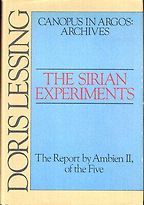
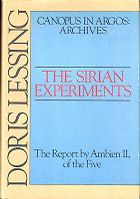
The Sirian Experiments by Doris Lessing – shortlisted for the 1981 Booker Prize
The first science fiction novel ever to be selected by the Booker Prize judges was Doris Lessing’s The Sirian Experiments (1980). Lessing, the winner of the 2007 Nobel Prize for Literature, is most celebrated for her 1962 novel The Golden Notebook, but she also wrote a five-book sci-fi sequence, ‘Canopus in Argos,’ exploring multiple civilisations on an imagined far-future Earth. The Sirian Experiments came third in the series, and features a fascistic extraterrestrial culture fighting for control of the Earth-like planet of Shikasta.
The wildly speculative Canopus in Argos series was received with bafflement by the literary community. (The critic John Leonard complained that “I, and rational discourse, have lost a friend… to a smog of mystifications.”) Undaunted, Lessing explained in the preamble to The Sirian Experiments that she used science fiction to “put questions, both to myself and to others; to explore ideas and sociological possibilities,” although personally she preferred to use the term “space fiction” to describe her project, which drew also on Sufi ideas of cosmic evolution.
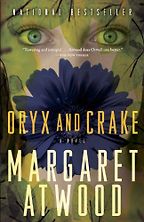
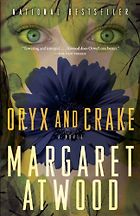
Oryx and Crake by Margaret Atwood – shortlisted for the 2003 Booker Prize
Margaret Atwood has been nominated for the Booker Prize no less than six times and won it twice. She made her first appearance on the shortlist back in 1986 for her landmark feminist dystopia, The Handmaid’s Tale; it’s sequel The Testaments was the joint winner in 2019 alongside Bernardine Evaristo’s Girl, Woman, Other. Both of those novels explore a nightmarish theocracy in a post-war, almost unrecognisable United States, but are not overtly science fictional in nature.
Her 2003 novel Oryx and Crake, on the other hand, is unapologetically sci-fi in form. The first book in her Maddaddam trilogy opens in a post-apocalyptic world, ruled by biotech conglomerates and featuring a gentle, genetically-engineered humanoid species known as ‘Crakers.’ In it, a figure called ‘Snowman’ ruminates on the collapse of civilisation and suspects himself to be the last surviving human as he positions himself as a caretaker to the Crakers, the creation of his brilliant former friend. It’s a dark parable warning of the dangers and deceptions of a rapaciously capitalist society.
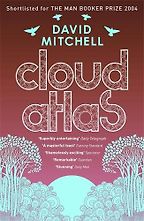
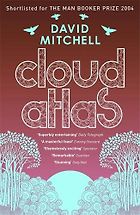
Cloud Atlas by David Mitchell – shortlisted for the 2004 Booker Prize
Mitchell’s ingenious novel takes the form of six nested stories, each set in a different time period but linked in some way through recurring objects or characters. Each story starts strong, before being interrupted by the beginning of the next story until – at the midpoint – the direction changes, and the stories come to their conclusions in reverse order. (Mitchell was, he has said, inspired by Italo Calvino’s If on a winter’s night a traveller…).
Each story has its own strong character and setting: one takes the form of a colonial-era maritime journal, another a crime thriller, with all the classic mystery conventions. For our purposes, the most relevant section is the fifth strand, titled ‘An Orison of Sonmi-451’, a science fiction story about cloned slaves written in Q&A form. (The final story, ‘Sloosha’s Crossin’ an’ Eve’ry’thin’ After,’ also offers a vision of a Tolkienesque future presented in a fictional dialect, in which Sonmi-451 reappears as a local deity.) Brilliantly imaginative and cleverly structured, although bear in mind that the sci-fi element makes up only a small proportion of the full text.
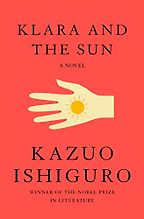
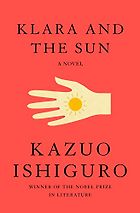
Klara and the Sun by Kazuo Ishiguro – longlisted for the 2021 Booker Prize
Klara is an outdated model of ‘artificial friend’ – an android purchased to keep a struggling teenage girl company. Despite Klara’s excellent skills of observation and empathy, her programming prevents her from understanding certain truths about the world around her. And Josie’s mother, fearing the worst for her sickly daughter, has unsettling plans for her continuation should the worst happen.
Klara and the Sun – which was recently adapted for the screen by Taika Waititi, albeit to poor reviews – is an unusually sweet-natured take on the dystopian novel, in which our view of an unsettling, technologically advanced future is tempered by seeing it through the eyes of a benevolent robot. “I was drawn to a narrator with peculiar limitations of vision, as well as outstanding abilities to observe and learn quickly about the human world,” the author has explained. “An extreme outsider at the same time child-like and sophisticated. Through her eyes it would feel natural to ask big questions like: What’s special about humans? Are humans fundamentally lonely? What do humans mean when they say they love one another?”
In Ascension by Martin MacInnes – longlisted for the 2023 Booker Prize
Leigh, a marine biologist with a specialism in algae, takes up a position on board a deep-sea submarine exploring an ocean trench deeper than any previously studied. But all is not quite as it seems – uncanny things are happening on board, and the mission is proceeding according to a secret agenda. Leigh’s research ultimately earns her a new job for a space agency, studying algae as a sustainable food source for ultra-long-distance travel. But as her first major mission approaches, Leigh realises she must choose between a life of interplanetary adventure and supporting her sister with the care for their ailing mother.
“I’m exploring interconnectedness because it’s vital and relatively absent from English language fiction, too much of which draws a world in which humanity is walled off from the rest of creation, as if we were entirely self-involved, made from some other, more rarefied kind of stuff,” explained the author in an interview on the Booker website. Despite dramatic plot points, the result is a long, eerie and somewhat slow-moving novel. As a result, it has been divisive among sci-fi fans – especially those who went in hoping for a rapid-fire eco-thriller. In Ascension is for those who like their science fiction literary, and as much about human relationships as extraterrestrial forces.
Five Books aims to keep its book recommendations and interviews up to date. If you are the interviewee and would like to update your choice of books (or even just what you say about them) please email us at [email protected]
Five Books interviews are expensive to produce. If you've enjoyed this interview, please support us by donating a small amount.