To start us off, would you reflect on the coming-of-age novel: what it is, and why you might be attracted to the form?
Yes. It’s an electrifying time, isn’t it? And a shared experience we all have. I think the meat and bones of great writing and great novels can be contained in that experience between your childhood and teenage years. For me, it’s a more attractive period to write about than many of the subjects we look at in adulthood. It does get a bit boring to be writing about mortgages, divorces, things like that—it just doesn’t interest me as much.
When I sat down to write my first novel during lockdown, I think it was a bit of homesickness that inspired me to look back on my own childhood in Scotland in the 1990s. I live in London, so I was probably pining for my family and friends and home. All that is contained in our childhoods, so it made that really attractive to me as a writer.
As you said, adolescence or young adulthood is a vivid time of life; everything feels up in the air. There’s a great sense of potential or possibility, but you now have to commit to one path or another. Who are you? Who will you be when there’s no one there to tell you what to do?
I grew up in Stirling, a quiet town in Scotland. There was nothing happening there, yet we were really inspired by the books and beauty we were consuming, which were full of excitement, lives on the edge. We were left to make our own entertainment. Looking back, I can see how we used our creativity, and how this was a self-defining time—not only in terms of choosing a career or school subjects, but in forming our own interests. Things are planted in you at that age, things that continue to influence you throughout your life. I think it’s always interesting to go back to the roots of someone, by looking at their adolescence.
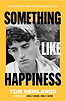
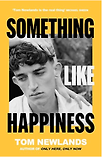
Absolutely. Your own novel Only Here, Only Now is set in 1990s Scotland, as you said, and you are shortly to publish Something Like Happiness, in which the protagonist has also been shaped by the town and community he’s grown up in.
Really, Something Like Happiness is a love story, which opens at the end of love. Two people, Frazer and Caitlin, have been childhood sweethearts, but the pressures of life have brought them to an impasse in their relationship. Frazer has retreated inwards and built a castle around himself of memories and objects and things, looking back to the better days of his relationship. As the book unfolds, we learn more about how these two people have arrived at this point, through work stress, through grief, through raising a non-verbal autistic son.
I also look at the built environment—I’m fascinated by ‘new towns,’ the hope with which they were built and the neglect they have experienced. I wanted to write a story about two people who grew up in that environment and how it has shaped them and their relationship.
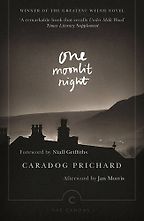
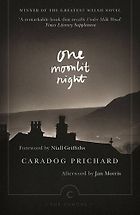
Absolutely. Let me ask you about the first book you’ve chosen to recommend. This is Caradog Pritchard’s One Moonlit Night. It’s sometimes described as a Welsh modern classic. It was originally in 1961 but not fully translated into English until the 1990s.
In my opinion it’s a British modern classic. If this had been written in England, it would be massively heralded. It’s the most magical book. It’s very disturbing—there’s a murder, sexual abuse, all those things. I’ve only read it once, and I’ve been scared to go back and read it again, because I’m not sure I can replicate the experience.
If you were to dip into it at random, you’d be a little confused. It’s often compared to Under Milk Wood. It’s called ‘lyrical’, ‘poetic’. Caradog Pritchard was a poet, but if you were to look at one of the pages in isolation, you might wonder what the fuss is all about.
There’s a lot of dialogue, a lot of strange nicknames, some very leaden speech and unadorned prose. But it builds rhythmically and through the mystery of what is happening in this village. It was a very overwhelming reading experience and it must be one of my favourite books of all time.
One thing that comes through partly from what you’ve been saying, and also more generally from your selection of books, is the impact of place and community on one’s coming-of-age. Perhaps adults become more discrete or self-contained, but as a teenager, the outside world bleeds into your very nature.
100%. Being neurodivergent—although I can’t speak for all neurodivergent people—I have a very special link to places I’ve been. Not just important places, but unimportant places: AirBnBs and hotels, places I went on holiday when I was younger. I have bery strong vivid memories of the textures of places.
One thing very crucial for me as a writer is to ground my characters. I can’t start writing until I know the kind of place that they are from. That’s just as important to me, to know where these characters belong, as it is to build the characters themselves.
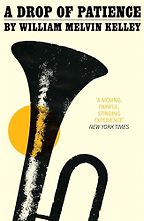
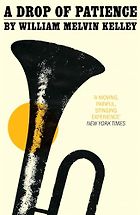
Absolutely. Can we move to your second book recommendation? This is William Melvin Kelley’s A Drop of Patience.
This follows a character called Ludlow Washington, a blind horn player during the Jazz Era. He starts in a fictional town in the Deep South, then on to New York, where he makes his name. It’s a real landmark book, I think. It was first released in the 1960s and re-released recently, but in the interim period it was somewhat overlooked.
I really love it because it is a wonderful depiction of disability and a brilliant character study of a man othered by his race, his disability, but also by his ability too—his prodigious talent. I found that a very heady mix. He’s not able to function in society the way other people are, but this talent saw him plucked out of a children’s home and able to make his way in the world. It’s also beautifully written.
Here, his music talent offers yet another route to self-definition.
I love protagonists with a skill or passion. In Something Like Happiness, Caitlin is a boxer. Despite her circumstances and her limited abilities, she’s very determined to train. I was inspired in writing about that by books like A Drop of Patience.
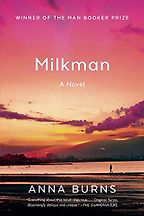
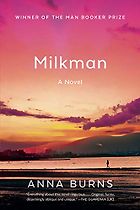
Let’s move to Anna Burns’s novel Milkman, which won the Booker Prize a few years ago. It never names the place where it is set, although it’s clearly infused with the culture and atmosphere of Northern Ireland during The Troubles.
Yes. I love the voice. It’s so propulsive. As you say, there are very few clues initially as to what’s happening, where you are. You drive so much from the vernacular and the interplay between the characters. It was a huge, huge influence on my first book Only Here, Only Now.
I re-read Milkman during lockdown and was blown away all over again. When I sat down to write my book, I wanted to craft that kind of immersive voice, one that’s 100% authentic, urgent, and keeps readers on their toes.
That’s important. I find a lot of fiction is not challenging enough. I don’t like books serving it up to you on a plate. Milkman is very good at unfolding the story through the eyes of the protagonist.
Right. In Milkman, you have the sense that the protagonist herself doesn’t really know how to navigate the world, which feels to be threatening and unpredictable. Although it’s a very different community to the one I grew up in, I recognised the feeling—of having to think on one’s feet, to figure out how to move safely through the world. It’s very vivid.
It’s a masterpiece. A great marriage of story being told and protagonist telling you. She has that naivety, as you say—she’s exploring, trying to work out her place in the world. But she’s also very smart at the same time, a heady blend.
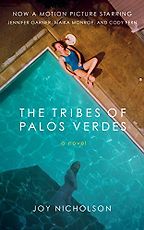
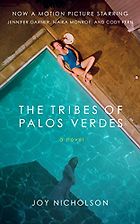
Your fourth novel recommendation is The Tribes of Palos Verdes by Joy Nicholson, set in a Californian community that is very different to what we’ve just been talking about. But I think it also conjures up this rawness of the coming-of-age?
My sister recommended this book to me. It was published as a YA novel. and Joy Nicholson only wrote two books before she disappeared. I think she runs an animal sanctuary now.
But this is such a brilliant book. It tells the story of a young girl in a gated community, a very well-to-do community in California. Her parents’ marriage is disintegrating. She and her brother are surfers and she gets drawn into this very masculine world of surfing that she wants to excel in. Again, I’m drawn to protagonists who have a passion for something a little unusual, like horn playing or surfing.
I read this book in my late teens or early twenties and had never seen the emotions of a protagonist on the page this way before. It was a real eye opener for me. I wasn’t a teenage girl, but I could relate to so much of the emotion and sensory experience. It really grabbed me and I think it deserves a wider readership because it’s a beautiful book.
It’s interesting that this is marketed towards a young adult audience. I think there can be some difficulty in knowing how to categorise writing about teenagers.
I think I was too naïve to worry about that when I wrote my first book, which is about a fourteen-year-old girl. A lot of agents told me that it could be a hard sell—was it literary fiction for adults, or a YA book? But this book is YA in that it will certainly appeal to a teen audience. But there’s more going on. And that label annoys me a bit, because teenagers are emotionally intelligent, more emotionally intelligent than we give them credit for. I don’t think teenagers should be served up a simplified version of something that exists in more complex fashion elsewhere.
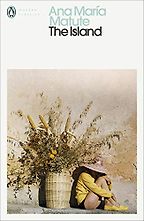
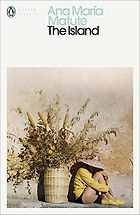
I think that might bring us to your final recommendation Ana María Matute’s The Island.
This one is probably the hardest book to give an overview of. Nothing much happens in this book. It’s about a young girl called Mattie, who is unhappy with her family. She’s rebelling against her grandparents. She falls in love. She has strange friends, a strange cousin. It all takes place on Mallorca in a baking hot landscape. The book is filled with allegorical symbolism, allusions to fairytales, art. The prose is at times a little purple, a little over the top but I’m willing to let that go because the other parts are so beautiful.
I’ve heard someone compare it to a Paula Rego painting and I’ve never heard a better comparison between a book and art. It’s exactly like that: the moon, the plants, the action, you’re not really sure what’s going on. A sinister feeling permeates it. It’s a really unsettling story, one of the most memorable books of a childhood I’ve ever read. There’s not much of a strong narrative in there but it is very lyrical, very poetic, very memorable.
I love an unsettling book. It’s probably my favourite kind of book.
I mean, you’re reading and thinking: where is this going? And it doesn’t really go anywhere. But I love stuff like that, you know? I don’t need narrative. Nature doesn’t have a narrative, does it? You can go outside, you can look at the trees. They’re beautiful. That’s what this book is like. It’s a joy to read.
Thank you. That’s a great recommendation. I feel these interviews often resurface books that have slipped from view. If you like, we could add as a kind of postscript that you wanted to mention The Basketball Diaries, Jim Carroll’s 1978 memoir.
Yes. It’s published as a memoir, but having learned a little more about Jim Carroll’s life, I know it was fictionalised somewhat. But it tells the story of his childhood. He was a prodigious sportsman, a heroin addict and a male prostitute—a hustler working in the public toilets of New York. So, a very interesting life that he recorded in this diary. The book is very important to me because when I came across it at age 15 it was the first time I’d encountered a writer who was alive and living so on the edge.
Jim Carroll was associated with the Velvet Underground, Patti Smith, Andy Warhol. He was cool, edgy. This came to me at a time when we were all in bands, seduced by the appeal of rock music and the rock lifestyle. At the same time, at school, we were reading books like Of Mice and Men and An Inspector Calls. It was all dustbowls and beards.
I’d always been a huge reader, very passionate about books. But I was falling out of love. My local library didn’t have things like The Basketball Diaries, so when I came across it in a charity shop it was tremendously exciting. It got us writing.
Jim Carroll talks about how he would walk around with a notebook in his back pocket. He would sit shooting up heroin and writing poems, stuff like that. I didn’t get into the heroin but I did get into the notebooks. I started writing stuff down, and started thinking that I could be a writer: this was not an academic, he wasn’t wearing horn rimmed spectacles. He was just writing his life. I thought, I could do that too.
Interview by Cal Flyn, Deputy Editor
August 12, 2026. Updated: August 24, 2026
Five Books aims to keep its book recommendations and interviews up to date. If you are the interviewee and would like to update your choice of books (or even just what you say about them) please email us at [email protected]
Five Books interviews are expensive to produce. If you've enjoyed this interview, please support us by donating a small amount.