Mythological beings were ever-present in the world for ancient Egyptians. Author Garry J. Shaw introduces his five best books to get started, from guides to source texts to lavish illustrations. He tells us why the worst parts were never written down, where to look for ghosts and magical spells, why the north is less well understood than the south, and why life is less well understood than the elaborate rituals of death.
I know from your book that there are cave paintings in Egypt that could be as early as 6000 BC. What time period are we looking at when we talk about Egyptian mythology? And is there a consistent mythos over all that time?
In my books, I focus on the Pharaonic period, a period of about 3000 years: very roughly 3000 BC to a few centuries before zero, when Alexander the Great arrives. Then it becomes the Greek Ptolemaic phase, then the Roman phase — but there are still overlaps. The mythology continues during those years.
During those 3000 years, is the mythology the same all the way through? Yes and no. Certainly things do change over thousands of years of history, and there are variations in locations as well. Each town and city and village has its own spin on the material, and you might find certain gods or characters being replaced by local gods playing similar roles. Or there might be completely different viewpoints on things like creation – creation myths are very different, depending on the city. These all coexisted. The Egyptians had no problem with conflicting ideas and different interpretations.
At the same time, there are consistencies. The god Osiris and his role basically stay the same throughout. The god Ra, who is the sun god in his most powerful manifestation, is continuous as well. So the really big famous gods have a pretty continuous role, but certain specifics in different locations are individual. That’s why my book, Egyptian Mythology, takes an approach based on location, so I get to mention some of these differences.
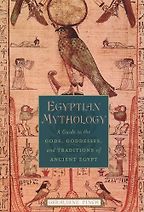
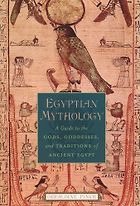
Let’s talk about your first choice – Egyptian Mythology: A Guide to the Gods, Goddesses, and Traditions of Ancient Egypt, by Geraldine Pinch. What can you tell me about this book?
This is a classic of Egyptian mythology writing. Pinch is really clear in the way she approaches the material, and it’s accessible, so it’s something that I find myself going back to a lot. Even after decades now of working on this type of thing, it’s handy to have information that’s easy to read and clearly laid out. If I can’t quite remember something, it’s really easy to find it in Pinch.
It goes through different aspects of Egyptian religion – so it’s not just simply retelling the myths. You get a bit of the history of Egypt, and the mythological history too: creation myths, and the time of the gods on earth through to the time of the first pharaohs. After that, there’s a whole section that is simply an alphabetical breakdown of the aspects of mythology – not just gods and goddesses, but feline deities, magicians, and so on…
Sometimes resource books will just list the gods and goddesses and tell you who they are. But this one has other aspects of mythology, so it’s really handy for the beginner – for someone who knows nothing at all about ancient Egypt or Egyptian mythology. You can pick it up and immediately launch yourself into it, and that’s because she’s such a good writer.
Could we talk a bit more about that diverse mythological cast, beyond the gods? I was struck reading your book by the presence of other figures, kings and magicians and ghosts…
Yes. The Egyptians had a really complex view of the supernatural and the mythological. There are ghost stories – sadly many of them are very fragmentary, but there are a few that are better preserved. The ghost stories are interesting from our perspective because we’re used to horror movies or books about ghosts and zombies and vampires. But in ancient Egypt, when people meet a ghost, they’re meeting an old friend. They don’t get scared; they just chat. Normally people want to help the ghost out, because the ghost is haunting a place because its tomb is falling apart, for example.
You also have the gods all around you at all times, because – and this is one of the more complex areas – the manifestations are around you. The god him-or-herself might be off doing something with other gods and goddesses, but there’s always different manifestations of their power. A good example of this is the god Shu, who represents the atmosphere. Shu has an independent life, and he can go around doing whatever he wants, but if you feel the wind in your face, that’s a manifestation of this god’s power. The Egyptians refer to clouds as the bones of Shu. So it’s a mythological world they were living in, where it’s all around you.
There are also tales and stories which were composed for entertainment, and these are quite fantastical. They were normally made for the royal court, so they tend to feature kings and princes and courtiers. But one of the most famous ones is the Tale of the Shipwrecked Sailor… A sailor is returning from a mission, and the boat gets destroyed, and he winds up on an island which is the realm of a divine snake. They both share tales of woe: the shipwrecked sailor’s crewmates have all been killed in the shipwreck, and the snake had a similar situation, with a falling star that kills all his family. And they help each other. So there’s a lot of creativity in the literature.
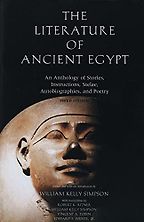
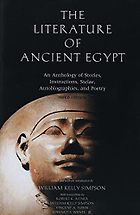
Let’s go to that literature directly now… Your next choice is The Literature of Ancient Egypt, edited by William Kelly Simpson. Subtitle: An Anthology of Stories, Instructions, Stelae, Autobiographies, and Poetry. Tell us about this one.
I wanted to include different types of books. Pinch is a general resource that anybody can pick up, and she’ll introduce you to the world of Egyptian myths. This one is a bit deeper. If you really want to understand the myths, you’ve got to look at translations.
There are different versions knocking around. The one I’ve always found myself coming back to is this book. It’s quite a thick book, lots of content, lots of translations, and my copy is completely beaten up and falling to pieces. What makes this book special is that it contains translations from different types of Egyptian writing – so it’s not specifically about mythology, but of course the mythological content is there. So if you want to learn a bit about, let’s say, the Pyramid Texts, there’s a bit about that, or The Book of the Dead, there’s a bit about that, too. But if you want to learn about Egyptian tales and stories, those are in there, and many of these feature gods and goddesses. The myth of the celestial cow or the heavenly cow is one of my favourites: basically that story ends with beer saving the world.
On top of all that, you’ve got royal stelae, with the activities of kings. It goes all the way through Egyptian history to the later phases too, so you get a whole array of insights into Egyptian thinking.
And the sources for our understanding of the mythology are diverse, right?
Because the gods and goddesses are such a big part of life, you see them cropping up all over the place. A lot of our mythological information isn’t just from a tale or a myth. There aren’t that many narrative myths that survived from ancient Egypt, not in the way that we get from the Greek and Roman world. Much of what we have is fragmentary, pieced together from little bits of information that’s all over the place. Often in magical spells, for example, the top of the spell has an introduction with some mythological storytelling. The point is to give you a divine precedent: if the goddess Isis used this spell in the distant past to save her child Horus, it’s going to work for you too. So we get information there, and in references to gods in hymns and prayers that we find on the surviving stelae or temple walls. It’s very incomplete – it’s like putting together a jigsaw puzzle sometimes, and you don’t know the full picture you’re trying to reconstruct.
It’s biased towards the elite. We don’t have a lot of information about the ordinary people, because they were mostly illiterate. So it’s just the elite, and it mainly comes from temples and tombs and lucky survivals.
You mention that they don’t like to record adverse events, so we get a lot of the darker stories from foreign sources?
Yes. A lot of the information comes from temples and tombs, and because of the way that Egyptians envisioned magic and the power of words, you couldn’t write down something dangerous in a tomb or a temple. If you wrote it down, it could magically become real.
The most famous example of this is the myth of Osiris. Osiris is the god of the blessed dead, the king of an underworld realm. He’s also the god of regeneration, and famously he’s the god who was killed by his brother Seth. The Egyptians try not to directly mention this in their religious texts. It’s only later on, when classical writers take Egyptian mythology and write it down for their own audiences, that we start getting a bit more detail about this type of thing. And we have to be careful with that, because it’s filtered for the Greek and Roman audience.
In certain tombs you’ll find a hieroglyph showing a dangerous viper, and they’ve drawn a knife through it to make sure it’s not dangerous for you in the afterlife. Or take King Seti the First: he’s one of the great kings of ancient Egypt, and his name means the man of Seth. Seth is a dangerous god who represents aggression in the cosmos, and because of that, you couldn’t write his name properly in the tomb. They replaced the images of Seth with Osiris, who was a force of regeneration and would help him in the afterlife. They took the power of art and the written word very seriously, and it does impact our understanding of the myths.
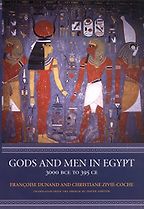
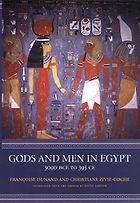
Your third choice is Gods and Men in Egypt, 3000 BCE to 395 CE, by Françoise Dunand and Christiane Zivie-Coche. Why is this one on your list?
I wanted to have a book that was a bit more of a deep dive, but also accessible. This one’s a lot more detailed, a lot more academic, but it’s still accessible and can be picked up by someone who’s not an expert.
It’s wide-ranging in its content. It’s not just mythology: it is also how the temples operated, and the priests, and the ordinary people’s lives, and interactions with the dead. So it covers all sorts of aspects of Egyptian religion. And normally a book on Egyptian religion might just cover up to the arrival of Alexander the Great, but this one carries on into the Greek and Roman phases too, so you get a bit more of an idea of how these ideas continued and melded with the Greco-Roman world.
It sounds so useful to understand a bit more about how these religious stories mattered in practice…
I think if you want to understand Egyptian mythology, you need a book like this one that talks about the society at large and its interaction with religion and the mythological. It gives you more of an insight into the way they saw the world. It was not mythology to them; it was simply their way of viewing the world around them, the way they observed and interpreted the unexplained. A lot of Egyptian mythology is explanation – for why a temple is located where it is, why a particular rock is a particular colour, why the kingship passes from father to son… So to understand that worldview, this type of wide-ranging guide really provides insight. Then it’s not so strange anymore. From the outside, it looks a bit odd, but the Egyptian viewpoint makes sense if you see it from within the bubble of their worldview.
You definitely get a sense of the practical reality in your book, Egyptian Mythology. You go city by city, moving northwest through the book. Why did you choose that geographical approach?
Egyptian religion and mythology lends itself nicely to this type of organization, because of differences between the cities. The most obvious one is that pretty much every city had its own major god: Hermopolis had the god Thoth; Heliopolis is the centre of the sun god; at Thebes you have Amun, or Amun-Ra. So each city is set up for its own mythology, its own rituals. And if you start looking at locations, you can start pulling out some of the lesser-mentioned mythology – the different version of the creation myth, say. I have a chapter on Memphis, for example, which means that I can talk a lot about the god Ptah, who might not get as much space in other syntheses.
So I’m hoping that readers get a sense of the variation, and just how different some of these beliefs were in different locations all at the same time. It gave me a chance to talk about the major stories too – say, the death of Osiris, I could talk about in the Abydos chapter – but there are also other lesser-known ones, from some of these papyri or temple wall inscriptions that might normally be passed over quickly.
The geographical approach brought out the striking fact that the surviving artefacts thin out as you go northwest. Is there a southern Egypt bias in what we know?
Yes. Picture Egypt: there’s the delta at the top, and then you have the Nile Valley coming down. In the delta, the Nile fans out, and it’s a lot wetter and marshier. Remains just don’t survive as well as in the south, where there’s a lot more desert. There’s a general bias overall in Egyptian archaeology, because things that are in the desert survive better, and the things they tended to build in the desert were tombs. So the tombs are where we get a lot of information from. That’s why it often seems that the Egyptians were obsessed with death.
I did think they were obsessed with death. So they’re not just incredibly morbid?
No. Certainly they thought a lot about death. If you were rich enough, building a tomb was something you would start doing early on, as soon as you had the money. But picture Egypt: there’s a very thin strip along which you can really live and build villages and towns, the same spots that people live on today. This has all been destroyed and rebuilt over thousands of years.
Things that survive tend to be tombs in the desert, chance survivals of papyri in places like that too, and temples – because temples were made from stone. So we have information about the gods and goddesses, because in the temples the hieroglyphs often describe the rituals. We know a lot about the rituals and the priests, and we know a lot about the dead.
It’s not quite the same for daily life – there, we only have chance survival — although it is more of a focus these days, and we are learning a lot more.
There aren’t a lot of stone quarries in the delta, so the temples that stood there have all been taken apart and the stones reused. The mud bricks have dissolved, or been reused. So there’s a lot less to find, and excavation is an expensive project – you need to keep pumping out the water in the trenches and all this type of thing.
Another reason is that Victorian Egyptologists focused on the south, because a lot of the big stuff survived in the south – the grand temples and the tombs. That was the focus, because many of them were looking for great finds for the museums. The north just wasn’t as appealing to them. If you’re going to find a few nice statues, you were going to go to the south, not go looking around the marshes in the north. Now there’s a lot more focus on trying to understand the delta and the archaeology there, which has been making great progress.
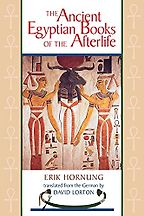
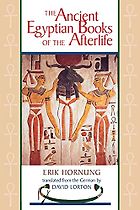
Well, let’s talk a little more about their not-an-obsession with death: your next choice is The Ancient Egyptian Books of the Afterlife, by Erik Hornung.
I wanted to pick a book that gave people a dive into specific afterlife books. The most famous one that people have heard of is The Book of the Dead, but we also have translations of the Pyramid Texts, which are earlier, and the Valley of the Kings in Luxor has all these royal underworld books as well. It’s quite overwhelming – the walls of the tombs are just covered in inscriptions and mysterious little figures, and it’s hard to follow. They’re very complex mythological scenes about the sun god’s journey through the night…
Tell us more about that one.
So, the sun god disappears over the horizon at night. The Egyptians were very concerned with where he went, and every day this was a battle against chaos: the sun god passes through the underworld during the twelve hours of the night, and each hour he faces different challenges. In the middle of the night, he becomes re-energized, and that leads him to go back to the eastern horizon and rise again. Each day was a cycle of birth and death for the sun god, and the king in death joins him on this journey. They are basically fused together, merging as a single entity. That’s why the king’s tombs are decorated with all these underworld books describing the journey – because magically, if you describe these things, they become true.
Now, I picked this book because it has a meaning to me. I bought it twenty-five years ago, and I’ve carried it around with me in The Valley of the Kings every time I’ve gone there. It’s a bit beaten up. It’s been dropped on the floor, it’s covered in bits of sand… It’s great because if you are there, you can flick through it and see the scenes you’re looking at on the walls, and get a bit more of a feeling for what’s going on.
It’s easy to follow: it’s clearly written, with sections on the sources, the research, the content and the structure. It’s not a thick book, but it covers pretty much every single version of these underworld books. It’s really handy to have while you’re there, but at the same time, it’s rare to find a book as good as this for an armchair Egyptologist. You can really get to grips with what these royal afterlife books were all about.
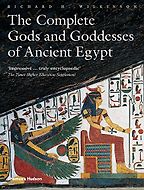
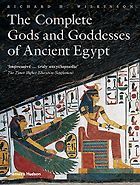
Your final choice is Richard H. Wilkinson’s incredibly bravely titled The Complete Gods and Goddesses of Ancient Egypt. Complete. Is it?
It’s very complete. And a very good book. I wanted to include a book that was mainly illustrations, which is why I picked this one. The other books I’ve picked are a lot of text, a lot of interpretation – this one also has great text. These Thames and Hudson ‘complete’ books — there are more: The Complete Pyramids, The Complete Temples, and so on — are really handy books to pick up and flip through.
This one’s about the mythology of gods and goddesses, but also about the iconography. The information is broken down into mythology, iconography, and worship, so you learn different ways of approaching the deities. It gives you a real insight into the art behind all of this – the way that the gods were represented, and the importance of how they were represented. There are hundreds of pictures in this one. Understanding the text is one aspect of all of this, and trying to see the worldview is one aspect too, but it’s also important to understand the iconography – how they were depicted, the artistry behind it all. There’s a very rigid way of presenting artworks in ancient Egypt. There were rules behind it.
It’s just the beauty of it, too. It’s very unique, and I think it’s one of the reasons that ancient Egypt remains popular. It’s so striking, the imagery they created, and the gods and goddesses are a big part of that.
Five Books aims to keep its book recommendations and interviews up to date. If you are the interviewee and would like to update your choice of books (or even just what you say about them) please email us at [email protected]
Five Books interviews are expensive to produce. If you've enjoyed this interview, please support us by donating a small amount.
Garry J. Shaw
Garry J. Shaw is an author and journalist, covering archaeology, history, world heritage, exhibitions, and travel. He writes on the latest research and breaking news, and has written features on diverse topics, from the world’s most mysterious manuscripts and the Near East after the Bronze Age collapse, to heritage destruction in Yemen and heritage crime in post-revolution Egypt. He also writes the monthly archaeology column "Buried Treasures" for the Art Newspaper. Shaw has a PhD in Egyptology and is the author of eight books including Egyptian Mythology: A Traveller’s Guide from Aswan to Alexandria and The Story of Tutankhamun: An Intimate Life of the Boy Who Became King. His newest book, Cryptic: From Voynich to the Angel Diaries, the Story of the World's Mysterious Manuscripts, was a New Yorker best book of 2025.
Garry J. Shaw is an author and journalist, covering archaeology, history, world heritage, exhibitions, and travel. He writes on the latest research and breaking news, and has written features on diverse topics, from the world’s most mysterious manuscripts and the Near East after the Bronze Age collapse, to heritage destruction in Yemen and heritage crime in post-revolution Egypt. He also writes the monthly archaeology column "Buried Treasures" for the Art Newspaper. Shaw has a PhD in Egyptology and is the author of eight books including Egyptian Mythology: A Traveller’s Guide from Aswan to Alexandria and The Story of Tutankhamun: An Intimate Life of the Boy Who Became King. His newest book, Cryptic: From Voynich to the Angel Diaries, the Story of the World's Mysterious Manuscripts, was a New Yorker best book of 2025.