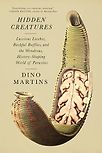
Many people are leery of creepy crawlies—but insects are critical to the functioning of the planet, says Dino Martins, the entomologist, evolutionary biologist and author of Hidden Creatures. We asked him to recommend five entomology books that seek wonder in unexpected places, including bee colonies and termite mounds.
Welcome to Five Books, Dino. You’re an entomologist and evolutionary biologist, so you know a great deal about all things creepy and crawly. What drew you to the study of insects?
My childhood was really incredible, when I think about it now. I spent most of it in a very rural part of Western Kenya, and in the bush, the drylands of Northern Kenya the Kakamega rainforest, and even the eastern DRC—formerly Zaire—and in many ways I was left to my own devices to entertain, educate, sometimes even feed myself. So I looked at what was around me, and insects were a constant. Of course, there are big animals, all this incredible wildlife that we have in Kenya, but I liked insects because I could actually hold them.
As a child you want to see things up close and even possess them, and I could do that with insects. And I realised how amazing they were. I think almost every child, if they are allowed to, goes through a bug period. I think it’s how we’ve been wired. But I got into mine and never got out of it.
Of course, I was very lucky to have teachers and family who encouraged me.
That’s lovely. You’ve written a new book about a subject many people find off-putting, which is parasites. But I was struck by how wondrous, how surprising it all is. I have the sense you are looking for beauty in unexpected places.
The more you look at it, the more you realise that there are all kinds of nuances in nature. Many things turn out to be very different to how we imagined them to be.
The Western scientific perspective has partitioned nature into a neat arrangement, but it absolutely isn’t like that. And even the most highly evolved mutualistic relations can switch into being exploitative or parasitic.
What I was trying to do was to say: Look, all this intricacy, all this complexity, all these bizarre things are actually how nature really works, and we have to accept that. If we close off our minds to half of all life, then we will have a very incomplete picture of the world.
When you put together your selection of five books, what were you thinking about?
It was surprisingly hard to pick these books. My books are my only possessions, apart from my dog, that I’m really attached to. So I thought about it a lot.
Growing up, we didn’t have social media or television, but we did have books. Books were one way for me to open an eye into the rest of the world. But they were also hard to come by, so they were really precious. You had to value them and look after them.
Some of these are older books, and none of their authors are still alive. But they were very influential in my life in many ways.
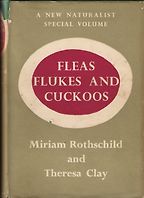
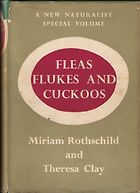
It’s not so often, in fast-moving scientific fields, that books stand the test of time in that way. Can I begin by asking you about Fleas, Flukes and Cuckoos: A Study of Bird Parasites, a 1952 book by Miriam Rothschild and Theresa Clay?
I love this book. I’ve had this copy since I was a young teenager. There was a little second-hand shop in the town near to where I grew up. And when we went to town, I would always go in to look at the books. Most of the books were Mills & Boons, not particularly interesting, but I found this book there and I was so excited. It’s just the most brilliant natural history, in an area that very few people had written about. What it did was show me that my interest in these things was legitimate.
I had such a curiosity. I would read a little bit of this book, then I would rush out into the farm, or into the forest, to look at things, then I would go back and read more. When I first got this book, I skipped school for a couple of days because I was so excited to read it.
Later I learned about Dame Miriam Rothschild and the impact she had on the field.
In her obituary in 2005, The Guardian called Rothschild “the Queen Bee… one of Britain’s leading naturalists, a world authority on fleas, on butterflies, on pyrazines and chemical communication.”
She was the classic eccentric English naturalist. On her deathbed, she was surrounded by cages full of rats. She would wear a special belt that had mini pockets for fleas to live in, so they could feed on her while she studied them.
Theresa Clay was another iconic person, although she wasn’t quite as famous as Miriam. Both were just so committed to their subjects, so passionate.
I think now, in science, it’s much rarer to find people who have the luxury to indulge their curiosity in things, to just open their hearts and minds to everything, to go off on all these tangents. The positions these women held in academia and museums allowed them to do it—having these vast collections, which of course is part of the legacy of empire, and in Miriam Rothschild’s case having the family financial backing to accrue and amass large collections.
But they also turned it around and supported young scientists, all these different endeavours. They were really amazing people in terms of their outlook on the world.
So many people think of parasites as bad, dirty, disgusting. These are labels that we put on them. People want to shun them, avoid them. But, actually, you’ll never escape them. And, secondly, there’s a lot of complexity here. Reading this book as a teenager opened my eyes to that.
We kept chickens, pigs, birds, dogs, horses, you name it—hedgehogs, baby antelopes, bush babies. Animals that we would rescue. After I read this book I would chase after these animals, grab them and comb through their fur or features looking for the parasites Rothschild and Clay were writing about? And they did. That was great.
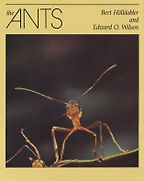
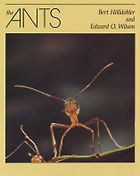
Applied learning, fantastic. Can we talk next about Bert Hölldobler and Edward O. Wilson’s The Ants? It’s a very comprehensive textbook about the biology and behaviour of ants.
Yes, it’s a massive tome. The level of synthesis that went into it is just breathtaking. There’s so much detail. And yet, so little, because there are so many species of ants and so many ways of being an ant. They condense almost everything known about ants at the time into a single text.
I think what it did for me was show me that you can love these creatures and study them deeply, and you can also share that wonder. In this particular book there is incredible wonder on every page.
They got into trouble for making parallels between animals or insects and human behaviour, and for writing about the biological basis of social behaviour—sociobiology. It was very controversial. But for a while Edward Wilson was the David Attenborough of the United States. He won two Pulitzer Prizes and was very respected as a spokesperson for science.
Yes, but look, here is someone who did so much for nature and science. He was incredibly prolific, and he gave people like me a real chance. I was so lucky to get to know him. We’d have weekly teas, where we would get together and talk about ants and the universe and politics, everything.
He came from a humble, rural background, but ended up at the top of his field, influencing huge numbers of people around the world.
This book is what won him his second Pulitzer. It strikes me as an unusual selection by the committee, because it’s a rather technical textbook.
Yes, it’s not just a science book but heavy science. I think it’s sad that we don’t see other books like it winning that kind of award. At that moment, there was a real feeling for the synthesis of knowledge. It’s harder for books like it to rise to the prominence they deserve now.
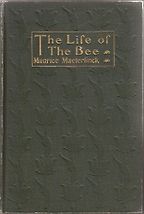
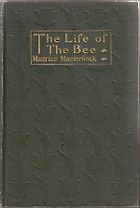
Well, let’s look at your third book recommendation, The Life of the Bee by Morris Maeterlinck, first published in 1901.
Maeterlinck was a playwright and poet who won the Nobel Prize for Literature. He also wrote natural history. It’s a very interesting book, and another one I came across as a child.
I loved bees, kept bees, was often stung by them. But, after reading this book, all these things I was seeing started to make sense—how the bees behaved, how they communicated, how they swarmed, why they visited flowers at certain times of day.
With him being a very accomplished writer, the language is so riveting. It’s luscious and abundant. I learned a lot from reading this book and still have my copy. It’s bees as a metaphor for all life.
There’s another wonderful book about bees I want to mention: Bees: Their Vision, Chemical Senses and Language by Karl von Frisch, who won a Nobel Prize together with Nico Tinbergen and Konrad Lorenz for establishing the field of animal behaviour.
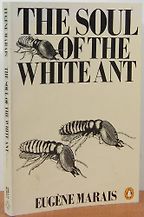
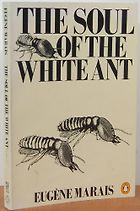
Next we should discuss Eugène Marais’s The Soul of the White Ant. ‘White ant’ being a common name for the termite.
Yes. I grew up surrounded by termites. I loved watching them. We’d dig up nests to look at them, which was a bit naughty, and they were just a constant part of our lives. They’d eat our house, eat the buildings. They’d be eaten by the chickens. One of my earliest memories is of the explosions of termites coming streaming out of their nests at the beginning of the rains. Walking home after school in the evening there would be millions of flying termites, their wings catching the evening light. These things stick with you.
They fly for just a short window. That’s when they disperse and mate. They pair up, chase each other around on the ground, and that’s it. They dig a hole, never again emerge to the surface.
The farmers were always fumigating them, but I would argue with them, just say: no, no, no. And so this book was a vindication of my interest in termites and my advocacy for them. I would get really upset when people killed them.
Now there is an interesting link to make between Marais and Materlinck. Eugène Marais was South African at a time when South Africa was a very isolated part of the world—not only geographically, but culturally and scientifically, because of all the terrible things that were going on there. He also wrote in Afrikaans, which then had to be translated into English. But his books did make it to East Africa, where he helped establish the field of ape behaviour. He wrote The Soul of the Ape, a study of baboons in South Africa, and established many of the methods used by people who got very famous subsequently. This was before Jane Goodall, before Dian Fossey. But the amazing thing is that he wrote these essays, which were then plagiarised by Maeterlinck.
Really!
I know! A Nobel Prize winner. Why would he do that? And Eugène Marais was poor, he didn’t have the resources to deal with that.
Both were brilliant in their own way, but this was quite devastating for Marais and Maeterlinck never explained or even responded. I think he just thought he would get away with it.
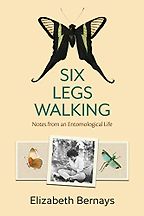
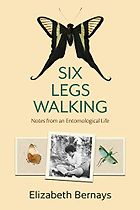
I think that brings us to our final book, which is Six Legs Walking: An Entomological Life by Elizabeth Bernays.
Again, this is beautifully written. She takes people along on that journey of wonder. It talks in great detail about what she studied during her career—very precise work on caterpillars and grasshoppers. She travelled all over the world, from rural Australia to India, Kenya, Arizona, and ending up as a professor at Berkely.
In entomology, there are classic papers, studies and textbooks. She was very much part of that world, but this book also has a mixture of personal memoir and travelogue, and a history of the personalities of the scientists as she knew them. It’s not a very well-known book but it has become one of my favourites and it really influenced me.
A few minutes ago, you talked about ‘advocating’ for insects, and I want to pick up on that. Many people are frightened of insects in general and parasites in particular. As a result, people very casually kill insects. As an entomologist, you must be very aware of this anti-insect current of thought?
I was confronted by it from a young age. In a farming community, I was always the one trying to stop people killing things. Including my own family. Then, as a professor and a scientist, I have to collect specimens. Those are very important for collections and museums, but I really struggled with this as a student.
Insects are extraordinary. They can see in ultraviolet, sense in near-infrared. They can live for centuries. They can replicate themselves in the most bizarre ways. They break the rules of biology that we think we have established. And there are just so many of them. As Ed Wilson used to say, it’s the little things that run the world.
Think about mammals. 96% of the biomass of mammals on Earth are humans and their livestock. Only 4% is wildlife. That includes elephants! Only 4%—that just shows you how far we’ve tipped the balance across the whole planets. Two thirds of all the birds on the planet are now one species: chickens. That’s very frightening.
However, the one thing we’ve not yet managed to tip is the biomass of invertebrates, because ants and termites are still there, the driving force of the nutrient cycle, the carbon cycle, the nitrogen cycle, the pollination of plants—all these fundamental processes that keep the planet working. The planet we inherit is the result of millions of years of ecological processes that have largely been driven, on land, by invertebrates.
But we are starting to chip away at it. Numerous studies have found insects on the decline—not in all places, thankfully, but in certain parts of the world.
I would say that advocacy for insects is really advocacy for ourselves and our own survival.
Five Books aims to keep its book recommendations and interviews up to date. If you are the interviewee and would like to update your choice of books (or even just what you say about them) please email us at [email protected]
Five Books interviews are expensive to produce. If you've enjoyed this interview, please support us by donating a small amount.
Dino Martins
Dino Martins is an award-winning entomologist and evolutionary biologist. A professor at Stony Brook University, he has served as the director of the Turkana Basin Institute in Kenya, founded by Dr. Richard Leakey, and previously as the director of the Mpala Research Centre. He holds a PhD in organismic and evolutionary biology from Harvard University. His research and writing have been featured in Smithsonian Magazine, The Guardian, TED, the BBC, Granta, and National Geographic. He lives on Long Island and in Malindi, Kenya.
Dino Martins is an award-winning entomologist and evolutionary biologist. A professor at Stony Brook University, he has served as the director of the Turkana Basin Institute in Kenya, founded by Dr. Richard Leakey, and previously as the director of the Mpala Research Centre. He holds a PhD in organismic and evolutionary biology from Harvard University. His research and writing have been featured in Smithsonian Magazine, The Guardian, TED, the BBC, Granta, and National Geographic. He lives on Long Island and in Malindi, Kenya.