What were your criteria for choosing these five books?
It’s simply that they made me laugh. They’re all very different, and they all have very different ways of making me laugh.
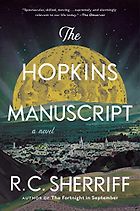
Let’s talk about your first choice: The Hopkins Manuscript, by R. C. Sherriff.
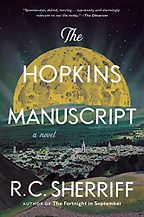
The Hopkins Manuscript is a very prescient bit of sci fi from 1939. The premise is simple: the moon is going to crash into the Earth. That’s a very serious situation, and the only reason this book is a comedy in most part is because of the narrator. He is a well-meaning amateur astronomer who is more interested in raising prized chickens than in the end of the world as it’s approaching. It’s basically the apocalypse, as told by Alan Partridge. By a quirk of his hobby, his interest in astronomy, he is one of a very select band of people who know the horrible truth – that the moon is about to crash into the Earth – before anyone else does.
Having a strong character makes the difference between a brilliant comedy and a bad one. He’s so funny, and he’s so well-meaning – he’s a very small-minded and petty person, but he’s not malign. He’s quite benevolent in general. When the moon does crash into the earth, and there’s a requirement to rebuild civilization afterwards, he comes out of his shell a bit and becomes a bit less of a difficult and annoying character.
It’s a wonderful and weird premise, and it was written right on the eve of the Second World War. And there is a strain in it towards the end about the folly and the horror of war, where it does become a bit more serious.
I think another element that’s important for a comic novel is that it has to reflect human nature, which is basically unchanging: the circumstances can change, but human nature doesn’t. That’s always one of my rules for writing fiction.
So that’s the story of Hopkins and his manuscript, and I just adore it.
Why ‘manuscript’? Is it supposed to be an old document?
Yes. There is a little foreword from the Imperial Research Press in Addis Ababa, so it has this lovely little framing device: it’s been tracked down centuries after it was written. The idea is we’re well into the future, and the Royal Society of Abyssinia discovered the Hopkins manuscript two years ago in the ruins of Notting Hill. It was hoped that some valuable light would be at last thrown upon the final tragic days of London – but, it says, unfortunately Edgar Hopkins is so self-regarding, vain, and useless as a narrator that his narrative is almost valueless. I really love that too, as a way of saying, ‘You’re not going to get anything useful out of this story.’
It’s so funny. R.C. Sherriff was a brilliant writer, and a very varied one in his career. He wrote A Fortnight in September, which is literally just about a family going on holiday for a fortnight in September… So he could do very big stuff and very small stuff at the same time, and all of it manages to engage the reader. He’s terrific.
He was writing this in 1939, of course, but dystopian collapse doesn’t feel far away today either… Is it a stressful read?
No, I don’t think so. It’s such a warm and funny book, and the idea of the moon deciding to spiral in and crash into the Earth is so absurd that I don’t think it is stressful to read. It’s quite encouraging to read in a way – chicken breeding goes on, even under the most difficult circumstances.
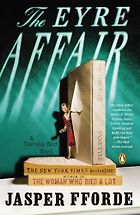
That is comforting. Great, could you tell us about your second choice? This is Jasper Fforde’s The Eyre Affair.
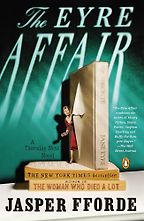
This is the story of Tuesday Next, who is a literary detective. She lives in an alternate reality where reading is much more core to day-to-day life than it is in our own world, and the plot concerns the abduction of Jane Eyre from her own book.
Tuesday Next is a detective who can move between books. So can the villains of the piece. The whole thing is just completely wonderful. If you’re a fan of reading, it’s wonderful, not least because there are a vast number of references to other works of fiction scattered through the pages. But you don’t have to have read everything to enjoy The Eyre Affair and all of its sequels (Tuesday Next crops up in lots more books).
There’s something about the sheer pleasure in reading and the joy of the world that Jasper Fforde creates that makes it very infectious. It’s a wild story as well, and you’re able to pinwheel through all sorts of different worlds. I don’t know if Jasper Fforde would like the comparison, but I thought it was like a much, much more sophisticated version of Ready Player One, which borrows from all sorts of other fictional worlds. But because Jasper Fforde was doing it with literature, and because he was doing it first, I think it is better on both counts.
Pinwheeling is a great description. It’s definitely sci fi, but it’s also fantasy, and it’s also police procedural… Do you feel one genre has the dominant note, or is it just its own thing?
It’s so mad – I remember there’s a scene where there’s a kind of mass Richard III, almost a sing-along Richard III, where everyone’s quoting along to the entire play… I think it’s a bit of everything. I do like a detective novel because they have so much potential for comedy. Again, because there’s such a strong narrative voice – which we’re probably going to come onto with one of the upcoming choices…
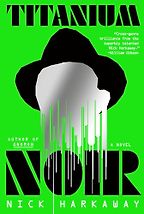
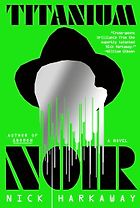
Let’s talk about that one now then. What is Titanium Noir by Nick Harkaway about?
It’s so good. It’s about a gumshoe detective called Cal Sounder, who lives in a world of giants. A technology has been invented which, after the first injection, makes you 20% taller, younger, and harder to kill. There are only about two thousand of these Titans on the planet, but they control almost everything, and the people who’ve taken three or four doses are now absolutely enormous and absolutely impossible to kill.
Cal Sounder is a human who works as a kind of fixer for these titans, and this is a crime story he gets caught up in, where the victim is himself a titan: seven feet tall and ninety years old, but doesn’t look a day over thirty. Since titans being killed is impossible, Cal Sounder has to investigate just exactly what has happened.
And he’s the main vehicle for the comedy?
Yes – this is another one which is so character-led. The character of the gumshoe detective is such a well-established one. But this crazy world of near-future titans and genetic manipulation allows Harkaway to have a huge amount of fun with that, and to be very world-weary about a grubby, Blade Runner-style broken world.
It’s not actually a comedy. This is probably the least out-and-out funny of the five I’ve chosen. But it did make me laugh a lot. There are a lot of scenes which are very funny because the main character is funny, and that does almost all the work for you. So you’re laughing throughout, even though you don’t realise you are.
I know we’re here to discuss funny sci fi, but you do also write funny crime – and there’s so much of it about. Is there something about the crime novel that lends itself to humour?
It doesn’t have to, because there are a lot of extremely serious crime novels. This all links to: what makes things funny? I’ve been thinking about comedy and satire a lot recently, and whether satire has to have a joke in it. I used to think it did, but I now believe I was wrong. Actually, all you need is a perspective, a changed outlook on the world that you’re trying to communicate to your audience. I think that’s all comedy really needs: to present a different way of looking at the world. The classic form is a joke, where there’s a bit of a surprise in it. But the reason that character comedy is so strong is because an individual, a well-written character, can have a completely different perspective on the world. If you can write a character whose perspective is consistent and different to most other people’s, comedy is the inevitable result.
Detective stories also rely to a large extent on strong characters. The crime may not be especially interesting, but your detective will certainly have to be. Look at stories like the Lord Peter Wimsey mysteries, where he’s a cricket-playing aristocrat who has decided to quixotically go around solving crimes more for his own amusement than anything else: that’s a terrific character, and he’s such a weird character that he can’t help being funny, just because he’s different to all of us.
Interesting. So, you’ve written funny crime, and you’ve written sci-fi, but your next book brings together the humour and the sci fi for the first time. Tell us about Everything Happens So Much.
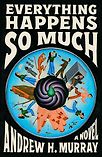
It’s about a woman called Esme Good. Esme has a job she doesn’t like, and a life she doesn’t really like – she’s never quite managed to get into gear. That’s her basic problem. Part of the reason for that is that she is addicted to a little substance called the Elsewheres. The Elsewheres are a technology that you can take a dose of, in a pill or potion or whatever it might be, and for fifteen minutes you are catapulted into the mind of one of the other versions of you, one of the other trillions of versions of you that might have been. Esme really, really likes these things, and she has spent so many years in other versions of her own head that she has completely failed to start living her own life.
It’s basically a book about the experience of being alive now, and why it feels so difficult to thrive and simply get on with one’s own life – because we’re bombarded with everyone else’s lives constantly. It’s really about the twenty years since social media was invented in a big way.
Esme goes through an experience, which means that she is forced to start living her own life. She actually becomes an immensely important person – and she doesn’t handle it very well. So that’s the setup. There’s a huge caper adventure that rolls out from there.
This is the book I’ve been writing for – gosh, about ten years now. – working on it and improving it. Again it’s character-led.
A real labour of love. What have you discovered from the process of bringing humour and sci fi together?
In both sci fi and humour, I like work that – as we’ve touched on – reflects reality and human nature. I think there are some sci fi works in the space opera category, which have a little too much sci fi for me, and not quite enough of the human behaviour. The really successful works are those which combine them. This kind of sci fi works for me because we’re in a recognisable version of our world – it just happens that things go a bit crazy.
At the same time, the fact that you’re in a world where things are allowed to be different means that you can do all sorts of things, and the only limit is your imagination, which is so enjoyable. It’s so nice spending time in a book that an author has really thought about, and where they’ve shown you little touches of the world without having to go into huge detail – and that again can be a huge vehicle for comedy. So that’s why the combination works.
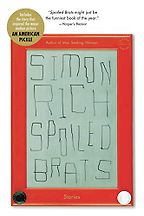
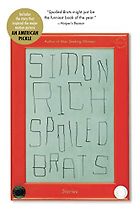
It’s time for your fourth choice: “Sell Out,” which is a short story in Simon Rich’s collection, Spoiled Brats (and was serialised in The New Yorker).
Yes. This is the story of Herschel Greenbaum, a worker at a pickle factory in 19th-century New York, who falls into a big vat of pickles and is frozen there for over a century – until he’s thawed out, returned to life, and goes to meet his great-great-grandson. Simon Rich has been a writer on SNL for many years, and he writes fantastic short story collections.
It’s a classic mismatched pair comedy. The story is told from the perspective of the great-great-grandfather. He starts selling his own pickles on the streets of New York using river water, completely unsanitary pickles, and is shocked when he’s stopped from doing this – a classic fish out of water story. And he’s convinced that his great-great -grandson and his great-great-grandson’s girlfriend are doing terribly badly for themselves because they’re so thin; he’s worried that they’re going to starve, because that was much more of a concern in Eastern Europe in the 19th century, where he came from.
It’s an extremely funny story. Simon Rich is so good at creating little worlds, quite economically, yet stuffed with brilliant observation. It was done as a film with Seth Rogen, which is a very good low-budget comedy film of the kind that you don’t really get many of these days. It’s good, and worth watching, but the story is even better.
We spoke about satire – some of these jabs are pretty sharp, and aimed squarely at the average New Yorker reader. And at me, honestly, but it didn’t feel bad to laugh at them…
No, it’s fine. The character of the great-great-grandson is quite clearly based on Simon Rich himself, because he’s a comedy writer who is working on punching up incredibly stupid-sounding comedy scripts, like one where the president is a monkey… So he’s having a go at himself.
It’s part of a short story collection called Spoiled Brats, which begins with a harrowing gulag-style memoir by a class hamster. They’re not all sci fi, but they all have an amazing way of presenting perspectives.
Being funny in short story form must be a different art…
Yes. It’s how I started, before novels. I wrote a lot of short stories, which were sci fi and comic, very much in the Douglas Adams mould. You’re allowed to be a bit madder in them, because you don’t have to sustain a serious story over 100,000 words. In fact – and I know we’re about to come on to it – the books in the Hitchhiker’s Guide to the Galaxy series are almost a collection of short stories strung together. Douglas Adams will just go off and tell a five-hundred-word story about a particular planet or civilization or technology, and then drop back into the main narrative. It’s a way of sneaking in a lot of extra crunchy detail, which is always fun.
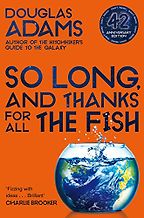
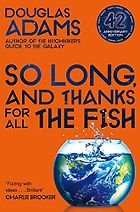
Yes – the time has come, let’s talk about Douglas Adams. Of course his Hitchhiker’s Guide series is on your list – but you’ve specifically chosen the fourth of the trilogy of four (which would eventually become five). This is So Long, and Thanks for All the Fish. Can a reader start the series here?
Definitely read the rest of the series first. That’s no imposition. They’re all about 40,000 words long – they’re so short. I’m shocked by how short they are, given how much they do with their word count, and how big an impact they’ve had on my life.
This is the book in the Hitchhiker’s series where Arthur Dent falls in love, with a girl called Fenchurch. It’s 42 years this year since it came out…
Aha. “42”, we should explain, is an important number in the Hitchhiker’s world – it’s the answer to the ultimate question.
Yes. There isn’t a huge amount of sci fi in this story. There’s a little plot, but not an enormous one. It’s a really beautiful story about falling in love and learning to fly, and there isn’t a huge threat to the universe – no evil army to be defeated. But it’s about the change in your perspective when you fall in love, and the fact that it is almost a sci fi experience in itself, to really fall for someone. It’s a really charming and beautiful story, with lots of classic Douglas Adams touches, but it’s quite different to lots of the other Hitchhiker’s books.
One thing that science fiction and comedy do very well when they’re combined is to suggest why life feels the way it does, which is what I try and do in all my stuff – try and get to the heart of the human experience, and why it’s so strange and mad, and why we spend so many of our days quite stressed and unhappy when actually a lot of us are leading quite good lives by any objective standard. Sci fi can allow you to get into some of those questions.
Five Books aims to keep its book recommendations and interviews up to date. If you are the interviewee and would like to update your choice of books (or even just what you say about them) please email us at [email protected]
Five Books interviews are expensive to produce. If you've enjoyed this interview, please support us by donating a small amount.