What is psychological horror, as a genre?
I understand it as a type of horror where the instability or threat is in the mind of the person perceiving it as well as in the world they inhabit. So rather than the monster being outside us, a creature lurking in the trees outside the light cast by the bonfire, the monster is sitting around the fire with us, or maybe it’s in our mind. Or maybe, in reality, we’re the monster.
I associate this type of horror very much with the literary device of the unreliable narrator. Some classic examples are Maupassant’s short story “The Horla” or Poe’s “The Fall of the House of Usher.” It can involve body horror, the Gothic, or various forms of the supernatural, but there is often an element of ambiguity – is the horror real or imagined? – which makes it particularly compelling and fertile as a genre.
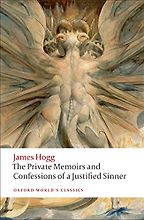
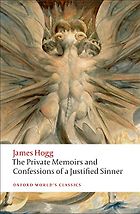
Tell us about the first novel you’ve chosen for us, The Private Memoirs and Confessions of a Justified Sinner by James Hogg.
James Hogg was a working-class Scottish poet and writer from a farming background who was known as the ‘Ettrick Shepherd’ during his lifetime and was a protégé of the far more famous Walter Scott. This novel was published in 1824 and was not very successful but was rediscovered later on, sadly after the author’s death.
It’s a story that’s obsessed with duality, even telling the central narrative—about a young man who is brought up to believe he is a member of the ‘elect’ (or saved) and goes on to murder his own brother—twice.
The story is told once from the perspective of an ‘Editor’ in the third person, and once in an autobiographical narrative that we learn at the end was found buried with the narrator’s corpse when it was exhumed. Famously, it inspired Stevenson to write The Strange Case of Dr Jekyll and Mr Hyde.
How else does duality manifest in the novel — is there a ‘bad’ and a ‘good’ character?
Robert Wringhim, who narrates the autobiographical part of the story, is the anti-hero. His mother is a Calvinist religious fanatic who was married off to a louche aristocrat and rejected him completely after their wedding night. Robert is the illegitimate son of her priest and hates and resents his older brother, who is legitimate and the heir to the family fortune.
So there is a duality between the two brothers; but there is another duality between Robert and a mysterious stranger who befriends him as a young man, Gil-Martin. Gil-Martin is an incredibly persuasive and charismatic person who Robert believes to be a member of the Russian royal family in disguise. He finds Gil-Martin very compelling to talk to but often feels strangely exhausted and demoralised after a long time spent in his company.
It’s the ‘auld wives’, ‘weel kend for witches too’, who recognise Gil-Martin for the shape-shifter that he is:
‘they say the deil’s often seen gaun sidie for sidie w’ye, whiles in ae shape, an’ whiles in another. An’ they say that he whiles takes your ain shap, or else enters into you, and then you turn into a deil yoursel.’
Does an unreliable narrator play a part in the novel?
Absolutely. Robert’s narrative is full of evasion and lies. He is very ambitious, envious and greedy, while simultaneously portraying himself as a paragon of morality. It’s a very unflattering portrait of a religious fanatic who believes he is ‘chosen’ and therefore above conventional morality. He draws the line at murder, though, until Gil-Martin enters the picture and persuades him to kill his brother.
Unsympathetic as Robert is as a character, some of the experiences he goes through at Gil-Martin’s hands (or possibly, because of his own guilt personified as Gil-Martin) are absolutely terrifying. There is a scene where he is in a delirium, and thinks he has split into two beings, which makes me think of the well-known phenomenon of depersonalisation, where people experiencing trauma feel as though they have left their body.
The book as a whole is very convincing as a portrait of mental collapse; Robert is driven insane, going from being extremely wealthy and successful to becoming a homeless farm labourer and finally being buried in a pauper’s grave. It’s a fascinating, challenging read.
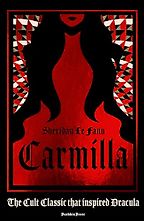
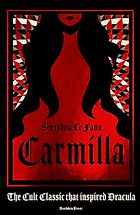
Your second choice, Carmilla, is a vampire novel. Is it also psychological horror?
Carmilla, published in 1872, is a very short and atmospheric novella that predated Dracula by a quarter of a century and was written by the marvellous Sheridan Le Fanu. It takes place in the traditional Gothic setting of a grand house, in this case an Austrian Schloss or castle, although rather than arriving in the house as an ingenue, the teenage heroine Laura lives there with her father, an Englishman. Laura’s Austrian mother died a long time ago.
A sensitive girl, Laura has one terrifying experience as a six-year-old child that haunts her; a young lady appears next to her bed, caresses her, climbs into bed with her and bites her on the chest. Her father and family assure her that it is a dream, but she isn’t convinced. The situation is set up right away where the narrator constantly questions her own perceptions of reality against other people’s more prosaic, rational perspectives.
So when a beautiful young woman arrives at the Schloss as an unexpected guest after a carriage accident, and Laura recognises her from her childhood vision, she is terrified at first. However, the stranger tells her that she had a similar dream herself, except that Laura was a young woman, as she is now, rather than a child. The dream becomes a bond between them, rather than making Laura anxious.
After all, the stranger is enchanting.
‘I did feel, as she said, “drawn towards her,” but there was also something of repulsion. In this ambiguous feeling, however, the sense of attraction immensely prevailed.’
So is Carmilla a monster?
Like Gil-Martin, Carmilla possesses enormous seductive powers (she also resembles another literary predecessor, the reptilian Christabel in Coleridge’s unfinished poem of that name). Her relationship with Laura is passionate, but also ultimately threatens her life; as Carmilla feeds on her blood, night after night, Laura finds herself accepting, and even welcoming, the idea of dying for love.
Some of the psychological horror lies in the fact that like many Gothic heroines, Laura is not believed. Her father is an Enlightenment man and does not believe in ghosts and ghouls until he is forced to do so by the intervention of his friend, whose own daughter was killed by Carmilla. The forces of patriarchy intervene, and the vampire is finally tracked down to her forgotten family tomb and staked through the heart.
The subversive strength of the novel is in the powerful presentation of Carmilla. She can transform into a black cat and walk through walls. She possesses superhuman strength in her ‘tiny wrist’. Seductive and eloquent, she rejects religion and the existence of God, and admires only Nature. She also is sexually uninhibited, which is very unusual in a depiction of a Victorian woman, even an undead one.
A family portrait of one of Laura’s mother’s ancestors in the Schloss is revealed to be an exact likeness of Carmilla, but with a slightly different name, Mircalla, Countess Karnstein. It is, of course, Carmilla herself. As an ancestor of Laura’s, she may symbolise Laura’s subconscious desires. Their quasi-incestuous relationship is typically Gothic, and underlines the forbidden nature of those desires according to the morality of the time.
At the end of the novella Laura tells us:
‘…the image of Carmilla returns to memory with ambiguous alternations—sometimes the playful, languid, beautiful girl; sometimes the writhing fiend I saw in the ruined church; and often from a reverie I have started, fancying I heard the light step of Carmilla at the drawing room door.’
Perhaps the horror here really lies in the suppression of female desire, as Laura returns to her passionless, rational, ordered environment, but fantasises about Carmilla’s eventual return.
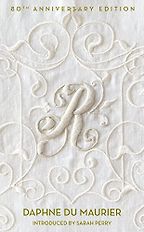
I think duality is also a trope in the third novel you’ve chosen for us, Daphne Du Maurier’s Rebecca, published in 1938.
Yes, it is. The unnamed narrator, a young woman with no living family working as a ‘paid companion’, meets and marries Maxim de Winter, a much older, wealthier widower, after a whirlwind courtship in Europe. She follows him back to his ancestral home, Manderley in Cornwall, where she soon finds herself haunted by her predecessor, the eponymous Rebecca.
Manderley is a beautiful, spacious, well-run home run exactly the way Rebecca wanted it to be by her housekeeper, the sinister Mrs Danvers, who is utterly devoted to Rebecca’s memory and wants nothing more than to see her successor fail miserably in the role of the second Mrs de Winter.
As we explore Manderley along with the narrator, we discover that Rebecca was beautiful, desirable and excelled at everything she did: riding, dancing, sailing… She was everything, the narrator begins to believe, egged on by Mrs Danvers, that she herself is not.
She finds herself constantly falling miserably short, especially when, in a devastating scene, she is tricked by Mrs Danvers into wearing the same fancy dress costume, a white gown worn by an ancestral de Winter in a family portrait, as Rebecca did at the Manderley Ball. When she comes downstairs wearing it, the ballgoers all gasp in horror and Maxim angrily orders her to change into something else immediately.
So is Rebecca the ‘evil’ Mrs de Winter?
I think that we are very much drawn into the narrator’s perspective, in that we are fascinated by Rebecca. She is wilder and more untamed than the narrator, which makes her more compelling. Like the scarlet rhododendrons associated with her memory, she is dramatic and showy yet ultimately sterile and toxic.
We learn from Maxim that she had a sadistic streak, tormenting a horse as a young woman in the same way she allegedly tormented Maxim during their marriage. Yet we also learn, during the narrator’s investigations, about Rebecca’s exquisite taste, her physical bravery, her brilliance and the fact that she was adored by everyone around her (except her husband).
Meanwhile, the naive heroine goes on her own journey from innocence to experience when Rebecca’s body is found in her sunken yacht and she learns that her beloved Maxim is responsible, thanks to one of his regular fits of uncontrollable rage.
After Maxim confesses to her, he says that her face loses its ‘look of innocence’. And she herself, in a dream sequence at the end of the book, sees Rebecca’s face instead of her own when she looks in the mirror. Her husband is making a noose of Rebecca’s long black hair, and ties it around his own neck.
One could argue that this dream is in fact wish fulfilment: the heroine has helped Maxim cheat punishment for what he has done, but as a result will find herself tied to him (and his unpredictable temper) for the rest of her life, which is spent in exile from their beloved Manderley.
What other books does Rebecca remind you of?
It’s influenced by Jane Eyre, and references it in various places, particularly the ending of the novel and in the emphasis on the relative plainness and poverty of the narrator. The first wives, with their ‘otherness’ (race and mental illness in Jane Eyre, affairs, including one with her first cousin, and possibly bisexuality in Rebecca), eventually bring down the entire patriarchal edifice on their abusive husbands’ heads.
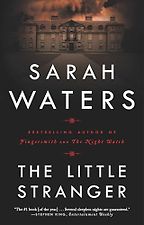
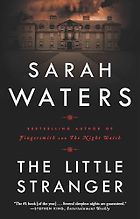
What made you choose The Little Stranger by Sarah Waters as your fourth novel?
I haven’t really talked about class that much in the previous books, although it is of course very important in all of them (the narrator is a middle-class interloper in Rebecca, for example, constantly having to explain to bewildered gentry that she has never learned how to hunt, sail, or shoot). But it’s crucial to the plot of The Little Stranger, which is set in 1947, nearly a decade and one world war after Rebecca.
Doctor Faraday is a middle-aged country doctor from a working-class family in Warwickshire. Clever, ambitious, and a man of science, he is asked one day to treat a maid at Hundreds Hall, a beautiful Georgian house owned by the Ayres family. His own mother was a maid there herself, and he has a powerful memory of being taken to visit it as a child and falling in love with the house.
The Ayres family are aristocrats fallen on hard times. Unlike the de Winters with their huge staff, they only have three servants left: the cook, the butler and the fourteen-year-old maid. Working-class people are getting factory jobs, or moving into their own council homes, thanks to the new Labour Government. Dr. Faraday sees the Ayres as pathetic relics, unable to fend for themselves.
Roderick, the scarred war-hero, is a mental and physical wreck, his sensible older sister Caroline despairs of ever marrying and escaping the Hall, and their beautiful mother, Mrs Ayres, is still mourning their late father and their older sister Susan who died as a child before they were even born.
As Faraday becomes involved with the Ayres family, helping to treat Roderick’s damaged leg and paying court to lonely Caroline, some strange and disturbing events start to occur. A visiting child is bitten very badly on the face by the old family dog, Gyp, who has never behaved like this before. Dark spots, like burns, appear in Roderick’s bedroom, followed by a terrifying incident when his room bursts into flames.
All this time Faraday behaves as though he is the Ayres’ best friend, and believes he is helping them. Yet consider the deft irony in this passage after Roderick is nearly burned alive in his room:
‘I said, “The whole house might have been lost, It doesn’t bear thinking about! And Rod was here, in the middle of it? Is he really all right?”
She gave me, I thought, an odd sort of look…’
It’s a wonderful portrait of someone who is not even aware of the depths of his own obsession. Faraday’s love affair with Hundreds Hall blinds him to the humanity of the people living in it, with tragic and sinister consequences.
So it’s the unreliable narrator again?
Yes, but with a truly creepy supernatural backdrop. I defy anyone to read this book on their own in a dark house without jumping a few times. And as in many of my favourite books, not everything is explained at the end. You will have to make your own mind up about who, or what, is haunting Hundreds Hall.
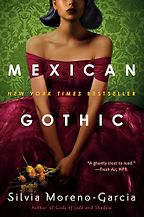
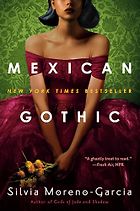
And finally, tell us about Mexican Gothic. It’s also historical fiction, and set in a more recent time period than all the other books, isn’t it?
Yes, it’s set in Mexico in the 1950s. The author, Silvia Moreno-Garcia, has said the town where her fictional family, the Doyles, live was inspired by a visit to a mining town in Mexico called Real del Monte or Mineral del Monte, which was colonised by the British.
The heroine, Noemí Taboada, is a vibrant, clever and lively young woman from a wealthy family in Mexico City. Bored by her social round of cocktail parties, gossip and the occasional piano performance, she jumps at the challenge set by her father of going to visit, and help, her newly-wed cousin Catalina who has been sending disturbing letters from her mountain-top home, High Place, saying that she is being poisoned and is surrounded by ghosts.
Another story of an interloper entering an unusual family?
The Doyles turn out to be very unusual. Their house, High Place, although ornate and grand, seems to be on the verge of collapse, with mould dotting the wallpaper. Although the family have lost most of the money they made from silver-mining since the revolution, they are still extremely arrogant and abusive.
Howard Doyle, the ancient, dying patriarch, is openly racist, criticising Noemí for having darker skin than her cousin, and espousing eugenic theories. Virgil, Catalina’s husband, is flirtatious, in a sinister and controlling way. Francis, his younger brother, is the only person Noemí feels she might be able to trust. The servants speak in monosyllables and seem like mindless automatons.
Where is the psychological horror in this story?
In Carmilla, Laura is sick and dying but no one believes her. In Mexican Gothic, the heroine (and her cousin) are both being sickened and caused to hallucinate by the strange environment they are in but Noemí denies the reality of their situation until it is almost too late.
Noemí is a modern, rational young woman and unlike Catalina, whose favourite book is Wuthering Heights, she scoffs at the idea of the paranormal, until she starts sleepwalking, seeing waking visions and hearing ghosts in the cemetery next door to the house. Eventually, she uses her brilliant mind as well as the folk wisdom of the town’s local healer to fight back against the Doyles and find the cause of the phenomena she is experiencing.
And who, or what, is the monster?
We discover that the Doyle family have gained their wealth, power and longevity literally from the bodies of indigenous people, and women. Without giving too much away, it’s a brilliant reimagining of the Gothic house and family trope that shows how patriarchal, capitalist and colonial power exploits others. The ‘ghosts’ which haunt the house are the collective consciousness of the people who the Doyles have oppressed and whose abilities they have harnessed and misused. I particularly like the way the novel uses body horror to make the invisible visible.
Is there duality, as well?
Yes, in the paired women, like the two sisters Alice and Agnes, one of whom is sacrificed to ensure the immortality of the Doyle patriarch and the other of whom is the mother of his children, or the two unnamed sisters who are forced into incestuous relationships with their own brother, and of course Noemí and Catalina, who have different sensibilities (Noemí is modern and rational, Catalina is more of an imaginative, Gothic heroine). These pairings often represent different forms of oppression: Noemí is treated less respectfully and in a more predatory way by the Doyle family than Catalina, for example.
But the duality that all psychological horror explores most frequently is the tension between perception and reality. Is Gil-Martin a manifestation of Robert’s suppressed desires? Is the ghost in Hundreds Hall a manifestation of Faraday’s? Is the unnamed narrator in Rebecca obsessed with her predecessor because secretly, she wishes to be as free as she was? As Goya put it in the caption to his famous print, ‘The sleep of reason produces monsters’. It’s up to the readers of psychological horror to work out who is awake, and who is asleep.
‘“I thought I dreamed you,” he said, still a little sleepy.
“I’m real,” she replied, a murmur.’—Mexican Gothic
August 22, 2026. Updated: August 24, 2026
Five Books aims to keep its book recommendations and interviews up to date. If you are the interviewee and would like to update your choice of books (or even just what you say about them) please email us at [email protected]
Five Books interviews are expensive to produce. If you've enjoyed this interview, please support us by donating a small amount.