What is a memoir, in your view?
It is a factual account of somebody’s life where the writer enters a contract with their reader, saying, ‘I am going to be true to the facts as I remember them, and the emotional truth will remain.’ But we must all accept that memory is fallible and that people can have differing interpretations of the same experience.
Memoir usually has something to say about not only the personal but also the political, or a wider point to make.
That’s what I liked about your book—not only was it a memoir about your life, but it was also an investigation into a really important story about the tabloid press in the UK, and how unscrupulously they can behave.
Yes, and that’s why it was commissioned. It’s a personal and inside take on a story which landed in the public consciousness as the ‘phone hacking scandal’ and something to do with Hugh Grant’s voicemail. It’s actually a police corruption scandal, at its heart. That was the real betrayal—the fact that there was illegality on a widespread scale happening at Murdoch tabloids and others, and the police helped cover that up.
That’s where my direct interest was because I had reported a crime to the police—and private details of that crime were then printed in the Sun newspaper. So I trained as a journalist to find out how that happened.
I had had other traumatic experiences too. I felt a bit sorry for the commissioning editor, Emma Smith at Little, Brown, when I was delivering it to her because I thought, ‘She’s expecting an investigation, and she’s going to get dead dad, dead brother, dead baby.’ But it’s a life, and what can you do? That is my experience. And despite that being my experience, I consider myself a very lucky person. I’m a loved person. I have never been neglected. I have always been caught when I have fallen. I have sought and found incredible friends. I have a very strong love from the family members who have survived. I’m a lucky person and I really hope that that comes across.
The examples of memoirs you’ve chosen are also nearly all about trauma, to some extent. Is that an important aspect of memoir?
Not necessarily, although I have chosen books by women, and I think that women are probably drawn both to read and write memoir to express our experiences of being a woman and of womanhood. And who lives a life without trauma? No one.
What I tried to do was reverse engineer these books and work out how the writers constructed them. I ended up massively intimidating myself and thinking, ‘I can’t do this! These are amazing!’ — but nevertheless, finding my own pathway and my own voice in the end. I kind of had to give up trying to be as good as everyone else and just write.
You come across as a very determined person—first you became a journalist; later you trained as a lawyer as well—all to get to the bottom of what happened.
It was much messier than that in reality. Part of my wanting to be a lawyer was because I’d been working on a story journalistically and I thought it might be a civil case, for example. I tried to encourage my sources to gather together and bring that case, but they wouldn’t do it without me. Or couldn’t, maybe. Trauma again. You need to feel safe to be able to act. That pushed me over the edge. I was like, ‘Fine. I’ll train to be a lawyer, and I’ll do it with you.’ There are many reasons why these things happen.
One of the weird things about writing out your life is that you begin to see yourself and the decisions you have made in patterns and themes. The reason I trained in law, it is clear now, and the journalistic story I mentioned falls into this, is that I have become very interested in ‘institutional abuse’ and means of accountability. Powerful institutions and organisations are well set up to protect themselves from criticism at this point. I had seen through my work with lawyers like Tamsin Allen of Bindman’s, on phone hacking, that the law, used creatively, has a good chance of puncturing those walls of self-protection. You can use legal frameworks to find discrepancies and sometimes compel answers in a way journalists are locked out from unless they have a whistleblower. That is very interesting to me.
With journalism, yes, I wanted to find out how this thing—details about a sexual assault I reported to the police ending up in the press—had happened to me, I definitely did. And I trained as a journalist to find out, but I was also motivated by the power asymmetry and wanting to redress the balance in some way. I had felt – experienced – the huge amount of power wielded by the people who had control of information, and I wanted some of that too. I wanted to regain some control, to grab some power. I wanted someone like me, who felt she had integrity, to be out there being a journalist, as well as those guys.
So there were many reasons for me to train both as a journalist and as a lawyer. But of course, when you’re writing a memoir, you boil it down to a nice, neat narrative. You tie it with a bow when, in fact, life isn’t like that.
What’s also interesting is that journalists are so often portrayed as a force for good, uncovering scandals. But in this case, they did some terrible things.
Yes, but I understood the pressures they were under. The system they were working in was incredibly misogynistic and full of male and white privilege. I understood why they had found themselves doing the things they had done. I found within the tabloids many highly intelligent, talented journalists with integrity.
I suspect the people who got higher up that chain lacked or perhaps lost integrity. With a nod and a wink, some of them encouraged criminality—in unlawful means of gathering information, such as phone hacking—and expected to get away with it because they were so well in with the police. Then, when their foot soldiers got caught, they did not take accountability, but instead threw the reporters under the bus.
It’s really the higher-ups—the executives and the desk heads—that I would say are responsible for what happened, or happens, within tabloid culture. Individual reporters were responsible for their actions too. But some were working in a culture where refusing could cost them their job. That matters when we ask who created and sustained that culture. Some left the industry; others tried to cling on because they wanted to be journalists and were good at their jobs. It’s not always easy to see clearly how toxic your working environment has become.
I lived overseas at the time and also thought the phone-hacking scandal was just something to do with Hugh Grant, but once, when I was passing through Heathrow, I picked up a book called Dial M for Murdoch by Tom Watson and Martin Hickman. It was so shocking. I kept telling everyone I met to read it. Like everyone, I was deeply affected by the story of Milly Dowler. I just couldn’t believe it.
It’s extraordinary. And Murdoch has kind of got away with it: he’s still one of the most powerful men in the world. As much as we could, we did a good job of exposing it, especially Nick Davies, but his tendrils reach far into establishments across the world.
Nick was actually one of the first people we interviewed on Five Books, back in 2009 or so, when we started. Several of us were journalists, and we thought, ‘Who would be the best person to interview on good books on being an investigative journalist?’ Still, despite all the public outrage, I don’t think the Leveson Inquiry’s recommendations were ever implemented.
Leveson Part Two—which was meant to be the investigation on the relationship between the police and the press—was cancelled. The Leveson Part I recommendations were accepted to a degree. From memory, David Cameron said something like it was going too far to regulate the press. I think that’s a fallacy, because TV journalism is regulated by Ofcom. It’s perfectly reasonable.
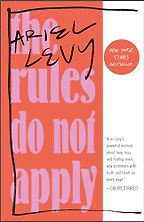
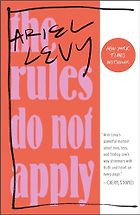
Let’s turn to the memoirs you’re recommending, examples of the genre on which you modelled your own. Let’s start with The Rules Do Not Apply by Ariel Levy.
The Rules Do Not Apply is about Levy’s life. The title is so clever. She was brought up unconventionally, and she has always tried to make the world work for her, rather than the other way around.
The key is that she lost her baby at 19 weeks. Her writing about that is just so incredibly beautiful. As someone who lost a baby at 27 weeks, I found it the most validating thing I’ve read in that space.
What she describes feels, at first, like a memoir of collapse. It’s not just about pregnancy loss; it’s about the marital breakdown of her parents, and her own; it’s a kind of shattering. But the book hints at the end that even though she lost her baby, she’s met someone new, and that she’s able to make a life even though the rules do not apply. Her life is unconventional, but she’s able to rebuild. I find that inspirational.
Do you think that’s the reason we read memoir – when we go through something, we feel like we’re the only one feeling it. And then when you read it in someone’s memoir, you realize you’re not alone?
Absolutely. All writers write because they’re seeking connection in some form. Even if they’re writing a murder mystery, they seek community. It’s an art form like any other. It’s about expressing yourself and seeing if you can find connection with others. We are looking for validation. At the same time, we might be looking to understand the counter point of view.
We all enjoy a narrative arc that ends in hope. My own book falls into it ever so slightly. We seek this hope that everything will be all right in the end. It’s not what real life is like. Life is messier than that.
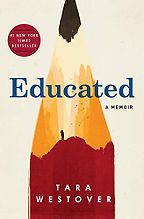
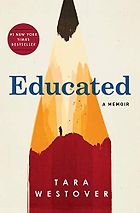
Let’s go on to the next memoir you’ve chosen, Educated by Tara Westover. This was a huge bestseller, about growing up in a strict Mormon family.
Again, a very unconventional childhood, which she is encouraged to explore through academia in the end.
Educated is interesting because there are people who have questioned her version of events. A memoir is one person’s truthful account of events as they understood and experienced them.
I think memoir is really interesting because, beyond all other genres, it leaves you open to shame. Your credibility can be questioned, but what allows your credibility to be questioned is very gendered. We experience shame so viscerally as something wrong about us, but I often think that it belongs to the systems that got us into it in the first place. The same expectations we place on women elsewhere follow us into the way we read their memoirs. We judge whether they were good daughters, good mothers, whether they behaved as we think they should. Those judgments can become judgments about whether we believe them. It makes you very vulnerable to write a memoir —especially as a woman.
I found Educated intimidating because Westover is so clever. At times, though, I wondered how particular episodes served the larger story. It made me think about selection: how much do we include because it happened, and how much because it helps us tell the story?
In Ariel Levy’s writing, her scenes are vivid, but they’re never overwritten. She chooses one or two details rather than loading a scene with texture. It’s probably because she’s a journalist, but it is impactful. They’re just different ways of storytelling, I suppose.
I think Tara Westover is in this tough situation in that she’s writing about her family, and then it’s her family who challenges what she’s written.
We will come on to this with The Salt Path, but what do we expect? What is the contract we have entered into with writers of memoir? How much is truth, and how much is allowed to be poetic license or emotional truth?
Educated is set in Idaho, which she sounds beautiful in her descriptions. In your book, you write about growing up in Wales and your childhood.
Yes, it’s presented as slightly idyllic. My mum read the first draft and she said, ‘God, you’ve romanticized your childhood a bit, haven’t you?’ And I was like, ‘No, that’s how I see it, because I was the child. You were having a failing marriage and stressed about being a grown-up. I wasn’t.’
Tara Westover is similar to Maya Angelou, who is next on my list. The way they write is novelistic. The means by which they are able to convey what’s in their minds, the recall, is way beyond me.
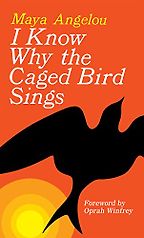
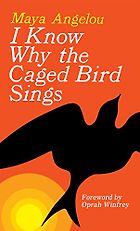
Let’s move on to Maya Angelou now, because she is like a lodestar, a thread through your own memoir. Tell me about her 1969 autobiography, I Know Why the Caged Bird Sings.
So I read that when I was young, and I reread it when I wrote my book, and listened to the audio version as well. Maya Angelou is a poet. She’s so careful with her language. She does write in detail, but it’s not necessarily the precision, it’s the authority of her voice and the emotional and moral truth of what she’s saying that gives it its power.
She communicates very directly and simply, almost in a populist way. She was an activist, and she’d have been a brilliant politician. She appeals to your emotions and that’s why she appeals to young people, I think, and is so endlessly quotable and instagrammable.
When I first read her book, I was grieving heavily for my dad. I was probably about 15 when I met her. I was struggling with how vulnerable bereavement and grief make you feel, and the strength with which you have to present yourself to the world, especially as a teenage girl. When I was in her presence, she was absolutely magnetic. A kind of stoic vulnerability. I was blown away by the fact that she wore her vulnerability as strength.
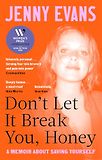
And when she left the stage she was speaking on – I had been to see her talk at the literature festival in Hay-on -Wye – she called me to her, wrapped me into a hug and whispered, ‘Don’t let it break you, honey. Don’t let it break you.’ Then she gave me her incredible smile. I have never forgotten it. Who would? So that became the title of my book. Maya-inspired.
Going back to why we read memoir, I just saw who I aspired to be in her.
What’s so wonderful about memoirs is that you also learn about totally different lives – like hers, being brought up by her grandmother in the American South in the 1930s and 1940s. That also is what keeps me reading.
It’s so beautifully drawn and so novelistic from her. What I found when I was reading both her book and Tara Westover’s—because, as I say, I was trying to reverse engineer them—was, ‘How are they remembering the wind was blowing a certain way? There must be poetic license in this.’
But then I found, when I started writing my own, that I could close my eyes and picture myself there. Your brain does offer you these little details, like a pigeon pecking at the paving, or a fingernail worrying the flaky paint on a bench. I couldn’t tell you whether that is 100% the truth or not, but it very much felt like it was to me. It was like I was reliving the scene, and it was all coming back. I was also having EMDR therapy while I was writing. I found that revisiting these scenes brought back more detail than I had expected.
I suppose we think of things in headlines. I don’t know how we file things away in our brains, and maybe we all do it differently, but I think I had them as folders with titles on them. And then, when I went back and retrieved the folder to try, and put myself back in, say, the British Museum, with a particular source, I found there was loads of detail in there.
After that I thought, ‘Okay Angelou, Westover, maybe you did remember which way the wind was blowing that day. I think there’s a difference between honestly remembering something imperfectly and knowingly changing what happened. You can be truthful about your experience without claiming that your memory is infallible. But emotional truth isn’t a licence to invent the facts.
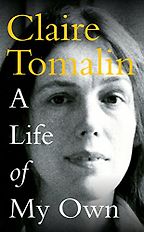
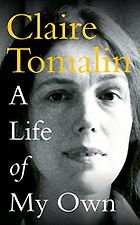
Before we get to that, let’s talk about A Life of My Own by Clare Tomalin. She’s a famous biographer of other people, but here she’s telling her own story.
I absolutely love her biography of Dickens, and for many years, it was my go to when I couldn’t sleep at night: ‘I’m going to listen to my Dickens audiobook.’
She does write about herself more like a biographer. Her writing is quieter and more restrained than some of the others, but it’s about grief and work and ambition and endurance. She doesn’t seem interested in romanticizing her life. It’s all quite clean and English and maybe cautious, but it’s an incredible life, really, and quite unsentimental. I don’t know if that is an English thing too, or a class thing.
I was drawn to it because I love her biographies. I wanted to see what she would do with her own life. And she basically did herself as she would have done someone else, I think.
Some terrible things happen to her, don’t they?
Her daughter dies by suicide and her husband, who was a foreign correspondent, has lots of affairs and then is killed. She had a profoundly disabled son, but she does lots of work to make their house work for him.
She has this incredible career in newspapers and it’s just an example of perseverance and determination, really—not that she ever makes a big deal out of that. She keeps going, without making a great declaration of her resilience. I admire that restraint.
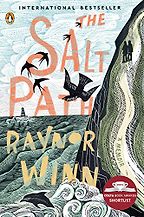
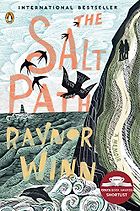
Let’s turn to the final memoir you’ve recommended, The Salt Path, which was a huge success and turned into a movie before garnering some less positive attention. For those who haven’t come across it, can you say what it’s about?
It’s about a couple who—we are told—lose their family home because of a technicality in a court case. They have made the wrong investment after being duped by an old friend. In their 50s, with no home and no money, they decide to become vagabonds, essentially, and to walk the South West Coast Path with just their backpacks. At the same time, they discover that the husband has a very serious degenerative illness.
So it’s really a story of multiple journeys, both a physical journey along the South West Coast Path and also through his illness and facing up to that, and their loss of everything they built up in their lives and what that means.
It’s a beautifully written book, and when I first read it I was blown away by the prose. Subsequently, the Observer’s investigation raised serious questions about the account of how they lost their home. Winn has disputed the reporting. For me, that raises a really important question about the contract between a memoirist and their reader.
If you change the circumstances to make yourself appear blameless, that is a different thing from remembering a conversation imperfectly. I still think it’s a really interesting example of memoir, because it raises the question of how honestly we can write about things we feel ashamed of.
There have also been questions about the account of her husband’s illness, which they have disputed. I’m interested in what readers take from a story in which walking appears to bring recovery from serious illness. That is a powerful promise, and it matters how accurately it is presented.
So that space where memoir sits between reality and memory becomes a tug of war. The statement she has made via her lawyers is that it remains the ‘true story of their journey.’ Is that enough if the facts are incorrect? If the central circumstances have been misrepresented, I think that breaks the contract. I think people will accept that you can’t remember which way the wind is blowing, necessarily, or that memory is fallible and that not all of it will be verifiable facts. But you can’t knowingly change the facts to make yourself appear blameless. You have to own up to your fallibilities and bad decisions too.
But you’re still recommending it…Do you rate it as a book?
I thought her writing was beautiful, so on one level, I do. But the distinction matters. Fiction gives you the freedom to invent. With memoir, you are asking people to trust your account of what happened.
But if she’d written ‘I got into trouble because I stole some money,’ would that have worked as a story a publisher would be interested in?
There is a way of writing in which you own your terrible decisions. A story in which someone acknowledges wrongdoing can still offer a redemption arc. It becomes the journey within you to accept that you are fallible and can do bad things, that you owe apologies and can still forgive yourself and find beauty in the world. There is a version of that kind of story that I think would be very valuable.
But you have to be willing to look at the parts of yourself you would rather avoid.
In the end you the title of your memoir is Don’t Let it Break You, Honey, which gives a good indication of what you were up against. But you said you nearly called it Shame. Could you explain a bit more about that?
Shame can be one of the things trauma leaves you with. For me, it makes you want to hide. Guilt says, ‘I have done something bad.’ Shame says, ‘I am something bad,’ and sometimes, ‘That’s why these things happen to me.’ Talking about it with people who respond with care can begin to loosen its hold. For me, writing was part of that.
What I began to see when I was investigating this story—the ‘phone hacking scandal’— was the systems that create and perpetuate shame. Shame is a control mechanism, and it is used against women in very particular and powerful ways. The phone hacking scandal was a very misogynistic scandal, make no mistake. The tabloids are misogynistic. The way that they treated their female reporters was misogynistic and dangerous, as is the way that they portrayed and portray women. Also, the way they treated their sources, including women who reported crimes.
So women would report sexual violence as carried out by a famous person—as happened to me—and then the tabloids would offer them a huge amount of money to shed their anonymity and to talk about it in the pages of the newspaper. Then they would call them up on the day of publication and say, ‘Sorry, we’re not going to pay you because we don’t believe you. If you have a look at your contract, it says, if we don’t believe you, we don’t have to pay you.’ Then they would publish the story, and shame her.
As I say in my book, shame is the fuel on which the tabloids’ engines run. I began to see it as a construct sewn into this whole system. Rebekah Brooks is very senior in the Murdoch company, but mostly these were men. At the top of the police, it was almost all men. It seemed to me that they were all embroiled in this kind of shame-soaked battle. Tabloid reporters of old would take a load of coke, and then they would shame someone for selling coke. Or they would use sex workers, and then shame sex workers. They were making decisions, sometimes illegal decisions, sometimes unethical decisions, because they wanted to remain part of that group and retain their power.
And tabloid reporters behaving unethically or illegally to escape the shame of feeling they don’t belong, or have relinquished power in some way is one thing, but police – senior police – is quite another.
They have a duty to the rest of us to behave ethically, whether that’s to take care of us or whether that’s because they are part of a system that is designed to hold people to account. To break that contract to stay in a boys’ club with tabloid executives is – is it unforgivable? I think many police I know would say that it is. And these particular connections, at that particular time, were exposed, mostly by Nick’s hard work, so jobs were lost and apologies offered, but there’s a lot of work to do to dismantle those boys’ clubs today. It’s very dangerous.
How do you feel now, having written the book? Are you happy you did, or do you sometimes wish, ‘oh, gosh, I wish it wasn’t all out there’?
I feel many things at once. I was carrying a lot of shame about what has happened to me. I’ve experienced multiple instances of sexual violence over my lifetime, all of which leave you with a healthy dollop of shame. Also, the fact that I wasn’t considered worthy enough of respect for the police to keep my secrets, or that the tabloids would keep them, that I could just be used as so much fodder, left me with a lot of shame.
I thought most people’s response to the book would be, ‘Oh, wow, how interesting this investigative narrative is.’ Actually, most people who’ve written—and I get quite a lot of messages and DMs—say they saw themselves in the shame. People don’t write about shame because of the nature of it – it makes you want to hide. So I feel really there is a catharsis in writing about shame and shedding it. There is power in saying ‘I feel it too. And it doesn’t belong to me. I belongs to the person, or organisation, or institution that hurt me’. That is my version of Maya Angelou’s stoic vulnerability. I still feel exposed, and afraid of the book being used to shame me. Writing this stuff makes you vulnerable. Being a memoirist makes you vulnerable. But we should keep talking anyway, because there is power in community, and talking brings community.
You’ve been so incredibly brave about everything that’s happened—from reporting it and then sticking with it and fighting it. I mean, every step of the way, the instinct must have been to run away and not think about it, but you didn’t. You dealt with it.
But of course you don’t feel brave. You feel like shit, and you’re doing it because you feel like shit, and you just want to feel different and better. And you’re like, ‘Maybe if I get an answer, maybe if I find out the truth, maybe if I expose the bad person, I will feel less shit.’ It’s a survival mechanism in me, I think. Maybe I need to learn when I’ve done enough.
It’s a really good book. It’s also got really strong elements that would make a great film. Is it going to be made into a movie?
It’s been bought. These things quite often get stuck in development, don’t they? But Empire Street Productions, which has a strong feminist value system, has the rights. They work with Lily Allen, Self Esteem, Jodie Comer, Suzi Miller. I hope that means it’s got a good chance.
Five Books aims to keep its book recommendations and interviews up to date. If you are the interviewee and would like to update your choice of books (or even just what you say about them) please email us at [email protected]
Five Books interviews are expensive to produce. If you've enjoyed this interview, please support us by donating a small amount.