In our stressful world, why are we drawn to reading dystopias?
I think the appeal of dystopia is twofold. Firstly, as a reader and a writer, it’s very narratively fertile. In a dystopia, it is very clear what is wrong, which can go a variety of ways; and it is frequently a human-created wrong. So it gives you lots of fun friction points. You can explore the people who are genuinely having a dystopic time of it, and the people for whom that dystopia is a utopia – which of course is usually the case for someone.
What guided your choices today?
It was a very interesting exercise to think, ‘What is a dystopia?’ A lot of the things that came to mind were post-apocalypse stories, and I realised that a post-apocalypse world is not necessarily a dystopia. Post-collapse stories are not dystopian stories, because a dystopia has got to be in place and ingrained. You need a system that is actively oppressing, and has the stability and authority to oppress. So a lot of collapse stories, where the problem is that everything is falling apart, are not dystopias.
I was thinking about things like the Adam Robertson and Dave Hutchinson Aftermath series, which starts with Shelter. That’s a post-apocalypse story, but it’s not a dystopia story, because people are building up. Similarly, Claire North’s Notes From The Burning Age was another one I considered, but the hardships are not part of a system – they are part of a less caring environment, which I feel detracts from the core idea of dystopias. In a dystopia, the problem system is here to stay. It’s not a thing you build out of. It’s a thing you resist.
With this set, I’ve tried to give a variety of different takes. With one exception, they are relatively near-future – there’s one also that’s full-on wacky space opera dystopia. But they’re all flagging up different elements of what can go into a dystopian setting.
I’ve avoided anything that seemed too obvious. So, for example, The Hunger Games is an excellent dystopia series, but it’s also enormously well known. I feel that most people are going to discover that one on their own, probably through the film. And I have not put 1984 on this list, for example. I absolutely assume that people are going to come to 1984 on their own.
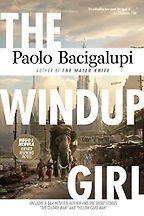
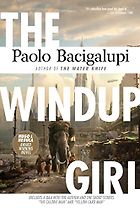
Then let’s talk about some books that deserve to be discovered. Starting with a Nebula and Hugo winner: Paolo Bacigalupi’s The Windup Girl. Tell us about this one.
This is a book I encountered when it was doing the rounds the first time, and yes, it did extraordinarily well, and deservingly so. It is set in a near-ish future, post an energy and climate collapse. It’s set in Thailand. The windup girl of the title is, to be blunt, essentially a sex-bot who is wandering around feral through a lot of the story. It’s not really about her – or it – that’s just an extra interesting thing that Bacigalupi is looking at.
There is a dystopian regime running Thailand, and the whole world is in a fairly poor situation. This book gives you the cold equations of what happens if you’re trying to run a state after the collapse of globalism: what it comes down to is calories. You don’t have fossil fuels – what fossil fuels you do have are very carefully hoarded – so all of your physical power is coming out of animal and human labour. Obviously that then takes calories. So how many calories does your wage buy you? How many calories are you exerting?
It is a grim and astonishingly well-realised picture of desperate people who have been left over in this crash of globalism. The regime is not a nice regime, but you can also have quite a lot of sympathy for the fact that they are having to make a lot of very tough decisions in the wake of everything that’s happened. There is not enough food for everyone, and at the same time, the need for food for everyone is much higher because everyone is having to do all of the work to keep civilization going.
It sounds fascinating. To go back to the titular windup girl, how do robots fit into all of this?
Robots are left over from before – there are no labouring robots. The windup girl is a biological construct who was designed as a companion, and she is just loose now, and potentially an object of desire coveted by some of the characters in the book. It’s tied in with this idea of there having been an incredibly opulent, interconnected global society that had things like this, and now she’s a weird relic of a previous time.
Obviously there are still privileged people who have more, but no one on that level. There’s a bit towards the end where there is a revolution, and the government breaks out their fossil fuel reserves – they say, ‘Right, we’re getting the tanks on the streets.’ And no one can really stand against this, but it’s very obvious that they do not have much of this stuff to go. They don’t have many revolutions that they’re going to be able to put down. It is this dreadful situation of a hand about the throat of the people, but even that hand is starving.
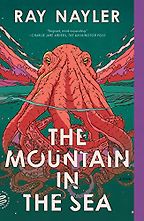
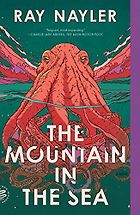
Let’s move from robots to a very different extra-human intelligence. Could you tell us about Ray Naylor’s The Mountain in the Sea?
This is interesting. Again, we start with: what is the point of the book? And the point of The Mountain in the Sea is that someone discovers a fully sapient octopus civilization. That aspect is not in any way dystopian. And there is also AI, which is a proper AI. (The standard disambiguation that we science fiction writers now have to give every time we mention AI is: not large language model, spicy-autocorrect nonsense, but actual AI.)
The reason I’m bringing The Mountain and the Sea in as a dystopian novel is the B-plot, which is not the octopuses. It is set on an automated fishing vessel with a crew that are essentially slaves, who have been taken on board this ship and made to do the various menial tasks that it is not worth getting machines to do. The point is what this says about global capitalism in the world that Naylor is writing about… They have an uprising, and they kill the exceedingly oppressive crew of the ship. But they can’t overthrow the ship itself, because the ship itself also has a kind of artificial intelligence. It bottles them up below, and it has various security features that it can kill them with, and it forces them to keep doing the work. It doesn’t care about its killed crew — they turn out to be icing on the cake. So you have a computer enforcing its will on human slave labour – and they’re not convicts or anything, whether that would be a justification or not (I feel probably not). They are just people who’ve been grabbed and shoved on the ship, and that’s going to be the rest of their lives until this ship works them to death. As a microcosm of a capitalism hellscape, it’s astonishing. It’s probably the thing that had the greatest impact on me from that book, even though I love the octopus stuff.
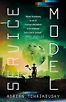
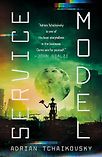
You explore AI in Service Model, your own dystopia. Here, society has collapsed. Our protagonist is a robot, and his sentience is unavoidable because we’re in close-third-person perspective, but his free will is debatable. How would you describe the robot interiority you were setting up here?
This book started because I very much wanted to write from the point of view of a robot. The thing is: what does that actually mean? Because when fiction goes to robots, the temptation is to make them machines that are people, and have thoughts and feelings and desires. They’re basically people in all ways except for their relationship to people-people. You see this right from the beginning – with Frankenstein, I guess, but certainly with Rossum’s Universal Robots and things like that. So as long as we’ve had the word ‘robot’, that’s been what robots were about.
I wanted to think about this. When I’m writing a spider, from a spider’s point of view, I’m not writing a person in a spider suit. I’m trying to make it a spider doing spider things in a way that’s comprehensible to a human reader. In the same way, my character Uncharles is a robot: he doesn’t think in the way that people think, and in fact would claim that he doesn’t really think at all. He has a series of directives. Because he’s a very sophisticated machine, those directives are very sophisticated, and he’s able to improvise a great deal around the idea of trying to fulfil them – up to and including making a whole plan at the end of which is ‘… I will have an owner and be able to do my job again.’ So all of Uncharles’s interiority is based on this idea: if it’s not going to serve his directives queue, then it’s not something he would think of doing.
This means there are things that we would think of as absolutely basic impulses for a human being which Uncharles doesn’t really care about, up to and including self-preservation. There are a variety of circumstances in the book where it’s perfectly logical that he allow himself to be destroyed, because there’s no particular reason why he wouldn’t. As the book goes on, and as things get more complex and confused, he gets more and more inputs – and you start to see that maybe there is more going on with Uncharles’s interior than he would necessarily admit. But it is at least an open question, even at the end of the book, as to just how much Uncharles is a thinking and sapient being, and how much he is simply sentient and following a complex logic chain.
It’s inherently very funny to watch him navigating a distressing dystopian world in his logical way. Were you aiming for a humorous book, or did that emerge once you knew what your robot was like?
I’m a strong believer that if you want to go bleak, you should go funny. This is something I learned weirdly from Joe Abercrombie, who writes incredibly grimdark fiction. He’s one of the best writers of that particular movement, but he’s also very funny with it, which means that his writing is extremely palatable and enjoyable. If it had just been grim, as some of the writers who came after him tried, it would get a bit wearing.
I’ve used this with a number of my books when I’ve been writing about spectacularly horrible things. In this case, it’s the complete collapse of civilization, and all that’s left behind is a bunch of robots who don’t really have a purpose anymore but are still trying to fulfil one.
That could be extremely depressing, but instead, I’ve gone for full-on Douglas Adams-style comedy. That’s somewhat influenced by the fact that one of the big inspirations for the book is a small bit out of the Hitchhiker’s Guide sequence… There’s a world that Zaphod finds himself on where civilization has completely collapsed, and he finds a starship waiting to take off. Inside the ship, people are being kept in suspended animation, and he learns that the ship is awaiting a consignment of lemon-soaked paper napkins before it can take off. So he says, ‘Look, there’s no society out there. Nobody’s making lemon-soaked paper napkins.’ And the ship says quite complacently, ‘At some point a new civilization will arise, and in all probability, it will invent lemon-soaked paper napkins. At that point, we can take off.’ That robotic 100% logic, 100% nonsense position was something I really wanted to explore.
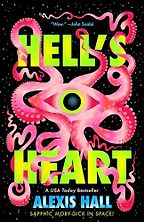
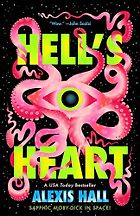
Let’s stay in space and discuss your next choice – you promised us a wacky space opera earlier. Tell us about Hell’s Heart by Alexis Hall.
This is another book which is extremely funny whilst also being extremely bleak. Again, the dystopia stuff is the B-plot. It’s not the main thing: the main thing is a spicy queer retelling of Moby-Dick in space – or depending on your view of Moby-Dick, it’s just a retelling in space, because you can certainly read a lot of that into the original.
So yes: it’s out in space. It is in the far future. Earth is completely abandoned, and people are living in various colonies across the solar system and hunting vast leviathans that live in the upper atmosphere of Jupiter. There is a Captain Ahab, and there is a Queequeg, and there is an Ishmael. But going on behind this is a satirical dystopia.
So how does that factor in?
It’s brought through in the account of the Ishmael character, who is telling you absolutely straight-faced how wonderful everything is: how the rampant exploitative capitalist society they are part of, which requires people to go on these dreadful voyages for a tiny share of the profit, hunting ship-destroying leviathans in terrible environments, is all obviously the way it needs to be. There’s a lot of religion in there, and she belongs to a religious sect, which has a prosperity gospel idea – everyone who is rich is beloved of God. All this is delivered very straight-facedly by the narrator and the writer… The narrator tells you, ‘We were watching this action movie about how, when the amazing defenders of capitalism cracked down on this asteroid miners’ strike, they were right to do so. And those unarmed women and children had it coming’ and so forth… And you can absolutely tell that both the narrator and Hall are shaking the reader and saying, ‘You do see that this is nuts, right?’
Like I say, it’s all just in the background of the whaling stuff. It is a really brutal takedown of a capitalist dystopia, and the ways that capitalism justifies its own predatory ethos.
Hm, I’ve got distracted trying to think of pro-capitalist dystopia takes…
I suspect there were probably plenty back in the day. But yes, overall, I think science fiction tends to skew left rather than right.
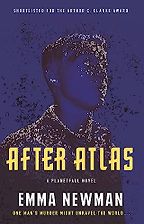
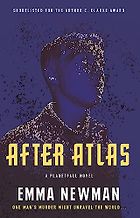
We’ve come to your fourth choice, back on Earth: Emma Newman’s After Atlas. Tell us about this one.
This is actually the second book in a series, but they are very independent and can be read individually. In the first book of the series, there was a great big colony ship called Atlas, which, at the behest of a visionary messiah character, goes off to a planet that everyone is assured they can make a colony of. The first book is what happens to that. Then, After Atlas does what those sorts of books generally don’t do, and looks at what happens on Earth.
There’s been an enormous sink of resources into this thing that’s just gone, and an awful lot of the best and brightest have gone with it, and there’s been an immense global depression. In this world, everyone is queuing up for food. Again, it’s an anti-capitalist book, because we may as well look at close-to-home dystopias. There are corporations controlling everything, and they basically use human life as a resource, much like in The Windup Girl.
Who are we following this time?
The main character is someone who has essentially spent their entire childhood on a regimen of drugs and surgery to make them a very specific kind of neurodiverse investigator. The story is about them interacting with a grand conspiracy, and the way that a world which is already in extremely bad shape is going to get massively worse as things go on. I’m not going to spoil some of the reveals in this book. It has one of the most astonishingly gut-punchy moments towards the end that I’ve ever come across in anything I’ve read. But on the way there, we see the mechanisms of control and oppression, up to and including the main character not having control or ownership of their own mind. They’ve been crafted into a tool of the oppressive state from infancy.
Are we meant to be able to solve the mystery they investigate, if we’re paying attention?
From a writer’s point of view, it’s one of those perfect cases where when you find out what’s going on, it’s very obvious that that’s what the book was leading to at all points. But I think you’d have to be a considerably sharper reader than I am to see where it’s going to go – if only because it goes to some spectacularly traumatic places.
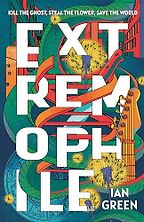
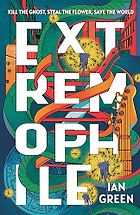
Let’s talk about your last book. This is Ian Green’s Extremophile. We’re back where we started with some climate-driven changes… tell us about this one.
Extremophile was nominated for the Arthur C Clarke Award. I was wondering whether to do Gibson’s Neuromancer, because you want some cyberpunk in a dystopia list and one of the problems with a lot of cyberpunk post-Gibson is that there’s lots of cyber but relatively little punk. For me, a genre that wants to have ‘punk’ on the end of its name needs to be against something, in resistance to some sort of systemic issue – so, it should be a perfect ground for writing a dystopia – but a lot of the time, it gets distilled into the fashion and the vibes and the visuals, and you lose that sense of anger and resistance.
Extremophile is biopunk: the technology it looks at is bioengineering rather than traditional cyberware. But it is a book which absolutely brings that angry resistance to the way the world has gone wrong, which in this case is simultaneously corporate and ecological. It’s not a world that has collapsed yet, but it’s a world where a great deal has been lost.
And which part of this world does the book follow?
It’s a book about angry young people who are living in an underclass in a broken state, where all of the power is concentrated in a vanishingly small set of hands. They’re doing what they can to fight back against the man. We started with the question: why do we read dystopia? Bizarrely enough, 1984 aside, dystopian narratives are frequently wildly optimistic, because you do get to fight back against the man – whether it’s Gibson or The Hunger Games or Extremophile. In most of these stories, there is some sort of blow that the ordinary person can inflict against the brutal and oppressive world that they find themselves in. That is maybe the real reason we like dystopias: because they tend to still have hope. Most of us, when we write dystopias, go towards an ending where something has been achieved. That gives a satisfying narrative payout for the reader: that even though the world is dreadful, we can still do something.
Would you say your choices today are optimistic about human nature?
They all recognise the complexity of human nature. None of them take the position that everyone is bad and it’s all Lord of the Flies out there. I prefer to read books about complicated people and complicated societies.
Interview by Sylvia Bishop
August 8, 2026. Updated: August 24, 2026
Five Books aims to keep its book recommendations and interviews up to date. If you are the interviewee and would like to update your choice of books (or even just what you say about them) please email us at [email protected]
Five Books interviews are expensive to produce. If you've enjoyed this interview, please support us by donating a small amount.