In your book, you mention that Isaac Newton didn’t know what gravity was. Do we know now?
That’s actually the subject of one of the books I’ve recommended, The Trouble with Gravity. It depends on who you ask and how you ask the question.
Most experts would agree that we don’t know everything there is to know about gravity. Gravity works and quantum mechanics works, but where they overlap, they disagree. Maybe we don’t really understand quantum mechanics. Maybe we don’t really understand gravity. Or maybe the question doesn’t make any sense. It’s possible that doesn’t matter, practically speaking.
To the extent that we understand how gravity works, in the domain where gravity applies, people know what it does and how to calculate its effects. And even in the places where it would conflict with quantum mechanics, we understand gravity, but it can’t be the whole story.
And you’ve really been fascinated by gravity your whole life, is that right?
Yes, absolutely. When I first became fascinated with gravity, I didn’t know that that’s what it was. As I explain at the beginning of my book, my father worked on the Apollo missions, Spacelab, and the Space Shuttle, so I’ve been close to the space program my whole life. It was weird to have this relationship with gravity as a kid and not know what it was until later.
It’s a different perspective than somebody else might have, with a different set of circumstances. If somebody was, say, a gymnast, they might have a different relationship with gravity. But gravity is such a pervasive part of our existence that the pieces come together to create each person’s unique picture of gravity. Your personal relationship with gravity is almost certainly different from mine because of your unique set of experiences throughout your life.
I was just visiting Cambridge and ended up walking past Trinity College a lot. All day long, Chinese tourists, holding an apple, were taking photos in front of an apple tree that is supposedly grafted from the one that gave Isaac Newton the idea of gravity. I was amazed to see it attracting so much interest.
Yes, and Newton explained gravity so well. But then, at the end of his book, the Principia, he says he doesn’t know what gravity really is, even though he came up with an equation that explains very well what it does. For Newton to say, ‘You know what? I’m going to let the reader figure it out. I’m not going to weigh in on this’ is stunning to me.
Let’s go through the books you’ve recommended. You said in your email that you found it very hard to choose?
Oh, yes. If I were to show you my bookshelf—it’s not very organised—I have dozens and dozens of books on gravity from various perspectives. There are just so many terrific books, which is why I initially wondered, ‘Why should I write a book?’ But things have changed a lot in recent years. It’s a very dynamic field. There have been great turning points in gravity in this century, in recent decades, and there are hints that we’re on the verge of another. It seems like every few years, you could write a whole new book on gravity.
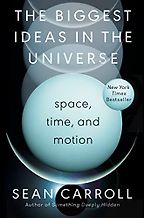
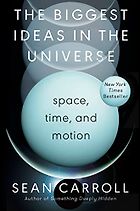
Let’s turn to the first book on your list, The Biggest Ideas in the Universe by Sean Carroll. Can you tell me a bit about it and why you chose it?
The nice thing Sean has done in this book is respect us as readers. He writes out an almost unintelligible equation, Einstein’s field equation, and says, ‘I’m going to tell you everything you need to know to understand it.’ It does feel, to me, like a completely intelligible, accessible course in gravity and general relativity.
It is a bit like running up a hill. I run three-quarters of the way up and then have to stop and think, ‘Do I really understand it?’ I have gotten to points where I don’t completely follow everything, but I understand enough that I can keep going and get to the end.
One of the other books on my list is Astrophysics for People in a Hurry, which is effectively the entire history of gravity as we understand it, all in one quick read. The Biggest Ideas in the Universe, by contrast, is gravity for people with plenty of time on their hands. It’s not a big book, but I had to stop sometimes, go back and read parts of it again. For me, it was not a linear progression. Climbing up the hill of knowledge came in fits and starts. But when I got to the end, I felt very accomplished.
I have the same sort of relationship with gravity, after Sean explains it, as I have with cars. I know how to drive a car and generally how a car works, but that’s not enough to build a car. Sean is showing how gravity works, how Einstein’s equation works. I couldn’t use it to write a paper or do a PhD in physics. I could never duplicate it any more than I could build a decent car. But I can imagine the pieces turning inside an engine in much the same way that I can understand what Einstein’s equation does, thanks to Sean’s book.
The book is focusing on ‘space, time and motion.’ How does gravity fit into that?
It’s part of Sean’s series of books. In this one, he’s taken on Einstein’s general relativity. It’s a very concise and—physicists would say—beautiful equation. In Einstein’s relativity, gravity, space, and time are all wrapped into this one equation. Sean breaks it down and tells you everything you need to know about the cutting edge of gravitational research, of general relativity research. In a nutshell, the book shows how professional physicists think of gravity today. It’s much more holistic than the gravity of a few years ago, or certainly before Einstein.
And is there a way of summarizing the conclusions he comes to about gravity?
It is really a deep dive into what gravity is from a mathematical perspective, but written in a way that you don’t have to be a physicist to understand it. He takes you through the mechanics step by step. He uses terms and examples that are familiar and approachable for most people. All together, Sean’s book is a detailed tour of the topic where, at the end, you really feel like you grasp what a physicist’s view of gravity is. It’s very different from some of the other perspectives that we’ll see in the other books we’re going to talk about.
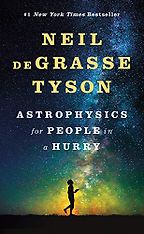
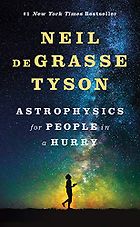
Let’s turn to your next book, Astrophysics for People in a Hurry by Neil deGrasse Tyson. Presumably, this book is a quick read and ideal for somebody wanting to get a quick understanding of gravity?
Yes, although it’s probably not as quick a read as Tyson would like it to be. Where Sean Carroll shows you the nuts and bolts, how they fit together and how they make gravity work, Neil deGrasse Tyson, steps back and says, ‘This is what gravity does.’ It’s like learning how to drive the car, as opposed to building it.
Tyson offers a view of the cosmos from the very small to the very big. It’s not just about gravity. The book shows how we fit in the universe, from our place here on the Earth to our place in the wider cosmos. He starts out at the personal level, then zooms out and out and out until, at the end, you have what he calls ‘the cosmic view.’ Tyson shows that we are insignificant specs in the enormous universe. To some people, it could be depressing. We’re tiny little things in this grand cosmic machine.
His view is more joyful—and he really is very convincing about this—it’s a sort of celebration of our place in this amazing universe. That makes us amazing too. We’re part of this huge continuum that spans from the very small to very large, from the very beginning of time to the very end. Tyson doesn’t get into any of the math, but he gives you this elegant, and reasonably complete, picture of the entire span of the cosmos, both in time and in space. When he puts it that way, his cosmic view isn’t depressing. It’s inspiring.
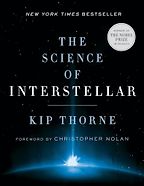
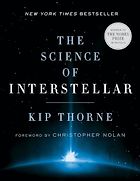
Let’s look at your next book, which is slightly different. It’s called The Science of Interstellar by Kip Thorne. I knew Kip Thorne had been involved in the movie Interstellar, but I hadn’t realized to what extent. Tell me about this book.
To me, Kip Thorne does what I used to think all scientists do. When people ask, ‘What are the possibilities?’ scientists like Thorne can paint beautiful pictures of some amazing ideas, concepts nobody has thought of in the past.
Here he was working with Christopher Nolan, who was making the movie Interstellar and thinking about things like ‘What does it actually look like to fall into a black hole?’ or ‘How do time machines work?’ Thorne gets to step beyond dry academic interpretations and present things in elegant and visual terms, which Christopher Nolan transformed so you can see them on a screen. Kip Thorne was able to take what is typically an equation on a blackboard and give a visceral description of what it looks like in such a way that a filmmaker could then turn it into a picture. To me, that’s almost magical. It’s transforming what might initially seem like a preposterous idea into something visual and approachable. It’s stunning.
And the pictures Thorne includes are gorgeous. In this book, he takes a lot from the CGI of the movie. You just flip through, find a beautiful picture that you can read about and understand what it means. You find out it’s not just an artist’s interpretation but an artist’s representation of really hard science. All the pieces make sense when you go through these images that he’s assembled for the book.
Kip Thorne won the Nobel physics prize for his work on gravitational waves, so he’s presumably a fairly serious scientist in this field.
He’s among the most serious. There’s a great textbook which I was tempted to put on this list. It’s called Gravitation and it’s by Misner, Thorne, and Wheeler—the Thorne being Kip Thorne. It’s the book that all gravitational physicists must own. It’s divided into two tracks. One track is very approachable for beginning students, and even general readers. It illustrates relativity and gravity with descriptions of things like ants crawling on apples. Track one is full of interesting, evocative stories that make difficult concepts intelligible. Then track two gets into the math.
When you go through their examples in Gravitation, you can see the seeds of Interstellar and what Thorne’s done for the movie to explain things. He’s very good at finding these examples of how, yes, gravity is math, you have complicated equations to explain it—but it’s also all around us in ways we can see and feel. You can describe the universe using equations, but you can also just point at things we can observe in telescopes and tell us what’s going on.
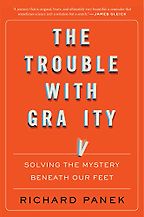
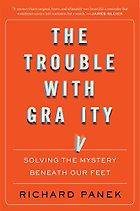
Your next recommendation is The Trouble with Gravity by Richard Panek, which you mentioned at the beginning is a book that asks, ‘What is gravity?’ I think he’s the first author on your list who is not a physicist, is that right?
Yes, he’s a great writer, and that’s one of the reasons I love it. It is so beautifully written. It’s the way I imagine a poet talks about gravity. The interesting thing is that, while it purports to investigate gravity, a lot of Panek’s book uses gravity as a lens to look at society. He talks about personal interactions where people are interpreting gravity for theological and philosophical reasons. So when Panek asks the question, ‘What is gravity?’ it’s almost like asking ‘What does our view of gravity say about us?’
It’s a little unsatisfying in that at the beginning, he says, ‘We’re going to find out what gravity is.’ Then he also says warns you, ‘We really don’t know, and when we get to the end, I’m going to tell you that I still don’t know what gravity is.’ If you ask what gravity is, the answer, he says, is that nobody knows.
I don’t think most physicists really agree with him. Panel mentions interviewing Kip Thorne and asking him what gravity is. Kip Thorne replies that the question is meaningless. I don’t feel that the question is meaningless. But, certainly, thinking about it in the terms that Panek does is not something that Kip Thorne bothers with. Most scientists don’t spend a lot of time wondering, ‘What does it mean that the ancients thought of gravity as being what holds up the sphere of the sky?’—because the question doesn’t apply these days. Aristotle said that some things belong in the sky and some things belong on the ground. What does that say about Aristotle? What does that say about gravity? It doesn’t really say anything about gravity as physicists think of it today. Panek uses it as a lens to understand our relationship with each other and the universe rather than with gravity itself.
It’s probably the most eloquent, readable book on this list. It’s worth reading, even if you don’t care about gravity. He could have chosen just about anything else and asked, ‘What does it say about the meaning of life?’ and written a book very similar to this. He happened to choose to write about gravity, which is why I first picked it up, but it’s also just such a joy to read.
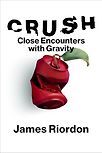
Before we go to the last book, tell me the answer to the question you raised earlier. How come you decided to write a book about gravity, Crush: Close Encounters with Gravity?
It’s partly that reading all these books, in each one you’re learning about one side of gravity. Sean is very much about the nuts and bolts of how the equations work, with Panek it’s ‘What does our understanding of gravity say about us?’ What I didn’t see was a book that satisfied me by giving the whole perspective on what gravity is. One that sticks with the science, but asks how does gravity affect you and me personally? Each one of the five books on my list is focused on one aspect or another of gravity. I wanted something more holistic.
I found it immediately useful to learn what height you can fall from without ending up in the emergency room. Those basic details are important for a human being living here on Earth.
They are. Also, as a snowboarder and a skateboarder—I’ve done a lot of what some people call ‘gravity sports’— the risks that come with heights are very much forefront in your mind. This is something that, if all goes right, I’m going to have a lot of fun. And if it goes wrong, call an ambulance.
The things I include in the book have touchstones in my own life. Somebody else could write the same book and end up conveying the same concepts with very different stories. I hope the stories are entertaining. They’re reflections of the way I see gravity.
In the book, you explain how your dad worked for NASA, so from a young age you’ve been surrounded by and fascinated by all things space?
Yes, absolutely. When you have a parent working with NASA, it’s hard to imagine that the whole world doesn’t spend all their time thinking about going to space. We lived in Clear Lake City, Texas, but we called it Space City when I was a kid, because, from the moment you woke up to the moment you went to bed…there were astronauts around, there were space-themed decorations everywhere, we’d have space-themed parades. I had no idea that everybody wasn’t obsessing about space and gravity until we left Clear Lake City.
It must have been amazing.
It was a golden age. It’s a shame to see it pass. I’m back at NASA now. I’m a member of the Earth Science News team. I write about satellites looking back down at the Earth rather than looking out at space. But gravity is important whenever we put something in orbit in order to observe the Earth. And measuring gravity can tell us a lot about the planet’s oceans, ice, and even what’s going on under the ground. Those are the sorts of things that I cover for NASA.
Astronauts come and visit all the time. It really is like going back to my childhood. We obsess about space as part of our jobs, and think about it all day long.
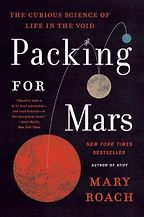
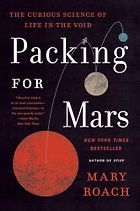
Okay, let’s go on to the last book you’re recommending, which looks like it’s very funny. It’s called Packing for Mars, the Curious Science of Life in the Void by Mary Roach. Tell me more.
Of these books, this one and Panek’s book are the ones written by non-scientists who are both particularly talented writers. The theme of Roach’s book is ‘How does gravity, or the lack of it, affect us as humans?’ So in Packing for Mars, she tries to get you to understand the physical and psychological impacts of going into space on humans. What does space travel do to your bones, your heart, your brain? What is it like to defecate in space? Have people had sex in space? She finds answers to lots of these questions, but not all. Some of them are personal enough that folks at NASA aren’t inclined to discuss them.
Packing for Mars is not the type of book you want to read as you’re eating. A lot of the sanitation issues, for example, are pretty grotesque. ‘What is it like to defecate in a plastic bag while floating in zero g?’ is not a question I would ask someone who’s been to space—but Roach does, and we get a great deal of uncomfortable, but fascinating, detail.
Are you keen to go to space?
I probably was more keen to go to space before I read Roach’s book. It sounds absolutely horrible, to tell you the truth. I love to learn about it, but I don’t know that humans belong in space when you see how challenging it is to survive even for a matter of days—and certainly for the people who are up there for years. We evolved with gravity, and that’s the way we work best. Everything seems to be slightly off kilter when you get into space and try to do without gravity.
That’s partly why I called the book Crush. I’m fond of gravity. Sure, it can kill you if you don’t respect it. But I prefer living with gravity down here. I’ll let other people get on without it in space.
Five Books aims to keep its book recommendations and interviews up to date. If you are the interviewee and would like to update your choice of books (or even just what you say about them) please email us at [email protected]
Five Books interviews are expensive to produce. If you've enjoyed this interview, please support us by donating a small amount.