Taiwan is a crucial lynchpin of the high-tech global economy, but its international political position is far from stable. China has explicit ambitions to incorporate it into the Chinese state and seems intent on building the military capacity to do this by force. The US is committed to preserving its de facto independence. For the moment, there is a stand-off, but a crisis over Taiwan would be a crisis for the world, politically and economically. Eyck Freymann, a fellow at the Hoover Institution, recommends five books to help understand the dynamics of the situation and the possible outcomes.
Before we get to the books, can you explain why the security situation in Taiwan is so important and why it is so dangerous?
Taiwan, as we know, manufactures 90% of the world’s advanced semiconductors and 99% of the most advanced NVIDIA GPUs that train the cutting-edge AI models. Geographically, it’s a key link in the first island chain, which hems China’s navy in close to its shores and prevents it from spilling out into the wider waters of the Pacific.
It’s also more broadly about the sort of century we want to live in. Taiwan’s ambiguous status has held for the last 50 years of US-China relations, and if China chooses to break from this and upset peace and stability in the region by force, US-China relations will never go back to where they were. There will be a cascade of geopolitical consequences as allies globally rethink their alliances with the United States. There might be nuclear proliferation.
So there’s no way for the United States to escape catastrophic consequences should Taiwan fall by force or through coercion. The goal should therefore be to deter a devastating war with China, but also maintain an honourable peace in which Taiwan is free to negotiate this unfinished business of the Chinese Civil War, free of force or coercion and in a way that’s democratically acceptable to its people.
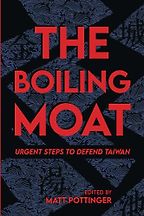
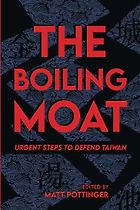
Matt Pottinger is a former Deputy National Security Advisor, a former Marine, and a Chinese speaker. In the book, he assembles an impressive array of analysts from across the United States and allied countries to tell us why Taiwan matters, and what the United States, Taiwan and other allies and partners can do to shore up military deterrence. In particular, the book is exceptionally strong at explaining why Taiwan falling by force or coercion would be so bad. It gives the clearest articulation of what the division of labour would be between the US, Taiwan and partners in a military contingency. It provides a raft of really specific, actionable and feasible steps that each of the players can take. It’s exceptionally lucidly written as well.
What would US involvement in defending Taiwan look like?
Beijing has many options for moving against Taiwan, and not all of them involve an amphibious invasion. Another option is blockade, which can be prosecuted with varying degrees of severity. Another is what I call a quarantine, or others have called ‘indirect control,’ which is an effort to take control of who and what comes and goes from the island. That might be branded not as a military operation, but rather as a customs or law enforcement operation.
China also has a range of capabilities to bombard Taiwan with missiles, with drones, or to use plausibly deniable, ‘civilian’ vessels to harass Taiwanese vessels or ships coming in and out. Any of these options Beijing can use in a modular way, in combination, or in sequence. The Boiling Moat focuses on the amphibious invasion scenario, which, in a sense, is the hardest and most obvious scenario. If you can take that pathway to victory off the board, you can argue that creating any kind of crisis makes less sense for Xi Jinping.
Taiwan is a very difficult target—geographically—to take through an amphibious invasion, because the Taiwan Strait is a nasty body of water, but China is doing everything that it would be doing if it wanted the capability to do that and do it soon. So the question of how we organize and train and equip ourselves to defeat such an operation is something that I think deserves careful attention. Ivan Kanapathy, now senior director for Asia on the National Security Council, has a chapter on this in the book. So he’s the man in the US government directly responsible for coordinating with Taiwan on this, which is a sign of the book’s authoritativeness and credibility.
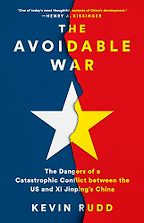
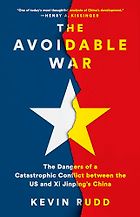
Kevin Rudd is a former Prime Minister of Australia, ambassador to the United States, and also foreign minister. He’s a trained Sinologist who speaks exquisite Chinese, and therefore got to know Xi Jinping in a way that few other foreign leaders have, and no other Anglophone foreign leader has.
The book is essentially an accounting of the last 15 years of US-China relations from the vantage point of Washington and Beijing, and it’s inspired by or informed by Rudd’s several hours of one-on-one conversations in Chinese, in informal settings, with Xi Jinping, through which he gleaned insights into Xi’s worldview. The book shows how the same pattern of facts has been interpreted or can be interpreted so differently in Washington and Beijing. We think that the history of what has transpired between our two countries in the last 15 years is obvious, and there’s only one way to read it. Rudd busts that narrative comprehensively.
Does he set some alternative up in its place?
Briefly, but the main point of the book is to understand the divergence in perception. He says it is an avoidable war, but it will not be avoided if we fail to have ‘strategic empathy’ for the other side’s perceptions. That doesn’t mean you have to agree they’re correct, but as an empirical matter, you have to understand how your counterparty sees the world. Xi Jinping has a view of the world informed by his own upbringing, his own rise to power, his own Marxist-Leninist ideology, promises that he believes were made and broken, and responsibilities that he believes he has to the Chinese people and the Communist Party.
I included this book, as well as the Tsang and Cheung book, because ultimately, Taiwan deterrence is not a question of deterring a country or even an organization. It’s about shaping the decision calculus of a single man, and Rudd knows that man better than any other Western leader.
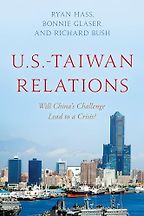
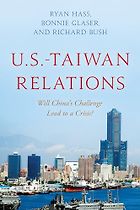
This is the one-stop shop to understand how US policy towards Taiwan has evolved over the past half-century. Richard Bush is a sort of god of US-Taiwan studies in the United States. He’s right now a non-resident Senior Fellow at Brookings, but for many years he served as the Chairman and Managing Director of the American Institute in Taiwan, the de facto embassy, and for decades he has been one of the primary advisors to presidents and diplomats who want to understand what our One China policy actually means.
The One China policy is unique in American diplomatic practice. It takes a long time to recite, as there are many explicit and implicit layers. To understand how flexible it is, how it can and cannot be reinterpreted, how it can and cannot be re-communicated, you really have to understand how it has been shaped through history, through crises both famous and less famous, not just with Beijing but also with Taipei. The US and Taiwan are democratic, open societies, and they are responsive to signals from one another. This book is not just a primer on the political history of Taiwan, but it shows how the US and Taiwan are so responsive to each other.
Broadly, what does the One China policy from the US side mean, and how does it differ from the One China policy that the Chinese think they’ve got?
So the US has a One China policy. Beijing has a One China principle. Beijing’s One China principle has three parts. There’s only one China in the world. The CCP regime, based in Beijing, is the only legitimate government, and Taiwan is a part of China. That’s that.
The US One China policy, we would say, is guided by the three joint communiqués, the six assurances and the Taiwan Relations Act. So you can already see how it’s a policy that has emerged through accretion. The three joint communiqués, signed between 1972 and 1982, were the three major diplomatic agreements on the basis of which the United States and the PRC can have a relationship. They include a number of promises made, both explicit and implicit, and some of the key language is translated differently in English and in Chinese, which allows each side some flexibility to claim that the other has said things that the other side wouldn’t say that it has said.
This is a recurring feature of this issue in cross-strait relations. There’s something similar called the ‘1992 consensus.’ The Taiwanese can’t agree on whether such a thing even exists, and if so, what it means.
But the core idea of the One China policy is that the United States does not take a position on Taiwan’s status. It does not affirmatively support Taiwan independence. It believes that the status of Taiwan is something to be worked out peacefully through diplomacy, without coercion, between Beijing and Taipei, and that any unilateral attempt to resolve that issue by force or coercion would be a grave threat to peace and stability in the region, and therefore to the United States.
So that’s the basic idea—any outcome should be freely agreed to and acceptable to the people of Taiwan. Those commitments to Beijing are counterbalanced by six assurances made to the Taiwanese under the Reagan administration, which essentially boil down to: we will not negotiate about you without you; we will not force you into negotiations from a position of weakness; there is not, and there will never be, pressure from us onto you to negotiate your autonomy away.
Then the Taiwan Relations Act, which was passed in 1979 by Congress, makes a number of commitments that say, essentially, we will treat Taiwan de facto, though not de jure, as a state in pretty much every aspect of relations other than the military. We will deliver their mail. We will treat them as an autonomous economy that can make its own trade deals. We will issue visas. Moreover, it expresses the sense of Congress that if Beijing tries to change this situation through force or coercion, including economic coercion, we will regard it as a grave threat to our interests.
Zooming out, the basic idea is dual deterrence. You’re deterring Taiwan from unilaterally declaring independence, going from its current ambiguous state to a formal declaration of independence, and you’re deterring Beijing from attacking or using equivalent methods of economic warfare. The idea is, then, if either side threatens to disrupt that status quo, you can remind them that we may adjust our policy or clarify our policy in a way that would be disadvantageous to them.
You mentioned that the military was excluded from that agreement. Does the US have a military relationship with Taiwan?
This is one of the aspects of the policy which is established through norms and precedent, rather than explicit commitments. In the third communiqué, we made commitments about arms sales to Taiwan. The third communiqué promised to wind down arms sales to Taiwan over an unspecified period, but it implied that restrictions on US arms sales to Taiwan were contingent on China’s continued restraint. So as a matter of custom, the US won’t send active duty military to Taiwan, but we will send what I like to call ‘burly English teachers’ who may or may not be able to give very specific advice on how to organize, train and equip Taiwan’s armed forces. It has been publicly disclosed that the number of such military advisors on Taiwan has increased by an order of magnitude in recent years. So the last number that was revealed was several hundred of them.
I think it’s appropriate, given all the ways that China is trying to change the status quo through salami slicing, for the United States to push back by reinterpreting its own limitations under the communiqués to create a balanced situation overall. But both sides, of course, point to the other and accuse it of salami slicing its way to change the status quo.
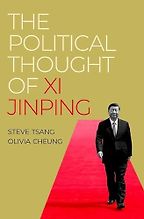
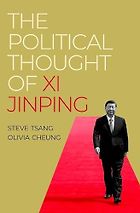
This is an absolutely extraordinary book, which is just a model of contemporary Sinology done well. The authors are based at SOAS. Essentially, they close-read the entire canon of material that Xi Jinping has put his name to since taking power, which is voluminous because ‘Xi Jinping thought’ has opinions about a whole lot of things, from ethnic harmony and ethnic minorities to the environment to the rule of law to foreign policy. They read through and across this body of sources to paint a picture of his political worldview, where he wants China to go, his vision for the governance of China and his ideas about the place of China in the world.
There are a couple of operative concepts that emerge from that book. One is his concept of national rejuvenation, which is the overarching idea for what he’s trying to do by 2049, the 100th anniversary of the founding of the PRC. What comes through in the book is the scale and scope of ambition in that vision.
Taiwan plays a role, and the discussion of Taiwan in the book is, I think, masterful because it shows how Taiwan is connected to and is inseparable from all of these other goals, which include making China technologically advanced, economically self-sufficient, domestically harmonious and culturally confident. So Taiwan, in a sense, seems to be the keystone in the arch of national rejuvenation, but it’s not the same as national rejuvenation itself.
This book has had a deep impact on my thinking, and I cite it multiple times in my own book, because if you want to deter Xi Jinping, you have to show you can hold at risk things that he cares about. And this book tells us, better than any other, what he cares about.
You’ve mentioned the big picture issues around national rejuvenation, economic security, technological advancement and so on. Are there other more narrowly focused things that he cares about, like his own political survival? And does he have some sort of ideology underpinning what’s going to deliver all these things?
What’s interesting about the book is that, amidst all of this scope and scale of ambition, he doesn’t articulate any sense that there are trade-offs between these different goals. He wants it all. He wants every gold medal at the Olympics and every silver medal and every bronze. That speaks to his confidence and ambition, but it also speaks to his insecurity and vulnerability, because when you promise that much, there are consequences if you fail to deliver, not by a little, but by a lot, across many domains, and it’s hard to see how China can accomplish all that by 2049.
There’s more beyond the things I listed. There’s reshaping international institutions and global governance to be more favourable to China’s system of government and values. It essentially involves redefining the concepts of human rights and rule of law and democracy in the world to make the world a safer place for China.
It has to do with the reform and flourishing of China’s institutions in every aspect of life, including the social system. Domestic harmony of every kind, peace and tranquillity at home. But if you’re refusing to stack-rank your priorities, to say that the following things are more important than others, potentially you can be deterred if you’re presented with very hard choices. That’s my takeaway.
Is Taiwan a very populist issue in China? Is it something that Xi Jinping can up the ante on in order to whip up support for himself, or does it not really work like that?
Taiwan has been the single most salient propaganda issue for the CCP since it took over the mainland in 1949, because Taiwan represents the unfinished business of the Civil War.
Taiwan proves that the CCP’s claim that Chinese people are not ready for democracy is a lie, because Taiwan is not only a thriving democracy—a freer society than France or the UK or the United States, according to Freedom House—it’s also technologically advanced. It’s far wealthier than the mainland.
It maintains a society that is deeply Chinese in many respects, but also enjoys so many advantages that citizens of the PRC do not have. It’s a living, breathing challenge to the CCP’s legitimacy.
With that said, the CCP historically has shown that it can dial the propaganda up and down depending on domestic circumstances and other factors, in the same way that they can dial propaganda against Japan and the United States up and down. So there are some who argue China is a peaking power, that actually their best days are behind them. The growth engine has sputtered and it’s all downhill from here. Therefore, there is a risk that Xi Jinping, out of desperation or domestic pressure, might try to wag the dog with a crisis over Taiwan. I don’t think you can rule that out, but as I discuss in my own book, I think that’s quite unlikely.
This idea of China as a peaking power, which is articulated in a very interesting set of articles and books by Michael Beckley and Hal Brands, is deeply thought-provoking. I’m actually sympathetic to their argument, but I think the Tsang and Cheung book proves pretty comprehensively that that’s not how Xi Jinping sees the world. His worldview is just confident by nature, and I don’t think it can be spun in a less confident way.
Despite the paranoia and the insecurity, I think it’s very easy—as we also see from Kevin Rudd—for Xi Jinping to look around the world and see the advantages of the Chinese system, of the CCP system, and therefore to believe that China’s best days are still ahead.
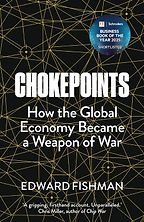
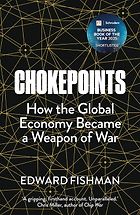
This book is a history of how the United States learned to weaponize the role of the dollar in the global financial system to achieve geopolitical goals.
Eddie is a former US government official who was one of the architects of the sanctions on Russia and Iran. He’s also a terrific storyteller who interviewed all the key people, and it’s just a yarn of how the United States, in the post-Cold War moment, especially through the War on Terror, realized that it had this monumental financial power that it had acquired almost by accident.
A number of things come through in this book which I think are really relevant to understanding American power today and the way that a US-China conflict might unfold. The first is how much American financial power has emerged through improvisation rather than design. The second is adaptation against it on the part of all the authoritarian powers who either have been targets of it or who fear that they might be targets of it in the future. By the end of the book, you already see the emerging anti-sanctions coalition with Russia, the most prominent player, but really coordinated behind the scenes by China to try to build resilience to that financial sanctions playbook.
Eddie has written really cogently, both in this book and elsewhere, about how, despite the fact that this is the perfect weapon that can impose immensely asymmetrical costs on an adversary, there are still real limits to the American public’s willingness to accept economic pain to punish bad guys. This raises profound questions for deterrence against China and Taiwan, because we began this conversation by talking about Taiwan’s centrality to the global electronics supply chain. There can be no AI without Taiwan. But also, if a crisis over Taiwan forces a reset in the US-China relationship, that is an economic shock far more devastating than what we’re seeing in Hormuz today, or that we saw after Russia’s full-scale invasion of Ukraine.
It raises the question: yes, in principle, the United States has these formidable tools of economic punishment that it could use against China. But is China just too big, too important, too central to global value chains to target with those tools? Would the collateral damage simply be too great?
Eddie ends the book by throwing up his hands and asking, ‘Is this playbook, which worked pretty well against Venezuela and Iran, where we saw the limits against Russia, actually going to work against China, an economy ten times Russia’s size?’
My own answer is no. I think that these threats have some value in the same way that nuclear threats do, but they really are much less effective because economic mutually assured destruction isn’t a thing. The way we should be thinking about the Taiwan crisis scenario, from an economic point of view, should be less about punishing China and more about how we would protect our own interests and restructure the international economic system if relations with China broke down. It would be a monumental economic shock. There would be no going back, and the tools that we have come to rely on in this post-Cold War moment might not be the tools we would want to use.
Eddie has shown us essentially the ingenuity involved in building and applying those tools, but maybe we need to be even more ingenious and think even more creatively.
Finally, tell us about your book, Defending Taiwan. What part of the story are you filling in?
I’m drawing on all of these books as well as others. The goal of the book is to chart a strategy to prevent a devastating war and preserve an honourable peace. An honourable peace means a peace where China can’t coerce its neighbours by threatening them with starvation.
I think China’s preferred plan of action against Taiwan is going to be political and economic. It’s going to be an economic strangulation through incremental steps to take control of who and what comes and goes, alongside political pressure to break the will of the people of Taiwan to resist and to break the will of the US and its allies to hold together. So my book tries to articulate how the United States and its allies can draw on every aspect of their national power and link them together to deter China from testing us in that way. A big piece of the puzzle is showing that we have an economic contingency plan for what happens if China takes us to the brink of disaster over Taiwan. I think Taiwan’s fate is more likely to be decided through a crisis than a war. So our strategy should be to deter the crisis, not just deter the war, and also prepare for both.
Five Books aims to keep its book recommendations and interviews up to date. If you are the interviewee and would like to update your choice of books (or even just what you say about them) please email us at [email protected]
Five Books interviews are expensive to produce. If you've enjoyed this interview, please support us by donating a small amount.
Eyck Freymann
Eyck Freymann is a Hoover Fellow at Stanford University and a Non-Resident Research Fellow at the U.S. Naval War College's China Maritime Studies Institute. He previously held fellowships at Harvard and Columbia, and holds degrees in history and China Studies from Oxford, Cambridge, and Harvard.
Eyck Freymann is a Hoover Fellow at Stanford University and a Non-Resident Research Fellow at the U.S. Naval War College's China Maritime Studies Institute. He previously held fellowships at Harvard and Columbia, and holds degrees in history and China Studies from Oxford, Cambridge, and Harvard.