It’s a bumper list this year, full of big-hitter names and innovative titles. It leans gothic and dark, but nothing here is easily put into a single box. We’re in for a treat.
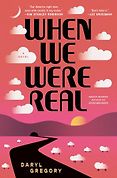
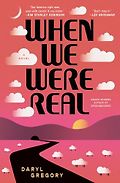
First, we have Daryl Gregory’s When We Were Real, for fans of The Matrix and/or The Canterbury Tales. The premise: seven years ago, we were all politely informed that the world is a simulation. A motley crew of tourists are now gathered on the Canterbury Trails bus tour to see the ‘Impossibles,’ the marvellous phenomena created by simulation glitches. Two old friends facing a diagnosis are at the heart, but there’s also a questing nun, an influencer on a mission, a professor on the run, and more… It’s an ensemble piece. A glowing Kirkus review notes that “the people in this novel, and not the bizarre phenomena they’re observing, are the most fascinating part.”
When We Were Real is also a finalist for the Locus this year, and Gregoy’s earlier novel We Are All Completely Fine won the World Fantasy and the Shirley Jackson. Reading When We Were Real, you will be in the safe hands of a genre-hopping, powerhouse writer.
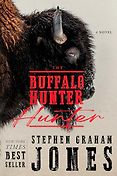
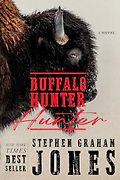
Next on the list is The Buffalo Hunter Hunter, by Stephen Graham Jones. The audiobook has already won two major audiobook awards for best horror, so if you like to listen to your books, this comes highly recommended.
This is a vampire novel, but not like any you’ve read. These immortals must take the form of the creature whose blood they drink. And the blood-drinking Good Stab, a Pikuni man born in 1833, is here almost a century later to right historical wrongs. The story centres on the 1870 Marias Massacre, weaving true historical events into the fantastical account.
Daniel Kraus of the New York Times thinks it is “very likely Jones’s masterpiece” – no small praise for an author already racking up several major awards. As Katherine Arden told us when she chose it for her top five picks, “It’s a horror novel, it’s bloody, it’s fantastical, it’s vengeful. It’s wonderfully written. It’s very complex, and very heartfelt.”
Third, we have a previous winner back with a new title: R. F. Kuang returns with Katabasis. Two PhD students must descend into hell to rescue their irascible – but enormously influential – supervisor, or lose their coveted recommendation. He has got lost there in a magical-academic experiment, and the hell he descends into is packed with references to other literary descents. A maximalist feast for dark academia fans.
Kuang has studied at Oxford, Cambridge and Yale, so she knows what she’s talking about when it comes to the hellish parts of academia – and she also knows her literary precedents. But critics have praised the novel’s humour too. Writing for NPR, Gabino Iglesias notes that “what makes this novel shine is the way it is happy being goofy, playful, and campy but then doesn’t shy away from being deep, smart, well-researched, innovative and surefooted.”
If you loved Yellowface, Kuang’s novel about a writer, Iglesias thinks it’s even better. If you loved Babel, Kuang told Elle, “I like to think of Babel and Katabasis as two parts of a dark academia duology. There’s no continuity in terms of characters or plot or anything, but they’re both examinations of the university and its problems—and the really weird type of person who decides to stay in academia anyway.”
This brings us nicely to Death of the Author by Nnedi Okorafor: a book that begins in academia and moves to the publishing industry, so perhaps one to pair with Kuang. Zelu is fired from her job as a writing professor and is facing the repeated rejection of her literary novel; despairing, she finds herself writing a sci fi novel which becomes wildly successful. This creates its own troubles, from her new struggles with fame to her ongoing relationship with family.
This has been widely described as a move to ‘mainstream’ fiction from a leading sci fi light. The extracts are far-future sci fi, but the developments in Zelu’s own world are more near-future – enabling her greater mobility, for example, as she is paraplegic.
This book has scooped the hat trick of sci fi nominations, being a finalist for the Nebula, the Hugo and the Locus this year. It’s already won the NAACP Image Award for fiction and the Libby award for science fiction. And this is another one to consider consuming in audiobook form, recommended to us by Audiofile editors as a best of 2025. Gary K. Wolfe, of Locus Mag, describes it as “one of her most revealing, deeply felt, and insightful novels to date.”
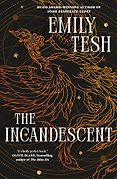
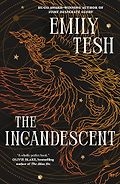
Emily Tesh’s The Incandescent is the only other book to appear on both the Nebula and Hugo shortlists this year. It’s more dark academia, this time at a school where teens are learning magic, which in this world is a cultural cachet subject sure to play well with Oxbridge. On the downside, it also involves messing with the demonic plane and its hungry inhabitants. The twist: our protagonist isn’t one of the students having their coming-of-age years, but their teacher, Doctor Walden. She is responsible for their education – and also for their risk assessments.
Tesh is a teacher herself, so it was important for her to see teachers in a magic school actually doing their safeguarding job for once, as she explains to Nerds of a Feather. And this means she has all the humour and frustrations of reality to draw on – as she told Locus Mag, “I had all these staff-room jokes stored up, I had all this observational comedy that I finally had somewhere to put.”
Tesh has previously won both a World Fantasy Award and a Hugo. This year’s list is full of big-hitter names.
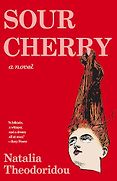
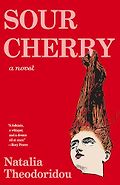
This makes it all the more impressive to see a debut here: Natalia Theodoridou’s Sour Cherry. While it’s a debut novel, Theodoridou is no stranger to the major awards, as he already has a Nebula for game writing and a World Fantasy Award for short fiction. Small wonder, then, that his novel was a “most anticipated” pick for the Chicago Review of Books: editor-in-chief Michael Welch describes it as “a modern fable masterpiece.”
The novel re-tells Bluebeard, the serial wife-killer most famously recorded by Perrault in Tales of Mother Goose. The chorus of ghostly wives weave in with a real-world narrator, and as the novel goes on, they multiply. Theodoridou told Mary Robinette-Kowal, “The wives proliferate. They repeat, they rhyme, they become increasingly fantastical, metaphorical, symbolic, their stories muddled and impossible. These chapters are my favorite bit of this book… But there’s always something different, too, the crucial detail that makes each one of these stories unique, each wife uniquely vulnerable, trapped in some new way. People often ask of survivors, ‘Why didn’t they just leave?’ There are so many answers.”
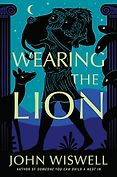
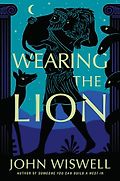
And finally, a second mythological retelling: John Wiswell – also the winner of a past Nebula and Locus – returns with Wearing the Lion. Another interesting pairing – Sour Cherry looks at toxic masculinity, and Wiswell deliberately sets out to model something different, as he explains to Split Lip Magazine. This telling paints a Hercules who has been realistically affected by the death of his children, and who befriends his monstrous foes; a Hercules “with a rich emotional life, whose greatest strength isn’t inherited from Zeus, but lies in his network and caring for others.”
Wiswell has already earned his reputation telling stories with both humour and heart, and is sure to be a loveable guide for this superficially familiar tale.
June 2, 2026. Updated: June 6, 2026
Five Books aims to keep its book recommendations and interviews up to date. If you are the interviewee and would like to update your choice of books (or even just what you say about them) please email us at [email protected]
Five Books interviews are expensive to produce. If you've enjoyed this interview, please support us by donating a small amount.