Thank you for talking to us about the six-book shortlist for the 2026 Bollinger Everyman Wodehouse Prize for comic fiction. I wonder: is judging humorous writing unusually difficult?
Yes, I think there is a difficulty. I guess what different people find funny or ‘comic’ is pretty subjective. It sounds a touch grave to say that it feels like a responsibility, but it is. We were all trying to come to these books with as open a mind as possible about the varieties of humour that we might encounter. We, as a panel, were looking for books that would make us laugh out loud, but were were also open to those that made us smile or raise an eyebrow, which plunged us into the absurd and grotesque, or the dry and the wry…
Also, crucially, we wanted books that were exceptionally well-written. My own acid test for any really great book – particularly a great comic or joy-giving book – is that I want to press it into the hands of someone who, say, tells me they are going into hospital and need something good to read. Maybe that sounds vague, but these were the rough ingredients of the recipe we were looking for.
A funny book is not the same thing as a light read. They can be both, but a great funny book should still be a quality book.
That’s right. And when I look at the shortlist from this year, that comes through.
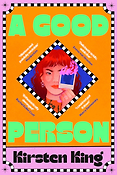
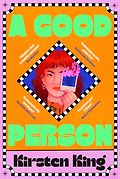
Let’s look at those books, one at a time. Can we start with A Good Person by Kirsten King? It features a modern-day hex.
I love this one. Here’s the plot. The heroine of this book breaks up with her boyfriend, who she spent quite a lot of time getting. She also works for a marketing company, and through her work encounters the ‘Wellness Witch’, a social influencer, who gives her the tools to put a ‘hex’ on her ex.
It’s very filmic – King is a screenwriter, and you can tell. I think what stands out in this one is the voice. It’s so good, full of very funny one-liners, which are integrated beautifully. It’s also a page-turner.
The title is A Good Person, and it is very thoughtful about ethics, carried with a light touch. It makes one think about what that means, to be a good person, and what it might be like to want to hex someone, and what to do with shame when things get out of control.
Then all of that is played through a sort of millennial angst about paying rent and having roommates. It’s a gorgeous piece of work: quite dark, very funny.
It’s a classic combination. Comedians are famously troubled. Is there a thread of darkness running through all of the books?
In many of them, yes. There’s quite a lot of trauma and darkness to negotiate in this list. But what the books have in common is that while the dark recesses of the soul might be pondered or traversed, the joke always lands at home. The thread these books have in common is that the comedy is entwined with kindness. They certainly don’t punch down.
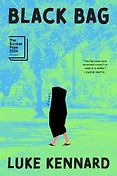
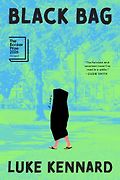
Luke Kennard’s Black Bag also featured on the Booker Prize shortlist, which I was delighted to see. I think it’s great. Why did the Wodehouse Prize judges admire it?
Well, it made us all laugh out loud. That’s the first thing. I don’t know if that is the most important thing to say about it, but for this prize it is very important. It’s not a book that is safe to read on a train because you will spill your coffee. And, actually, there’s a fantastic scene involving a coffee mishap—
Yes!
It’s a really, really funny book. So the scenario is based on a real-life psychological experiment where a professor hired someone to wear a large, leather, full-body black bag around the campus of a university to see what happened. So that is clearly completely absurd. The person in this book who is performing as the black bag is a failed actor, and this ‘part’ becomes his starring role. We admired the huge comedy of the novel, but in its construction, Black Bag has really thought through this comic scenario and what it can tell us about what it means to make art, and what it is like to be a human being.
Again, this is a book that does not laugh at anyone, but rather at the predicament of what it means to be human. We also loved the physical comedy. The tiny details. The actor wearing the black bag immacs his lower legs to make sure that no one can work out whether he’s male or female. And he talks brilliantly to the visceral feeling of wearing hot, black leather. There are also interesting themes which emerge around another character who makes a living through livestreams and cryptocurrency. So this book makes us ponder the relationship between the virtual and the material.
It’s a very clever book, but with great humour. You’re physically wincing as you read. It’s masterly.
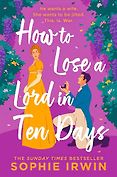
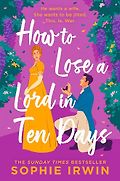
Well, we have a very different book up next. This is How to Lose a Lord in Ten Days by Sophie Irwin. It’s a Regency rom-com. Tell us more.
One thing I want to highlight about this book is that it is gorgeously reflexive. It begins with the heroine reading a novel. The title too, is a riff on How to Lose a Guy in Ten Days, the Kate Hudson and Matthew McConaughey film.
Plotwise, it’s a Regency comedy in which both members of the couple are trying to break off an engagement, but modernity keeps poking its nose through the pages. You get a sense, almost, that they are wearing sneakerinas under their muslin frocks. It’s an enjoyable historical novel, but also a comedy about what it means to write historical fiction. It’s clever and quite delicious – probably the lightest book on the list.
I did want to give a shout out to some of the period descriptions: There’s a moment when Lydia takes a seat between a beef tremblant and a pigeon à la crapaudine. And there are descriptions of characters galloping ventre à terre, a Georgette Heyer term – if somebody really loves you, they will ride so that their horse’s belly is grazing the ground.
So, yes, romantic, but it’s a story not just about the characters but how we reimagine history. It laughs at, and with us, for wanting to revisit the past.
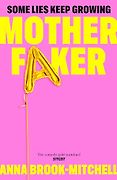
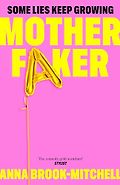
I love that. And the fondness that comes through for the genre itself, and the writers that came before. Mocking can be a kind of flattery. Shall we talk about Anna Brook-Mitchell’s Motherfaker? This novel has a great concept. I’ve heard of fake relationship novels, but fake pregnancy is a new one on me.
Well, if you want a how-to guide, I know now that in order to fake a pregnancy you need a variety of sizes of fake stomachs.
As soon as you say it, I think: Of course.
And you will probably need to bond with these different stomachs by giving them names when you wear them. That would help.
The main character is a teacher, who is becoming increasingly infuriated by the cult of the child in her workplace – the fact that her colleagues keep taking maternity leave or leaving her to do all the work while they attend baby yoga or sports days. Through a variety of circumstances, she ends up pretending to be pregnant. So, it’s a concept driven novel focussing on what happens when a scenario gets out of control. That’s quite intriguing, I guess, because in some ways being pregnant is rather out of one’s control.
Again, Brook-Mitchell is super good on physical comedy. And as you said, we often have plots involving people “passing” for different identity categories. But I’ve never encountered one about passing as pregnant.
But the book does have a core of sadness and anger to it. There is something both hilarious and deeply plangent about someone taping latex imaginary futures to themselves, about conjuring a baby.
It feels quite timely, with the rise of the child-free movement. By taking the idea to a comedic extreme, does it force us to some new thinking on the subject?
Yes. It connects with a great book by Sarah Knott, Mother Is A Verb. I think it does try to remind us – in a light way – that to mother is to nurture, and that this is open to everyone, not the domain of a particular few.
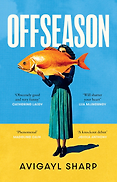
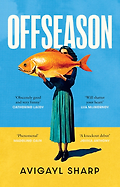
Thank you. Can we talk about the fifth book on the 2026 Wodehouse Prize shortlist? This is Offseason by Avigayl Sharp, a novel set in an all-girls boarding school. This was completely new to me.
So this is wild. Offseason is offbeat, off key. The narrator, heroine, is also a teacher. She’s been hired to cover teach for a term at a private school in a remote town on US coastal seaboard. It’s the off season there, so it’s quite empty, bleak and dark. But I guess the ‘off season’ also reminds us of the theatrical nature of what it means to be, or not to be, acting a role. And there’s a lot of comedy and tragedy in this novel about the roles and games people play. It’s also hugely focused on questions of negotiating trauma, and there’s a biting wit in relation to that.
She’s just dropped out of her PhD, our heroine-narrator, and there are there are some standout comic scenes about teaching. Like when she tries to correct a basic error made by a student, and her charge starts to ‘weep openly. Tears ran from the corner of her eyes down to her mouth, where her tongue flicked out automatically to lap them up’. Our narrator then furiously back-pedals, ‘I quickly tried to think of tender remarks that would make Anita stop crying so that I would not get fired and have to move back in with my parents’. The deadpan comic rhythm of that sentence, which moves from compassion to narcissism gives you a sense of this book.
And I also thought this was an interesting book, politically. It has two ghost texts underneath it: Bleak House – the class set text. And Sharp, like Dickens, is interested in who gets to be a main character and who doesn’t, in the people that cities ‘forget’. Meanwhile, it also has an epigraph from The Prime of Miss Jean Brodie. And there’s a lot, in this novel, as with Spark, about searching for a hero, for a story, for a meta-narrative, to find one’s way.
I’d say that the thing that makes this novel so particularly dark is that you spend all the time in our heroine’s mind. Actually, almost all of these books are in the first person in one way or another, but this is a mind that you’re quite glad to get out of.
She’s described as giving “manic” lectures.
Yes, you’re in the intensity of her thoughts, and those thoughts are, well, messy and full of snot and vomit and sex.
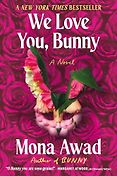
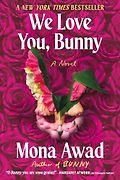
I think that might bring us to the final book on the shortlist, which is Mona Awad’s We Love You, Bunny. It’s described as ‘horror-satire’ which is an intriguing mash-up.
Yes. I’d say dark academia. Donna Tartt crossed with Alice in Wonderland, performed by the cast of Heathers.
I’m listening.
It’s about a group of obsessive MFA students who are holding hostage one of their former cohort. They are all telling their stories. The plot is centrally about storytelling, and in some ways you could see it as a sort of working-out of what Faulkner said about killing your darlings. (And these narrators are all, literally, darlings. They are all concerned with writing and floral prints and satin and nail polish, and they call each other ‘Bunny.’ ) Again, it’s very intense, completely absurd, magical realist.
They’re on a MFA course, and they are all comparing what the professor has fed back on what they have produced and performing their responses to it. One says:
How I cried and cried in the rose garden about his formatting comments. Actually totally inconsolable. How dare he suggest that I change the shape of my story? That I break up my paragraph further? It’s like he’s insisting I change the shape of me or something.
I did love this. Each of the narrators, as they are talking through what has happened, touches on the idea of the writing ego and the idea of inspiration. So I found this absurd and completely unexpected.
The MFA workshop format is ripe for a good comedy of manners.
Yes. And there are a lot of campus novels here on this list. Many of our list were, it seems, drawn to that sense of the closed world and its potential playing out big ethical questions of how we manage to be human and how we connect with other people. In Offseason we have the boarding school; in Motherfaker, she’s also a teacher.
Black Bag is set in a university. Then there’s this.
I was intrigued by that common thread. The campus with its potential for playing out ethical and imaginative questions. In We Love You, Bunny, it’s ego and creativity. In Black Bag, perhaps it’s big questions of how we connect with other people.
Right. In a closed community, you can allow the pressure to build until it becomes absurd. Otherwise, would you offer any other takeaways from the judging process? Did you find it easy or hard to come to a consensus?
There was a lot of consensus in what we were looking for. What I enjoyed about the group was that someone would say, oh, this is funny, and another person would be able to speak to the construction of it – something that explains why it is funny, which you had felt in your heart but hadn’t seen. That’s what I really enjoyed.
In some sense, I think the judging process was not so much one of resolving disagreement but of helping each other shed light on articulating why each book should be on the shortlist. All the books on there are brilliantly written and constructed, and independently we came to the same decisions – and together we were able to justify that.
I do feel these books are friends. They are not rivals, but compatriots. And so in some ways it will just be about deciding which best fits the bill for this prize. We’re a convivial bunch and I know we won’t leave the room until everyone is in total agreement.
Interview by Cal Flyn, Deputy Editor
November 24, 2026
Five Books aims to keep its book recommendations and interviews up to date. If you are the interviewee and would like to update your choice of books (or even just what you say about them) please email us at [email protected]
Five Books interviews are expensive to produce. If you've enjoyed this interview, please support us by donating a small amount.