More than a century after it went down, our fascination with the Titanic shows no signs of dimming, its story told in numerous books and movies—both fact and fiction. Steven Biel, a historian at Harvard, recommends books to read about the Titanic, from early first-person accounts of the disaster to a comprehensive and lavishly illustrated reference guide.
Before we get to the books, can you explain the enduring fascination with the Titanic? What is it about this particular ship and this particular disaster that keeps gripping people over 100 years after it happened?
Part of it is that it is an industry. It’s a kind of perpetual motion machine now that just keeps going. Whenever it seems to be fading away, there’s a new anniversary, or there’s another expedition—or, recently, a failed exploration, a new disaster to add on to the initial disaster.
When the first edition of my book came out in the mid 1990s, it happened to coincide with a Broadway musical and then the Cameron film. So everything Titanic hit a new high point. How the story of the Titanic was told in the 1990s, of course, was very different from how it was told in 1912. Changing contexts shape how the disaster is remembered at different times.
If you ask real Titanic buffs what keeps it going, to a lot of them, I think it’s that there are things that are just never going to be known about it, so there’s always room for speculation. There’s also always some new story, or some new path, or some passenger story that hasn’t been told, or some survivor’s letter surfaces, or some previously obscure detail.
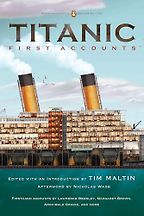
Let’s get into the books. First up is Titanic: First Accounts by Tim Maltin. What does this one tell us about the disaster?
Maltin’s book came out around the 100th anniversary, 13 or 14 years ago, and, as the title suggests, it’s an excellent collection of early attempts to report on and understand the disaster. It starts with two of the first books written by survivors. One is an excerpt from Lawrence Beasley’s The Loss of the Titanic and the other is a republication in full of a book called The Truth About the Titanic by a first class survivor, Archibald Gracie. Then it goes into some excerpts from the British and American inquiries into the disaster from 1912, newspaper reports, and other survivors’ recollections. It’s a really well put together collection, and gives you a sense of what people were saying about the disaster at the time.
One of its limitations, oddly enough, is that it tends to emphasize reports that were more balanced and accurate. To me, as a cultural historian, it’s often the apocryphal stories told about the disaster, the more outrageous stories, that hold interest for what they might reveal about how people reflected on it and understood it at the time.
Maltin’s collection consists largely of sober accounts—with a few exceptions—and he is up front in saying that he chose the first accounts that stand the test of time. To me, the best of these, and the best extended survivor’s account, is Lawrence Beasley’s The Loss of the Titanic. Beasley was a second class passenger. He was an English school teacher. What’s remarkable about it is how calm a reflection it is—so soon after what he endured in the disaster. A lot of initial reporting and survivor accounts are understandably highly emotional, overblown, and laden with purple prose.
Beasley’s is a measured account that tells stories about heroism and about some less admirable behaviour. By and large, it is just a straightforward retelling of what he saw. He was a talented writer, so his description, for example, of what the sky looked like, that he’d never seen stars like that as he was watching the ship go down from a lifeboat, is really beautiful. There are a number of similar passages.
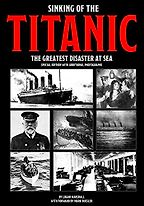
Let’s move on to The Sinking of the Titanic and Great Sea Disasters by Logan Marshall.
Marshall’s book is the opposite of sober. It reports every crazy story imaginable. Marshall’s real name was Logan Howard-Smith. He was a hack writer from Philadelphia. He liked to churn out books in no time at all about newsworthy events. And so he threw this one together, and he based it on anything he could find. Any news report, no matter how unsubstantiated and fantastic, including the story of a Newfoundland dog that supposedly swam for three hours to guide a lifeboat to the Carpathia, the rescue ship.
But what I find most interesting about it is the ways that it echoes the main version of the story that was told in the American press—and I think to a large extent the British press—at the time, which is the story of first-cabin heroism, of ‘women and children first.’ He celebrates what he and many others at the time called ‘Anglo-Saxon heroism.’
To contrast with that heroism, he tells a story of two wireless operators, working as long as they could to get messages out, calling for help. When the surviving wireless operator told the story, he said that they were disrupted by a crew member who tried to steal the other operator’s life preserver. According to his story, which he embellished a bit at a later date, they knocked out this thief. In Marshall’s hands, the intruder becomes a ‘negro stoker’. And instead of knocking him out, they actually kill him. They lynch him. And so it becomes a story in which the villain of the Titanic is described in racist terms.
That then connects to some curious things. When I was first getting into this, I was wondering why Leadbelly would have written a song about the Titanic in which the heavyweight boxer Jack Johnson wants to get on board and gets refused passage by a racist captain, and then celebrates because he isn’t there when the ship goes down. The refusal to let him board the ship ends up keeping him alive. Why would there be a black American folk song about this? But, then, when you see stories like the one that Logan Marshall told, celebrating the lynching of a fictional black stoker, you get a sense of how the Titanic resonated with the racial tensions of the time and why there would be this extensive black folk tradition of Titanic songs and spoken-word poems.
Does the social history of the Titanic throw up a lot of contested narratives about the benign or evil effects of racial and social hierarchies?
There was a standard narrative at the time, and it doesn’t really even matter what newspaper you’re talking about. This was in everything from the New York Times to the more scandalous papers. You get this story that the rich and famous men of the first class had a monopoly on heroism, and that there were ‘swarthy’ steerage passengers rushing the boats, who had to be ‘shot down like dogs’ in a phrase that appeared all over the place. Another apocryphal story had Archie Butt, who was an aide to President Taft, and a first cabin passenger, shooting down rampaging Italian men who were trying to save themselves ahead of even their own women, the women of steerage. This standard narrative insisted that women-and-children-first and chivalry was a class and racial characteristic that wasn’t shared by the people who inhabited steerage.
Obviously, in the immigrant and socialist press, in the black press, and in the feminist press, you get a very different version of what went on and the implications. The way that any number of anti-suffrage voices held up the Titanic as evidence that women shouldn’t agitate for the right to vote because they were best off accepting the chivalric protection of men is remarkable, and this didn’t go unchallenged by suffragists.
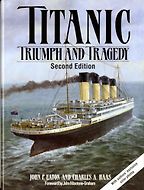
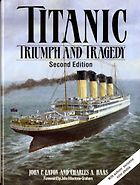
Book number three is Titanic: Triumph and Tragedy by John P. Eaton and Charles A. Haas. What story does this tell?
For me, this is the indispensable reference book on the Titanic. It’s enormous. It’s lavishly illustrated. The index alone makes it essential. Eaton was a self-described New York bohemian whose day job was working at a hospital in Manhattan. Haas was a high school teacher in New Jersey. They were both early members of an organization called the Titanic Historical Society, which was initially a small group formed in 1963 of Titanic hobbyists. Eaton and Haas made themselves into two of the world’s foremost experts on the Titanic.
The book was originally published in the late 1980s, then in a revised edition in the late 1990s. Its chronology extends far backward and forward from the night of the disaster. It starts with the founding of the White Star Line and goes all the way through to Robert Ballard’s discovery of the wreck in the 1980s and beyond to some of the salvage expeditions.
I especially like it because I can never keep track of facts about the Titanic. It’s not my approach to the subject. I didn’t get into this as somebody who had a mastery of all things Titanic. I still sometimes might mistakenly forget that Lowe was the fifth officer instead of the fourth. So anything like that that you want to know is there, and it’s got an appendix that lists all of the passengers.
For me, its narrative aside, it’s just an extremely useful resource. The range of photos is stunning. There are photos of passengers, photos of the ship itself under construction, photos of the lifeboats, plans, menus, the wreck site, pretty much anything about the Titanic you could want. I got into this subject before it was all over the internet. It was especially useful back then. But it’s still incredibly valuable as an exhaustive collection of reliable information in print in one place.
Next up is Beryl Bainbridge’s novel Every Man for Himself. Why have you chosen this one?
I wanted to include a novel, because fiction can do things that a straightforward historical narrative can’t, no matter how deeply and widely researched. You can’t really get at what people were thinking and feeling at the time, in the moment as the event was happening. Bainbridge’s book takes an event that we know a lot about—and even if we don’t know a lot about it, we know what the end of the story is. We know that the ship goes down but Bainbridge manages to build mystery and intrigue into it. It’s narrated by a protagonist named Morgan, a young relative of JP Morgan, who has done an apprenticeship at Harland and Wolff, the Titanic’s builders. He’s kind of in, but not entirely part of that world of the first class passengers, because he grew up in poverty, and was rescued by JP Morgan and JP Morgan’s money. He’s also a closeted socialist—an ambivalent and complex character. Then there are other mysterious incidents and characters, including a shape-shifting character named Scurra, who seems to be everywhere and nowhere and has almost a supernatural quality about him. You can’t quite figure out how he knows intimate things about the narrator and about other passengers. It’s got intriguing coincidences, double crosses, unrequited love, sex.
I should say there isn’t much great Titanic fiction. There’s a lot of not-so-great science fiction and not-so-great romance fiction about the Titanic. This is the one novel I’ve encountered that is subtle, free of stereotypes and cliches, and beautifully written. Its pacing as the disaster unfolds is extraordinary.
You know from the beginning that the narrator survives, not only because he’s telling the story, but because the novel starts as he’s about to get swept off the ship and then it backs up in time to the day of the Titanic’s departure to develop the narrator’s inner life and build suspense. Bainbridge brought fresh imagination to a story that tends to get hackneyed.
Where does the James Cameron film Titanic with Kate Winslet and Leonardo DiCaprio sit in your view, on the scale of fiction around the Titanic?
The films about the Titanic are better overall than the fiction. The movie version of A Night to Remember, a British production directed by Roy Ward Baker from 1958, is a wonderful movie, and holds up extremely well. I have mixed feelings about the Cameron film, but it’s spectacular, of course, and it’s completely absorbing. And anybody who had a book that came out about the Titanic in the mid-to-late 1990s isn’t really in a position to complain about that film, because it really helped sales a lot!
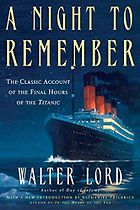
Let’s go on to the final book, Walter Lord’s A Night to Remember. This is about the final hours of the ship, right?
It’s hard to imagine anybody producing a more thrilling account of the Titanic than Walter Lord’s book from 1955. The Titanic has never really gone away, but between 1912-13 and 1955 there wasn’t a lot of sustained interest. Then Walter Lord came along and published A Night to Remember. It was a bestseller that has never gone out of print.
Lord’s book is a moment-by-moment telling of the events of the night of April 14 and the morning of April 15. What’s most skilful about it is the way that it moves around in space as it recreates these moments in time. From the outset, you get phrases like ‘meanwhile’ or ‘on the boat deck.’ He moves you around the ship, creating a sense of simultaneity, even as he’s conveying a sense of the vastness of the Titanic and all of these different experiences happening at the same time, from calm to panic. He also plays around with the pacing so that it’ll slow down to have Thomas Andrews, the ship’s designer, reflect on his career, or Isidor and Ida Straus reflecting on their marriage. And then the pace speeds up as the danger becomes clearer, the lifeboats are being loaded and launched, and the water is rising. It becomes a complete page turner by the time the ship is going down.
It’s also held up incredibly well in terms of accuracy. That’s in part because of the advantages he had writing this book in 1955 as opposed to later, because he could interview or correspond with 60-plus survivors. He was a meticulous researcher. He used newspapers, the British and American inquiries, the published survivors’ accounts, as well as his interviews and correspondence with survivors. He was careful about not reporting some of the more dubious stories that were told about the disaster at the time.
Lord really bears a lot of responsibility for people who, like Eaton and Haas, got interested in the Titanic and who started organizations devoted to the history of the ship and the disaster. Pretty much all of those people were inspired by reading A Night to Remember. It’s still a book that’s especially popular with kids. I read it as a kid. I didn’t develop an immediate and lifelong Titanic obsession, but I think a lot of people who read that book in the 50s and have read it since have become Titanic obsessed for their whole lives.
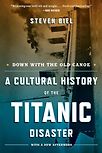
Finally, Steve, tell us about your book, Down with the Old Canoe: A Cultural History of the Titanic Disaster. What were you trying to do with that book?
I wasn’t interested in retelling the story of what happened that night. I don’t think A Night to Remember will be surpassed in that regard. I saw it as doing something that the books that I’ve talked about didn’t do. I got into it after I read some letters written by Henry Adams, who was the grandson and great-grandson of American presidents and a famously curmudgeonly critic of technology and the whole idea of progress at a time when it was widely taken for granted. It turns out from these letters that Henry Adams had passage booked on the return trip of the Titanic from New York to Southampton. And so, when he heard that the ship had gone down with this enormous loss of life, he wrote to friends saying how the Titanic was supposed to be the triumph of civilization, and now look where we are, look at the misguided confidence, look at the hubris.
It occurred to me that this must have been an event that people really struggled to make sense of, and that got me going. I knew the Leadbelly song. I knew some of the other folk songs about the Titanic. What I didn’t know was how it was reported on at the time. I didn’t know about the endless number of poems that were churned out about the Titanic in its immediate aftermath, or the reams of sheet music. So I thought what I could contribute was to really work out some of the ways that the disaster resonated in the moment in 1912, and that’s when I discovered that it was being deployed in debates about immigration and women’s suffrage, and in debates about Jim Crow and segregation and racial violence and labour agitation. It just kept opening out for me.
I was going to write about how it resonated in 1912, and then I decided I had to follow it through time. So the second half of the book includes a chapter on Walter Lord and how the Titanic resurfaces, so to speak, in the 1950s. And then I took it up to Robert Ballard’s discovery of the wreck, which I situate in the Reaganite 1980s.
I think if I were writing it again, I would make it more transatlantic than it is. It’s largely focused on responses in the US. There’s a lot of overlap to responses in the UK, but there are important differences that I could have teased out in the book.
Five Books aims to keep its book recommendations and interviews up to date. If you are the interviewee and would like to update your choice of books (or even just what you say about them) please email us at [email protected]
Five Books interviews are expensive to produce. If you've enjoyed this interview, please support us by donating a small amount.
Steven Biel
Steven Biel is Executive Director of the Mahindra Humanities Center and Senior Lecturer on History and Literature at Harvard University. He is the author of American Gothic: A Life of America's Most Famous Painting, Down with the Old Canoe: A Cultural History of the Titanic Disaster, and Independent Intellectuals in the United States, 1910-1945, and of the edited collections American Disasters and Titanica: The Disaster of the Century in Poetry, Song, and Prose.
Steven Biel is Executive Director of the Mahindra Humanities Center and Senior Lecturer on History and Literature at Harvard University. He is the author of American Gothic: A Life of America's Most Famous Painting, Down with the Old Canoe: A Cultural History of the Titanic Disaster, and Independent Intellectuals in the United States, 1910-1945, and of the edited collections American Disasters and Titanica: The Disaster of the Century in Poetry, Song, and Prose.