It’s a golden age for nonfiction, with books on a range of important topics written in an accessible way. As 2025 draws to a close, Five Books editor Sophie Roell takes us through some of the books that won prestigious nonfiction book prizes this year, and what they can tell us about the world we live in.
While I enjoy novels as much as the next person—I read mysteries to relax and one of my daughters is named after the heroine of War and Peace—what I enjoy most about being editor of Five Books is the number of nonfiction books I have the privilege of reading. I pay particular attention to the books shortlisted for the nonfiction book prizes, where a group of 4-5 judges get together and, between them, decide which is the best book of the year. This is a high bar—who wants to put their name to a bad book?—and what I particularly enjoy about seeing the book they choose is that it’ll push me to read about a subject I wouldn’t necessarily have even considered if I saw it on a shelf in a bookshop.
The various nonfiction literary prizes awarded in any given year have different focuses, and below, I’ll try and give a sense of what each of them is about and what kind of books they tend to highlight.
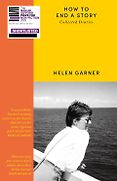
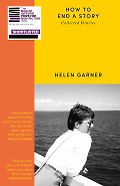
The judges for the prize change every year, so the book that wins in any particular year will tend to reflect the makeup of the judging panel and the dynamics between them. This year, the winner was completely unexpected—both to me and, based on my conversation with him, perhaps also to Robbie Millen, the literary editor of the Times, who was chair of the 2025 judging panel. How to End a Story is the collected diaries of Helen Garner, a talented Australian writer. The book of hers that has been recommended on Five Books is This House of Grief, about a father who stood accused of killing his children by driving them into a reservoir. How to End a Story is very different. It reads like little snippets, and the book is quite hard to get into, at least initially. But this is the story of a life, of a marriage, told without taking any prisoners and, as a result, gives a very unusual and unfiltered insight into what it is to be a human being. “It felt like being privy to very raw emotions,” Millen told me. “It surprises me that she hasn’t published it posthumously. Obviously, she’s edited it and shaped it, but there are parts where she is very unsparing of herself. There are some completely embarrassing moments, yet she puts it all out there.”
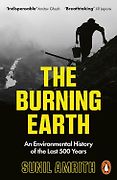
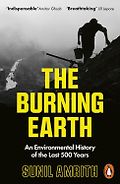
Another important nonfiction prize is the annual British Academy Prize. This is a prize we particularly value at Five Books because it aims to narrow the divide between academic work—the British Academy is the UK’s national academy for the humanities and social sciences—and writing that is enjoyable to read and accessible to a general audience. The prize is also quite internationalist in outlook, aiming to promote a broader understanding of the world and between different countries and cultures. This year’s winner was an environmental history of the past 500+ years, The Burning Earth, by Sunil Amrith, a professor of history at Yale who also has an appointment in the Yale School of the Environment. Despite the tough topic, this book is fun to read because of its range—you learn, for example, about the Mongol expansion and how many horses each of Genghis Khan’s horde had, amongst many other historical details. The ultimate message of the book is that “the environment is not something that’s happening on the side of history. They’re intertwined, and you can’t separate them out,” historian Rebecca Earle, one of the prize’s judges, explained to me. “The book shows this really compellingly.”
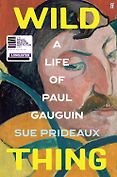
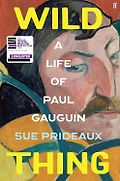
Another nonfiction prize we cover at Five Books is the Duff Cooper Prize, named after the British diplomat who wrote Talleyrand, a biography of the French statesman and one of my father’s favourite books. Despite being a nonfiction prize, it does tend to gravitate towards history books, so is worth keeping an eye on if you like history. This year’s winner was Wild Thing, a biography of Paul Gauguin, the French painter who ended up on Tahiti, and whose reputation biographer Sue Prideaux tries to rehabilitate in this book. She reports, for example, that he was not responsible for bringing syphilis to Tahiti. I was also moved by the chapter on Gauguin’s visit to his friend Vincent van Gogh in southern France, shortly before the Dutch painter’s mental illness got the better of him. Van Gogh painted the sunflowers specially for Gauguin’s visit, to decorate his bedroom.
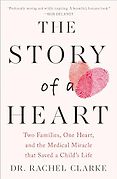
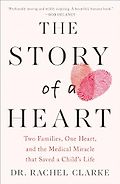
If you want a nonfiction book that will make you cry, the book to go for is The Story of a Heart, written by British doctor Rachel Clarke. This book was the winner of the 2025 Women’s Prize for Non-Fiction, a new prize that was first awarded in 2024 for nonfiction books by women and judged by women. The Story of a Heart is the story of a girl who died, and a boy who lived because he received her donated heart. I don’t want to give away too many details, but as journalist Isabel Hilton told me: “It’s a book that once read is never forgotten. It’s told with extraordinary insight, medical knowledge and extraordinary sensitivity to the people involved. She tells their story, of something we take for granted, heart transplants, in a way that I’ve never seen it told before. It’s profoundly moving.” According to Kavita Puri, who chaired the prize, “I cried throughout reading this book. So did a lot of my fellow judges. There’s such dignity in how she deals with the subject matter, and in the behaviour of both sets of parents. There is also dignity in the medical staff.”
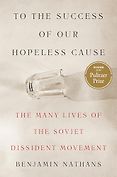
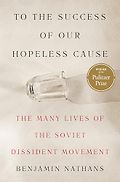
Lastly of the general nonfiction book prizes, we have the Pulitzer Prize for Nonfiction, awarded to an American author. This year, it went to a book about the Soviet dissident movement, To the Success of Our Hopeless Cause by Benjamin Nathans, a historian at the University of Pennsylvania. As Russian political scientist Gulnaz Sharafutdinova explained it to me, “This book is a very important, groundbreaking study of the dissident movement in the Soviet Union, not as a group of people with values that were pro-Western or liberal, but as a group of people who grew up as second-generation Soviet citizens and within that Soviet system, found the space and impulse to question the foundations of how that system worked in their time. They came up with very original strategies for confronting the issues they were not happy about…They came from a belief in the system they lived in, and used a legalist approach to keep the Soviet leaders true to their word.”
Communist systems tend to the legalistic, and one can’t help but wonder whether Chinese dissidents are taking note of this book and the methods used to confront the Soviet system.
Other, more focused nonfiction book prizes
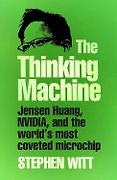
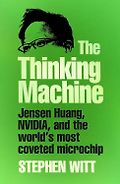
Lastly, a shout-out to all the book prizes aimed at the general public that aim to improve our understanding of specialist subjects, including business, politics, philosophy, foreign affairs, sports, and science. I’m so grateful to you for trying to separate the wheat from the chaff and reliable information from successful marketing. Here’s a list of some of those award-winning books, starting with The Thinking Machine, which won the Financial Times Business Book of the Year Award and is all about the computer chips that are changing our world and what a single person with a big appetite for risk and a relentless focus can achieve:
Five Books aims to keep its book recommendations and interviews up to date. If you are the interviewee and would like to update your choice of books (or even just what you say about them) please email us at [email protected]