We are here to discuss the shortlist for the 2026 Elizabeth Longford Prize for Historical Biography. Perhaps you could start us off by reflecting on what the judges are looking for?
The Elizabeth Longford Prize seeks to award works that epitomise the approach to historical biography, which Elizabeth Longford herself—with her great biographies of Wellington and Queen Victoria and others—achieved, which is narrative drive and an accessible approach, all founded on a bedrock of original scholarship and historical judgment.
It has also involved us, more and more, in judging what a historical biography is: what kind of lives contribute to historical influence, to changing the world. We’ve come up with som rather unexpected and original winners over the twenty-odd years we’ve being doing this, and I think the range is more and more inclusive.
The 2026 shortlist is one of the very strongest shortlists we’ve ever had, but also one of the most varied and interesting.
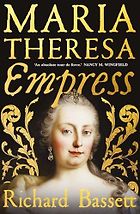
I think I agree. Shall we talk about the shortlisted books? Let’s begin with Richard Bassett’s Maria Theresa, Empress: The Making of the Austrian Enlightenment.
The old-fashioned view of historical biography would be royal biographies, And, in fact, we gave the prize to a royal biography last year, to Tim Blannings’ terrific book about Augustus the Strong, the king of Poland and elector of Saxony. We chose that book for its originality and its intellectual heft, showing how someone could be a political fiasco, but wield lasting artistic influence.
Richard Bassett’s book on Maria Theresa is also groundbreaking. She comes across as an intellectual, highly intelligent, balanced and subtle negotiator, as well as the queenly figure she’s been celebrated as for so long. What Bassett has done, in a sense, is rejig the balance between her and her traditionally more celebrated son Joseph, who was considered the best kind of enlightened despot.
Interesting.
Joseph seems a slightly disastrous ruler in this version, who almost negated the real achievements of his mother, and which his brother later helped to restore. That’s one of the strengths of the book: it changes our perspective of an accepted royal figure.
It also—and this is true of another book on the shortlist as well—reminds us of the incredible importance of religion in history. It still carries immense heft and importance in how countries are governed and how politics happen. Anti-Semitism is a theme in this book, as it is, I’m afraid, in Austrian history. That’s the kind of facing up to uncomfortable truths that we look for in the work we shortlist for this prize.
It’s also written very accessibly and lightly, in a great many very short chapters. Which is a way that biography has been moving in the last decade or so, and which is advantageous both for the general reader and the scholarly reader too.
What other qualities should a good biography have?
I think one is looking for psychological insight, which owes a lot to developments in psychology and indeed psychoanalysis over the last century or so. That wasn’t really available to earlier royal biographers, or biographers of any kind.
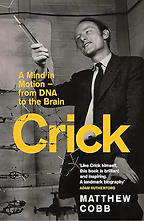
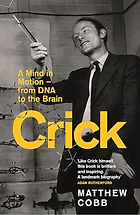
Next we have former Five Books interviewee Matthew Cobb’s biography of Francis Crick, Crick: A Mind in Motion. I think we’re already getting a sense of the range of this shortlist.
Yes, this is a very different kind of book. Crick comes across as the most extraordinary and endearing, even slightly loopy character. We know him as half of Watson-and-Crick, the great discoverers of DNA and the double helix. But he’s established here as the kind of intellectual that could only have come to fruition in the conditions of mid- to late-twentieth century America and Britain. Besides being a stellar scientific researcher, he’s a quintessential figure of the 1960s.
The book is embellished with pictures—look here he is in psychedelic shirts, with bottles of wine, a joint, scantily dressed women. A rave culture scientist as happy at an attic party in Paris or California as he is in the lab. He’s a party-goer, a joint smoker, a psychedelic experimenter, but there is this bedrock of scientific commitment. We learn about his psychology, his relationship to other scientists: his acolytes, opponents, gurus, his great collaborator, Watson—who in some ways is a much less appealing figure—and, famously, the relationship with Rosalind Franklin, who has been cited as the figure cut out of history. This book reassesses her relationship with Crick. His attractiveness as a generous scholar and theoretician who mostly gives full credit to his collaborators is also an important part of the story.
There’s also a very strong marriage with his French wife, who is clearly one of the key figures keeping him on the path that led to the Nobel and these great discoveries. It’s warmer and more engaging—sometimes hilarious—than most biographies of great scientists. In that world of the 1960s and 1970s, barriers were broken down both socially and artistically.
Would it be helpful for the reader to have a background in biology?
I’m profoundly ignorant of this kind of high-octane science, but it is made very comprehensible. Matthew Cobb is an extremely gifted populariser, and I mean that in the best possible way. He makes these developments accessible to the general reader in a way that is quite rare, but he doesn’t shirk away from the difficulty and originality of the groundbreaking theory he has to explain.
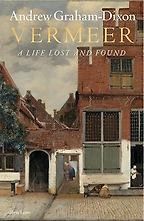
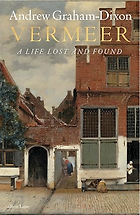
Thank you. Let’s move from science to art history. The next book on the 2026 shortlist for the Elizabeth Longford Prize for Historical Biography is Andrew Graham-Dixon’s Vermeer: A Life Lost and Found.
The inclusion of a book about a painter, Vermeer, on the list shows the way we have been trying to expand the view of what makes history. A couple of years ago we gave the prize to Jackie Wullschläger’s life of Monet, for instance, which showed how he changed the way the world looked at things, relating him very brilliantly to abstract expressionism, as well as the impressionism for which he is known.
Graham-Dixon’s approach to Vermeer is rather different: he contextualises him with terrific, vivid detail in the Netherlands of his era, particularly to radical liberal Christianity, and groups like the Collegiants and the Remonstrants, who believed in revelation within the self in a gradual flowering of light rather than a thunderbolt from on high.
He relates that to Vermeer’s paintings—like his ‘View of Delft’, which Graham Dixon writes beautifully about as a kind of revelation of a new world, or this picture on the cover, a famous little street. Behind that alleyway at the centre of the painting was a very discreet church where the Remonstrant group met, whose chief members were a family who were Vermeer’s great patrons. A very high proportion of his paintings were related to this religious group, who commissioned, owned and preserved them.
It’s also a wonderful study of how a painter can drop out of sight after death, but then be rediscovered when the world is ready to understand them. Vermeer was rediscovered in the late 19th century, and was much used by Proust and other writers. But Graham Dixon, with a true historian’s instinct, has brought us right back to the historical moment of his life, at a time when religion was all-encompassing and a central part of people’s life and way of living, which is immortalised by these astonishing paintings.
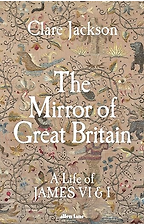
Thank you. We have another royal biography next on the list, which is Clare Jackson’s The Mirror of Great Britain: A Life of James VI & I. He seems to be having a moment in the sun—I noticed another recent biography on the same subject, Queen James.
You’re right, it is a moment for James studies. There was also Lucy Hughes-Hallett’s book about Buckingham and James a couple of years ago, The Scapegoat.
What we liked so much about this book was the thick texture of the history, placing James very exactly and inspirationally, I think, in the intellectual moment of his time. That means, for instance, his homosexuality isn’t played up or vulgarised, it’s part of a discussion of the sexual mores of the times he lived in. His infatuation with young men was something that was, if not completely acceptable, then not unusual, and not the chief marker and identifier of his emotional and psychological makeup, as some treatments have recently made it out to be.
It’s also important that she stresses his intellectual abilities because there is a version of James that sees him as a Scottish pedant, annoying more balanced minds and boring people to tears with his abstruse lectures. That isn’t the James that comes across here. He’s insightful and intelligent, a real intellectual. Religion, again, is central to his life, but he has to play it so carefully: we’re on the edge of the English Revolution at the end of his career, and the epilogue deals with how things will fall apart in his son’s reign.
James himself is dealt with, again, in short, accessible chapters. A tremendous wealth of scholarship is worn very lightly. We get the sense of a man who is the first king of Great Britain, after all, but also—as the author Clare Jackson says—the most interesting. Intellectual precocity, brilliance and insightfulness aren’t necessarily always associated with monarchs of Great Britain, and she puts James in a class of his own.
He’s an engaging character with an extraordinarily traumatic and difficult and violent early life, which he somehow survived to become a rounded intellectually and psychologically interesting character. We see his relations with his wife and family, the extraordinarily diplomatic ballets that he had to dance, and, of course, the religious movements that were stirring in his reign. It’s a masterclass in relating someone’s life and ideas to their times.
It’s not a royal biography in the normal sense, but something much more ambitious and engrossing.
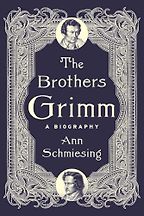
That brings us to the final book on the shortlist for the 2026 Elizabeth Longford Prize for Historical Biography, which is Ann Schmiesing’s The Brothers Grimm. What a great idea for a biography.
Yes, it is a fantastic subject. A great deal has been written about the Brothers Grimm. Schmiesing brings us back to the world of post-Napoleonic Europe in which they lived, the quickening sense of a German identity linked to these stories. Wagner is just around the corner and, in a fascinating epilogue, she looks not only at the way that psychologists and psychoanalysts would use the Grimms’ findings, but also the way that the Nazis would use the idea of German identity associate with the soil and the folk.
But the main body of the book is not about the misuse of these fairytales in later history, but about the way these two brothers, who were very close and socially awkward after a difficult and in some ways sad background, intensely related to each other. When one of them marries, the unmarried one becomes, in a sense, a third element of the marriage in an affectionate and moving way.
They don’t have an easy life; their work is not appreciated by the people who pay their miserly stipends as state librarians at first. Slowly their reputation grows, butwhat they are doing is also discovering new words. There’s a great dictionary that they collaborate on, and the book shows them as intellectuals working across a broad range of achievement and effort. The extraordinary stories of Rumpelstiltskin, Hansel and Gretel, Snow White—so often recast and revised and interpreted and misinterpreted—are only part of their discoveries.
It’s also a family history, showing how a family relationship produces a kind of intellectual powerhouse and relates it to that moment of early 19th-century Europe, when the French Revolution’s influence has been but not gone, when Napoleon’s attempt to reorder Europe has only partly succeeded.
Only about ten years after the last Grimm brother died, you have the reunification of Germany, and so the historical world in which these extraordinary scholars beavered away is related to the world that their historical, linguistic and mythological discoveries are shaping. It identifies them as historical figures, as well as figures in intellectual history, which is, in a sense, true of every subject on this shortlist.
It sounds like a difficult decision, to choose a winner.
We have rarely had such an equal division of heft between the five shortlisted books. Sometimes there is an obvious front-runner, but not this year.
A critic could say we are trying to compare apples and oranges, but I think we have tried to define—and, in a sense, redefine—the idea of the historical biography as encompassing people who have had an influence on the intellectual, artistic or historical worldview. We will now have to look at the way the subject has been handled, how narrative accessibility is balanced with scholarly and sometimes specialist knowledge without sacrificing or simplifying the difficulty of recreating a historical world view.
I’m sure it will be an intellectually stimulating discussion. Looking at this list of five extraordinarily accomplished books, it will be a worthy winner.
Interview by Cal Flyn, Deputy Editor
June 3, 2026. Updated: July 8, 2026
Five Books aims to keep its book recommendations and interviews up to date. If you are the interviewee and would like to update your choice of books (or even just what you say about them) please email us at [email protected]
Five Books interviews are expensive to produce. If you've enjoyed this interview, please support us by donating a small amount.