Heroic explorer or harbinger of doom? The impact of Christopher Columbus has become the focus of intense debate—in both academia and the arena of popular opinion—in recent years. We asked noted scholar of colonial Latin American history Matthew Restall to recommend five of the best books that explore Columbus's life and legacy.
Most of our readers will know of Christopher Columbus as the ‘discoverer of the New World.’ But I understand that his story, and his image in Latin American Studies has become somewhat clouded. Would you give us a brief overview?
Yes, he’s become an incredibly contested figure on both sides of the Atlantic. The nature of that battle differs from nation to nation. Broadly speaking, there’s the phenomenon of the American Columbuses—I argue that there are more than one—and the United States became the primary nation in the world for interest in Columbus. There he was turned into a greater hero, but one increasingly contested in the late 20th century and in this century.
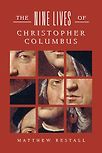
Then there are variations in Latin America. In my book, The Nine Lives of Christopher Columbus, I briefly compare the situation in Mexico versus that of the Dominican Republic. The Dominican Republic embraces Columbus, claims that it has his bones, and has a huge monument to him. Whereas, in Mexico, Columbus is seen as a symbol of all the negative things that came with European colonisation: mistreatment of indigenous peoples, genocide, and so on. So, there’s a very negative view of him in Mexico, although, again, when you really dig in, it’s contested like it is in the US.
There’s an element of the left wing/right wing battle. There’s an element of the generational divide—older people feeling Columbus was a hero, and younger people saying, ‘no, he wasn’t.’ But there’s more to it than that. It’s very complex, and that’s part of what makes Columbus so fascinating. And also important, right?
“Columbus has become an incredibly contested figure on both sides of the Atlantic”
Not ‘important’ in the sense of being a hero that we must continue to idolise, but important because he elicits and prompts so many presentist opinions, by which I mean not opinions about what was happening in the 15th century, and 1492 specifically, but about the world today—about whether he determined how the world is today (and if so, in a good or bad way), whether he sets a positive or negative precedent, and so on.
That’s why I wrote about Columbus as having many lives. To really understand the Columbus phenomenon, we need to start by thinking of him as having multiple identities and manifestations. Then we can get somewhere.
Am I right in thinking that one of the reasons his reputation has spun so wildly in different directions might be because there is a haziness around the historical detail of his life?
That’s a good question, but it’s a tricky question. Yes and no. I discovered in the course of researching my book that one of the major problems with understanding Columbus is this fallacy that his life is a mystery.
Many books about Christopher Columbus start with this premise. They begin: ‘We don’t know anything about Columbus,’ or: ‘the great mystery of Columbus has been solved.’ But many books about Columbus are actually historical novels masquerading as biographies. So, right from the get-go, he’s portrayed as a mystery, and that opens the door to so much of the phenomenon I call ‘Columbiana’, which has really very little to do with Columbus himself.
For example: there are dozens of claims that he is not from Genoa. There are entire bodies of literature that have convinced many thousands, even millions of people, that he is really from Spain or Portugal. That he was, secretly, a Jewish nobleman, a love child, a spy. It sounds like I’m exaggerating, but you can find these phrases on the covers of books.
About 2000 books about Columbus have been written over the last hundred years; he’s one of the most written about historical characters. If we’re talking about books written in English, he must be right up there with Lincoln. And a huge percentage of those are biographies of some kind or another.
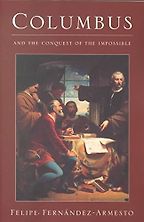
Well, I think you have selected one biography from those thousands that you would like to recommend, which is Felipe Fernández-Armesto’s Columbus. It was published in 1991.
My own book tries consciously not to be a traditional biography, which may not satisfy readers who want a straight narrative. So, for those people, I would say that Felipe Fernández-Armesto’s is the best.
I’m a little biased, because I’ve known him since I was an undergraduate—he was a faculty member at Oxford when I was a student there—and he has influenced my thinking and my career ever since. I think he’s absolutely brilliant and very witty, and he has written dozens of brilliantly original books, including a series of books about Columbus. This is the best of those books.
What really makes this biography stand out is that he questions all of the old assumptions and myths about Columbus. When he finds in previous biographies a statement that Columbus had a love affair with Queen Isabel, say, or that she pawned her jewels to pay for his voyage, or Columbus was secretly Jewish, or Columbus thought the world was round when nobody else did—the list goes on and on—he does not unquestioningly accept a single one. That’s really important, because there are other writers of good, very readable Columbus biographies by good historians who do. They see a story repeated over and over in previous books, and they just kind of swallow it as true. But Fernández-Armesto relentlessly questions all these little myths that have become enshrined in Columbus biographies.
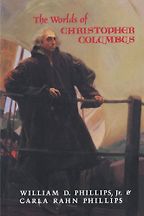
Your second book recommendation is The Worlds of Christopher Columbus by William D. Phillips and Carla Rahn Phillips. How does this book differ?
The strength of this book is that the Phillips are historians of this time period in the history of the Atlantic world and the Mediterranean world. They really understand the historical context. And they do a very good job of emphasising a crucial point, one that I emphasise too, which is that Columbus was not alone. He was part of a phenomenon involving hundreds of ships and many thousands of Italians, Spaniards and Portuguese who were, in his lifetime, all exploring the Atlantic Ocean.
If you were a student in one of my graduate seminars, I would tell you to read these books in sequence—Fernández-Armesto first and then the Phillips’ book. You’d notice that they don’t question the story of Columbus battling pirates and other stories he questions. And then, noting the differences, you can make up your own mind!
The short answer is yes. The longer answer is that I wasn’t hell-bent on being a contrarian: I set out to be open-minded. I really wanted to examine respectfully all the claims on Columbus from parts of the Iberian Peninsula, for example. The seed for my book was planted when I was in Galicia in Spain, where they have a museum in the house where they claim he was born, and so on. I didn’t want to dismiss all of this as being clearly invented. I wanted to take it seriously.
As a result, I discovered that Columbus, or the entire industry surrounding him, is so heavily imbued with mythology that the book ended up being myth busting. I invented a word—‘faithistory’—which refers to a view of history in which people approach an event or subject with a pre-existing belief. Everything they then read, they reject or accept depending on how it fits with their faith, just as people do when they have any other kind of ideology, religious or not. I realised I needed to come up with a term to encapsulate for the reader these kinds of opinions or beliefs.
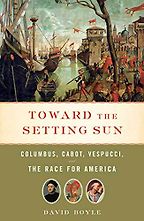
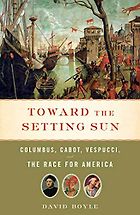
Let me keep us moving to your third book recommendation, which is somewhat broader in scope as we view Columbus among his peers. This is Toward the Setting Sun by David Boyle.
Yes, Boyle writes about Columbus, Cabot and Vespucci all together, advancing a theory that they knew each other very well, and interacted and influenced each other far more than has been previously understood.
So, what is good about it, why is it in here? Well, it has an originality that encourages the reader to think about Columbus not as somebody doing this all alone. It picks up on that theme of the previous book by the two Phillips. So, there’s a larger context. Boyle argues that there are these three northern Italians, who all have the Genoa/Florence connection. And it stimulates the readers’s imagination. Boyle writes really well, and with enthusiasm. I like his writing style.
Now, if I’m playing devil’s advocate, I might also ask, what is wrong with this book? The writing style you can look at from the other direction too: it’s so nicely and engagingly written that it becomes believable, and you swallow everything that he says. That’s fine, except there’s a lot of imagination in there. Where there are gaps, he uses speculation and imagination. That’s central to what makes the book enjoyable, but it also undermines it a little as a reliable historical source.
You could almost begin your reading with this one and then go back to the Phillips’ book and to Fernández-Armesto, and you’ll then be able to see where Boyle gets a little carried away here and there. So that makes the book fun to read, but also problematic if it’s the only book you are reading. If you think you come away understanding Columbus—well, you do and you don’t.
I suppose that’s the difficulty as a nonfiction writer: what to do when you approach the edge of certainty. Different writers have different philosophies, but as a reader you really need to know what the philosophy is.
Exactly. There are some pretty obscure scholarly works that touch on various aspects of Columbus’s history, but I’ve tried to avoid those here. This isn’t a list for a doctoral student writing a thesis. I mean, it is, but primarily these are books that someone who is not a professional academic, but who is interested in Columbus, should be able to pick up and enjoy and get something out of. The Boyle book is clearly written for a larger audience.
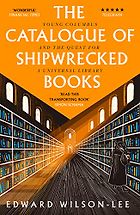
Got it. I’m very intrigued by your next book recommendation, which is The Catalogue of Shipwrecked Books, which offers us Columbus in a different kind of context again.
Yes, this comes a little out of left field. It’s more of a scholarly book than the previous ones. Edward Wilson-Lee is a professional academic who teaches English literature at Cambridge. He’s not a historian, if that matters. The reason this book is in here is, first and foremost, it’s a brilliant book. Even aside from what it tells us about Columbus, it’s magnificent.
He picks a surprising topic that you wouldn’t think would support a whole book, which is the library created by Columbus’s youngest son—not the oldest son Diego, who inherited all the legacy, and from whom the Columbus dynasty descended (there’s even a Christopher Columbus today who is a nobleman in Spain, the 20th Admiral of the Open Sea)—but the illegitimate Hernando.
You’d think: that’s an obscure topic, how’s he going to have the material to support that? But Wilson-Lee is very clever. He goes through the books themselves, talks about the library, and what it tells us about Hernando, and then his father. So, we get to a new way of thinking about Columbus, and a new way of unpacking the mythology about Columbus along the way, although that’s not Wilson-Lee’s primary purpose.
Sometimes people who love books also love reading books about books. This is a book about books, and as such it is unique and engaging.
To recommend to you five biographies of Columbus would be tedious, and after a while you’d just lose interest. Thus, I wanted to include something that comes from a different angle, and does tell you about Columbus, but also broadens the subject out, to get you thinking differently about the 15th and 16th centuries.
Columbus himself died in 1506, so he’s not much of a 16th-century figure. But of course, his son was, and this helps us understand how Columbus was seen in the 16th century. And that leads us towards my fifth book, which is how Columbus was seen in the 20th century.
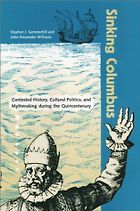
Yes, then let’s move to Sinking Columbus by John Alexander Williams and Stephen J Summerhill.
This is the most conventionally scholarly of my five books, and it’s also the one that takes us furthest from a Columbus biography. There’s almost no biography in here at all, but an assumption that you won’t need all that information, because you can get it elsewhere.
As the title indicates, it’s about contested history, cultural politics, and mythmaking. It focuses on the 1992 Quincentenary, which is absolutely crucial to understanding anything about Columbus since then. People say that they like how, in my book, I connect statues being pulled down in the 2020s back to the 19th century, and even back to Columbus’s own lifetime. And, absolutely, yes, but the huge event that took place between today and all of that is the 1992 Quincentennial, which was very contested.
In the lead up, people preparing the celebrations thought it would be like 1892, which was the absolute peak of Columbus adulation. All kinds of stuff came out of the 1890s in America, which might not be super interesting to you if you are not here in the States, but, for example: American children have to pledge allegiance to the flag in elementary school every morning, right? Generations have grown up like that, and Americans don’t think anything is wrong with that, but people outside America are astonished at the blatant instilling in Americans of this level of patriotism, which is relatively unusual in the modern world.
Right. Patriotism and flag-waving played very little role in my education.
It’s one of the things that makes America stand out. I think Europeans often see this not just as patriotism but kind of jingoistic. It’s so out of sync with modern ways of thinking about nationalism in Europe.
But some of it dates from 1892 and is actually about Columbiana. It’s about taking Columbus as a patriotic figure and using him to socialise American children to be very loyal and patriotic to their nation. Columbus became part of that.
Fast forward 100 years. The US Post Office was reissuing the 1892 stamps, which in the 1890s had been the biggest-selling stamps in US history. They are very important in the history of philately, if you care about that. They were a cultural phenomenon, and in 1992 they reissued the stamps and simply changed the ‘8’ to a ‘9’. Everything else all the same—these 19th-century images of Columbus. But stamps like that were very out of step with how many Americans now saw Columbus. There was a huge battle over the Quincentenary.
So, that’s what Sinking Columbus is about— Columbiana not Columbus. I would argue that you can’t just read books about Columbus in 1492 and then understand how he is seen today. President Trump repeatedly issued statements in 2025, for example, that ‘we’re bringing Christopher back,’ or ‘we’re going to put more statues up,’ or ‘we’re going to make sure that Columbus Day is an official holiday’—which it already is and has been for 100 years. But all that is less about what Columbus did and more about what he has come to stand for.
I think that brings us right up to the present and gives our readers an understanding of this constantly shifting topic.
That’s important, because Columbus is still a battleground today. But I would like to see that turned around. He shouldn’t be a battleground, but a talking point, or a site for people to exchange contrary opinions and beliefs in a way that leads to mutual respect and understanding.
I think he can be a figure that is used to better understand what happened not only 500 years ago, but in the last 200 years, and not just in the United States, but in the whole Atlantic world.
Five Books aims to keep its book recommendations and interviews up to date. If you are the interviewee and would like to update your choice of books (or even just what you say about them) please email us at [email protected]
Five Books interviews are expensive to produce. If you've enjoyed this interview, please support us by donating a small amount.
Matthew Restall
Matthew Restall, educated at Oxford and UCLA, holds a chair in History at Penn State University. His two-dozen books, in seven languages, include Seven Myths of the Spanish Conquest and When Montezuma Met Cortés. His most recent (all 2025) are Ghosts: Journeys to Post-pop, On Elton John, and The Nine Lives of Christopher Columbus.
Matthew Restall, educated at Oxford and UCLA, holds a chair in History at Penn State University. His two-dozen books, in seven languages, include Seven Myths of the Spanish Conquest and When Montezuma Met Cortés. His most recent (all 2025) are Ghosts: Journeys to Post-pop, On Elton John, and The Nine Lives of Christopher Columbus.