Communication is critical to getting on in our lives and in business, but many of us fall short in communicating what we want in the right way to the right audiences. Matt Abrahams of Stanford's Graduate School of Business talks us through five books packed with practical advice on how to improve your communication skills—from the insights of improvisational theater to the acronym to use if you want people to remember what you've said.
Before we get onto the books, I suppose we all think we know what communication is, but what do you mean by it, and why is it something that people often seem to find quite hard?
Communication is critical to people’s success in business and in life. It is the way in which we connect to people, it is the way we learn and share. Many people struggle with communication because they’re never formally taught, or they don’t take the time to reflect, but we can all get better at our communication, and in so doing, build deeper relationships, deeper understanding and deeper connection with those around us, and that allows us to have fuller, more complete and meaningful lives.
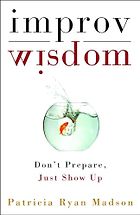
Let’s go on to the books you’re recommending. First up is Improv Wisdom by Patricia Madsen. Why have you chosen this one? And what does it tell us?
Patricia Ryan Madsen is amazing. Ultimately, our lives are spontaneous. They’re improv. We don’t script out our day, and Patricia provides easy principles from the world of improvisation, like, ‘say yes’, ‘dare to be dull’, and ‘don’t just do something, stand there’. These are fundamental principles from improvisation that we can apply to our lives in bite size, easily digestible, actionable ways. This is the book that I have read more than any other book. If you look at my copy, it’s highlighted, underlined and dog eared. It provides very practical, tactical lessons that have been very meaningful to me.
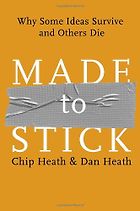
Next up is Made to Stick by Dan and Chip Heath. What’s this one about?
Whenever we communicate, we are competing in a landscape where attention is our most precious commodity. The ability to get people’s attention and, more importantly, sustain that attention is super important. You have important things to say, and if people don’t pay attention and engage with you, you get in trouble. So what Dan and Chip do is they provide a six-step process to help people craft messages that stick, that are memorable, that are actionable. What I love about their writing is that not only do they provide really engaging storytelling, but they give really concrete examples that bring to life the principles that they’re talking about.
And what are the characteristics of messages that stick rather than those that don’t?
So they provide an acronym called SUCCESS—I won’t go through all the elements—but, for example, ‘story’ is really important when you communicate. People also engage and remember more when you use concrete detail. Our brains are wired to remember ‘concrete’ detail better than high-level gist. Also, ‘surprise’ is important. The brain is attracted to novelty, things that change—so that can be really helpful as well.
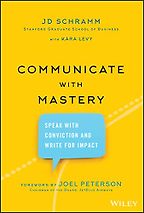
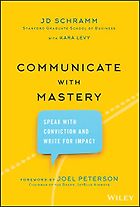
Next up is Communication Mastery by J.D. Schramm. Tell us about this one.
J.D. Schramm really looks at communication as a skill that we can learn and gain mastery of, and he has some very simple, straightforward, applicable techniques and approaches. I’ll give you an example. He argues that all communication needs to be aimed at a target, and AIM is an acronym. It’s about ‘audience’, ‘intention’ and ‘message’, and you have to align those to be able to communicate clearly. And he gives specific examples and guidance based on his years as a teacher of strategic communication. So it’s approachable and useful.
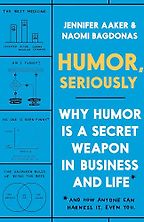
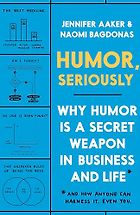
Now we have Humor, Seriously, by Jennifer Asker and Naomi Bagdonas.
Jennifer Aker and Naomi Bagdonas are also at Stanford’s Business School. This is the only business book I’ve ever read where I’ve laughed out loud. It is an expert book on how to use levity and humor in our lives in general, but specifically in a business context. And they provide advice and guidance on how to find the appropriate humor. And by appropriate, I mean not just for the environment, but also for yourself. Not everybody is funny in the same way and they give guidance and advice on how to do that and how to apply it. They also talk a lot about the benefits of humor, not only personally—you are healthier, both mentally and physically, when you can bring levity into your life—but when you bring it interpersonally, it allows you to connect and engage. It’s a wonderful book and a lot of fun to read.
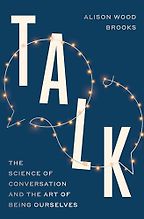
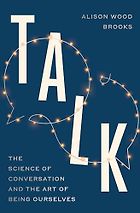
Last up is Talk by Alison Wood Brooks.
Alison teaches at Harvard Business School. She really looks at conversation. Most of our communication happens in conversation with others. It’s not just us broadcasting information, and there are a lot of dynamics that go into making for effective conversation. I’ll give you two examples. First inquiry, asking questions. There’s an art to asking questions that lead to disclosure and connection in a way that doesn’t make somebody feel interrogated and put on the spot. There are turns that are taken in conversation that we need to pay attention to. Are we keeping the topic in line? Are we switching topics? There’s a way to find a balance so it feels natural and normal, and Alison does a great job of giving very specific advice and guidance.
You’ll see across all my books, including my own, that they’re all very practical, tactical, specific, because when you want to learn communication, that’s what you need. It’s not about theory, although theory is important; it’s about how you apply it and how you live it to make it real for you.
Finally, tell us about your book, Think Faster, Talk Smarter.
Most of our communication, when you reflect on it, happens spontaneously. It doesn’t happen in a planned way. It’s not a planned presentation pitch or a meeting with an agenda. Somebody asks you a question, you have to respond. Somebody asks you for feedback, you need to give feedback. If you make a mistake, you have to fix it. Most of our communication happens in the moment. And although counterintuitive, you can actually prepare to be spontaneous, much like an athlete prepares for their game. So the book is predicated on the ability to adjust, adapt and respond successfully in the moment.
It’s divided into two parts. The first part is the methodology. Many of us see spontaneous speaking as anxiety-provoking and as a threat or a challenge. So we have to work on our mindset and how to approach things. Once we’ve worked on our mindset, we then have to think about how, in the moment, to recognize patterns and construct messages to be efficient and effective.
The second half of the book looks at six different spontaneous speaking situations and equips people to deal with them—be it apologizing, giving feedback, or making small talk.
So not only do you learn a methodology, you learn very specific advice and guidance for six of the most common types of spontaneous speaking.
Five Books aims to keep its book recommendations and interviews up to date. If you are the interviewee and would like to update your choice of books (or even just what you say about them) please email us at [email protected]
Five Books interviews are expensive to produce. If you've enjoyed this interview, please support us by donating a small amount.
Matt Abrahams
is a leading expert in communication with decades of experience as an educator, author, podcast host, and coach. As a Lecturer in Organizational Behavior at Stanford University’s Graduate School of Business, he teaches popular classes in strategic communication and effective virtual presenting.
is a leading expert in communication with decades of experience as an educator, author, podcast host, and coach. As a Lecturer in Organizational Behavior at Stanford University’s Graduate School of Business, he teaches popular classes in strategic communication and effective virtual presenting.