Our topic is daily life in medieval England. From the research you’ve done over the years, what’s the most surprising thing you have found out about life in medieval England?
To set some parameters here, medieval England lasted a very long time, around 1000 years, from the 5th century through to the end of the 15th century. I concentrate on the later period, when there’s documentation. As we’ll talk about with the books I have chosen, my emphasis is on interpreting evidence.
For me, what’s most surprising is not any one particular ‘surprising thing’, but the ways in which people approach the past and either pretend to understand medieval England and daily life in the past, or assume things about it—as opposed to determining what really went on. The documentation has been there for ages and yet there are so many ways of finding out and interpreting and taking meaning. That range – in the modern world – is what I find most interesting.
To give an example, one of my pet projects for the last four years has been to look at every single pub in the country which claims to be medieval or genuinely is medieval and doesn’t claim it. My wife and I have considered 1,239 pubs and you see the same range on display. There are places which are just exaggerated stories, like the Fighting Cocks in St Albans, which claims to date from the eighth century, but is documented to have been built around 1600 with reused timbers probably dating from the early 15th century. Others have got no idea how old they are, even though the documentation and the architectural evidence are there—such as the George in Stamford, where there is a 12th-century window in the gents’ loo.
So you’ve got this whole range of invented stories, invented knowledge and, at the same time, there’s the real evidence there, waiting to be discovered by those who understand it. That range is reflected in everything you can read about the Middle Ages.
So, on balance, what do you make of all the books that are out there, when you look on a medieval history bookshelf or at medieval historical fiction? Are you seeing a high level of attention to what actually happened?
Books that really pay attention to how we know what we think we know, and the most accurate work, are inevitably developed by scholars within academia. They don’t normally write for the public, so it’s very rarely presented for public consumption. Those who have a vocation to write for the public very rarely have the training to go back to the original documents and work out what was really happening. Even those who are patient enough to do the proper research or even just read the peer-reviewed literature are frequently pressed by publishing deadlines. They haven’t got the time to go through all the background.
So I see very little middle ground between academic rigour, on the one hand, and popular storytelling on the other. There is some, and there are some good popular historians who have got a doctorate and the training. I might mention Marc Morris as a prime example—although he concentrates on political, not social history. But there are very few of them, and most things fall in between those two. (Also, when you look at the academic rigour side of things, frequently it’s not as rigorous as the academics think it is.)
When it comes to historical fiction, even when you are very, very thorough in your research, it’s hard. Take a book like Wolf Hall by Hilary Mantel. She only starts to speculate when she has done enough research to be confident that we don’t know otherwise. Yet even that fails. In her case, it’s not about the accuracy or the factual detail; it’s because she can’t be authentic to the time. If you’re writing a historical novel about the early 16th century, you can’t put a sense of bloodlust into your main characters. You can’t have your heroes or heroines—with whom you want your audience to sympathize—to go along to a bear baiting and cheer when the dogs have got it by the throat, or at the end of one of these contests, when they tie a monkey to the back of an old horse, set the dogs on the horse, and everyone is delighted and cheers as the monkey goes mad as it thinks it’s going to be ripped apart by the dogs killing the horse underneath it.
You can’t put that into a novel and think everybody’s going to sympathize with your heroine or hero because it’s downright barbarous. You can’t expect people to tolerate wife-beating or child-beating, even though these were sometimes seen as responsible behaviour. We can’t have an authentic view of pre-industrial society and that really is more important than the lack of accuracy.
So there are all these areas where it is very problematic writing about the past.
And are your books an effort to bridge that gap between academic accuracy and being accessible to a popular audience?
In a way, yes, some of them are. I wrote four biographies, starting with The Greatest Traitor, a biography of Roger Mortimer, the first Earl of March. They were an attempt to take academic methods of knowing and present them from the perspective of the protagonist in a way that ordinary members of the public would find interesting, educational and exciting.
The last of those biographies, 1415: Henry V’s Year of Glory, was a shift in form. I took everything we could know about Henry V in the year 1415, and laid it out according to the day on which it happened. By doing that, I was able to circumvent the criticism that historians pick their facts and arrange them according to their arguments, which is a 150-year-old criticism of history, and also one that post-modernists raise.
It wasn’t the easiest book to write, but it’s a way of combining academic rigour, popular writing, and purpose, because you’re showing how this man evolved over the course of the year. And by looking at everything we know about the man in that year, you can start to say what doesn’t feature in the record. So there are no records of Henry V being kind to any woman across the whole year, except the people who looked after him in childhood and the wives of his closest friends. Otherwise, he’s enormously cruel to women. Almost everything you read about him in that year is borderline misogynistic. So you start to develop new ways of looking at him.
After that, I decided to start looking at new forms whereby you could be rigorous and accurate but even more entertaining and I hit on the idea of The Time Traveller’s Guides. By looking at the questions that we want to ask about the past—without being limited to a particular collection of documents, and interpreting it in a very didactic way—you can start to investigate whole realms of evidence from the perspective of the reader. That was really exciting. Some people regard it as dumbed-down history because it’s not academic, but in many ways it’s going beyond academia, taking academic skills and putting them to new uses for the wider public.
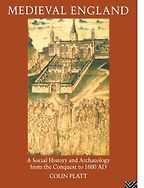
Let’s turn to the books that you’re recommending today. First up is Medieval England by Colin Platt, ‘a social history and archeology from the Conquest through to 1600,’ so covering quite a long period. Tell me about this book.
In the early 1990s, I was beginning to research social life in late medieval England. There were two historians who changed my entire perspective on what was possible. Both Colin Platt, the author of Medieval England, and Christopher Dyer—whose book we’ll come to in a minute—had one thing in common: they paid as much attention to archeological sources as they did historical ones. Chris Dyer is a historian who looks at archeology; Colin Platt is an archeologist who looks at historical sources.
Historians and archeologists don’t always see eye to eye. You’d have thought they’d be trying to attain the same ends, but, frequently, archeologists proceed in complete oblivion to what the historical record says. Likewise, historians sit in their libraries and pontificate about what happened in the past without going and looking at the ground, the remains, the places, the artefacts. These two historians reversed that. In fact, they put an end to that way of proceeding. Chris Dyer was so successful within academic circles that he revolutionized the study of social history of medieval England, and probably further afield.
Colin Platt is deceased now, but he was very thorough. He worked from the material culture outwards. His book showed me there is a way of integrating what I can go and look at for myself and the narrative about how medieval England changed—because medieval England changed so much between the 11th and the 16th centuries. You go from a world which is riven by violence, famine, hostility, hardship, slavery, fighting the Vikings, through to the age of Shakespeare. That’s an enormous transition. We talk about Shakespeare ‘speaking for us’, and yet Shakespeare would never have spoken for people in the early 11th century. Those transitional 500 years really made the modern world.
So to have that explained through the things you see around you, and the objects and the buildings of southern England….it’s one of those books where the scales fall from your eyes. You feel you can see in greater detail than ever before.
Medieval England made a huge impression on me about how much is possible when you tie the material culture with the written record.
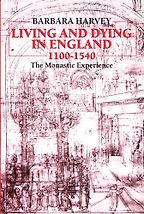
Let’s go on to the book by Barbara Harvey, Living and Dying in England 1100-1540: The Monastic Experience. So she’s looking at life in the Benedictine community at Westminster Abbey. Tell me more.
Barbara Harvey is one of those old-school academics, very rigorous and with a keen attention to primary sources. I don’t think she cites a secondary source in the entire book! For me, it’s about her scrutiny of the documents and the ways they could be used—and by documents, I mean those generated by the monks of Westminster Abbey and their staff. They include a lot of accounts, but also manuals and procedures. How did the monks live within the Abbey? It’s a very rich archive and she goes into it in painstaking detail.
For example, she gets a statistician to use all the figures she’s collected from the registers of novices and acolytes—the young monks—until their deaths, to calculate life expectancy within the Abbey. Now, since the Abbey was very wealthy, most of the monks came from high-status families, and there was no risk of them being killed in battle, you’d have thought they would live much longer lives.
Abbots frequently did live to very advanced years, but when you look at the monks as a whole, a remarkable fact emerges, which is that if you went into Westminster Abbey, you’d probably live five years less than the man in the street. So at a time when life expectancy at birth in society in general was about 35, life expectancy at Westminster Abbey was 30.
This statistical approach to the documentation blew my mind. You wonder, ‘How can this be?’ Then you realize that all these monks were sleeping and eating and sharing all sorts of things together. It was a hotbed of disease because the monks were exposed to every infection that came to town. They didn’t have the means to understand contagion, and even if they did, they couldn’t really isolate the sick.
So that’s Barbara Harvey’s approach to finding out how they were living and she goes across many different areas. What did the monks like to eat? Why was it that they introduced the misericord, a place where some monks could go off furtively and eat meat on certain days of the week, when they weren’t really meant to according to the rules of St Benedict?
They really liked bacon and eggs, so that was a real indulgence. But despite these proteins, they really were suffering more than most members of society, because of their vulnerability to disease.
So that book was very exciting for me, because it gave me exactly what I was looking for—a vision of what really was happening, based on primary sources with exactitude—and yet telling this fantastic story that I would not have otherwise known.
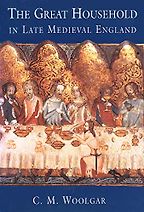
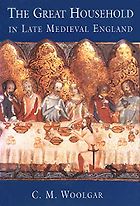
Let’s go on to the third book you’ve chosen. What can you tell me about The Great Household in Late Medieval England by C. M. Woolgar?
Like Barbara Harvey, Chris Woolgar has read an awful lot of accounts. In fact, he’s published a two-volume compendium of the medieval household accounts that survive for England. So he’s got a lot of experience in using primary sources.
In The Great Household, which is aimed at a wider audience, he explores the culture of late medieval England through the prism of the wealthy. Not only are rich people able to afford many more things, but they have left many more accounts of their attitudes, their approaches to the tangible things around them, their ideas, their beliefs—religious beliefs, but also their personal beliefs, their outlook, their superstitions, their attitudes to medicine. It’s a concise compendium of how the wealthy lived.
Chris Woolgar was working in the wake of Colin Platt, so he takes into account the fabric too. You’ll have attention paid to the rooms in a castle, and why we go from a society in the 12th century—when perhaps the lord of the manor would have had his own chamber but everybody else used to sleep in the hall—to a late medieval castle like Bodiam, built in the 1380s, where there were numerous private chambers for the officers of the household or for guests. Bodiam Castle had more than two dozen private chambers built within it. That changed the dynamics of a great household and charting that change is part of the book.
But the book also deals with things like what people smelled and when they used makeup and perfume in the late Middle Ages. It’s the entire culture of the upper class—not because they’re special, but because they’ve left the best records, which allows us the greatest accuracy. And we do know the middle classes tended to try and ape the upper classes, so this is indicative of some of the things that the lower ranks of society were aiming to achieve as well. It’s a real keyhole view of how people lived.
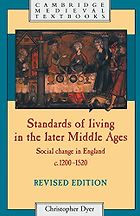
Now we’re at the seminal book you mentioned earlier, Standards of Living in the Later Middle Ages: Social Change in England c.1200-1520 by Christopher Dyer.
Yes, this is the book that really knocked my socks off in the reading room of the British Library back in the early 1990s. I can remember opening it at random and reading about how Chris Dyer was measuring the size of ruined peasant houses from the 14th century. I thought ‘Gosh. This takes everything to a whole new level.’ Previously, I’d been reading social histories that were not really pinned on accounts or objects or houses. They’d been drawn up by Victorian or early-twentieth-century historians, who were really working from the literary sources. So they’d read Chaucer, or Sir Gawain and the Green Knight, and then go on to tell you all about life in England based on these texts. This allowed no accuracy. They were full of impressions. The sources also tended to be written by the wealthy for an audience who were also wealthy, because they were the ones who were literate.
I had never imagined that somebody would manage to revolutionize history to this extent—to look at how big a medieval peasant house really was. How was it heated? What did they make the door from? What was the calorific intake? Can you calculate, for a peasant family, what they had in calories every day? He did it, and it’s just extraordinary what he achieved.
It also had repercussions. When it came to the Mary Rose excavation, the archeologists did the same thing. They worked out the calorific intake of all the sailors on the Mary Rose, given what was documented to be taken on board.
This way of approaching history, this real insight into the past, was just mind-blowing. I can still remember that moment. After seeing the measurements of peasant houses, and then the calculation of peasant calorific intake, I just thought, ‘Yes! History like I want it to be possible, is possible.’
I was very excited, as you can probably tell.
While we’re on the subject of calorific intake, I gather from your latest book that they didn’t eat much, did they?
You’re right. It was difficult to get protein in the Middle Ages if you were low status. And, most importantly, this affects our understanding of what things were worth.
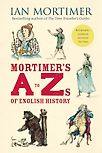
In Mortimer’s A to Zs of English History, I refer to the difficulties of comparing prices over time. If you want to know, say, what the equivalent of five pounds in today’s money was in the 13th century, there are two reputable machines online for doing this. One is the Bank of England’s inflation calculator. The other one is run by the National Archives. Both start in the 13th century, around 1270, and go through to the present day.
Now, if you take a median household income—which is £38,000 pounds today—and try to work out what that was 700 years ago, the Bank of England and the National Archives calculator will come out at around the same figure, around £60. This is totally wrong and misleading, because £60 pounds in 1325 was the equivalent to the manorial income from around 15,000 acres of land. You’d have had to be lord of three manors to have that sort of income in the past—and it’s one-and-a-half times as much money as you would have needed to be knighted in the early 14th century.
The fundamental error is that these calculators have regarded all things as having equal value to society down the centuries. But you really can’t compare because food was so scarce and more valuable in the Middle Ages.
So I use the unit of currency called the chicken. I point out that in the late 14th century, one day’s skilled labor—as, say, a thatcher or mason—would be the equivalent of one chicken. By Elizabethan times, it was about 10 pence for a day’s skilled labor, and about six pence for a chicken. By Restoration times, a day’s wage was about two shillings, and a chicken a shilling. In Regency times, you’re up to about ten shillings for labor and two and a half shillings for a chicken, so roughly a three-to-one ratio. Today, of course, a skilled laborer receives the equivalent of about 11-12 free range chickens for his money. Because food has become so much more affordable and is, in relative terms, less valuable, it’s thrown out all these figures.
Now, I started that comparison in the late 14th century after the Black Death of 1347-51. Before that event, the population was roughly twice as high—but there weren’t many more chickens. Protein was really, really scarce. If it hadn’t been for cheese, what would people have done in the 13th and early 14th centuries? You would not have seen the population grow to the level it did, because getting protein was so difficult.
In the 13th century, things were tough. The reason for so many gangs in the late 13th/early 14th century was simply starvation. People didn’t have enough food to live. After the Black Death, it was easier to get food. There is an irony in that the consequence of the Black Death was an increased life expectancy.
You mentioned animals at the start of Mortimer’s A to Zs of English History. One fact that was very striking is that cows were a third of the size they are now!
You don’t think of animals being different in the 14th century, but they were. And not just the ones we ate. All the squirrels were red. None of the modern dog breeds existed—they had different dog breeds.
Animals like cows, sheep and pigs have been bred and bred and bred all the way through. Sizes started changing in the 14th century, but in the 18th century they grew massively. A large Devon cow today—my local breed—is roughly 10 times the size of the average one from the Middle Ages.
So I began the book with A for animals, because that was one way of opening the door to things being different in ways you can’t necessarily anticipate.
So how does this latest book tie in with the Time Traveller’s Guides?
I wrote four Time Traveller’s Guides, which are attempts to show what life would be like in a particular period of time, if you could go there. So if you could go to the 14th century or Elizabeth I’s reign or Restoration England or Regency Britain, what would you eat or drink? What would you wear? Where would you stay? It presents a whole range of aspects of everyday life that people might want to know if they could go there.
I wrote all those books a number of years ago, and gave talks about each of them in the form of an A to Z of interesting things. There’d be big themes in there, and tiny things to make people realize all the things they didn’t know about the past. I wrote these talks expressly for people’s enjoyment, so one day I thought, ‘Why not publish them?’ I can include everything I’ve learned from this whole 25 years of looking at the past in the present tense.
So writing Mortimer’s A to Zs of English History was just great fun. It includes five A to Zs: the medieval one, the Elizabethan one, the Restoration, the Regency, and then my conclusions on the whole lot. So I can ask questions like: When was the best time to be a woman in the last 700 years? How does the class system survive? What can we learn from glass? Questions addressing the last 700 years of this country’s history that you can’t ask as a traditional historian suddenly become possible.
And looking back on those 700 years, in what period would you most want to be alive?
Now, definitely! I know too much about the past to want to go back there. I have no illusions. Some people think, ’Oh, you’d be alright if you were one of the wealthy.’
Well, consider this: between 1660 and 1700 there were 35 royal pregnancies. Of those 35 royal pregnancies, three children lived to adulthood. So you’re looking at less than 10% survival, and that’s for the royal family—who had access to the best physicians.
We’re not talking about the Middle Ages here. We’re talking about the 17th century, the time of the Scientific Revolution!
And when children die, it’s indicative of suffering throughout the whole family and society. It’s not just a lack of resources—though it is that for many families—it’s indicative of a lack of understanding, a lack of medical facilities to make things easier for everybody. It’s a real barometer of how much suffering there is.
It was really tough surviving in the past. We are the descendants of survivors. We aren’t the descendants of the ‘ordinary person’, because the ordinary person had such a hard time getting by that most of them died without children. We are the descendants of the lucky ones.
Yes, I think your statistic for the medieval period is that half the population was dead before the age of 20.
The median age was under 21, which is horrific. It means society was full of young people, on the one hand. It also means it was full of reckless people, because they didn’t have the life experience to calm them down. Some people lived to an advanced old age, but very, very few of them. Just 5% of the population lived to 60. I’m coming up 60 myself, so that’s a salutary thought…
Things weren’t much better in the 16th century; the Little Ice Age of the late 17th century was particularly tough. The Industrial Revolution was even worse. Life expectancy dropped as low as 13 in the unsewered parts of the industrial towns in the north. Life expectancy in working-class areas was 13¾ in some places, the lowest recorded anywhere on Earth at any time. You were better off being a slave on the plantations than growing up in Ashton-under-Lyne or Preston in the 1820s and 1830s.
So I have no illusions about the past being a wonderful place of freedom and exploration. It was a place of misery, and we are lucky that our ancestors survived to have us.
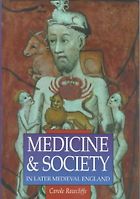
Let’s finish by looking at the last book you’re recommending, Medicine and Society in Later Medieval England by Carole Rawcliffe.
My PhD was in the social history of medicine. I concentrated on the 17th century; this book is about the medieval period. It’s an approachable study of the relationship between people in general and medical knowledge and medical treatment.
The great thing about the medical approach is that it’s a litmus test for how things are in general. If you want to understand how a society is getting by, look at people’s health, look at their diets and the impact on their bodies—because it’s the underpinning of everything they do.
How well were these medieval doctors functioning in terms of medical knowledge? Were they able to help?
Some of the earliest universities—Salerno, for example, in Italy—were founded to teach people medical texts. They offered didactic courses and there wasn’t much experimentation. They were largely forcing down students’ throats text translated back into Latin from Arabic sources which were preserved ancient sources, like the texts of Galen, written from the third century onwards.
So medieval doctors were not without knowledge. You and I would not trust it because, on the whole, the man and woman in the street today knows better than a medieval physician, surgeon, or apothecary. But they were able to impart hope to people. And, in some cases, especially with surgery, they did have good skills. They could conduct reliable operations. It has to be admitted that the chances of infection with a lot of these operations were very high because they had zero understanding of the necessity of cleanliness. They did not understand germ theory—no one did until the 1870s.
But increasingly through the 14th to 15th century, medical knowledge was one of the few areas of life where you can say without fear of contradiction that there was progress. It became more efficacious, more successful. There were English medical practitioners who were widely respected in their own day. John of Arderne, for example, wrote a book about how to proceed with an operation for anal fistula, which many men got from riding horses in wet weather for too long. His procedure for this was carried out many times successfully, apparently.
Then you have John Bradmore, who successfully managed to extricate an arrowhead that went into Prince Henry’s face at the Battle of Shrewsbury in 1403. How do you get out a barbed arrowhead that’s gone into the prince’s face without killing him? Well, Bradmore did it and wrote a treatise about how he did it, which is now in the British Library.
The medical men of the day were faced with huge challenges, but they rose to them. There’s a degree of courage in what they did. There’s a degree of knowledge in their achievements too. There’s also a social impact, basically buoying everybody and carrying them along. You get an ailment and it’s not necessarily the end.
And she covers all that in the book?
She covers a huge array of medical dimensions and social attitudes towards medicine and food in a relatively short book. I’d recommend it to anybody who’s got any interest in medieval society.
Interview by Sophie Roell, Editor
March 8, 2026. Updated: March 11, 2026
Five Books aims to keep its book recommendations and interviews up to date. If you are the interviewee and would like to update your choice of books (or even just what you say about them) please email us at [email protected]
Five Books interviews are expensive to produce. If you've enjoyed this interview, please support us by donating a small amount.