Adam, before we get onto the books, can you just very briefly say who Frederick was, why he was great, and why we should still take an interest in him today?
Frederick was the king of the German state of Prussia from 1740 until 1786. Prussia was the territories of the House of Hohenzollern. The Hohenzollern lands were scattered from the western parts of Germany all the way to East Prussia (which is now the Kaliningrad district of Russia), but were concentrated in what we would now describe as eastern Germany, east of the Elbe River, with the capital at Berlin. Frederick was the fourth in a succession of notably successful rulers of the Hohenzollern dynasty, starting with his great-grandfather, the so-called Great Elector, in the second half of the 17th century. Then came Frederick I, who succeeded in getting the Hohenzollerns the title of kings, linked specifically to their territory of East Prussia.
Then you had Frederick’s really rather unpleasant father, Frederick William I: a successful monarch, but not a personally sympathetic person, who built up the size of the Prussian army and was quite successful in accumulating financial reserves, which his son would find very useful when he acceded to the throne.
A theme that runs through all the book choices I have made is that Frederick was living in a time when new values were emerging, associated with what people typically call ‘the Enlightenment.’ There were starting to be alternatives to the traditional, more martial, ideas of what a king should be. The reason why Frederick succeeded at the time, and has succeeded since then, in achieving such a high reputation is that he succeeded in matching up to older ideas about a king being a military monarch and expanding their state as well as to newer, enlightened ideas. He abolished torture, he described himself—though I don’t buy it personally—as being the ‘first servant of the state, supposedly working for the common good rather than for his own personal benefit.
He was militarily extremely successful. Within a few months of coming to the throne, he invaded Silesia, which is now southern Poland but at the time was a province of the Austrian Habsburg Empire (the big hegemon in the German lands). Silesia was a very wealthy and populous province, and he spent the first half of his reign fighting a series of wars to hold on to it. The occupation of this single province increased Prussia’s revenues by 40% and hugely increased its population, forming the basis for Prussia to become a great power. In the latter part of his reign, Frederick joined with Austria and Russia in the carve-up of Poland: the First Partition of Poland, in 1772.
So, on the one hand, he was a successful military leader; on the other hand, he was a friend of many French philosophes, most notably Voltaire. He built the palace of Sanssouci in Potsdam, just outside modern Berlin, which is a noticeably small palace, with really only space for the king and a few of his intellectual intimates. He styles himself there as the great philosopher prince and has been honoured as such since then. He was also a very keen flute player and indeed composed his own music.
Frederick has continued to maintain a pretty high reputation because different aspects of him appeal to different people. He was attractive in Germany before the First World War as a strong military leader, and also under the Nazis for that reason. Since then, Germany has, of course, moved away from these military ways, but Frederick still gets substantial respect for his intellectual activities, as a patron of culture.
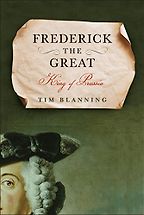
Let’s move on to the books. First up is Frederick the Great, King of Prussia, by Tim Blanning. Tell us why you’ve chosen this one.
Tim Blanning’s book is both an important academic work written by a senior scholar and also exactly the kind of properly descriptive biography that the general reader is looking for. If you’re looking for one book on Frederick the Great, this is it, without any doubt. There have been a lot of very important works on Frederick produced by German authors. I’m thinking particularly of Jürgen Luh’s Der Große, Thomas Biskup Friedrichs Größe, and the biographical studies by Wolfgang Burgdorf and Peter-Michael Hahn. These all came out as part of a huge flowering of literature on Frederick, marking the 300th anniversary of his birth in 2012.
Tim Blanning’s book was published just a few years afterward, and he incorporated all of this new scholarship that has been produced on Frederick in recent years. He produced a book that is very important for scholars but you can also read it without having any prior knowledge of Frederick. He tells the whole story in an entertaining and interesting way.
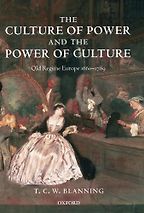
The next book up is also by Tim Blanning, The Culture of Power and the Power of Culture: Old Regime Europe 1660-1789. Tell us what this one is about and what this adds to the story of Frederick?
The crucial thing in understanding Frederick is to see a person who is operating both within traditional structures and traditional value sets of what monarchs should be doing, but also operating in very new circumstances, where people are thinking about what monarchs should be doing in very new ways. This book explains how monarchs across Europe in the 18th century were affected by the huge growth in the number of people who were reading, and the huge growth in written publications, starting from the 17th century and then continuing exponentially on into the 18th century. This period sees the development of public opinion as we nowadays understand it. That meant that monarchs were being judged in different ways, and so they had to legitimize their rule in different ways. Blanning describes how a number of rulers, including Frederick, did this. The book helps us understand how Frederick worked. He produced a huge number of writings, and Blanning explains this as Frederick engaging directly with the public sphere, becoming a producer of culture in his own right. This is a very, very important reason why his reputation stood so high at the time, and why he has been seen positively by many people since then.
Blanning’s book takes a very positive view of Frederick and how he related to the public sphere. The German scholar Andreas Pečar has recently published a book that does similar things, but shows how you can be more critical of Frederick, seeing him as somebody who quite cynically worked to promote his own image.
But certainly you can’t really understand Frederick without understanding the context of a reading public that is learning about monarchs and making judgments about them.
And what sort of things did Frederick himself write?
All sorts of things. Firstly, he was his own historian. He wrote a history of his dynasty up to his own accession. And then he wrote histories of his own reign in chunks. As soon as a portion of his own reign was finished, he quickly wrote its history. These have very substantially shaped the way in which we’ve seen Frederick and, indeed, Prussian history as a whole.
He also produced a lot of poetry. He even published it as the Works of the Philosophe of Sans-Souci. On top of that, he produced extensive military writings, which seem primarily to have been addressed to his military officers, to emphasize to them that he understood war.
His correspondence was not just about conveying information. He maintained a long correspondence with Voltaire, as well as other important intellectual figures, such as D’Alembert. And he’s not just writing to them in a private capacity. He expects them to share the letters, or certainly discuss the contents, with other people. This is a major way in which he engaged with the literary world and shaped public opinion.
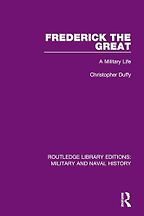
Next up, we’ve got Christopher Duffy’s Frederick the Great: A Military Life.
On the one hand, you have new, enlightened ideas. On the other hand, you have the more traditional role of a monarch, and Frederick fulfills this down to the ground. He is personally commander-in-chief of the Prussian armies. He acts as commander in the field, which is not unprecedented at the time, but he certainly goes further than most contemporary monarchs. Many monarchs in this period are taking the field. They expose themselves to danger and encourage the troops. But they are not generally there to oversee every detail personally. But Frederick is. I have argued that this is actually a response to enlightened ideas in many ways, because the idea is now that you need to show personal merit: it’s not just about being ruler through descent.
Christopher Duffy’s book is the essential description of Frederick’s activities as a general and very much accessible to the general reader. It’s 40 years old. When my own book comes out, I hope it will help us understand Frederick’s military leadership in slightly new ways. But Duffy’s is a very good book, and definitely the first stop shop for anybody who wants to understand Frederick as a soldier.
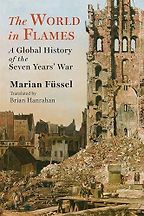
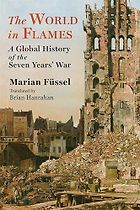
Number four is Marian Füssel, The World in Flames: A Global History of the Seven Years’ War.
This book is a very important example of new ways that people are looking at the history of war. Christopher Duffy’s book is very much a traditional, narrative military history. Marian Füssel’s book helps us to understand things like the perspectives of ordinary soldiers, how the violence of these wars was experienced by those caught up in them, and how people thought about who had won a battle in cases where it was indecisive.
The Seven Years’ War was the titanic struggle of Frederick’s reign. It was fought in central Europe as part of an attempt by Austria and its allies to recover Silesia from Prussia. At the same time, it was fought overseas, particularly between Britain and France over their lands in the Caribbean, America, and India. Marian Füssel’s book is one of the very rare works that combines all of these different parts of the Seven Years’ War together. It’s not a detailed narrative study in the way that Christopher Duffy’s book is, but for somebody who is interested in getting different perspectives on war in this period, and who is interested in connecting what Frederick is doing with what is also happening in America and India at this period, it’s the perfect choice.
Was Frederick allied with Britain or with France in the Seven Years’ War?
Frederick started out his reign allied with France against Austria. France and Austria were hereditary enemies, and both Frederick and Prussia suffered a series of humiliations at the hands of Austria during Frederick’s youth. Frederick himself was forced to marry someone acceptable to Austria, while his father wasn’t able to get Austrian support for acquiring various territories that Prussia wanted to add to its dominions.
So Frederick came to the throne very much opposed to the house of Austria. He was also aware that Austria was weak and primed for him to take some of their territories. France was a natural ally at that point. Frederick had learned, by observing French practice, that it was not helpful to get involved in long wars. You should try to keep your wars short, which he did successfully with his opening wars. But that meant making peace and leaving your allies to keep on fighting without you, which irritated the French hugely, and they came to the conclusion that Prussia was untrustworthy.
In the meantime, the world outside of Europe was becoming a much bigger game. The struggle with Britain for colonies and maritime trade became hugely more important for France, and so in 1756 you have the so-called reversal of alliances: France and Austria allied together. And Prussia ultimately ended up as the ally of Britain.
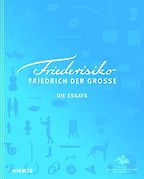
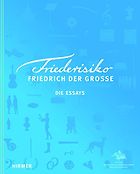
Finally, let’s move on to Friederisiko, which is in two volumes. Tell us about this one.
As I mentioned earlier, there was a huge outpouring of new work on Frederick to mark his 300th birthday in 2012. This has quite substantially changed our understanding of Frederick in all sorts of ways. Among other things, the custodians of the Prussian palaces produced a gigantic exhibition entitled Friederisiko, and accompanied it with a two-volume catalogue, richly illustrated with photographs from the exhibition and from the Prussian palaces.
To understand Frederick, you have to understand that he was working on several different planes simultaneously. I’ve talked about what he did militarily and also about how he communicated with the new reading public, not only through his patronage of culture but also by his own work as a writer.
Friederisiko really shows you the more visual aspects of what Frederick is doing to establish his own greatness. It gives you the opportunity to think about the magnificent palaces that he was building: not just his small palace of Sanssouci but his huge New Palace at Potsdam, which you can visit today in Potsdam Park.
The Friederisiko exhibition talked about all the different kinds of impressive things that Frederick put inside these palaces, whether it’s porcelain or crystal chandeliers: all part of the way in which monarchs in this period needed to display the pomp and circumstance of monarchy. The Friederisiko catalogue also includes a very, very important essay about Frederick’s sexuality, which emphasizes that he was almost certainly homosexual, although people didn’t quite use the word at the time.
Friederisiko helps the reader understand the visual dimensions of how Frederick established his greatness. It’s also a beautiful book that shows you wonderful images of Prussian palaces and the way they were decorated.
Finally, tell us about your own research.
I have done work on Frederick’s military ideas, trying to put them more into their broader cultural and intellectual context. There is a tendency to see Frederick as a very typically German military figure and connect him to what Germany was doing in the First and Second World Wars.
In fact, Frederick absolutely loved French culture. Everybody has always known this, and known that he was close to some of the French philosophes, but this has never really been connected with what he was doing militarily. People have been inclined to compartmentalize the two, and there have even been suggestions that Frederick was a fundamentally contradictory figure. I am finishing a book now that will bring these two together and show how things like French culture helped to shape Frederick’s war-making.
Five Books aims to keep its book recommendations and interviews up to date. If you are the interviewee and would like to update your choice of books (or even just what you say about them) please email us at [email protected]
Five Books interviews are expensive to produce. If you've enjoyed this interview, please support us by donating a small amount.