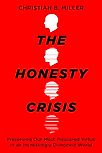
Society is facing an honesty crisis, argues Christian B. Miller, a professor of ethics and moral philosophy at Wake Forest University. Plagiarism, fake news and political deception are all commonplace in contemporary culture—and even the little white lies we tell every day are more problematic than you might think. Here, he recommends the best books on honesty and dishonesty.
It seems we live in a very dishonest age. Why choose to write and read about honesty now?
Dishonesty—which includes behaviors like lying, cheating, stealing, bullshitting, being hypocritical, misleading, and deceiving oneself—has been around for as long as there have been humans. But I choose to work on these issues now because, as the title of my most recent book indicates, I believe we are confronting an honesty crisis today. I wanted to both call out attention to this crisis and try to inspire people to do something about it.
An honesty crisis arises in an area of society whenever two things happen: first, dishonest behavior becomes significantly more incentivized or appealing, and, second, it also becomes easier to get away with. This strikes me as a toxic combination.
Actually, I think we are facing a number of different honesty crises today: AI-enabled student cheating, audio and video deepfakes, internet infidelity, and political misinformation on social media. The thread that ties them together is new technological development. I don’t claim that technology is ever inherently bad or dishonest. But AI, for instance, has equipped people with tools to plagiarize in ways that are more effective, efficient, and evasive than ever before.
You describe honesty as “our most treasured virtue.” More so than kindness? What place the little white lie?
This does sound like a bold claim! But I have some data to back it up. Some of my colleagues here at Wake Forest University ran a study where they forced people to rank order sixty different characteristics a person could have. Compassion was on the list, along with honesty and other traits like intelligence and humor. The rankings had to be done along three dimensions: what do you like the most about someone, what do respect the most about someone, and what do you want to know the most about someone. In all three cases, honesty was the number one characteristic. That’s pretty striking.
Now I admit that, as a philosopher, at the end of the day, I am not sure I would argue that honesty is the most important of all the virtues. But it does seem that people care about it an awful lot.
White lies are tricky. Yes, when we tell them, we sometimes do so to cover-up a minor wrongdoing or to avoid an argument or disapproving scowl. But sometimes we tell them for more compassionate or kind reasons, say to protect the feelings of another person we care about from being hurt. That is understandable, and shows that in some specific instances we value kindness over honesty. But we also know that there are other cases where we value honesty over kindness. Neither is absolute, and neither always trumps the other. Both are clearly incredibly important.
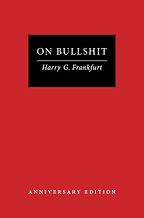
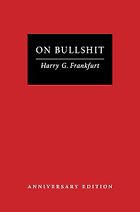
Let’s start with Harry Frankfurt’s On Bullshit. Perhaps you could begin its discussion by defining bullshit, and where it sits in relation to honesty and dishonesty?
I’ll let Frankfurt have the first word. He writes:
It is just this lack of connection to a concern with truth – this indifference to how things really are – that I regard as of the essence of bullshit.
When I make a bullshit statement, I am simply making stuff up. I don’t care whether it is true or whether it is false. I am, instead, making these statements out of concern for something else, such as what would benefit me.
For example, a shop clerk could be asked by a group of tourists if it is supposed to rain later today, and whether she recommends that they buy some umbrellas. The shop clerk has no idea. So she makes up a bullshit answer about there being thunderstorms in the forecast. Not because she believes it is false (in that case, she would be lying) or because she believes it is true (in that case, she would be honest). She simply has no idea, and grabs at the answer that will make her the most money.
There is little doubt that bullshitting is dishonest. To saying this, we have to accept that dishonesty has to do with more than telling lies. As I noted above, I think the category of dishonest behavior covers a lot of ground. At its core, and as I argue at length in my 2021 book, dishonesty is a matter of intentionally distorting or misrepresenting reality as the person takes it to be. That’s what the shop clerk is doing in intentionally misrepresenting her knowing what the weather will be like later in the day.
Why is the book worth reading? It’s quite a slim text, I think.
It is incredibly slim! In fact, it was originally just an article in a journal, and Princeton University Press had the brilliant idea of repackaging it into a book. It became a bestseller, and Frankfurt ended up on The Daily Show, 60 Minutes, and TheToday Show. That doesn’t normally happen to philosophers.
There are lots of reasons to read Frankfurt’s piece. It is fun and accessible. It provides great insight into the phenomenon of bullshit and helps us remember to not just focus on things like lying and misleading, which are different. But perhaps most of all, it helps us to better understand our current moment, where we seem to be awash in bullshit in places like politics and social media. Some philosophers have even argued that what AI generates is bullshit.
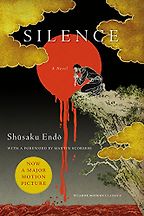
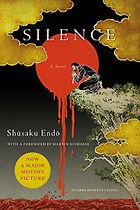
I think I agree! It’s a kind of confabulation designed to please its user. Your next book recommendation is Shūsaku Endō’s Silence. It sets up a direct ethical challenge to the case for honesty, is that right?
I think that’s right, but the really interesting question for me is, in what way does it challenge the case for honesty?
Endō’s book is set in 17th century Japan in the context of the persecution of Christians. The main character, Sebastião Rodrigues, is sent to Japan to help the persecuted church, but he is captured and told to publicly renounce his faith by intentionally stepping on a bronze image of Christ. If he resists, then many Christian peasants will continue to be tortured and killed because of his resistance. Eventually Rodrigues brings himself to step on the image, after hearing the voice of Jesus telling him to go ahead and do it.
In what way does dishonesty factor into this famous scene? Not in the usual ways – not primarily in terms of lying, cheating, or stealing. But it does emerge as hypocrisy. Rodrigues claims to be a follower of Christ, who has given his life to spread the gospel message. But then he is willing to trample an image of the very person who is meant to be his Lord.
Strikingly, though, Endō has Jesus approve of what Rodrigues does. His hypocrisy, then, get outweighed by something else. What? Presumably it is compassion for the suffering peasants. Protecting them is worth more than staying true to your deepest religious convictions. And so, as in other famous examples like the Nazi-at-the-door, we find that while honesty is an extremely important virtue, in some cases it can be outweighed. Preventing suffering and death can matter more.
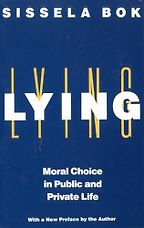
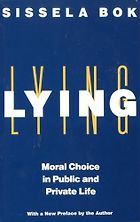
Yes, I still stand by that claim. Bok’s book came out in 1978, and even today it is still widely read and discussed. At the time, people in ethics were focusing a lot on justice and rights. Bok basically founded the contemporary ethical discussion of deception, and helped get ethicists to pay a lot more attention to truth telling and trust as well. This ended up being huge for bioethics, especially discussions of honesty when patients are dying.
Bok understands a lie as a statement with an intentionally deceptive message. As she rightly notes, the statement itself can be true, but it still could be a lie because what matters is the person’s intention behind making the statement. She goes on to defend what she calls the principle of veracity, which basically says lying is always presumptively wrong unless there are special reasons in a situation for lying.
One especially nice application of Bok’s argument, which I have also tried to support as well in my writings, is that white lies are far more problematic from a moral perspective than people typically assume. And we tend to downplay the harm that they often do.
Bok also has very informative discussions of deception in specific fields like medicine, law, and government. She covers a lot of ground and her book is still worth reading today.
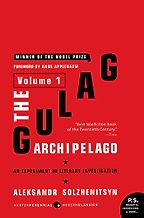
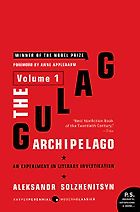
You’ve selected a novel next—Aleksandr Solzhenitsyn’s The Gulag Archipelago. What does it add to our discussion of dishonesty?
I think of it as more of a historical documentary combined with personal experience, philosophical reflection, and religious journey. Solzhenitsyn’s massive three volume work is an incredibly grim portrayal of what a society can look like that is through and through dishonesty. By painting such a horrific picture of Soviet communism and specifically how it treated prisoners, we can thereby come to appreciate even more the importance of honesty and related concepts like integrity and trust.
There are so many ways that dishonesty is operative in the society that Solzhenitsyn depicts. We see how self-deception can operative at a societal scale so that the Soviet people didn’t have to confront the horrors of what they were contributing to. We observe how environmental pressures can transform supposedly ordinary people into becoming willingly deceitful. We learn about victims’ names being erased from history as if they never existed in the first place.
But in my view the most jarring forms of dishonesty that Solzhenitsyn documents have to do with arrests, interrogations, and sentencing hearings. For example, he writes,
There is a very simple connection here. Once it was established that charges had to be brought at any cost and despite everything, threats, violence, tortures became inevitable. And the more fantastic the charges were, the more ferocious the interrogation had to be in order to force the required confession. Given the fact that the cases were always fabricated, violence and torture had to accompany them.
Solzhenitsyn goes on for dozens and dozens of pages about the horrific means used to secure dishonest “confessions,” including beatings, breaking the prisoner’s back, starvation, and confinement in bedbug-infested boxes. It is a depressing read, to be sure.
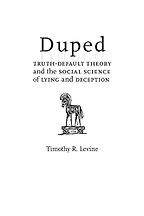
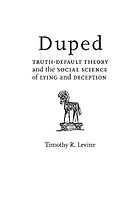
Levine is my favorite empirical researcher working on honesty and Duped deserves to be the classic discussion of truthful communication for years to come. On his view, which is called truth-default theory, most people tell the truth most of the time. It is only a small minority of people in a given population who lie frequently. This idea is now well supported with actual data finding that often the majority of participants report not telling a lie in the past 24 hours.
Related to this way of thinking is that we also tend to assume that other people are telling us the truth. As Levine writes,
Most people believe most of what is said by most other people most of the time. That is, most people can be said to be truth-biased most of the time.
Our default outlook is not that others lie to us, or even that we should reserve judgment and remain neutral until people earn our trust. Rather we typically just do trust what they say, unless they give us reasons to be skeptical.
Finally, Levine has found that we are usually not good at discerning other people’s lies. We think we can read lying from body language like lack of eye contact or nervousness, but it turns out that most people do no better than chance at figuring out whether another person is lying to them.
I do think that many of our current political travails lie in the public’s inability to judge truth from lies, and the general assumption towards honesty even when there is a great deal of evidence to the contrary. Would you agree? How do you see these forces playing out today?
Given what we just said about Levine’s theory, its implications for politics are tricky in my mind. Speaking just about the U.S. context, I suspect that many Americans have become so cynical about politics and it is so polarized right now, that they have actually switched into adopting a default untruthful attitude towards leading politicians in our society.
Or, I should say, they are not truth defaulting for those politicians specifically who are on the other side from their own political views. They needn’t be assuming that those politicians are always lying—perhaps sometimes they are misleading, or bulshitting, or being hypocritical—but at the same time they often aren’t assuming truthfulness is coming from them either. At the same time, they might be overly trusting towards political leaders on their side of the divide and not suitably critical of what they are saying.
This observation extends further to political media as well. One side is often going to default being skeptical towards Fox News or One America, while being overly trusting of MSNBC or CNN. The other side will do the reverse. And not just for traditional media platforms but also social media and political influencers online.
One of the greatest challenges here, then, is how to foster both greater intellectual humility about the limitations of your own political way of looking at things, and greater intellectual open-mindedness about the ideas put forward by the opposing way of looking at things.
Five Books aims to keep its book recommendations and interviews up to date. If you are the interviewee and would like to update your choice of books (or even just what you say about them) please email us at [email protected]
Five Books interviews are expensive to produce. If you've enjoyed this interview, please support us by donating a small amount.
Christian B. Miller
Christian B. Miller is the A. C. Reid Professor of Philosophy at Wake Forest University. He is the author of over 130 articles as well as Moral Psychology(2021) and four books with Oxford University Press: Moral Character: An Empirical Theory (2013), Character and Moral Psychology (2014), The Character Gap: How Good Are We?(2017), and Honesty: The Philosophy and Psychology of a Neglected Virtue (2021). He is a contributor for Forbes, and his writings have appeared in The New York Times, Wall Street Journal, Dallas Morning News, Slate, The Conversation, Newsweek, Aeon, and Christianity Today. Thanks to a $4.4 million grant from the John Templeton Foundation, he directed The Honesty Project, one of the largest research initiatives ever undertaken on honesty.
Christian B. Miller is the A. C. Reid Professor of Philosophy at Wake Forest University. He is the author of over 130 articles as well as Moral Psychology(2021) and four books with Oxford University Press: Moral Character: An Empirical Theory (2013), Character and Moral Psychology (2014), The Character Gap: How Good Are We?(2017), and Honesty: The Philosophy and Psychology of a Neglected Virtue (2021). He is a contributor for Forbes, and his writings have appeared in The New York Times, Wall Street Journal, Dallas Morning News, Slate, The Conversation, Newsweek, Aeon, and Christianity Today. Thanks to a $4.4 million grant from the John Templeton Foundation, he directed The Honesty Project, one of the largest research initiatives ever undertaken on honesty.