Could you introduce us to the concept of ‘Manifest Destiny’ and the role it has played in the history of the United States?
‘Manifest Destiny’ is a phrase that was coined at some point in the 1830s, and popped into American national discourse in 1845 when the editor of a very partisan Democratic Party journal invoked the term in order to lend support to the effort to annex Texas, at a time when the annexation of Texas by the United States was by no means a certain thing. He was trying to lend a sense of God-given inevitability to American expansion, or at least the absorption of Texas. The article went on to say that the United States should expand across the entire continent.
It does have a sense of there being a religious or supernatural element at play. Is that how people of that time would have seen it?
The words were certainly imbued with a religious element. The second part of your question is more interesting. I think people of the time would have seen it the same way that we see politicians today invoking the Almighty to justify a political position that they have; they would have seen it for what it is. So I don’t think that the Americans of the 1840s fell into line and said, ‘Well, John L. O’Sullivan says that God is on the side of American expansion, so I guess that settles the question!’
I look at it as political rhetoric. I don’t think it persuaded many people, necessarily, unless they were already persuaded that the United States should take on Texas.
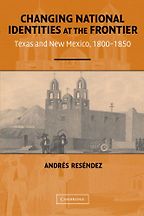
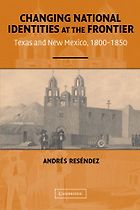
Interesting. Well, the first book that you’ve chosen to recommend looks at the Texas and New Mexico frontier. This is Changing National Identities at the Frontier by Andrés Reséndez, and it covers the period 1800 to 1850.
Andrés is an extremely skilled historian. He’s gone on to great success with other books as well, but this was his first. It was also one of the earliest books to challenge the idea of Manifest Destiny as a way of understanding what was happening in places like Texas.
To put it as concisely as I can, what Andrés is arguing is that national identities were relatively weak and unformed in this early part of the 19th century, and other identities that people had were oftentimes more important.
For instance, in Texas, if you were a member of a Masonic lodge, that might be more important to you than whether you happened to be an American citizen or a Mexican citizen; about half the land grants that American immigrants in Texas received from the government of Mexico went to members of one of the York Rite Masonic Lodges, because the legislature of the state of Coahuila was dominated by members of that lodge as well.
People wore their citizenship very lightly, is how I would put it. So giving up one’s American citizenship to become a Mexican citizen, where you received more land and you had this connection to other people in that state government through your lodge made sense.
I guess it helps me understand how these borderlands might be in flux, or ‘in play’ in some way, and how people within them might be accepting of that fact.
Yes, and one of the other things that Reséndez writes about is that institutions such as the Catholic Church connected people who lived in Texas or New Mexico to the rest of Mexico. But, economically, the northern frontier of Mexico was drifting into the orbit of the United States. So in both New Mexico and Texas, trade and commerce was being oriented towards the United States. That’s a much better way of understanding how they became detached from Mexico than the ideology of Manifest Destiny.
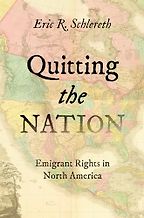
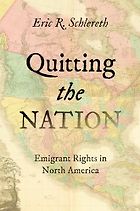
Got it, and I think we will be coming back to Texas shortly. First, can we look at your next book recommendation, Eric Schlereth’s Quitting the Nation?
This is a fascinating book that may seem to be on a very narrow, even abstruse, topic, but which overturns one notion that we have about the first half of the 19th century, that everybody wanted to be an American.
America was drawing in all sorts of immigrants; the United States was expanding its borders and Americans moved outwards and claimed more territory. But the point Eric is making is that for Americans in the first part of the 19th century, the right to leave, the right to emigrate from the United States, was a really critical thing. If you have the right to leave, it means that the United States is truly a democratic republic and not an oppressive regime.
That was an issue that was really important in this period, when there were lots of British seamen who jumped ship and latched onto American ships and declared themselves American citizens. The British government didn’t accept that as a real thing, so they would sail up alongside American ships, and if they saw anybody they knew was formerly in the British navy or formerly served on a British merchant ship, they would say, ‘You, you, and you, you’re being impressed into the British Navy.’ So the right to leave a regime and join another one was really critical.
“People of the time would have seen it the same way that we see politicians today invoking the Almighty to justify a political position”
One of the points that Schlereth makes about Texas is that Americans who went to Mexico were not merely half-way giving up their American citizenship, or thinking that they were the advanced guard for expansion, which is how partisans of Manifest Destiny interpretation have viewed immigration to Texas for a long time. Instead, he’s saying: this was a heartfelt belief that they were exercising their right as Americans not to be American any more. That’s what’s so counterintuitive about this. ‘I had the privilege of growing up in this place that is so free that I’m able to leave.’
He rolls into this interpretation other things as well, including the way that free blacks were able to emigrate to Canada. About 5000 went to Canada and Haiti in the first part of the 19th century. They saw this as an exercise of a privilege that they had won through freedom. Those same free blacks were very much against the forced emigration of free blacks to Liberia.
Does that make sense? It may sound like it’s only tangentially connected to Manifest Destiny, but to my mind it flips on its head our whole notion of the United States expanding. This is a way of trying to put things into context, to show how Americans had a very different sense of what it meant to be an American than what we imagine they thought.
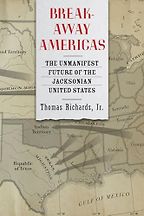
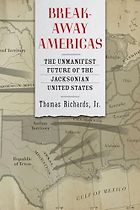
I think I understand. It certainly underlines how people on the ground had a far more complex relationship to expansion, borders, and ‘Manifest Destiny’ than perhaps we give them credit for. Does that bring us to Thomas Richards’ book Breakaway Americas?
Yes. I know when Tommy was writing this book originally, he thought about calling it ‘The Texas Moment.’ He’s looking at Americans who moved to places such as California, Oregon or Utah in the 1830s, when Texas had rebelled. For about 10 years, it was an independent republic, because the United States was not initially very eager to annex it.
All these other Americans, in these other places, had serious discussions and took concrete steps towards emulating Texas and creating republics for themselves. They might all—particularly Utah—have broken off and become independent republics.
To a lot of American politicians in the first part of the 19th century, that seemed totally understandable and normal to them. They had trouble visualising an American republic that spread across the entire continent. How, logistically, would you manage that in 1800? It just didn’t seem possible.
They were also quite concerned that if the United States expanded that way, it would simply become an empire. There’s no other way to control that much territory, except by assuming imperial form. So Thomas Jefferson, Thomas Hart Benton—a Missouri senator—all publicly talk about what will happen: Americans will move west, they will establish ‘sister republics’ populated by Americans, which will be allied to the United States and which will share some of the same institutional forms, but which will be sovereign. Because there’s no way to have a single state across the entire continent.
For a lot of Americans who started moving west—particularly in a place like Oregon—US institutions were so slow in getting there, particularly in establishing title to the land, immigrants to Oregon started setting up their own republic. They thought: ‘We need title to the land. The United States isn’t doing this. If we declare ourselves independent, we can start nailing this down.’
The Mormons who went to Utah were very much trying to get away from American institutions, and took a lot of concrete steps towards creating their own independent republic. That might have worked out for them in the 1850s.
So what Tommy does is challenge this idea that when Americans moved west, they were expanding the borders of the United States. He’s very careful to distinguish between Americans and the United States, as their interests did not align all the time. In fact, most of the time, as they moved west, they didn’t align.
What’s fascinating to me, as a British person, is how recent all of this seems to be. And yet how profound a question it is, in terms of identity. Are there echoes of this way of thinking that continue into the present?
That’s the question everybody’s thinking about right now. There are two schools of thought. One is that Manifest Destiny is this transcendent idea in the United States, one that is obviously animating the current administration right now. This is the idea that the United States has a God-given right to go wherever the hell it wants, and to take over territory.
The other one, which I lean towards, is that we need to talk about Manifest Destiny in context. In the context of the middle of the 19th century, it means particular things to particular people. I don’t think it had anywhere near the purchase that people think it had. It was by no means a consensus. There was considerable opposition to the idea of Manifest Destiny, or to any expansion. The Whig party wanted to keep the United States where it was, and just internally build up.
Donald Trump invoked the idea of Manifest Destiny in his second inaugural address. And he has obviously done aggressive and illegal things the same way that James Polk did. Does that make it the same thing, though? I don’t think so. I think they each belong to their particular historical context. Though he invoked the idea, it’s too simplistic to say that Manifest Destiny is the enduring trans-historical idea of American history, that keeps popping up, and Americans will always want to do this.
The Texas annexation is maybe one of the best cases. Texas became independent in 1835 and immediately wanted to be annexed. There was opposition to it for the next ten years. Each time the issue came up, anti-annexationists successfully defeated it. They kept turning down annexation until one time, in 1845, the pro-annexationists succeeded, and Texas became part of the United States. And that’s kind of how it works. There’s a lot of opposition to expansion, but pro-expansion supporters hammer at it and hammer at it. And they only need to succeed once. Opponents of expansion need to succeed every single time.
If you step back and look at the whole picture, it looks as if the United States is just inexorably expanding. We forget about how contested the whole idea was.
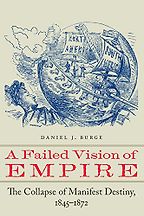
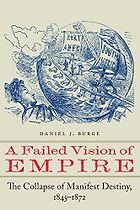
Let me move us on to Daniel Burge’s book A Failed Vision of Empire, which makes the case for what he calls ‘the collapse of Manifest Destiny’.
What Daniel does is very interesting. He looks at what became of Manifest Destiny after the U.S.-Mexico War, after the United States not only annexed Texas, but took an enormous chunk of territory that became California, Arizona, New Mexico, Nevada and Utah.
From our point of view, we tend to want more order in the past than there really was. So we will say: ‘Well, there was this moment of Manifest Destiny in the 1840s, and then it was done.’ But people didn’t immediately know it was done. There was a lot of talk about what would happen next—if they were going to keep taking on new land.
And there remained partisans of Manifest Destiny. This is why the United States buys Alaska in 1867. It’s why the Grant administration was looking to acquire Santo Domingo, and even before that the Pierce administration was trying to acquire Cuba. Those failed, in part, because there had always been resistance to Manifest Destiny. Resistance to expansion was more successful in those cases.
So he talks about how Manifest Destiny was this very contested idea, and how over the course of the rest of the 19th century, it became increasingly thought of as not something the United States wanted to do any more.
What Americans came to understand in the second part of the 19th century, after the Civil War, was the extent to which, up to and including the U.S.-Mexico War, expansion had been driven by slave-holding interests. They very much wanted to acquire Texas. They saw acquiring the rest of the Southwest as a place slavery could expand into. And so, in the second part of the 19th-century, that notion of expansion became delegitimised.
Interesting. I can see how, in the longer context you have given, we can see how expansion has taken place in fits and starts. Do you think it’s helpful to see Trump’s proposal to annex Greenland as a continuation along the same course?
I don’t think so. I mean, I hope not. I’ll put it that way.
I think that Donald Trump belongs to a 21st-century context. If we go back 50 years, we can see how Americans have, consciously and subconsciously, disassembled a lot of institutions and norms that would have prevented someone like Donald Trump from getting anywhere close to the presidency. And since taking office, Donald Trump has set out to disestablish the international norms that were created after World War II to prevent nations from violating the sovereignty of other nations. What is happening now is about the corruptibility of the American political system and the weakness of liberal internationalism.
That’s very different from how Americans were thinking in the middle of the 19th century. The United States was born as a republic in an age of Empire. It was on a continent with Spain—later Mexico—and Britain. It had to jostle for territory with these other, expansionist, empires. That’s a very different context.
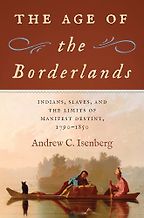
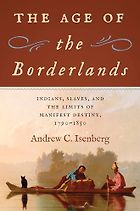
Then let’s turn back to the 19th century. Your own book is the fifth book you’ve selected for this list. This is The Age of the Borderlands: Indians, Slaves, and the Limits of Manifest Destiny: 1790-1850.
The biggest difference between then and now, is that now the United States is, if not the most powerful, then one of the most powerful nations in the world. That was not the case in the first part of the 19th century. That’s the major point I was trying to make in that book.
I explore different vignettes in the borderlands that only make sense if you begin with the realisation that the United States was weak, relative to those competing imperial powers. It was also weak, relative to some pretty powerful Indigenous nations. There were enslaved people who ran away into the borderlands, because the United States couldn’t exercise much power there. It’s not as if the United States was marching in and establishing its sovereignty through imperial military might. They didn’t have the power to do that. They had to win the goodwill of Indigenous people. They were negotiating diplomatically with them, and with imperial powers.
Americans who were dissatisfied with the United States in the age of Andrew Jackson moved out into the borderlands, where they put themselves under the protection of either an Indigenous nation or a competing imperial power, usually Mexico. They set up alternative experiments, almost like utopian communities, in a way.
I wrote about a guy who went to Texas when it was still a province of Mexico. He wanted to make Texas a haven for freed slaves, and actually got a contract from a Mexican state to establish such a thing. There was a group of missionaries who moved into what’s now the state of Minnesota who, rather than trying to acculturate Indigenous people to American norms, wanted to get away from American norms. They considered the United States saturated by sin. So they went to this remote place and kind of idealised the native people who were there. The Indigenous people weren’t Christians, but the missionaries saw them as unspoiled. They spent decades out there, with very little contact with the rest of the United States.
So if you start looking at what was really going on on the frontier, it was a very different place to this simplistic notion of American expansion.
To them, it wasn’t a place of Manifest Destiny, but of possibility, of alternate models.
They seized on the fact that the United States was weak in those places, and that gave them the opportunity to establish the kinds of communities they wanted to.
You do a wonderful job of turning established ideas on their heads.
When I was a very young historian, thirty years or so ago, I accepted the Manifest Destiny idea. Of course the United States was trying to expand west, and it was the dominant power on the continent. I wrote this book because, in the process of writing other books, I would stumble across things that didn’t fit the Manifest Destiny paradigm, take notes on them, and file them away. Over time, I realised these things I was writing up as exceptions to Manifest Destiny were so numerous that the rule didn’t work anymore.
We need to think about Manifest Destiny in a different way. It was an idea some people held in the 1830s and 1840s, but not all people, by any means. It has been presented as a kind of answer to American expansion. Why did the United States expand? Well, Manifest Destiny is part of the American character.
But the truth is a lot more problematic. As I was saying: people like the past to be orderly and simple. But the more you look at it, the more you realised how complex and disorderly the whole thing is.
Interview by Cal Flyn, Deputy Editor
February 11, 2026. Updated: February 12, 2026
Five Books aims to keep its book recommendations and interviews up to date. If you are the interviewee and would like to update your choice of books (or even just what you say about them) please email us at [email protected]
Five Books interviews are expensive to produce. If you've enjoyed this interview, please support us by donating a small amount.