Thank you for recommending these five books, which we have grouped together as ‘Shakespeare retellings’ of one form or another. Would you start us off by explaining how you interpret what retelling might entail?
Yes. There’s quite a permeable membrane between a ‘retelling’ and being ‘inspired by’ or written ‘in response to’. There are lots of different ways to interpret retelling.
I see it as something starting with a theme, or a character, or an aspect of a Shakespeare play, and doing something with it so that it becomes a different work of art. I’m personally less interested in a more straightforward retelling, basically the same story, but from the perspective of such-and-such-a character
There is so much breadth to Shakespeare, so much you can take from his work. It can inspire different kinds of writing that are quite tangential to the original plays.
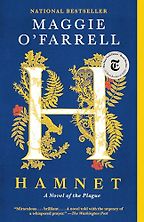
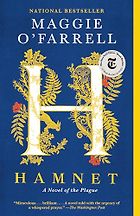
And there does seem to be so much hunger for these Shakespeare-adjacent stories, whether those involve plots derived from his plays, or even his actual life. On that note, perhaps we should discuss Hamnet by Maggie O’Farrell, which has been a true phenomenon, and was recently adapted into a Hollywood film. For those who haven’t come across Hamnet, it’s a fictional account of the death of Shakspeare’s son from the plague.
If I’m absolutely honest, I initially avoided this book because I was worried I would find it too upsetting. I have a son, and I’ve never written about bereavement as a parent—I think because I’m so scared of it. But I know what a courageous writer she is, having heard her interviews and read some of her other books. I thought: she will get to the heart of this. So, it came out in 2020, but I put off reading it for a while.
But I also wrote my PhD thesis on invented versions of Shakespeare. So I was very interested to hear that this book was about Shakespeare’s family. The real point of departure, the centre of the book, is not, in fact, Hamnet, but Agnes—the wife, who is quite an elemental, witchy kind of character with knowledge of folk medicines. Shakespeare is never named. He’s the slightly miserable and then absent husband. He’s a loving dad, but he doesn’t know what to do. I just loved that. It’s beautifully evoked.
It makes his working life as a writer both ordinary and extraordinary. Obviously, someone with the talent that he has is frustrated and unhappy when he can’t express it. So it’s her idea that he goes off to London. She knows he’ll be more fulfilled in the biggest city, and that’s where he started writing plays. But you don’t see much of that. You mainly see the domestic life around Stratford. Moving to and fro in time among the characters in the Shakespeare family.
At the climax she goes to London, angry that he has written this play. She’s thinking: is he writing about our son? But, of course, it’s Hamlet. So there’s a clue. Writing Hamlet is sort of giving Hamnet his life back. I puzzled over it a bit. I think that, in creating a character who is the most psychologically rounded character in Shakespeare, an extraordinary character, he has almost given Hamnet his adulthood. Hamlet the adult man makes choices that Hamnet the child didn’t get to make.
And it’s a beautiful book to read, with a true evocation of place. This is not a National Trust version of history.
It is interesting how not only Shakespeare’s most beloved characters have lived on in many different ways, but also Shakespeare himself. He is being reimagined constantly. Recently, for example, there was a book on the 2025 Wodehouse Prize for Comic Fiction shortlist, in which Shakespeare appears as an amateur detective investigating the murder of Christopher Marlowe.
Yes. That was something I studied, these different versions of Shakespeare. And the fact that Maggie O’Farrell doesn’t name him feels significant, because in a way he is only a name to us. At the start, she has a tiny intro about a couple who lived in Stratford. We see him as a family man, or a man frustrated by his family. That’s who he is. What’s important in this story is his relationship to Agnes and his children, not to his public.
In the mythology of Shakespeare, Anne Hathaway gets a bad press. She’s an older woman. They say that she wasn’t intellectual enough for him, he had to get away from her to do his thing. But this shows her as a powerful woman of her own agency, who actually says to him: ‘You should be in London.’ There’s no way in which she isn’t a good match.
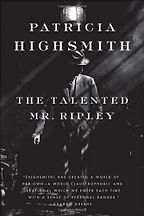
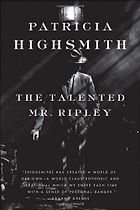
Can we talk next about Patricia Highsmith’s The Talented Mr Ripley? You suggest the plot to be drawn from Macbeth.
I’m not the only person who has spotted the similarity. Macbeth gets some good news: he is going to be Thane of Cawdor. Banquo, his mate, is like: ‘Well, that pretty good. Why are you looking so upset?’ But almost in the same breath, the Witches have told him that, also, he could be king.
In The Talented Mr Ripley, Tom Ripley gets some very good news. He’s given a lot of money by a very wealthy man to go off and find his son, Dickie Greenleaf, in Italy. Tom has been down on his lucky, with all these scammy little schemes going on. He’s a very dodgy character and everything is catching up with him. He could just have taken that money and had a rather nice time, slithered up the social scale a little bit—just as Macbeth could have been Thane of Cawdor. But as soon as he sees Dickie Greenleaf and his life, his charisma, the way he rides through life, he wants that for himself. He doesn’t immediately think: I’m going to murder this person. He wants to be his best friend. But when his influence is slipping, when they are on the boat, he kills him. That, to me, is the exact equivalent of bumping off Duncan.
“There is so much breadth to Shakespeare, so much you can take from his work”
Once Ripley’s done that, although he’s disguised the murder as an accident, things are going to catch up with him. There’s a period where he pretends to be Greenleaf. Then there’s a period where he goes to Venice and goes back to being himself. But there are always people on his tail who he thinks will reveal him. So he has to kill Freddie, and he thinks he will have to kill Dickie’s girlfriend Marge. Just as Macbeth, after that first murder of Duncan, has to start murdering people to stay where he is. The only way is down.
Another theme in both Macbeth and The Talented Mr Ripley is how disguise and subterfuge is mixed up with social status. A usurper is wearing the crown. What Patricia Highsmith has done is take on pre-existing myths, just as Macbeth itself took on older ideas about the Furies and the Fates and wise women from pagan Celtic mythology.
A key difference is that Ripley is famously amoral. He doesn’t have crises of conscience. He has crises of: ‘Oh my god, they might get me.’ But he doesn’t wonder: ’Am I a bad man?’ But, as with Macbeth, we are never really against him. We might not approve of him, but—as in Patrick Susskind’s Perfume, where the main character is a serial killer—you are always kind of rooting for him.
In each, we find someone who creates their new life through murder, and I think both Macbeth and Tom Ripley are compelling for that reason.
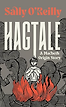
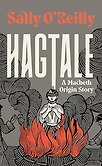
That’s interesting—echoes or reverberations of the older plot coming through. I think you took inspiration from the same play in your new book Hagtale, which has been subtitled ‘A Macbeth Origin Story.’
Yes, I’ve always been fascinated by Macbeth. I read it at school, and we also went to see Polanski’s Macbeth at the cinema. I was absolutely blown away by it, in particular, the Witches, who are amazingly evoked in that film. Polanski used three archetypes; not every production does. In Joel Coen’s more recent The Tragedy of Macbeth, they are identical, but Polanski went for the crone, the middle-aged witch, and the young maiden.
The witches have agency that far exceeds that of the kings. They are not punished, but influence the action. The kings are their puppets, is one way of looking at it.
The play itself is notoriously historically inaccurate. The real Macbeth, ruled for ten years, and was actually a good and peaceful leader. But Shakespeare wasn’t much bothered about that. He created a warlord who seized a throne not there for the taking, and the trouble follows on from this in Hagtale.
I wanted to take a story of male ambition and turn it around—make the witches the custodians of nature, which of course relates back to their mythical pagan function. I created two storylines to explore that—one, the story of a feral wolf child adopted by the witches, who eventually becomes Lady Macbeth, and another which takes place 300 years later, just after the Black Death in the 14th century, when a monk called Brother Rowan is given the job of saving records of these obscure Scottish kings from three centuries before. That’s the version of Macbeth that becomes Shakespeare’s play.
I’m yet another person to have come along and found my way into this story, and done it differently again. I wanted to write something feminist—inspired by Angela Carter’s short story ‘Wolf Alice’ in The Bloody Chamber, for instance—but also about climate, in a way that engaged people, and which would not seem preachy or didactic. I felt that Shakespeare’s power of storytelling is such that you can kind of co-opt his story and make it into an eco-fable.
In Macbeth, Birnam Wood is seen to move when the soldiers use branches as camouflage. In my story, the forest is moving because it is very angry. It literally moves. I use that image from the play as an opening mission statement. But I chose not to use Shakespearean language, because to me that is sacrosanct.
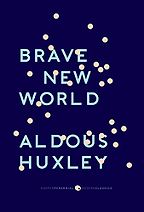
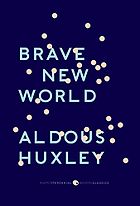
Can I move you on to your next book recommendation? This is Aldous Huxley’s 1931 dystopia Brave New World, in which the characters very explicitly quote from the works of Shakespeare. The title is taken from The Tempest. Perhaps you’d tell us more?
Yes, I reread this recently and, my god, there are so many ideas in this book! It’s kind of exploding. It could have been written now .The prose itself doesn’t feel contemporary, but at its core is a take-down of American culture of that time. The 1930s were the time of the Great Depression, and it’s all about Fordism. Ford is the god. They measure their calendar by Henry Ford, and there are a lot of jokes all through the book around that. So it has a dark humour around the capitalist consumer economy that was already set up in America at the time.
Then you have Bernard as the main character and Lenina, his love interest. He’s a bit of an outsider. When he was born as a kind of test tube baby, there was a slight glitch, so he is not totally with the programme. She is totally with the programme. She’s gorgeous, and there is a very polyamorous culture.
The character who immediately connects the story into The Tempest is John, a character Bernard meets in the ‘Savage Reservation’. He is natural-born, that is, he has parents, and he is in this reservation with his mother as a kind of exile. Then he is brought back into the mainstream society. He has absorbed all this Shakespeare—the Complete Works of Shakespeare was the only book he had in the reservation—so he’s steeped in it, and when he leaves the reservation he finds a world where everybody is taking Soma and contriving not to have extreme emotions about anything.
Everything is very homogenised. There’s mechanised work, a very stratified society. People are compliant, very obedient. He rages against that through this Shakespearean language. In one particular scene he says he wants the right to be unhappy. To me, that really resonates with the current moment, because it seems that we live a very numbed and increasingly dumbed down culture, either through the entertainment we are absorbing or the lifestyles people are living. There’s a lot of Soma in the modern world.
What Huxley is actually doing with this Shakespearean language is, I think, quite difficult to read. In one way, it’s absolute liberation. John Savage has an understanding of the human spirit through this language. He has absorbed it in a childlike way, without really knowing anything about human beings. When he wants to have sexual encounters, he is terrified. So his responses to it are quite weird in some ways. I wasn’t sure how to read that, but it seems to me that at the heart of the book is this notion that human beings can’t create a utopia without it being heavily controlled. The language that he has learned allows him to experience emotion, but he doesn’t know how to control that emotion or how to limit it, and so, in the end, it destroys him.
I think it’s a critique of The Tempest, or the island on which we find Prospero living, which is a kind of utopia in the play. The Tempest ends on this hopeful note, one of forgiveness and reconciliation. Brave New World ends with suicide. It’s a savage, nihilistic end. Around halfway through, you think: Maybe there’s hope? But there isn’t. Savage can’t function in this world with the equipment he has. The language of Shakespeare doesn’t, ultimately, help him.
In that way, he’s a little like Winston Smith in 1984. One person raging against the machine is not able to challenge it. There’s a romantic notion that this is possible, but he is crushed by the environments, and cannot live. So the ending is very bleak.
I’m sure there are more sophisticated readings of the book, but that’s how it came to me. It’s a very rich book, just bursting with ideas around how Western culture is going to go. Some people have said that it is more prescient, in some ways, than 1984, and I think it certainly says a lot about life as we live it. So, in that sense, it has a Shakespearean reach.
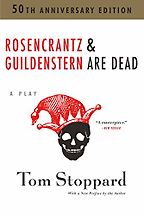
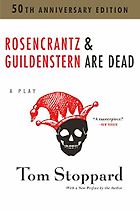
Next, you’ve selected Tom Stoppard’s playscript for Rosencrantz and Guildenstern are Dead.
Rosencrantz and Guildenstern are two courtiers in Hamlet. They are bit-parts, really, essentially messengers who are also friends of Hamlet. They are sent away from the court for a while, they come back, have some exchanges with Hamlet. They are given a letter, and end up being killed. If Tom Stoppard hadn’t written a play about them, they would be a footnote in a list of Shakespeare’s minor characters. There is no real exploration of their characters. Hamlet is this great, psychologically-rounded, existentially traumatised character. Then there are these two. Basically puppets.
What Tom Stoppard does is switch it so that they are the main characters, but they have no backstory. They don’t really know who they are, or even which one is which. And they don’t even particularly care. The play is full of these little jokes.
Hamlet appears, and so do members of his family. Claudius and Gertrude and Ophelia appear, and when they do it’s very wittily and brilliantly done. They are still speaking lines from the Shakespeare play. So it’s like you are being trollied off and on in an actual performance with these characters. Quite often there are gaps where they don’t know what’s happened during the gap. There’s a bit where they appear on a boat, and they don’t know how they got there. They have this letter, so they read it. There’s a sense of them as lost souls. They keep asking each other questions about what is going on.
Another joke that plays all the way through is this joke about chance and fate. They start off by tossing a coin. I think it lands heads-up 94 times in a row. I can’t remember if it’s Rosencrantz or Guildenstern who wins, but that doesn’t matter. This is a post-Samuel Beckett world, the world of absurdist drama. It’s extremely bizarre and extremely funny in a bleak, nihilistic way.
Hamlet is itself a meta-play. There’s a play within a play—you know:
the play’s the thing
Wherein I’ll catch the conscience of the king
The players from that play are characters in Rosencrantz & Guildernstern are Dead. So they are meta anyway, already.
Then there’s a scene with lots of jokes about how they all have such terrible roles, because it’s one of those revenge plays: everybody gets raped or murdered. All their entertainments involve being horribly killed. Which hasn’t changed much, has it?
There’s one bit where The Player, the main tragedian, dies horribly. You think he’s been stabbed. It’s quite visceral. Then he stands up again. Everyone is going to die in this play, and there are lots of jokes about that, and bleak references to the fact that we are all mortal. Rosencrantz and Guilderstern are aware of themselves as only being needed for this particular play.
It’s just so cleverly done, and I think of it as a more intellectual prequel to Shakespeare in Love, where Stoppard does very similar things, mixing in Romeo & Juliet, and less obvious Shakespeare plays as well. There are lots of jokes about theatre in Shakespeare in Love.
At the same time it does what I think the best retellings do: it makes you see Hamlet, the play, differently. You think of the workings of it in a different way, about the gaps in a play, how it is pared down. I think it refreshes watching any play, really, because it’s about theatrical staging more generally.
Great recommendation. As an aside, what are your thoughts on the film Shakespeare in Love?
I loved it. I also saw the stage version ten years ago, and I loved the freshness of it. It felt like a completely different version of Shakespeare’s world to anything I had ever seen before. I loved the jokes in it—the scene where Shakespeare has a quill, and is balling up pieces of paper and throwing them into a bin, like the screenwriter of film cliché with his Remington typewriter. There’s lots of stuff like that—just him running around trying to write a play against time. That probably is like working in Hollywood. Shakespeare has loads of ideas that are a bit crap, and the titles are a bit rubbish, and people are always suggesting alternatives. I loved all that.
Shakespeare in Love doesn’t take it too seriously, but it does make a serious contribution to how you think. There’s this idea of the great genius, a white male whose genius just pours out of him, and we must all bow down before him. But this is much more expedient, the plays are just something he throws together to beat his deadline, or to keep somebody happy, or pay off the debt. I think a lot of writers can empathise with that. The idea that Shakespeare had all that crap to deal with as well—and didn’t know he was Shakespeare—I love that.
Hilary Mantel said she wanted to walk along the corridors with the people who didn’t know what was going to happen. I love that you can do that with Shakespeare too. He just thinks:’ I need to write a play.’
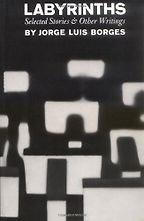
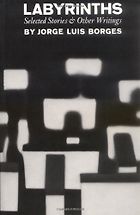
We’ve circled back around to Shakespeare’s own life. Let’s talk next about Jorge Luis Borges’s ‘Everything and Nothing’, which can be found in the collection Labyrinths.
Yes, first of all let me say there is a companion story to this, which is called ‘Shakespeare’s Memory,’ in The Book of Sand, which came out later. But both make the same point, which is this idea of Shakespeare having become some sort of god-like figure, somebody about whom we need to know. We need biographical detail, because if we have that we might get some insight into his creative process.
In ‘Shakespeare’s Memory,’ a short story, a man meets someone at a conference. They get drunk together, and this person says: ‘I can pass Shakespeare’s memory onto you, if you’d like to have it. Just say these words, it’ll be yours.’ So this happens. We get the memory—and the memory is taken up with things like smells, faces you don’t recognise, certain books. Chaotic bits and pieces, and quite unpleasant emotion—a feeling of coldness.
The man feels cursed by it. There’s a short period when he feels as if he’s having amazing insights, but he doesn’t know what they are. He feels he’s on the brink of some kind of knowledge, but he doesn’t know what that knowledge is. Then he gets horribly depressed.
He goes to a call box, phones loads of numbers, and speaks to anyone who sounds like an adult male—a woman or child, he thinks, couldn’t cope—until eventually he passes the memory on to the person on the other end of the phone.
‘Everything and Nothing’ is even shorter. It’s just a summary of what Shakespeare feels he is, and that sort of feels like nothing. In both, there’s a sense that he is making plays out of a lack, rather than abundance. He’s driven to it because of what isn’t there as much as what is. His experience is trivial and terrible, but the trivial and terrible for him somehow becomes universal. There’s nothing in his life worth knowing, because he’s just anyone.
There was a great burgeoning industry of Shakespearean biography in the Victorian period. A white Englishman cleverer and more gifted than any other person in the history of the world somehow validated the British Empire, which was being busily expanded at that moment. Or so they thought. Everybody was putting up statues everywhere. There were lots of florid stories about Shakespeare’s youth.
Then we had people like George Bernard Shaw, who sort of laughed at him. Except Bernard Shaw thought he was Shakespeare’s heir, and also a genius, so that slightly threw him off the scent.
Eventually we got to Borges, who basically said: ‘No, this is it. You’re not going to understand more.’
I love writers’ biographies, whether it’s a TV documentary or a book. But I can really see what he’s saying, particularly in relation to Shakespeare and the Shakespeare industry, which still privileges giftedness of a certain kind—this idea of God-given talents, which set somebody apart. But Borges connects it back to this idea of the extraordinary in the ordinary—that somebody who is not exceptional in their personal qualities or life experience can still be somebody who produces something extraordinary. And how that happens is a mystery. And I think he does that brilliantly.
It’s elliptical. There’s not much there in the Borges version, but that makes you imagine more. He, himself, is saying, let’s not know things about Shakespeare, so we can just experience his plays.
Interview by Cal Flyn, Deputy Editor
January 7, 2026
Five Books aims to keep its book recommendations and interviews up to date. If you are the interviewee and would like to update your choice of books (or even just what you say about them) please email us at [email protected]
Five Books interviews are expensive to produce. If you've enjoyed this interview, please support us by donating a small amount.