Whether you are preparing for a trip to Japan, are a fan of manga and anime, or simply curious about a non-European language, you might want to try your hand at learning Japanese. With recommendations ranging from Japanese textbooks for beginners, via an up-to-date guide to Japanese society and culture, to helpful online resources, experienced language teacher Kazuki Morimoto explains how to set about studying Japanese.
Before we get to the books themselves, can you give an overview of how someone might want to set about learning Japanese?
It depends on how you would like to learn — self-study, or go to school or university, or do an evening course — and how much you’d like to learn. That’s why I chose various different types of textbooks to recommend. Out of the five books I’d like to recommend today, four are language textbooks for beginners, and the last one is an introduction of Japanese culture and society.
What are the main reasons for your students to want to learn Japanese? Are they mostly interested in Japanese culture, or in linguistics, or are they looking for a challenge after learning a European language?
It’s a combination of all that, but most of our students are very interested in Japanese culture and society, which are quite different from European cultures. Some students are interested in learning a new language with written characters, and different structures and pragmatics, like how the politeness works — the social aspect of language.
Can you give a brief introduction to what kind of language Japanese is?
This is a very difficult question because Japanese is really distinct. The grammar of Japanese may be similar to the Korean language, in terms of the use of particles for example, but it’s still quite different. The order is subject, then object, and then the verb comes at the end, so translation could be really challenging, because until you listen to the last bit, you don’t know whether the sentence would be negative or positive.
Another distinctiveness is about the characters. We use two different types of Japanese characters. One is called hiragana, with 46 characters, and another one is katakana, which has another 46 characters. And then the native speaker of Japanese learns about two thousand Chinese characters by the time they complete their compulsory education.
Can you elaborate a bit on the three different scripts, and how they are used in Japanese?
You can write everything in hiragana if you want, but because there are so many words with the same pronunciation, without using Chinese characters it’s hard to read. Hiragana is nowadays mostly used for grammatical functions, such as particles and sentence endings. Most of the content words are written in Chinese characters, kanji. Katakana is used for foreign loan words, mostly from English. For example, ‘terebi’, which means television, and ‘rajio’, which means radio, are written in katakana, showing that those words are coming from a foreign root.
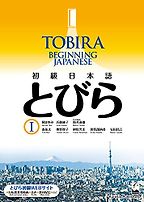
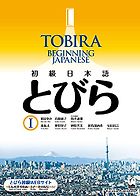
Let’s move on to your first recommendation, which is a textbook called Tobira 1: Beginning Japanese. Can you tell me about it?
Tobira means ‘a door’. Originally, when the first Tobira book was published back in 2009, it was an intermediate version, so the title was named like a door opening to a more advanced level. That book was really popular, so in 2021 Tobira 1: Beginning Japanese was published. We’re using it in our degree course. It’s really good because it offers a comprehensive coverage of vocabulary, grammar, and Chinese characters and all four skills — reading, writing, listening and speaking. It is relatively new, and comes with very updated materials, which are all available online.
If you want to learn Japanese on your own without going to school you can still use this textbook, because it comes with short, ten-minute grammar videos that explain specific grammar points in English. This book is full of practical drills which are very useful in actual settings, including role play and specific, context-based conversation. It has the 139 basic kanji, the Chinese characters, which are explained very well and integrated with practice so the student can learn them in context.
Do you find that your students are prepared for the commitment required to learn Japanese? How do you keep them motivated to put in time and effort?
Depending on the students, they find some aspects more interesting. Some students are very good at picking up vocabulary through anime and manga, and even songs. Some are really good at memorising the many different characters. With Chinese characters, each one has a specific meaning, like ‘flower’ or ‘tree’, and then there are combinations, and some students are very imaginative and learn as if they learn pictures. So, depending on the type of student, they are motivated to learn in different ways.
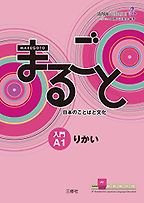
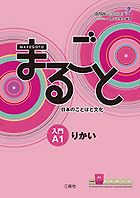
Let’s go on to the next book, Marugoto: Japanese Language and Culture Starter A1 Coursebook for Communicative Language Competences, by the Japan Foundation.
The Japan Foundation is an independent nonprofit organisation, but it used to be a government body, so it is a reliable and well-established organisation. The main purpose of the Japan Foundation is to promote Japanese culture and cultural activities, including Japanese language, all over the world. The Japan Foundation took the initiative to invent their own language standard based on the CEFR, the Common European Framework of Reference for Languages. It is called the JF standard, and is very clear and theoretically structured.
This textbook is also their initiative. It emphasises the learner’s interaction and cultural understanding, which is integrated with language skills. It is the first in a series, starting from beginner, A1. You can study continuously using the same series of textbooks until intermediate level. The next book is A2, and the A books are both considered as a beginner’s elementary level. B1 is intermediate and B2 is higher intermediate. There is a complementary book called Marugoto: Japanese Language and Culture Starter A1 Coursebook for Communicative Language Activities, which is more activity-based and less about understanding structures, giving flexibility depending on learner goals.
With this series, students can see exactly what they will be able to do by mastering each particular textbook, so it’s ideal in terms of aims and objectives and progress. That’s something I highly recommend.
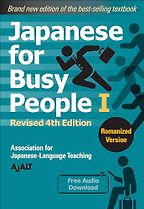
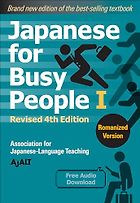
Next up of your book recommendations is Japanese for Busy People Book 1, by the Association for Japanese Language Teaching.
It’s a very popular textbook. It’s quite different from the other two textbooks which I mentioned, because it is mostly for businessmen. As the title suggests, it’s Japanese for busy people, tailored towards practical business and everyday Japanese. Quite often, a businessman will think, ‘I want to learn Japanese’ or ‘I’m going to Japan for business so I need to learn Japanese, but I don’t have the time to learn all the characters.’ That’s why this textbook has two versions, one with the kana (the Japanese characters), and a Romanised version for the busy people who don’t necessarily have time to learn the characters.
By a Romanised version, you mean a version of the textbook with no Japanese writing, just Roman letters?
Yes. This textbook with the Romanised version is mostly written in the Roman alphabet, so you don’t necessarily have to understand the Japanese characters. It emphasises conversational competence and functionality.
I noticed you can also download audio with it. The version I looked at introduces the hiragana syllabary on one page and katakana on another, so readers can see what they look like even if they don’t want to learn to write Japanese.
It’s very user-friendly and has all sorts of scenes and context, practical settings which you may encounter if you go to Japan for business or for a short trip. This textbook has clear, simple explanations of grammar and can be used mostly for self-learning, but it’s also very suitable to use with a one-to-one tutor. If you ask a tutor to teach you Japanese, then this textbook is one of the best ones.
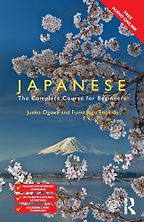
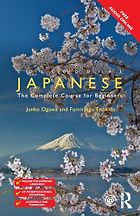
Your next book recommendation for learning Japanese is Colloquial Japanese: The Complete Course for Beginners. Why do you recommend this one?
This is a very beginner-friendly course, focusing on natural spoken and written Japanese. This book is compact and concisely written, but still well structured in terms of grammar explanations and the progression of language acquisition. It has a good mix of listening, speaking, reading and writing, with practice material.
I used to work together with these two authors, Junko Ogawa and Fumitsugu Enokida. They work in a university setting and teach Japanese both as a degree and as an optional subject, so they pitch at different levels depending on the student. This textbook is useful particularly if you want to study Japanese at a more casual pace, rather than achieve a certain level like intermediate or a full degree. It includes dialogues and audio by native speakers, with emphasis on idiomatic language and pronunciation. So if you just want to try Japanese, then this textbook can be very useful.
It mentions two styles of speech: polite and plain. Can you explain for our readers, please?
I start by teaching the polite style first, because as an adult you don’t want to be considered impolite. Polite speech is easier to learn and safer to use. But when young learners go to Japan, of course they want to use more like a casual, colloquial style of speech, which is plain style. As you advance in your study, the plain style can also be used in written Japanese, like essay writing and academic writing, because you don’t have to be polite to write academic content. But for beginners, I explain that the polite style is to show your politeness, and the plain one is more for casual speech.
When I studied in Japan, I had to learn to use honorific and humble verbs and so on, depending on the situation. Do people still use those to the same extent, or have things changed in recent years?
Honorifics are still a very important part of Japanese language, particularly in the service industry, such as hotels and restaurants.
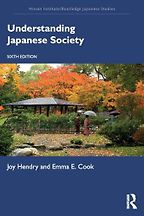
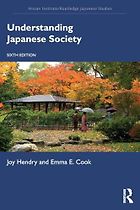
We have come to your final pick, Understanding Japanese Society, written by anthropologist Joy Hendry. The sixth edition has come out recently, with new content by Emma Cook, so it is very up to date. Can you introduce it?
This book is quite different from the language textbooks. It is all written in English with explanations about Japanese culture and society. It has scholarly yet accessible analysis from a Western perspective, and provides essential cultural and social context to complement language learning.
What I found interesting with this book was that it explains social norms and behaviours and contemporary issues in Japan. By reading this textbook, you will have a better understanding of how Japanese society works and how Japanese people think. So, for people going to Japan, particularly for study abroad but even for a short stay, I think this textbook will help.
Can you recommend any online resources to support Japanese language learning?
Yes, using apps and websites can definitely help. I recommend Nihongoena, an excellent portal site with various types of learning tools. Jisho is the most versatile and popular online dictionary for English speakers. Many of the newer textbooks are competing with each other, with a variety of materials available for free. All the newest textbooks explain specifics about how to write the characters, even including some short movies. The websites that come with textbooks such as Tobira and Marugoto are really well built.
For someone making good progress with the language, who wants to make the jump to reading Japanese literature, what is the first short story collection or short novel you would suggest?
I would recommend Breaking into Japanese Literature: Seven Modern Classics in Parallel Textwhich has a vocabulary list and English translation, so learners can enjoy stories by the famous authors Natsume Soseki and Akutagawa Ryunosuke. Bokko-chan and other “short short” stories by Shin’ichi Hoshi are among the most popular readings. Kiki and the Other Witch (Kiki’s Delivery Service Volume 3) is part of the novel series by Eiko Kadono that became the basis for the Studio Ghibli film Kiki’s Delivery Service, and it is written in relatively simple Japanese.
You have introduced many different textbooks for beginners wanting to learn Japanese. To summarise, which book would you recommend for what purpose?
If you are going to Japan for a trip, I would choose Japanese for Busy People or Colloquial Japanese. If you want to study Japanese as a degree, or you want to go to Japan for study and continue up to higher intermediate or even advanced level, then Tobira would be a very good one.
And if you want to learn Japanese more out of curiosity, as a cognitive challenge?
Japanese for Busy People is a good one even if you don’t necessarily plan to go to Japan, and Colloquial Japanese as well, because it is full of grammatical explanations. Marugoto and Tobira are designed for progression, but they come with a lot of practice which anyone might find interesting.
Five Books aims to keep its book recommendations and interviews up to date. If you are the interviewee and would like to update your choice of books (or even just what you say about them) please email us at [email protected]
Five Books interviews are expensive to produce. If you've enjoyed this interview, please support us by donating a small amount.
Kazuki Morimoto
Kazuki Morimoto is Associate Professor of Japanese and Co-Director of East Asian Studies at the University of Leeds. With an MA in Teaching Japanese as a Foreign Language from the University of Iowa, his areas of expertise include foreign language education and teaching methodology, English-Japanese translation, and study abroad in Japan.
Kazuki Morimoto is Associate Professor of Japanese and Co-Director of East Asian Studies at the University of Leeds. With an MA in Teaching Japanese as a Foreign Language from the University of Iowa, his areas of expertise include foreign language education and teaching methodology, English-Japanese translation, and study abroad in Japan.