The European Bank for Reconstruction and Development (EBRD) was set up after the fall of the Soviet Union to support countries in transition. The EBRD Literature Prize has been running since 2018 and can be won by any novel, translated into English, written by a living author from a country where the Bank invests. Literary critic Maya Jaggi, chair of the prize's independent judging panel, talks us through the novels that won between 2021 and 2025, a wonderful introduction to some excellent contemporary novels from Central and Eastern Europe.
Before we get to the books, I wondered whether you could tell me a bit about the EBRD Literature Prize. What kind of books are judges looking for?
The EBRD Literature Prize was founded by the European Bank for Reconstruction and Development. Unusually, the EBRD doesn’t just sponsor the prize: it started and runs it, and it’s funded via its shareholders. The prize began partly as an engagement exercise for its own staff. The EBRD is a huge organisation which works across three continents. Many of its original countries of operation are still in transition, because the EBRD began after the collapse of communism in 1989, and the establishment in 1990-1 of the post-Soviet states. The prize is shared between authors of novels or collections of short stories, who are nationals or former nationals of any of the more than 40 economies where the bank now invests, and their English-language translators.
This is my third year as chair of the independent panel of judges. Previously, I was invited to be a judge by the then chair, Toby Lichtig, Politics and Fiction Editor at the TLS. So I’ve already had three years of judging the prize and have had a chance to make comparisons. The prize is really very broad. We don’t disclose the exact criteria for why people are shortlisted or win, but it’s a prize given for quality, originality and cultural significance. So that’s what I and my fellow jurors are looking for. This year I’ll be judging the prize with the non-fiction author Marek Kohn, the novelist Chigozie Obioma and the author and scholar Lea Ypi.
For me, it’s a very interesting prize to judge because of the focus on places in transition. There can be pathologies that go along with having had autocracies or communist regimes of a certain kind for a long time. Many of these places are still facing these legacies decades after the fall of the Soviet Union, and the writing that comes out of that can be very exciting and innovative. These writers are grappling with form and style and language to try to reflect these very difficult realities. Some countries are at war—Ukraine, for example.
It’s also worth saying that although today we’re focusing on Central and Eastern European novels, this year is the ninth year of the prize—so there have been eight winners so far. They’ve been Turkish, Uzbek, Lithuanian (writing in Russian), Polish, Ukrainian, Czech, Hungarian and Croatian. So there’s really quite a geographical and linguistic spread. We also get books in Arabic. The prize is now extending to Iraq and new countries in Africa. So there are some newly eligible countries—economies where the EBRD is starting to invest —including Benin, Côte d’Ivoire, Kenya, Nigeria and Senegal. So the prize will change and develop, which I’ve been advising on and am looking forward to seeing unfold.
I love that the prize was originally for staff of the EBRD—this idea that even though you’re deciding on making a loan for an infrastructure project, reading the fiction is a valuable way to gain insights into a country that you’re working with.
Absolutely, and a way to understand from the inside not just the statistics and metrics of development, but the desires and dreams and the fears and traumas of people in these places. Literature is an incredibly profound way of doing that.
The other thing I want to mention is that it’s a prize for translation into English and is designed to honour the translator. In this case, it’s the literary translator, but it honours the work of all translators and interpreters everywhere. The prize has a shortlist of ten books, and then three finalists, all of whom will receive a cash prize. Then we choose a winner. All the cash prizes are split equally between author and translator—following the important precedent set by the Independent Foreign Fiction Prize.
That’s good to hear, because what I hear from literary translator friends is that their work is definitely a labour of love. Literary translation is not something you do for the money.
No. Also, one of the things that we’re finding is that the infrastructure of translation and publishing of translations is very different in Europe compared to Arabic, Central Asian and African languages. Turkey is doing what it can to help the translation process, but it takes years to train translators. Often, there aren’t enough for particular languages. I know that’s true of Georgian, for example, in the Caucasus. There are other small languages—not in their literature, but in the number of speakers—that are not as well served by publishers or the infrastructure of translation. So this prize is partly to create another incentive, as part of the publishing ecosystem, to help books from these regions reach readers—which is, after all, what it’s all about.
Let’s focus on the books we’re discussing today, the last five winners of the EBRD Literature Prize. Is there anything distinctive about novels from Central and Eastern Europe for readers who are used to reading (say) only English or American literature?
It’s not easy to generalise because they’re so different, but there are aspects of the society that are similar. There’s a strong emphasis on memory. You could say memory is the stuff of literature everywhere, which is true. But these are writers who are recurrently grappling with history—both personal and official—and memory. Inherited trauma is another thing that I have found, repeatedly, in these books—how the trauma created by certain social systems and political systems impacts families and relationships down the generations, and not just those immediately affected by it.
There are other commonalities that writers often talk about. For example, Bianca Bellová, who won the prize in 2023, is Czech. She talked to me at an EBRD event at the Oxford Literary Festival about the shared history and subliminal terrors of living in a post-Soviet space. There are challenges that continue for decades afterwards. Another Czech writer who has been shortlisted for the prize, Jáchym Topol, has talked about an acute interest in ruins in these areas that have had these kinds of states and are still grappling with the traumas of the past.
So, generally, they’re not going to be books with happy endings, possibly?
I could start with one that has, if you like. This is a wonderful book called The End.
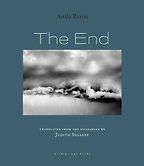
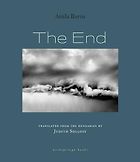
Yes, let’s start with The End by Attila Bartis, a Romanian-born Hungarian writer, which won the EBRD Literature Prize in 2024. It was translated from the Hungarian by Judith Sollosy. What can you tell me about this book?
It’s a portrait of the artist as a young man, a Künstlerroman, by a writer who is also a photographer. One of the things that we all loved as judges—and this was when I was judging with the novelist and translator, Maureen Freely and the international lawyer and writer, Philippe Sands—is the innovative, engaging structure of this novel. We’d never come across anything quite like it. It’s like a collage of vignettes or small chapters—a novel written in snapshots, freely associating and making connections between them. They’re like memories, in a way, and often very visual. It’s natural. It’s the way we all think, but it’s not usual to see a novel structured in that way. Because the author is a photographer as well, he’s using these different ways of looking and thinking.
In a way, it’s autobiographical. Not in the facts, but in the emotions. It’s about a father-son relationship of conflict. The author was born into the Hungarian minority in Romania and moved as a teenager with his father to Budapest. His protagonist was born more than 25 years before him, yet he also moves from a part of Hungary to the capital, Budapest, as a teenager with his father.
It’s a novel about the consequences of communist rule in Hungary, in an atmosphere of spies and informers and the sort of Faustian pact that everyone is under pressure to make: to inform on their fellow citizens, on people in the family. It’s about the pressures that that creates on individuals. The protagonist’s father has been imprisoned as a dissident—as indeed was the author’s father. It’s looking at the lasting damage created in a society, in a family, to individuals, by this kind of system at a very micro level.
And yet… you asked me about happy endings. One can talk about the police state and these traumatic memories and so on. But it’s also about an artist. Like all these books, it’s about the transcendence of art, because writing the novel in the face of this is itself a triumph. It’s taking a look at art and what that means in a society—how important it is everywhere, but also in these particular regimes.
It has an incredibly upbeat ending, which you don’t really expect. I won’t say exactly what happens. At the beginning, there’s a 50-year-old man, a fairly well-known photographer, who is awaiting a diagnosis for something that could or could not be cancer. From there, he goes off into his memories of childhood, of his family, his terrible relationship with his father, the death of his mother, and yet, by the end, through his freely associated memories, you’re brought to a place of quite a lot of light and happiness. The movement of the novel defies the idea that you have to succumb to regimes of that kind.
One final thing to mention: The End was published by Archipelago Books in New York. 2024 was the year the prize was expanded to include North American as well as UK and European publishers. From this year, eligible books can also have been published anywhere the Bank invests, including in African economies. So that’s quite significant, and gives a more global view of the state of translation into English by eligible authors.
The End won the 2024 prize. Does a book have to be new to win, or can it be quite old?
The translation needs to be new and published in the past year. But the book can be older. In this case, the translation was published in 2023 and the original was written in 2015.
The author must be living at the time the book is submitted. There are a lot of books in some of these literatures that are just beginning to come out in English translation, and the author may have long died, but this isn’t a prize for classics. It’s a prize for living authors and new translations.
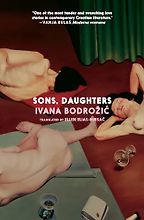
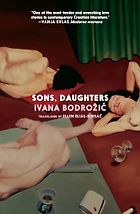
Let’s turn to the 2025 winner next, which is Sons, Daughters by Ivana Bodrožić. This was translated from Croatian by Ellen Elias-Bursać. Can you tell me a bit about it and why you, as judges, liked it?
At heart, it’s a very tender love story, but a love story with a difference. The woman who is the narrator and the protagonist, Lucija, has locked-in syndrome after a car accident. She is in a hospital, immobile, but for her eyes which she can only move vertically and which she uses to communicate by blinking.
The novel meanders through other people’s perspectives. The second part is told by her lover, who is also trapped in a body that he can’t recognize as his own. He was designated female at birth and he finds that his body betrays his own feeling of himself as a man by growing breasts, menstruating and so on. So he is another character who’s contending with what is described in the novel as “our body, our worst hell.”
Then there’s a third part, about Lucija’s mother, who, in a way, is also entombed and restrained by her own upbringing in a male-dominated society.
So the author’s contention is that there is a parallel between these three lives, with this metaphor of the body as a prison. We can be complicit in our own restriction by it.
In a wider sense, it’s a book about conformity and the price of freedom, in an atmosphere of violence where the pressure to conform is intense and malign. Somewhere in the novel, the author writes that “censure and mockery are the strongest glue in all human communities.” It’s about the way people are forced to suppress and censor their own sense of themselves in whatever way, in order to fit in. It’s about the tyranny of normality.
To give some background to this novel, it’s set in Croatia after the War of Independence in the 1990s. Lucija’s family has suffered a breakup as a result of the war. Everyone is affected by this: her mother, her brother who is a bully, partly as a result of this history. The author herself grew up in a refugee camp—she’s written about that elsewhere—and that’s very much part of this novel, the backstory as to how we get to this society.
A more specific context is that this novel was published in 2020 in Croatian. It’s made explicit in an afterword by the author that it was written after Croatia ratified the Istanbul Convention in 2018. The Istanbul Convention (2011) is about violence against women and it was one of the EU laws that Croatia, when joining the EU, had to agree to. But, as the author tells it, it became an excuse for far-right forces in Croatia to object to trans people. There was a welling up of a lot of hatred and physical violence. There were right-wing elements scaremongering, saying, ‘If you join the EU, your children will have to be trans.’ So that’s one of the author’s motivations for imagining herself into these different characters and this love affair.
The translation was published by Seven Stories Press in the UK. I felt the book was a cross between Jean-Dominique Bauby’s classic stroke memoir, The Diving-Bell and the Butterfly, which came out in 1997, and Jeanette Winterson’s novel Oranges Are Not the Only Fruit. It’s a combination of circumstances that creates something transformative.
As judges—this time, my fellow judges were the translator and Associate Professor in Ukrainian and East European Culture at University College London, Uilleam Blacker, the writer and editor, Selma Dabbagh and the writer and BBC foreign correspondent, Fergal Keane—we found it a very powerful novel that can transform the way the reader thinks about things, about people. It’s a profound act of understanding, of other people’s lives. That was one of the reasons why we chose it.
The language is also very fresh and invigorating. The candour of it, Lucija’s voice. She’s paralyzed in hospital but is fully conscious. She’s mordant. She’s spiky and truculent. It’s a very exciting piece of writing.
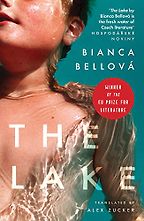
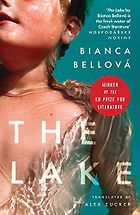
Let’s go on to the 2023 winner now. You’ve already mentioned The Lake by Bianca Bellová, which was translated from Czech by Alex Zucker. Can you tell us a bit more about this book?
The Lake reads like a dystopian novel, but is firmly rooted in reality: not only the reality of man-made climate change, but also the post-Soviet realities across Europe and Central Asia.
It’s about a young boy called Nami who lives with his grandparents in a fishing village on the shores of a shrinking lake that’s drying up. He appears to be an orphan, but he goes in search of his mother who has seemingly abandoned him. There’s also the mystery of his father: what is his paternity, who was his father?
It’s an almost mythic coming-of-age quest novel. It’s set in an unnamed land and yet there’s a square in the town with a statue of an unspecified statesman, and it’s recognizably post-Soviet Central Asia. There are certain clues—the caviar and fisheries and the kolkhoz or collective cotton farms, which are a very Soviet feature.
The author told me the book was inspired by a National Geographic story about the shrinking of the Aral Sea, which is in Central Asia, in Kazakhstan and Uzbekistan. She didn’t go there or research the sea, it just sparked something in her imagination. She is Czech with Bulgarian ancestry, and she combined this environmental catastrophe with her own knowledge of post-communist life in different countries.
Almost everything in the book is unnamed—the statesman, the country, the town. But there is a Russian occupying force, who are called ‘Russkiys’ by the children. They are growing up during a very violent occupation, seeing things, and suffering, that children should never witness. Women are preyed upon by these soldiers. The author told me that she tried to make it less specific, initially, and then found it didn’t work for her. It was false, because the reality for her in the region with which she’s familiar is that Russians have been the occupying power. So that is interesting, this combination of a stubborn element of reality with this very heavily fictionalised and mythical setting.
This book won the first year I was a judge. It originally came out in 2016 and was published in translation in 2021 by Parthian Books, a publisher based in Wales. For me, the novel is Lord of the Flies meets A Clockwork Orange in that sudden, sporadic, casual violence that erupts, and at the same time, this child’s eye view as he’s moving through it.
So we found The Lake extremely powerful and also universal. As with all good fiction, you can read into the specific circumstances many other scenarios.
I saw one description of it as a dystopian page-turner. Does that sound accurate?
I think it’s absolutely a page-turner, but I know the author would object to the term dystopian. A dystopia is an imagined opposite of utopia, and this is much more about reality.Like Sons, Daughters it’s immersive in that way with really good fiction when you’re immediately transported somewhere else and you just want to be left alone with your book.
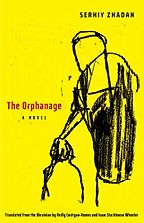
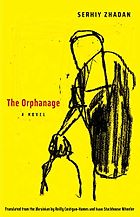
That’s what we’re aiming for in a book! OK, we’re now at the 2022 EBRD Literature Prize winner, The Orphanage by one of Ukraine’s leading novelists, Serhiy Zhadan. This was translated by Reilly Costigan-Humes and Isaac Stackhouse Wheeler. What can you tell me about this book?
The Orphanage, first published in Ukrainian in 2017, came out in English translation from Yale University Press in 2021. Written by a hugely popular Ukrainian poet and novelist who’s also a rock star—he fronts a ska band—it’s a viscerally compelling novel about civilians caught up in the early days of the war in Luhansk, eastern Ukraine, that began in 2014, years before the full-scale Russian invasion of the country in 2022. The author grew up in Kharkiv in eastern Ukraine, so it’s drawn from deeply personal experience. But like Bellová, he never names the places he writes about—or identifies the soldiers—reflecting the real chaos of war, and creating a sense that such conflagrations could potentially happen anywhere and take anyone by surprise.
The protagonist, Pasha, is a 35-year-old Ukrainian language teacher in a dysfunctional family who reluctantly travels from his hometown, called “the Station”, to the front line to retrieve his 13-year-old nephew from an orphanage where Pasha’s sister has left him. The orphanage—really a boarding school—is now in occupied territory controlled by pro-Russian separatists, and the three-day journey is like a descent into a Dantesque inferno. Pasha imagines himself to be uninvolved in the conflict, and ‘apolitical’, but he shares the fear, hunger, dread and desolation as he wanders through mud and snow across the shifting border, never sure who is friend or enemy, and trying to guess by listening to language and Russian accents. If anything, the novel shows the complexity of allegiances in this combat zone, where identity is not as simple as what language you speak.
There are many other insights. Pasha’s ‘old-timer’ father is glued to a TV that spews out propaganda. A foreign war correspondent named Peter gets short shrift from Pasha, who says, “he really just isn’t interested in anyone … He’ll leave, we’ll stick around.” But as a poet, Zhadan’s imagery and metaphors are inspired, and brilliantly translated by Reilly Costigan-Humes and Isaac Stackhouse Wheeler.
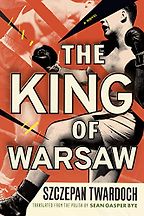
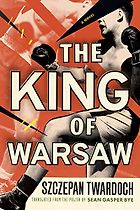
Last but not least, we turn to the 2021 winner, The King of Warsaw by the bestselling Polish novelist Szczepan Twardoch. This was translated from Polish by Sean Gasper Bye and is a work of historical fiction, I believe?
Yes, this is another extremely powerful novel, originally out in 2016, and published in English translation in 2020 by Amazon Crossing. Set in Warsaw in 1937, it’s an extraordinary act of historical memory and retrieval. The central figure is a larger-than-life Polish-Jewish champion boxer-turned-gangster, Jakub Szapiro, idolised in his community for knocking out antisemitic fascist fighters, but also a brutal enforcer for a Polish crime lord. Szapiro is seen through the eyes of an awkward 17-year-old boy, desperate to escape his more orthodox Jewish heritage. When Szapiro adopts him, ostensibly after killing his father, he becomes drawn into this twilight underworld of prizefighters and mobsters, bars and brothels.
The violence is brutally graphic—think The Godfather or Peaky Blinders—but at the same time, it’s an ingeniously structured literary novel, with unreliable narrators and fantastical elements, including a magic-realist sperm whale who surfaces in the plot from time to time to devour and spew out the characters. The violence has a counterpart in the ominous historical setting, with allusions to a planned coup by antisemitic Polish military officers and their cohorts.
With snippets of Yiddish dialogue—translated in footnotes—it recreates a multi-ethnic Poland that no longer exists, even though, at the time, Jewish and Polish Warsaw are seen to be intertwined yet also sharply segregated. That the novel moves between 1930s Poland and 1980s Israel, where the boy seems to have fled and to be writing his Warsaw memoirs, creates another layer of irony and complexity for the present-day reader. But as long as Szapiro vacillates between wanting to be king of the Warsaw underworld and to escape to a new life in Palestine, the looming historical violence, with the rise of Nazi power, lends the world of the novel an almost elegiac quality. It’s a marvellous read.
Five Books aims to keep its book recommendations and interviews up to date. If you are the interviewee and would like to update your choice of books (or even just what you say about them) please email us at [email protected]
Five Books interviews are expensive to produce. If you've enjoyed this interview, please support us by donating a small amount.
Maya Jaggi
Maya Jaggi is chair of the independent jury of the EBRD Literature Prize 2024-26. An award-winning writer, critic, cultural journalist and artistic director, she is a contributing art critic for the Financial Timesand her cultural writing appears widely, including in the Guardian, where she was a profile writer and a lead fiction critic for more than a decade. She was elected a Fellow of the Royal Society of Literature in 2023 and has an honorary doctorate from the Open University for 'extending the map of international writing.'
Maya Jaggi is chair of the independent jury of the EBRD Literature Prize 2024-26. An award-winning writer, critic, cultural journalist and artistic director, she is a contributing art critic for the Financial Timesand her cultural writing appears widely, including in the Guardian, where she was a profile writer and a lead fiction critic for more than a decade. She was elected a Fellow of the Royal Society of Literature in 2023 and has an honorary doctorate from the Open University for 'extending the map of international writing.'