What attracts you to spy novels as a reader—or as a writer in the case of your latest novel?
It does come from the reading. I studied English at university, and when I finished my finals, I read nothing except John le Carré for the next six months. It was like this purging of all the Samuel Richardson and Chaucer.
It’s about the way spy novels engage with moral choices and complexities, the gray areas in life that we all encounter every day, and makes them into drama. I’ve read a lot of spy novels and I don’t like the genre as it is sometimes characterized. For example, I don’t have a huge amount of time for Ian Fleming. What I’m interested in is those novels that are literary novels smuggled in through the generic window. And I do think John le Carré is the master of that.
I’m interested in novels that give you both the traditional satisfactions of the genre—the adventure and the thrills that you go to an Ian Fleming novel for—but give you moral and existential questions that engage seriously with what it is to be a human.
It’s why, to me, generic labels aren’t always that useful. I don’t really think of children’s literature as a useful label. If you think of books by Alan Garner, they’re novels that I continue to read, and seem to me profoundly serious. The fact that they happen to be read by children says a lot for children.
So tell me about the spy novels you’re recommending today, and how you picked them.
When I came to choose my five, I wanted to reflect on what it was that I looked for in a spy novel, and what I was trying to do with my attempt at the genre. I wanted to think who I was writing in the footsteps of, but also who is writing now and recently, who I think is doing it really well. I started off with Graham Greene.
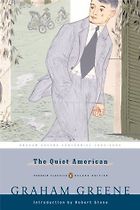
Yes, let’s begin with his novel, The Quiet American. Many people will have read it (or watched one of the movie adaptations), but for those who haven’t, can you tell us what it’s about and why you picked it?
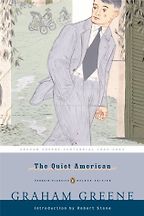
I love Graham Greene. He separated his work into either entertainments or serious novels. What I love about The Quiet American is that it collapses that divide, because it is both entertainment—a novel of intrigue and espionage—but also very serious. The novel is a bit Jules et Jim meets Bond or Bourne.
It’s set in 1950s Saigon, during the French Indochina War and the build-up to the Vietnam War. At the time, Greene was living this slightly louche expat life out there as a journalist. The main character in The Quiet American, Fowler, is also a British journalist.
Fowler is addicted to opium, morally corrupt, jaded and cynical. It’s a first-person novel and everything is told through the filter of this narrator.
The quiet American is a CIA agent called Pyle. He’s a theorist of geopolitical life and engagement. He has this idea about ‘a third way,’ that there’s a line that can be steered between communism and capitalism, and we slowly realize that he’s every bit as much a radical and a militant as the Communists who are beginning to push back against the French. You realize that the novel is about the danger of trying to apply theory to the complexity and difficulty of real life.
The Jules et Jim element of the book is that Fowler is involved with a local girl called Phuong, who is uncomfortably young compared to him. Pyle falls in love with her. Phuong is an interesting character who makes very clear-eyed decisions about her future and where it lies, both politically and personally.
It is a fascinating novel from a moral standpoint. Everyone is corrupted, everyone is out for themselves but also has something in their soul that requires protecting. It is this idea of how we project our own selves, but also our political selves, onto the world. Phuong operates almost as a representative of the country she’s from, of Vietnam.
One of the things that Greene is interrogating is the hypocrisy of the stated aims versus the real aims of what the Americans and the Brits and the French were trying to achieve in Vietnam.
The novel was published in 1955. The Vietnam War had not happened yet, but it was very prescient—in terms of what it says about the dangers of military interventions or meddling, by the power of its vision of the geopolitical world, of the dangers of idealism, of dogma, of the expectation of a recognition of one’s own moral superiority.
I was thinking about the threads that run through these novels and there’s a line in The Quiet American: “Sooner or later…One has to take sides if one is to remain human.” That line represents all of this, which is that you can only steer these nuanced paths for so long. Eventually, the pressures of events will make you choose.
Let’s turn to the next author you’re recommending, Eric Ambler.
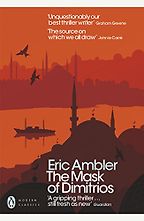
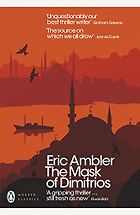
Penguin has just done a lovely reissue of some of Eric Ambler’s novels. I’ve been reading him, and indeed was reading him as I was writing A Stranger in Corfu. The Mask of Dimitrios—sometimes published as A Coffin for Dimitrios—is his greatest novel. It was written in 1939 and it’s about the mess the world is in in the lead-up to the Second World War.
In the same way that Greene has Fowler as an outsider in The Quiet American, Eric Ambler has Latimer, who is a crime writer. Ambler always has these outsider characters come into the world of spies and does it wonderfully.
Latimer is a bit of a John Buchan figure; he’s adventurous but also (like Fowler) a bit cynical and world-weary. He’s in Istanbul, which is the setting for a number of Ambler’s great spy novels: he sees it as this hinge point between East and West, and a place where the world comes together.
Latimer hears from a local police chief about a character called Dimitrios, who is this Greek supervillain, and goes after him. Latimer persuades himself it’s research for his next novel, but it feels as if there’s a more existential and mysterious drive behind it. Latimer is fascinated by the darkness of Dimitrios’s life. It’s about how paranoid and corrupt the world is—the world of the Great Game and great powers struggling for control. Reading it, you do feel it’s a barometer for the collapse that is to come. It evokes the climate that led to the Second World War.
[SPOILER ALERT]
Dimitrios is a man of his time. There are the terrible crimes that he carries out, the wheels within wheels that we discover. He engages with a slightly anti-semitic line in the novel about European banking. There is this sense that he is a representative of the clandestine corruption that runs through everything in the world at that point.
There are several spoilers one would want to avoid, but it’s saying that the state is implicated in the underworld of the time. Latimer goes deeper and deeper, and becomes more and more implicated. He is drawn closer and closer to this extraordinary and enigmatic figure, and, a bit like The Quiet American, he eventually has to choose sides.
The meta-narrative is also really fascinating. It’s a novelist researching a novel. He becomes the protagonist of the novel, and he is writing it constantly through the lens and with the voice of somebody who is unable to decide whether he is in a spy novel or not. I love that about it. It feels so modern.
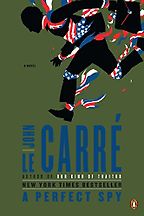
We’re now at the John le Carré book you’ve chosen, A Perfect Spy. Tell me more.
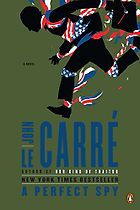
I think in some ways this is the perfect novel. It’s just a wonderful, heartbreaking, stunning picking apart of the world of espionage and what it does to the soul. It’s by some distance my favorite book on this list. It’s one of my top three or four books of all time. It’s the one I have reread the most in my life, because it is a book of extraordinary depth and complexity of character.
If you think about le Carré, this book takes to an extreme the two sides of his writing. You have the spy craft, the dead drops, the intricacies of negotiating borders and the outward narrative engines. Then you have his inward representations of what it is to be a spy. On the cover of my copy, it has that classic line: “He had been the perfect spy, but at the cost of his soul.” It’s the encapsulation of that inward, less narrative-driven, more philosophical, what-living-a-life-of-secrets-does-to-you novel.
It is full of the most wonderful writing about the soul, the love of family and the love of country, and about what betrayal is and how it endures, and whether you can ever really escape history.
For people who are a bit snooty about spy fiction and think, ‘Oh, it’s just bombs and ladies in bikinis,’ this book is the absolute antidote. It’s comparable with Dostoevsky: it is that morally serious.
A Perfect Spy is also, by some way, le Carré’s most autobiographical novel, and interesting to read in the light of what we have learned about le Carré—or David Cornwell, we should say—since his death.
For anybody who hasn’t read it, who is the main protagonist?
Magnus Pym is a senior British intelligence officer. He disappears at his father’s funeral, and the novel is both the search for Magnus Pym and how he avoids those who are coming after him, but also a book within a book of his own memoir, written while he’s on the run.
What’s so brilliant about that is that you feel that it is le Carré’s way of writing his own memoir. Magnus Pym writes about his relationship with his father, who is a con man. It’s why the father’s funeral is this hinge point for him. Le Carré’s own father was a notorious swindler and lived double lives himself, as we know le Carré himself did.
It’s a bildungsroman, the story of how somebody goes from childhood to an adulthood of betrayal, of a character that, because he can be anyone, is no one. That is the great tragedy at the heart of the book. Magnus, who is in his 40s, is completely unmoored and doesn’t know what he can believe in, because he has lied and betrayed so much. It’s incredibly confessional and heartbreaking. I absolutely love it.
In some ways, the manhunt, which is the contemporary narrative, is secondary. You feel that le Carré’s heart isn’t really in it. That’s fine, because what really sticks with you is the internal stuff and getting to know this character and just how shattered he has been by a life in which there is no solid ground.
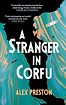
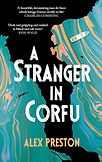
Alex, maybe this is a good moment to speak about your foray into the spy fiction genre. Tell me about A Stranger in Corfu. How did it come about, and is it based partly on something that actually happened?
I had been wanting to write about Corfu for a long time. I run the Corfu literary festival and spend quite a bit of time there. It’s a beautiful and historically incredibly interesting place.
I discovered this slice of espionage history that was unknown to me, of the first joint MI6 CIA operation in history, just after World War II. It was an attempt to overthrow the communist regime in Hoxha’s Albania. It was called Operation Valuable and entailed MI6 and CIA dropping Albanian dissidents into Albania. Unfortunately, at that time, Kim Philby was intimately involved in MI6 and passed all of the information about where these agents were being dropped to the Sigurimi, the vicious secret police. Corfu was used as a launching and drop-off point because it’s so close to Albania. There’s a point near Kassiopi in the north of Corfu where it’s only a mile across the strait, and you almost feel like you could touch Albania.
Corfu has always had this extraordinary strategic position, and it was just this idea that you could write a novel which made clear the geopolitical role it played in this extraordinary story.
The other thing that set me off was that my mother-in-law had been on holiday with a friend of hers to a little seaside village in mainland Greece. She said all of the houses on the seafront were owned by slightly dashing, retired Foreign Office types. She realized that they were all spies, and had all gone out there together, because there was a safety and comfort in being able to talk about things that you perhaps couldn’t talk about with others.
There was this extraordinary moment in the early 1990s where, after the fall of communism, MI6 carried out a purge of its spies. It was called the Christmas massacre, because that’s when all these spies—who were deeply embedded in the binaries of the Soviet/Cold War world and had been unable to adapt to the new era—were fired.
So I brought all of that together and created this retirement home for spies on a little island just off the coast of Corfu. From there, the novel almost wrote itself. You set up this closed world. You set up these characters who are freighted by their own personal histories. Then you just let it play out.
It’s also about the psychology of the people who, like Philby, went over to the other side. In the novel, many of them carry on working for MI6.
The idea there was to think, ‘There was a Cambridge spy ring. What if there was an Oxford spy ring that hadn’t been caught and had carried on operating within MI6?’ I did a lot of research on Philby and the others in the Cambridge Five, really thinking about how they went over to the other side and how they expressed and enacted their betrayals.
The thing that was most fascinating to me about Philby is that it was so obvious everything he touched went wrong—and yet he still went up and up in the service. It was because he had been to the right school and had the right accent, and he was charming and eloquent and erudite.
The book is also about what it’s like to view history from the other side, before it happened. I did that with my third novel, In Love and War, where I was writing about the British Union of Fascists, and how it seemed to some people—before all of the horrors of the Second World War—as an escape from the political world that had created World War I. We judge people much more harshly because we know what came after. In A Stranger in Corfu, I was thinking about how idealists could have been sucked into the Communist Party in the 1940s. It would have been presented as a more equal and, in some ways, more joyful way of recreating a world after the atrocities of 1939 to 1945.
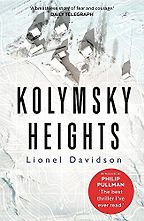
Let’s move to your fourth recommendation, which is Kolymsky Heights by Lionel Davidson. What can you tell me about this thriller?
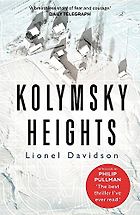
This was first published in 1994. Davidson wrote it right at the end of his career. It’s his last novel. It was then republished in 2015 when lots of people, including me, discovered it. I love it. It is probably the trashiest book on this list, but I make no apologies for that. It’s just so wonderful and weird and brilliant. It is so exciting and beautifully written, beautiful at the level of the sentence. It’s just an amazing novel.
The hero is Johnny Porter, who is an indigenous Canadian linguist, anthropologist and survival expert. In some ways, it’s a novel about the peoples of the North. Porter is First Nations Canadian, but he is able to pass as Siberian. He also pretends to be Japanese as he works his way around the world.
[SPOILER ALERT]
It’s about an attempt to unearth what’s going on at a research station deep in the wilds of Siberia. It’s a totally absurd MacGuffin, but you accept it.
There’s so much tradecraft and intricacy to how Porter manages to navigate, firstly, the infiltration and then the exfiltration. The ending is just amazing. I just can’t believe it hasn’t been made into a film. It’s just so cinematic. There is a final, very Bond-like moment on the ice in the far east of Russia.
Philip Pullman has showered this book with praise (as have many others), calling it the greatest thriller he’d ever read. I totally concur. It’s so exciting.
Yes, I enjoyed it so much that I read three of his other books, but they weren’t as good.
They just aren’t. In Kolymsky Heights, it’s as if something has dropped away, and he’s just having fun. There’s so much research, and he knows so much. The landscapes are so beautifully rendered. Both in Siberia and the northwest of Canada it’s just magically done. I was blown away by it.
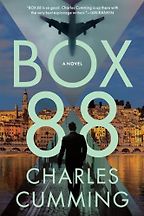
Let’s turn to your last book, by the only living author on your list. Tell me about Box 88, the first book in a series by Charles Cumming.
I wanted to include something contemporary because the whole point about a genre is that it is a tradition. I wanted to include somebody who was doing serious literary espionage fiction now and I think Charles Cumming is by some distance the best of the inheritors of the le Carré crown.
He is a superb author. I was writing about his latest book in the Observer the other day, and I do feel that with this Box 88 series, he is creating something that will last and is serious literature as well as hugely entertaining.
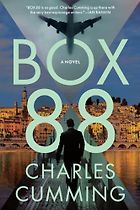
The hero of Box 88 is Lachlan Kite, who is recruited from school into a shadowy espionage group that operates outside of the law and is hardly known by MI6 and the CIA.
I’ve always been a sucker for a school story, and this is basically a school story and a spy story merged together. It’s a coming-of-age novel—a little bit like A Perfect Spy in the way that it takes this character and his very interesting upbringing, and then brings him into a world that is compromised and challenged and where he has to make really profound decisions.
In the book, in the present day, he has been abducted by Iranian agents, as has his wife, who is pregnant with their child. But then he looks back on his younger life, to the late 1980s. It’s this dual timeline that operates so well. It’s so smartly put together as a novel of how he came to be where he is. It’s also about what has changed for spies, what has changed in the world, on the other side of the fall of communism.
The other thing that Cumming does so well is that he uses real-world geopolitical events. Lockerbie is absolutely central to Box 88; his latest novel, Icarus 17, starts with the murder of Jamal Khashoggi. So the books use contemporary and real-life frameworks to play out this extraordinary story of espionage.
I think it’s the best new series of novels to come out in this world. He really transcends any idea that these are just spy novels. The spy novel is a lever into more interesting and emotionally and psychologically resonant pieces of work. Everyone in my family has read them, including my 15-year-old daughter, my wife and my father. We all love them. They are just wonderfully readable but also super smart novels.
So if Box 88 is about Lockerbie, where is it set? Is there a strong Middle Eastern focus?
There are the Iranians who abduct him, but a lot of it is actually set on the Côte d’Azur, which allows for a lot of beautiful set pieces with palm trees. The second book in the series, Judas 62, is set largely in Russia and does a brilliant job of bringing that to life. The next one, Kennedy 35, starts in Senegal.
The whole idea is that these are people whose job is to ping from one crisis to the next. That’s Lachlan’s role. So you get these globetrotting, geopolitical novels.
Alex, thank you so much.
Total pleasure. Lovely to chat to you.
Interview by Sophie Roell, Editor
February 16, 2026. Updated: March 27, 2026
Five Books aims to keep its book recommendations and interviews up to date. If you are the interviewee and would like to update your choice of books (or even just what you say about them) please email us at [email protected]
Five Books interviews are expensive to produce. If you've enjoyed this interview, please support us by donating a small amount.