Thank you for highlighting these five works of historical fiction set in South Africa. What do you look for in fiction, would you say?
I suppose that what I tend to look for in fiction is threefold. First, authenticity: a realism that is heavily dependent on a fully-formed character with a strong internal world. There should be an awareness or connection between the way the internal world and the external world interact. Second: good writing. Not overwriting. Not underwriting. Not fiddling with structure or gimmicks in a way that is nothing but an attempt at cleverness. And third, purpose. I look for fiction where the author knows what and why they are writing. I think too often books are published that are confused and messy.
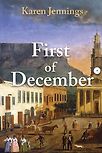
Your new novel, First of December, follows three characters over the week running up to the full emancipation of all slaves on December 1, 1838. Your previous novels Finding Soutbek and Upturned earth also offered insight into 17th-century and 19th-century South Africa. What comes first, while planning—the period or the story?
In terms of the chronology of the creative process, I tend to have a vague idea of a story and period before I begin my research, but the research might change that substantially.
I am one of those people who loves the research stage of writing. After all, what isn’t there to love about it? You get to read, to learn, to make notes in notebooks—which means you get to go shopping for pens and notebooks. Without having to do an actual second of the hard work of creating, ideas are being placed in your brain and are incubating there. It is a wonderful time! I would probably spend my whole life researching and doing nothing else, if I am completely honest.
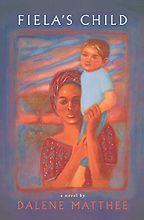
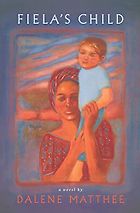
You’ve chosen to recommend Fiela’s Child by Dalene Matthee. It was first published in Afrikaans in 1985, and centres on a multiracial woman’s decision to take in a white child in the 19th-century Western Cape. Could you tell us more?
This book is going to break your heart. Be prepared to cry your eyes out, to feel immense anger, to laugh, to cry again. What a book! I don’t want to give too much away, but as you mentioned, a white boy is raised by a woman of mixed race. He lives there for 9 years before being discovered. He is taken away to go and live with what a judge tells him is his “real” family. His life is upturned from one of love and affection and education, to one of violence and ignorance and cruelty. I don’t want to give it all away, but the key here is about identity. Do we find identity in skin colour, in place, in names, in those who love us? How do we know who we are and how and where we belong?
My mom was a high school Afrikaans teacher to English-language pupils. I was a sickly child and so I would often be put on a blanket in the corner of my mom’s classroom and I would listen to her teach. Fiela’s Child was one of the prescribed texts she taught. I was completely enthralled by the way she brought the story to life and read out the different characters and the different worlds they inhabited. It might sound dramatic, but it is almost as though that book is in my blood – because of having grown up with it.
But why might it appeal to other readers? I would say the strengths of the novel lie in the powerful characterisation, the human-ness of the people and their beliefs, their flaws, their actions. One of the important things to remember about the past is that we are all tourists when we try to access it. We cannot know it completely; we can only hope to get some idea of it. Dalene Matthee is an extraordinary tour guide, taking us into the past and allowing us to live there with her characters, experiencing life as though we are one of them.
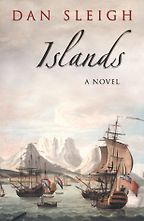
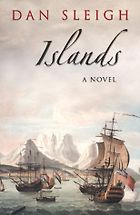
Next you’ve recommended Islands by Dan Sleigh, a sweeping work of historical fiction portraying the first fifty years of the Dutch colony at the Cape of Good Hope, from 1650. Publishers Weekly described it as “stately” and “nuanced”. What do you admire about it?
This is another personal novel. When I was 9, I used to visit the Education Museum that was across the road from my school. I would go multiple times a week and stay for ages. The reason I went was because Dr Sleigh was the curator of that museum and I absolutely adored him. I would go and talk to him and he would tell me all kinds of stories about the history of South Africa, and about different fashions and gadgets and ideas.
Years later, when his novel came out, I was surprised. I had not known that he was working on a novel, nor that it was such an impressive work. Looking at the novel’s almost 800 pages and small font, one can feel quite daunted. But what Dr Sleigh—I can never bring myself to call him Dan!—managed to do was to create a compelling narrative out of a painful and problematic history, doing so with nuance and sensitivity, yet never relinquishing the historical facts.
Yes, I believe he uses a historically faithful approach. How does he deal with gaps in the records?
Dr Sleigh was a historian, and an admirable one at that. As a historian he took a very no-nonsense approach. He sought the facts. In his fiction, he took the same approach. Where there are gaps in the record, Dr Sleigh would fill them by researching further and making informed decisions. He did not give way to flights of fancy or fantasy – something that perhaps happens too often in historical fiction these days.
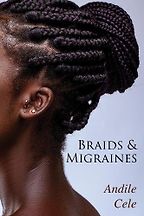
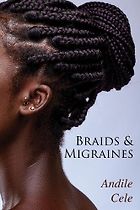
Can we look at Braids and Migraines by Andile Cele next? We interviewed her last year about South African novels.
This amazing novel looks at the complexities of Black girlhood, mental health, and the legacy of racial exclusion in post-apartheid South Africa. The protagonist, Nomandla, comes from an informal settlement and is awarded a prestigious scholarship to attend Cameron House for Girls in Durban. While she initially views this as a path to a better life, the reality proves to be a source of profound struggle. At her new school, Nomandla is treated as a token of “transformation” and is expected to show constant gratitude for her position. In addition, she battles poverty and racism while experiencing terrifying and sometimes heartbreaking visions that eventually lead to her hospitalisation. The novel is painful, funny, beautiful.
There’s an extract available online for anyone who wants to get a flavour of it.
Braids is the kind of novel that I would like all South Africans to read, regardless of race. I think, too often, there is ignorance about how people from different races and cultures experience certain situations. In Braids, Nomandla is given a scholarship to a private “white” school and is asked, for example, to dress in traditional Zulu clothing and perform a traditional dance in the school concert. While the school authorities might see this as a way of including her, she sees it as being asked to showcase her difference in an attempt to make the school look inclusive and welcoming. She views the request as exploitative and false. This is simply one example, but what it does, as all good literature does, is give readers an opportunity to experience, learn and understand from a different point of view.
Andile and I are more or less the same age. We grew up in the same country. Yet her sister died of malnutrition. Her family lived without many of the opportunities my family had – even after the end of apartheid in 1994. These are things we must remember. Apartheid is over, but what has it meant for different people, and what are the consequences of it that still hang over us to this day?
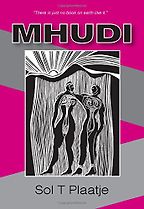
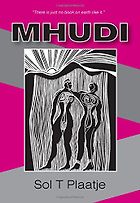
Can we discuss Mhudi by Sol Plaatje? It’s set in the early 1800s, as the Barolong people are being dispossessed by a Zulu group led by King Mzilikazi. This book has had a long tail—why should we read it now, and what can we take from it?
You name it, this novel has got it! Strong female protagonist. Romance. Fighting against patriarchy. Fighting against white dominance. Inter-racial relationships and friendships. Building a better world through interracial, intercultural, male and female understanding. At a time when the world is becoming more and more right leaning, this book can serve as an antidote.
I believe it was the first novel written in English by a black South African. Is most South African contemporary fiction now written in English, or is there a linguistic mix?
This is, sadly, a big problem. Afrikaans, as far as I know, still tends to outsell South Afrian English fiction. But in South Africa we have 12 official languages—one of which is sign language. Imagine English only being your second or third or even fourth language. Imagine loving to read, wanting to read, but not being able to find books in your language. That is the problem. There are a number of small publishers trying to work on improving this situation, but it is a struggle.
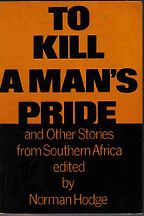
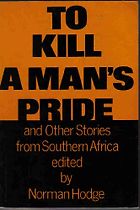
Finally we come to Can Themba’s short story ‘The Suit’—which can be found in the anthology To Kill A Man’s Pride and Other Stories from Southern Africa. Previously you described it as a story “so powerful that it hits like a novel.”
Firstly, this story was originally banned by the apartheid government – which tells you it must have been pretty powerful to begin with!
The story is set in 1950s Sophiatown, a black township. Philemon discovers that his wife is having an affair. The lover escapes before Philemon can catch him, but he leaves his suit behind. Philemon makes his wife, Trudy, treat the suit as a Guest. The Guest must be fed and waited on. Trudy becomes a slave to the Guest, and is oppressed by her cruel husband who takes delight in torturing her. I won’t say more, but the story does not have a happy ending.
You will not be able to forget this story after reading it. It will stay with you forever. It is powerful and disturbing –as a simple narrative, but also as a comment on something deeper: the systematic dehumanisation of people of colour under the apartheid system.
Would you describe historical fiction as a healthy genre in South Africa?
This is a difficult question to answer in any kind of simple way. The publishing industry in South Africa is a struggling industry. That is not to say that we aren’t publishing our own writers, but that we are in competition with the big names from America and the United Kingdom. South African authors tend to be overlooked in favour of global bestselling authors. In particular, fiction is less successful than non-fiction. But, I would argue, whether fiction, non-fiction, memoir, plays, podcasts, history cannot but be ever-present in South African text creation. As in James Joyce’s Ulysses, history is a nightmare from which we cannot awake. We live with it every day. To write and to live in South Africa is to be engaging with history.
Interview by Cal Flyn, Deputy Editor
March 27, 2026
Five Books aims to keep its book recommendations and interviews up to date. If you are the interviewee and would like to update your choice of books (or even just what you say about them) please email us at [email protected]
Five Books interviews are expensive to produce. If you've enjoyed this interview, please support us by donating a small amount.