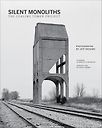
Every era has its monuments. What architectural legacy has the Industrial Revolution left behind? Jeff Brouws is a photographer whose work explores the American cultural landscape through a typological lens. His latest book, Silent Monoliths: The Coaling Tower Project, documents concrete coaling towers that once fueled steam locomotives across North America. He talks us through five essential books on industrial photography—from the Bechers' rigorous documentation to intimate portraits of displaced steelworkers—and explores what we preserve when structures themselves vanish.
I see them as monuments—remnants carrying a lot of social history. What I like about photography is that most photographs can be read multiple ways, at different levels of meaning. With the coaling towers, I get into this idea of deindustrialization. As the railroads transitioned from steam to diesel in the 1950s, there was a massive workforce shift. Perhaps tens of thousands of workers lost their jobs because of efficiency gains—dieselization required fewer workers.
I think the process of deindustrialization begins with efficiency. Capitalism and corporations are always looking for ways to save money, to be more efficient. These artifacts—these monuments— represent cultural shifts, capitalist shifts that affect human beings. Joseph Schumpeter’s concept of “creative destruction” applies here—something goes away, but something new gets created. So these artifacts are representations of former industrial eras, former aspects of civilizations. They suggest what was essential or important to a society at one point in the past.
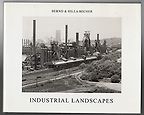
Let’s talk about your first book. The Bechers, a famous photographic duo, are known for their extreme formal rigor—isolated objects, identical viewpoints, grid arrangements. Industrial Landscapes seems different because it pulls back to include context, sky, surrounding buildings. When you’re photographing coaling towers, do you find yourself negotiating between isolating the structure versus showing the wider landscape?
In Silent Monoliths, I’m definitely nodding to the Bechers—I’ve got all their books and have spent a lot of time studying their rigorous typologies. They were masters at stripping away everything except the subject itself, but I’ve also been equally drawn to their Industrial Landscapes series, where they actually let you see the factories and mines in context.
I wanted this book to function on both levels, so I split it into two sections: “Typology” and “Topographies.” For most towers, you’ll see the isolated “object” shot, but then I step back to show the landscape and the towers in situ—sometimes it’s a still-active railroad, other times it’s a post-industrial, abandoned scene. It was an easy negotiation! as it was to be my modus operandi for the project all along.
When I characterize this book, I say it’s “Bechers with a twist.” Unlike the Bechers, my typologies aren’t as strictly uniform. Some towers are shot frontally, some at 45-degree angles, and they’re not as tightly framed as the Becher’s subjects are. I even have several photographed at night.
Looking back over my work from the last twenty-five years, I’ve realized most of it is about architecture and infrastructures. The coaling towers were integral to railroad infrastructure. Steam locomotives couldn’t run without coal, and these towers had to be strategically placed along mainlines to allow for rapid refueling of passenger and freight trains. A railroad’s motive power and operations departments were responsible for calculating where those locations would be. I wanted to suggest these elements of railroading, which is why I included the broader landscapes in the second section of the book.
This book documents industrial sites in both Europe and America, but the relationship between industry and landscape feels different in each place. European mill towns grew organically over centuries—houses built right up against foundries, residential life literally in the shadow of production. American industrial spaces often feel more spread out. Does that geographic and cultural difference affect the way we read industrial artifacts photographically?
I’d push back a little on the idea that American railroads aren’t near residential areas or embedded in townscapes. When you go into places like Mingo Junction, West Virginia, or Braddock, Pennsylvania, you see the working class or urban poor living right next to transportation networks—beside freeways, beside railroads. I could show you photographs from Chicago where high-rise public housing blocks were clustered along the Dan Ryan Expressway. That was Corbusier’s “Radiant City” concept—machines for living. They were horrible places to live. When you go into these hollowed-out Rust Belt towns, you see industry and residential life right on top of each other, so I’m not sure it’s historically that different from the situation in Europe.
The Hasselblad camera really changed your approach to photography?
Getting my Hasselblad in 1985 changed everything. Suddenly I was on a tripod. I wanted everything sharp from front to back, so I used a 50mm lense a lot. Handling that Hasselblad—it’s a wonderful machine. Just winding the shutter is satisfying. I wanted my photography to match that precision and mechanical beauty. There’s a meditative quality to being on a tripod too. You focus, lock up the mirror, use the cable release—it’s almost balletic. I don’t feel that with digital. It’s too easy to just keep going without contemplation. But maybe that’s just me; I sometimes feel like a loose cannon when I’m shooting digital!
My approach for Silent Monoliths was to shoot the monument with a Hasselblad on a tripod, then use a six-by-seven camera with a leaf shutter that allowed me freedom to walk around without the tripod’s restrictions. I’d even back things up digitally afterward, because I hand-process my film and occasionally something can go wrong.
“I also wanted to remind myself that “everyday” material culture is informative, rewarding, and sometimes beautiful.”
One more thing about the Bechers, and I say this with reverence for them and their work, but they covered so many industrial subjects it’s an interesting curiosity to me that they somehow missed the coaling towers. The towers were right there, hiding in plain sight, perhaps even next to other industrial sites they photographed. Maybe there were access issues. Around railroad environments it’s decentralized—not like going into a steel mill and talking to the plant manager to get permission. Also, maybe with an eight-by-ten camera, setting up next to an active railroad line was problematic. But I’m thankful they didn’t photograph them, because luckily I got to.
Like them I’m sure, what I find satisfying about doing typologies is that individually the images might not have much power, but put them together in a grid and it gets away from the idea of a single masterpiece. This contrast and comparison is endlessly fascinating to me. Also, by being drawn to what many would consider banal subject matter, my intention with the coaling towers—and the rest of the typologies I’ve done—was to rescue the commonplace from anonymity. I also wanted to remind myself that “everyday” material culture is informative, rewarding, and sometimes beautiful. I also love the process of cataloging and indexing which is the kind of activity you get into when doing typologies.
For your second book, you chose Factory Valleys. This book is distinctive for including people—workers at their jobs. How do you think about the presence or absence of people in industrial photography?
Factory Valleys is one of my favorite books. I bought a copy in the late 80s or early 90s, and it created a thirst in me to see these landscapes. Friedlander photographed in Ohio and Pennsylvania—the deepest part of the Rust Belt. I remember one portrait of a worker where you don’t even see the man’s face—there’s a huge drill press between him and the camera—and he’s just standing there, working the press, arms raised. His torso and face have been rendered invisible by the machinery. You think about this human being doing that for eight hours a day. You think about the millions who’ve labored this way for years on end, and the exploitation they’ve experienced, perhaps without even realizing it. You have empathy.
I’m a good liberal—I believe in unionism, power to the workers, all that. Friedlander’s portraits show that reality, that dignity in honest labor, not in an overt way, but subtly. But there’s a contrast here with other photographers. I should mention Chauncey Hare and his book Interior America from 1980. The art publisher Steidl recently published the complete body of that work as Protest Photographs—an apt title. Hare worked for the Chevron Oil Company as a mid-level manager and saw the exploitation and the dehumanization within the workplace. He became so disheartened by this he quit his job, and took his camera to Wheeling, West Virginia and Mingo Junction, Ohio—while also covering other significant areas of the Rust Belt. He used a wide-angle lens on a five-by-seven camera, and showed people in their working-class living rooms, bedrooms and kitchens, trying to capture that same sense of alienation, isolation and desperation which he felt in his own job, in his own life. It’s palpable in his photographs. You can feel it.
Hare took his photographs because he was angry and wanted people to wake up to this alienation, to what he termed “the problem.” He was probably on the spectrum—not a social person, internalizing this alienation. But Milton Rogovin, who did Portraits in Steel—another industrial artifacts book we’re discussing today—was the opposite. He was an optometrist in Buffalo and a humanist with a camera. If somebody was poor and couldn’t afford eye care, he’d do it for free. He had a loving wife for 50 years. The portraits he took of workers don’t show them dehumanized—Rogovin’s photographs, if anything, celebrate them, their work and their dignity.
It seems to me Rogovin wore his politics on his sleeve. Is political neutrality even possible when photographing deindustrialization?
It’s hard to be politically neutral. “Every aesthetic decision a photographer makes is simultaneously a social and political statement.” There you have it. Our conundrum. That’s from Mark Rice, his book Through the Lens of the City. I’ve shot a lot in Gary, Indiana, and Buffalo—in Buffalo it’s more deindustrialization, but in Gary and Detroit you’re really looking at racial injustice, landscapes of the urban poor. Even with the coaling towers, you could create a political conversation. Who exactly were the people doing the hard work behind the scenes that kept the railroads running? It’s damn hard trying to leave socio-political or socio-economic concerns out of the equation.
My friend the historian John Hankey, who wrote one of the essays in Silent Monoliths, wants to address the human aspect of the coaling towers in his future writings to explore some of those issues. Who worked on them? What was it like? You can imagine it was mostly African American workers—four or five people doing brutally hard work, operating in coal bins in 90-degree weather and stifling humidity. I’m assuming the lower-end railroad work weren’t the safest or best-paid positions either.
“It’s not that different from stumbling on an Inca ruin or Easter Island statues.”
Compare that to the Bechers—their photographs are neutral. Their work is really formal, about formalism. Which maybe rescues them from any social concerns being suggested in their work. If you look at their books, there’s no big elaboration or art talk. They tell you what the blast furnace is, what it does. That’s it. Like Dragnet’s Joe Friday: they give you “just the facts.” I think they purposely wanted that neutrality. It was conceptual art.
In regard to trying to achieve that neutrality, I’ve also been influenced by S.G. Ehrlich, who was an authority on 19th century evidentiary photography. In Erhlich’s view, the “something” that emanates from the photograph should be the physical reality of the evidence (the thing itself) and not the photographer’s skill in making the scene look more “compelling” or “dramatic.” As I said: “Just the facts, ma’am, just the facts.” This was my intention as well, but it’s not always possible depending on how the work is “read.”
Rogovin photographed Buffalo steelworkers both on the job and at home in the late 1970s, then returned in the mid-1980s after the steel industry collapsed. Not one of his earlier subjects was still employed. This before-and-after structure is powerful. Have you considered returning to coaling tower sites to document change over time?
Rogovin’s approach was deeply humanistic. He photographed these workers, then came back after everything had changed, after the steel plants closed and they lost their jobs. Some of them became friends. He was almost like Jimmy Carter—selfless. Where Chauncey Hare’s life was chaos, Rogovin had this stable, loving family life.
I haven’t done the same kind of re-photographic project—not yet—but the coaling tower photographs do capture these structures at a specific moment in their decay and there is one spread in the book that shows the tower at Girard, Ohio, changing over a five-year period. Also in the book, if you look at the back end of the typology section, you can see nature overtaking the towers; if I return in five years, they’ll be completely obscured. Hankey mentions in his essay that if these things are still standing 100 years from now and somebody comes upon them, they might be encased in that foliage like a lost temple—a Dr. Livingstone moment. What is this? The train tracks might be gone. It’s not that different from stumbling on an Inca ruin or Easter Island statues.
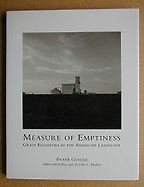
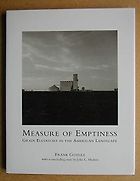
Measure of Emptiness is a terrifically poetic title for a seemingly mundane subject. Gohlke structures his book as a journey—from close detail to vast emptiness where the structure vanishes. How do you decide whether to emphasize similarity through typological grids or transformation through narrative sequence?
First off, I deeply admire Gohkle’s Measure of Emptiness precisely because of that more narrative/ varied approach to the photography he took. And the poetry of the book’s title itself, which so brilliantly describes metaphorically the feeling he was after in doing the project, is so apt, just right-on.
I was trying to, and hopefully been successful at, attempting to do something similar with Silent Monoliths—but obviously not to the extent Gohlke did—by purposely deciding to divide the book into two sections, with the typology one dominating. But the second half of the book—the “Typographies” section—moves more into that narrative, lyrical mode by me shooting the towers in a larger landscape that says something different than the typology of the same material. So the two styles have a mostly equal emphasis. I’m thinking here of the photograph I made at Lees, Maryland, or the night shot at Gilman, Illinois. These two approaches to my photography—doing typologies and narrative work— have always been there. If I could show you my other photographic projects—that are not typologies—you’d see that narrative impulse at work. So in essence, by including these two approaches in the book, I’m revealing my photographic split-personality.
Typologies alone can come off cold and detached. But here again—and if I can be so bold as to say—is the difference between my work and the Bechers’. Their work, which I view as Conceptual Art, has a more clinical, detached feel (which I believe was their intention), whereas my coaling towers, shot in the way I’ve shot them, have more warmth and don’t come off so clinically.
Permit me one aside about the Measure of Emptiness if you will. The book, for the first time in my early engagement with photography, also got me thinking about architecture as valid subject matter, which I hadn’t consciously thought about previously. So, in a way, I can say Gohlke’s book got me indirectly to the coaling towers.
You reference Walker Evans’s concept of the “historical contemporary”—photographing in real time what already belongs to the past.
Yes, exactly. His notion of the “historical contemporary” was an eye-opening expression for me to come across. That comment perfectly described and reflected what I was after in my photography and the subject matter I pursued. That it wasn’t just nostalgia—which Evans called a “blurry representation of the past.” My intent was to record every one of the towers that was still out there as the past seen in the present. And to also show an important architectural element of railroading—a remaining remnant from a different era of that industry’s history.
The last of your books documents something even more mundane. The Melnicks photographed something people literally walk over without noticing–manhole covers. But both manhole covers and coaling towers share the features of overlooked industrial objects. What draws photographers to these subjects?
Many of us are into the mundane and the overlooked. Normally, somebody would say, “Why are you even bothering to photograph that?” Well, like the Melnick’s with their manhole covers, I was interested in the coaling towers’ design elements. And perhaps like me, they may have also have been curious about the various firms that manufactured them.
In that light, from a design standpoint, I’ve been researching two towers—one in Wilmington, Delaware, another in Newport News, Virginia, both built in the 1930s. You probably know of Raymond Loewy, one of the chief industrial designers of that era, very much in the ‘streamline moderne’ camp. Those two towers have that streamlined look.
“Is this an economy that leaves any lasting physical traces?”
As far as the firms that made them, both towers were built by Roberts and Schaefer, one of three major concerns in Chicago (the other two companies building coaling towers were Fairbanks-Morse and Ogle). Hankey is developing a line of inquiry that suggests members of the Chicago School of Architecture perhaps socialized with the in-house industrial designers that worked at R&S, F-M or Ogle—you know, they went out and had drinks together—so an intermixing and exchange of ideas might have occurred. We may never know if that’s true unless we get into corporate history, but someone was designing with aesthetics in mind at those industrial firms, thinking about the streamlined looks that defined the era.
The Chesapeake and Ohio Railroad had their headquarters in Cleveland, and the architectural firm of Garfield, Harris, Robinson and Schaefer was involved in their industrial design. They designed two incredibly streamlined towers—one at Clifton Forge, Virginia and the other at Hinton, West Virginia—that were even bigger than the ones in my book. Unfortunately, those have been demolished. But the same firm likely designed the one at Newport News.
So industrial artifacts function like a kind of vernacular or folk art?
Yes, I believe they can. They have an anonymous, everyday, functional quality that perhaps puts them in the realm of the vernacular depending on how one looks at them. The coaling towers weren’t designed as art, but they come in varied shapes and sizes with a sculptural presence. And on some level, could be considered or defined as “high art.” All industrial artifacts speak to a societies history or it priorities which makes them have value. In my estimation a piece of folk or vernacular art can also reach those heights of consideration. All to say: these categories all have art value to me. I consider the coaling towers pieces of art.
Which makes me wonder about the 21st century’s architectural legacy. Right now the biggest infrastructure spending is on data centers, which are designed to be invisible and nondescript as possible.
They’ll probably take a cue from generic warehouses or strip malls—boxy, hidden in plain sight, no logos. The buildings are designed to disappear, but it also raises the question of land use. What’s going to happen to all this industrial land not used? In Buffalo and some places I’ve seen gentrification—former industrial buildings becoming coffee bars, artist lofts, high-end condominiums. But there are a lot of brownfield sites that need remediation. So it’s a toss-up as to how these landscapes will unfold and develop in the future.
I’ve been reading about these data centers and the amount of electricity and resources they consume. Everything is becoming miniaturized—we’ve gone from coaling towers to a switch on a diesel locomotive, and now tremendous energy consumption to power an abstract information economy that sits in the palm of your hand. Is this an economy that leaves any lasting physical traces?
Any additional thoughts before we wrap up?
Sure. A few last things about the towers themselves: the early ones were made of wood—long ramps that took up a lot of space and weren’t fire retardant, so many burned down. The evolution to concrete is an interesting industrial progression. And certainly left lasting traces unlike the wooden ones.
Some of the towers are also far from uniform. You notice striations in color on some of their surfaces—evidence of construction with slip forms that moved up as the concrete was poured in stages, and depending on temperature and environmental conditions at the time of the pour, each layer took on a slightly different coloration. The coaling tower at Reevesville, Illinois, in the book is a prime example. This is more evident in the boxy shapes than the cylindrical ones.
And why did they evolve from boxes to cylinders? Cylindrically, it was easier to handle coal. Internal pressures were more evenly spread. These were gravity-fed, so with a box you’d have coal stuck in corners. The worker was down there with a shovel moving it toward the chutes.
Concrete brings us full circle in architectural terms—landmarks like Roman architecture still standing today.
Who knows? It’s possible that in 100 or 200 years we will find them overgrown with weeds, waiting to be discovered by a futuristic Indiana Jones. Industrial archeology may have even greater resonance in centuries to come.
Five Books aims to keep its book recommendations and interviews up to date. If you are the interviewee and would like to update your choice of books (or even just what you say about them) please email us at [email protected]
Five Books interviews are expensive to produce. If you've enjoyed this interview, please support us by donating a small amount.
Jeff Brouws
Jeff Brouws (B. 1955 San Francisco, California) has spent the last 35 years documenting the American cultural landscape, using his photography to explore the historical underpinnings of socioeconomic and political issues. He Is the author of seven books including Twentysix Abandoned Gasoline Stations (Gas-N-Go Publications, 1992), Approaching Nowhere (W.W. Norton, 2006) and Silent Monoliths: The Coaling Tower Project (MIT Press, 2026). Brouws’s photographs are in numerous public and private collections including Harvard’s Fogg Museum, Princeton University Art Museum, and the Whitney Museum of American Art. He lives in Stanfordville, New York.
Jeff Brouws (B. 1955 San Francisco, California) has spent the last 35 years documenting the American cultural landscape, using his photography to explore the historical underpinnings of socioeconomic and political issues. He Is the author of seven books including Twentysix Abandoned Gasoline Stations (Gas-N-Go Publications, 1992), Approaching Nowhere (W.W. Norton, 2006) and Silent Monoliths: The Coaling Tower Project (MIT Press, 2026). Brouws’s photographs are in numerous public and private collections including Harvard’s Fogg Museum, Princeton University Art Museum, and the Whitney Museum of American Art. He lives in Stanfordville, New York.