I first became aware of MAGA when I started seeing it printed on red baseball hats. Before we get to the books and your particular focus, could you explain what it is?
MAGA is the ‘Make America Great Again’ movement, which is the slogan that Donald Trump chose at some point in his first candidacy to represent the spirit of his movement. He put it on the red hats and all over. Anyone who is a Trump supporter now is included in this MAGA acronym and the MAGA world—it’s just used as a generic descriptor.
MAGA is tied to America First, which is an older slogan that goes back to the early part of the 20th century. America First was a more isolationist or restraintist approach, which turned into a pro-fascist group in the interwar period, during Weimar in Germany. There’s this history there. MAGA is obviously aspirational, but there’s also a reactivity, a reactionary dimension to it.
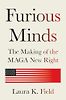
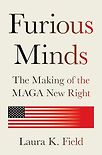
My book, Furious Minds: The Making of the MAGA New Right, is really focused on one narrow slice of MAGA. In an American context, the MAGA New Right connotes an intellectual flavor. That’s what I’m focused on, the intellectuals—as opposed to the broader religious dimensions or QAnon or the working class. Every iteration of new conservative intellectualism is called ‘the New Right.’ So the MAGA New Right is one way of defining that. They’ve called themselves the New Right since about 2018 or 2019 too.
It was really interesting to read about the intellectual underpinnings of MAGA. You cover a lot of thinkers and activists in the book, some of whom I hadn’t heard of, some of whom I had but didn’t really know why they’re always mentioned. It can be bewildering, so I really liked the way you presumed no knowledge. It was also a bit of an eye-opener because when I think of populism, I tend to presume the causes are economic. Your book is a reminder that ideas matter, don’t they?
Part of the appeal of Trump is that he does seem to acknowledge the forgotten worker. That’s a big part of the narrative. So there is an economic concern there. You could go either way on how sincere that is, including with the people I write about. Some of them are sincerely concerned, for others, it’s more performative.
But, generally, in the book, I talk a lot about ‘ideas first’ as the paradigmatic way in which a lot of the people I’m writing about think. In terms of their theory of change—how we change the world—the approach is very ideas-driven. It’s very elitist, it’s top down: ‘We change the culture, we change the way people think.’
That has long roots in the American political tradition, where people talk about ideas having consequences or how politics is downstream from culture. There’s almost a Gramscian inflection, this ideas-driven way of thinking.
People’s economic situation does matter for politics, but it’s not necessarily because of the simple circumstances of their lives. The economic causes don’t quite capture the psychological draw of MAGA, which has to do more with a loss of pride or stolen status. There’s a sense of grievance. People often speak about having lost their country. With men, it’s that women have taken something from them in this modern world of professionalism and bureaucracy. There’s something there that is really core that is lost in a more straightforward economic narrative.
One other important point I try to get across in my book is that with the ideas-driven method that the people I write about use—the culture-warring and so on—what ends up happening is that it becomes untethered from reality. The ideas aren’t always very good and they’re divorced from empirical reality and from history.
But as I think you say in the conclusion, the ideas are appealing to people. If you’re a liberal, there’s something to be learned from that.
Yes, they’ve been extremely effective with these ideas. I do think we’re seeing now the point at which reality comes back and says, ‘You can’t go much further.’ But they have had a lot of success, at least in terms of getting into power.
Let’s turn to the books you’ve chosen. Let’s start with Carl Schmitt and The Concept of the Political, first published in 1932. Tell me more.
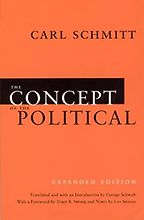
This is perhaps an unexpected place to start, but I thought if there’s one book that you could read to understand the underlying premise of how a lot of the people I write about are thinking, and just the sheer radicalness of it, it would be Carl Schmitt’s The Concept of the Political. If you read my book, I cite and quote a lot of New Right thinkers. There are some books out there that they have written that matter. Not all of them would call themselves Schmittians, but I still think that the spirit of what’s happening is very much in the mode of Carl Schmitt.
Carl Schmitt was a legal scholar and jurisprudent from the interwar period in Germany. He wrote a lot about the administrative state, some really big texts and then a few narrow, sleek volumes that are quite gripping and attractive. He’s quite brilliant, but they’re extremely reactionary and explosive.
What he was worried about during that period was that the constitutional order would never settle down, and that there was nobody in Weimar Germany who could make things happen. He had this deep unease with the disorder and the chaos of it.
He ended up embracing a far more authoritarian politics with an executive emergency power mode.
He was embraced by the Nazis and became a Nazi. He never recanted, so some people call him ‘the Crown Jurist of the Third Reich.’ That’s exaggerated because he ended up being ousted from the actual regime, but it gives you a flavour of his politics.
What Carl Schmitt is known for—and what he writes about in The Concept of the Political—is that for politics to really count as politics, it has to have an existential dimension. Politics really involves these core differences, these big conflicts between different ways of life and worldviews that you’re willing to die for. It’s a conflict between friends and enemies. Hard decisions are made, and it’s about winning out over your enemies. That, to his way of thinking, is the essence of politics—and if you’re not doing that, you’re not really doing politics.
He’s also got this very radical critique of liberal parliamentarianism in the book. He doesn’t speak of it this way, but for him, liberals are just real flakes. Parliamentary democracy is this elaborate schema and all it does is avoid politics. It avoids decision-making and getting things done. It’s always kicking the can because it’s so unwilling to make hard decisions. He talks about it as ‘politics by committee’ or some such—I can’t remember the exact phrase.
It’s quite a damning critique of liberal democracy, and it’s quite effective. It’s lucid, and it can be very appealing. So that’s a good book to start with. I’m not a Schmittian. I think it’s toxic and really dangerous. But there’s something there that readers can look at and understand the appeal of. It helps you understand the psychology that dominates a lot of the people I’m writing about.
Is he endorsing tribalism, then? He thinks it’s a good thing, as opposed to something that rips communities and even families apart.
It’s strongman tribalism. He wants one big figure to win out and dominate and then impose order, though it’s deeper and more intellectualized than that. It’s attached to this critique of liberal democracy. Anyone who’s lived in a liberal democracy thinks, ‘Okay, I see where he’s going. This makes some sense, even if I wouldn’t go as far as him.’
There’s a contrast with others who would say that the essence of politics is that it’s deliberative. We get together and make decisions together. We use our rational faculties and we compromise. There are many different ways of understanding politics that are not just more wholesome, but also truer and tap into something more important about the human condition.
So The Concept of the Political is the best place to go if you want to really understand what these New Right thinkers are drawing on and how they think. Some of them, like Adrian Vermeule or a lot of people at the Claremont Institute, are quite drawn to this and explicitly cite Schmitt quite regularly.
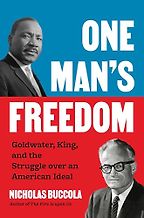
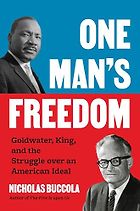
Let’s go on to your next choice. This is One Man’s Freedom by Nicholas Buccola, a dual biography of Barry Goldwater and Martin Luther King Jr. The latter needs no introduction, but while I’d often heard conservatives mention Barry Goldwater, until I read your book, I didn’t know much about him. How does this book fit in?
Barry Goldwater is an important figure in conservative history because he was almost a renegade candidate. He represented something new and West Coast, the rugged individualist arm of conservatism. He was pitted against East Coast elite candidates like Nelson Rockefeller and George Romney.
Goldwater won the Republican nomination in 1964. The reason he features in my book is because one of the figures who is pretty prominent in the history of the Claremont Institute—which is an important faction of the New Right—is Harry Jaffa. He wrote the famous line in the speech Goldwater made at the Republican National Convention at Cow Palace in 1964: “I would remind you that extremism in the defence of liberty is no vice. And let me remind you also that moderation in the pursuit of justice is no virtue.” It’s a good window into the tendency towards extremism and the justification for it. It also conveys this sense that they know the truth about virtue, justice and liberty. They own it.
The Cow Palace convention and the nomination of Goldwater matters a lot because it was the moment when the moderates in the Republican Party were ousted and left.
Also, although Goldwater failed in the presidential election later that year, he won the South. There was a big shift in the makeup of the Republican Party, with a lot of segregationists coming in, and Black people leaving and going to the Democratic Party. That wasn’t accidental.
Barry Goldwater had voted against the Civil Rights Act, not for unprincipled reasons. The Cow Palace convention was almost a referendum on that decision. There were a lot of protesters there, as well as a lot of unsavoury characters on the far right fringe who were there to support Goldwater for all the ugliest reasons. So that was a part of the story too, this shift towards the radical right and away from moderation.
Buccola is a wonderful writer. One Man’s Freedom is a sequel to his book on William F. Buckley and James Baldwin. That’s also a wonderful book, but it doesn’t bear on the material in my book on MAGA and the New Right so much. By doing dual biographies, Buccola is able to show how Goldwater and King’s lives were intertwined, at least for a part of this history, what they were fighting for, and how they understood American politics.
I loved it because it helps you understand the psychology of these different political actors. Goldwater is such an interesting case. Buccola is a political theorist and the conceit of the book is that he’s going to understand their different conceptions of freedom in a historically embedded way. So you look at Goldwater campaigning against labor unions, almost for states’ rights. Then you have Martin Luther. King Jr., fighting for a much more elemental freedom for people. Goldwater is focused on these niggling aspects of labor. You can understand what he’s doing, but in the sweep of history, it seems so much less important.
The book brings into a juxtaposition what’s at stake for the two sides here, in an important way. It also helped me understand the character of Goldwater, because he came to regret his vote against civil rights. He wasn’t—and even Martin Luther King says this—an evil, racist person. It’s just that his policies had implications that he couldn’t see or couldn’t or wouldn’t understand.
It made me understand this blinkered willingness to go along with things, or even just stand for things that don’t really hold up. I just found it an amazing character study that did help me understand some of the people I’ve been writing about.
In terms of what happened in the 1964 election, Lyndon Johnson won by a landslide. So at that point, Americans weren’t having any of it.
They weren’t. In my book, this is the setup for the 50-year history to follow. Ronald Reagan is sometimes seen as the culmination of Goldwater because he was able to ride some of that energy into his victories.
Others on the extreme fringe see Reagan as a betrayal of Goldwater. There’s this dance that gets played between the extreme fringe and the more moderate types like Buckley and Reagan. The truth is that that never got fully settled, the fringe elements were always festering. What we see with Donald Trump is the culmination of something that’s far more extreme than Barry Goldwater.
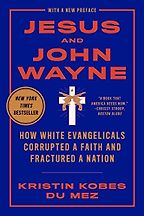
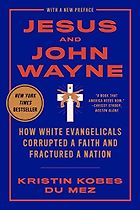
Let’s turn to the next book you’ve chosen, Jesus and John Wayne by historian Kristin Kobes Du Mez. This brings evangelical Christianity into the MAGA story.
This brings in a lot of things that are just a wonderful way to understand some of the background. I picked up this book in the course of researching my book, and even though I was writing about something else, it helped me understand what I was doing.
Jesus and John Wayne is the story of Goldwater masculinity in the Republican Party. Du Mez is a terrific scholar and writer. She’s from the evangelical world and she’s telling the story of cultural shifts in evangelical Christianity. She goes through all of the different masculinist portrayals and cultural visions that have been closely tied to evangelicalism and that have really transformed evangelicalism in the United States. She refers to movies and books and all these cultural artifacts.
What she’s also doing here—and I quote her in my book—is pointing to the misogyny and masculinist dimensions that the intellectual conservative movement, that I was writing about, was playing catch up with. She’s charting that transformation avant la letter, if you will, in the evangelical world.
She’s really good on foreign policy too, which is not what I expected going into the book. She understands how having these strongmen cultural figures become so appealing in the Christian world ties to a kind of cowboy attitude towards foreign affairs.
A lot of people thought when Trump was elected that it was a betrayal of the evangelical world and of Christianity. She offers a solid corrective. This was not a compromise position for many of the evangelicals who voted for Donald Trump—because of this cultural transformation and the shift in their values.
It’s really, really rich and it helps you understand so many different dimensions of this history in a highly readable book.
I think you say in your book how surprising it is that Jesus, this love-your-neighbour-as-yourself and care-for-the-poor figure, can come to be associated with toxic masculinity.
Yes, and now you have books coming out with titles like Toxic Empathy or Suicidal Empathy. That’s a super Nietzschean proto-fascist way of thinking—the dangers of too much compassion. I can understand intellectual arguments for some of this, and I’m not saying there’s nothing to it, but it’s also extreme and bizarre. Jesus and John Wayne offers a way of understanding where that’s coming from in one sector of the American public.
My book is more rigidly focused on the movement conservatives and the intellectual side of it and it’s much more contemporary. My book also has quite a bit about Catholics and Catholicism in it, the Catholic thinkers. Hers is about the evangelical Christian world. Our books are complementary, in a way.
Why do Catholics play such a big role in the movement?
Maybe there’s a natural affinity. William F Buckley was Catholic, there’s also Brent Bozell (on some of this history, I would recommend Jerome Copulsky’s American Heretics: Religious Adversaries of Religious Order). So there are these Catholic figures within the history of the conservative movement where a lot of the institutions that I write about come from. In higher education, the Catholic conservatives have had quite a strong role, and in the Federalist Society. The American conservative intellectual world of journals and think tanks and so forth offers a natural home for Catholics, and so they’re overrepresented there, perhaps.
I think that’s a sociological question, maybe, about how different doctrines are appealing or not.
J.D. Vance converted to Catholicism, which seemed a bit random until I read your book.
One of the big factions I write about, the post-liberal faction, is made up of conservative Catholics. J.D. Vance knows some of these people really well. One of them is in Hungary, working for Viktor Orbán. Another is Patrick Deneen at the University of Notre Dame.
Adrian Vermeule, who I mentioned, is also a Catholic convert. He’s the one offers a constitutional reread of American history that’s very much in line with not even contemporary Catholic thought, but a more theocratic version of Catholicism. It’s all very radical and strange. It’s quite an extreme group. There are other Catholics in the movement too, who might not identify with that integralist project.
But it’s certainly notable, the Catholic influence.
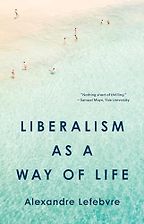
We’ve reached your fourth choice, which is Liberalism as a Way of Life by Alexandre Lefebvre. Tell me more.
This is a very fun book that’s a defence of liberalism, written mainly for liberals. The reason I put it on my list is that one of the strongest critiques of liberals that the New Right offers is that it’s culturally dominant, and it doesn’t even admit that it has any cultural power. Liberalism pretends to be this neutral arbiter between different opinions or different factions. The truth is that it’s a regime type that dominates everything in our culture—from our academic institutions to our media to the government. We now even have woke corporate life, as they would put it. There’s something really hypocritical and dishonest about how liberalism operates in modernity.
What the New Right is worried about is that it seeps into our lives and is an attack on conservatives. The fact that liberalism is so dominant is a deeply perceived threat. It prevents conservatives from being able to live their life and raise their children with the values that they hold.
Some argue that liberalism is completely destructive of social ties and there are other critiques of liberalism too.
What is refreshing about this book by Alex Lefebvre is that he says, ‘Yes, there is some truth to that.’ He’s a Rawlsian liberal, a true-blue liberal who really believes in the Rawlsian project. I won’t go into the political theory too much, but he says liberalism has become so dominant that it’s the water we swim in and we can’t even recognize it for what it is. I think he might go too far with this, but he accepts that as his premise.
Beyond that, we’re tongue-tied and unable to speak about morality and engage in moral discourse. The particular version of liberalism that we’ve inherited has stolen that from us, because it presumes that we leave morality for people to figure out for themselves. Different cultural groups can flourish on their own; there’s no infrastructure for or acknowledgement of cultural needs.
I agree with that. It’s one of the things that’s fuelling the New Right and that they’re feeding off, this incapacity of liberals to understand the moral universe. I’m not saying that liberals are amoral nihilists or relativists at all. We’re leading moral lives. It’s more that we’re confused about it. We’re unable to contend with it, and not really formed in our educational systems to grapple with some of the most important questions of life.
Liberalism says, ‘We’re not going to teach you how to live your life. That’s up to you. That’s your private choice.’ It may be that in a time of transformation and historical change, with religious traditions dying out, it leaves a lot of people pretty unmoored. Then the New Right comes in and they say, ‘We’ve got some answers for you, young man. We’ve got a whole world or a whole universe for you’—whether it’s evangelical masculinity or Catholic social thought or Nietzschean ubermensch stuff. There are bodybuilders online who also teach you about classical music. There are a lot of resources that they’re coming out with. They’re saying, ‘Nobody else is doing this for you, but we have some answers.’
That’s really powerful, and Alex’s book is a really excellent way into that problem.
Do you agree with it?
I agree with a lot of it. I did a review of it, where you can read my own spin on things.
While on the subject of liberalism, in your book you mention Why Liberalism Failed. Is it worth reading?
It’s highly readable. It’s more moderate than Patrick Deenen has since become. But, frankly, I can’t fully recommend it because it’s a really bad history of liberalism. People do need to grapple with the things Patrick Deneen is writing about, and there are definitely things in that book that I agree with. But I’m fussy as a political theorist. I wrote a long critique of it for the Niskanen Center because it does a real injustice to the history of political philosophy and of liberalism. There is also another important new book out on June 22 called Why Postliberalism Failed, by James Patterson and Thomas Howse, that offers a deep critique of the Catholic dimensions of postliberalism. If we were doing a separate list of books by New Right thinkers, Deneen’s is important, Vermeule’s Common Good Constitutionalism is important and Yoram Hazony’s The Virtue of Nationalism is important, too. I don’t talk much about Oren Cass in my book, but his work is important too.
Let’s turn to the final book you’re recommending, which is The Limits of Critique by Rita Felski.
Part of what I write about in my book is the vulnerability that the New Right sees in liberalism, and how they exploit that. They’re leveraging the weakness that Lefebvre writes about in our education system. There’s a huge push on the right for classical education, for patriotic or a more old-fashioned education.
This is not a new story, but they’ve really gained new energy through the MAGA era. Part of what they talk about is jingoistic, whitewashed history, but part of it is also a return to a more formative version of education. It’s a more classical, liberal arts education, where you’re asking big questions about the meaning of life. You’re learning about Christian traditions or classical traditions and engaging with authors of older books in ways that could maybe help you live your life.
That’s the way that I was trained. I’m a political theorist, and I was studying with Straussian political philosophers. My teachers were very open-minded and attracted me to this way of thinking. They were very Socratic: ‘We’re going to ask big questions about everything and it’s dangerous and risky and fun.’ They weren’t really buttoned up in the way that Patrick Deneen and a lot of the classical education people now are, but I’m very drawn to that.
I’m recommending The Limits of Critique because it’s one of just a few books that is able to describe the vulnerability of our dominant moral order and our educational institutions in the humanities in a way that people can understand. It can help people who are very sympathetic to those institutions and liberalism see what is making the other side so angry on a high-plain, academic level.
The book is not hard to read. It’s about critical theory in literary studies, the tradition Rita Felski comes from herself. She was trained in it. She is not a reactionary. She knows that her arguments are going to sound reactionary and can be used by reactionaries, but says we still have to have this conversation. In the humanities in the United States today, there’s an excessive emphasis on skepticism, on the ‘hermeneutics of suspicion’, on deconstruction. Conservatives have been complaining about this for decades, but I think she gives it a fresh new spin and offers a way forward that’s not reactionary.
There is this mode of critique which is always trying to get under the power dynamics, trying to deconstruct these cultural inheritances. She says that can be very valuable. She’s not out to destroy that mode of inquiry, but she says it has become the only way, and it’s become a dogma unto itself, to only critique, to only tear down.
This book offers a smart description of the problem, and then an effort to expand our horizons, to think of other ways to engage. She writes, “the work of the humanities is frequently descriptive or appreciative or provocative or speculative”—I would add formative—”more than it is critical.” She shows us all the ways in which our ways of thinking about our cultural inheritances don’t always have to be that. She opens up a way of expanding humanistic inquiry with liberal political philosophy and engagement with these texts for civic education, at least for K to 12.
A renewal of the humanities that is much broader would be good for young people. I tried to get at that in my conclusion. It’s not going to be a quick fix, but in the long view, if we’re looking at the next few 100 years, don’t we want young people to have a rich humanities education? It shouldn’t be uncritical, but it could take up these different traditions, exploring alternative worldviews to help them live their lives. Don’t we want them to have that?
That was my reason for including this book.
Let me give you one more line from the book. She describes the problem: “What afflicts literary studies is not interpretation as such, but the kudzu-like proliferation of a hypercritical style of analysis that has crowded out alternative forms of intellectual life.” Then she has this line that I love. She says, “Why are we so hyperarticulate about our adversaries and so excruciatingly tongue-tied about our loves?” I’m guilty of that in my book. I’ve written this long, 400-page book about my adversaries, but the real challenge moving forward is to defend, with moral courage and strength, the liberal tradition that we want to see in the world.
Laura, before you go, you wanted to give a shout-out to a few other books that people should be aware of?
I indulged myself with my list, but if you wanted to read books that are straightforward complements to my book, there are a few good ones. There’s a book called When the Clock Broke: Con Men, Conspiracists, and How America Cracked Up in the Early 1990s by John Ganz. It’s about the 1990s and covers some of this history of conservatism. That’s really a great read. There’s also a book by David Austin Walsh, Taking America Back: The Conservative Movement and the Far Right. That gives you a deep reflection on the history of the right-wing, fringe elements in the Republican Party. I’d also like to mention Nicole Hemmer’s Partisans: The Conservative Revolutionaries Who Remade American Politics in the 1990s. She’s a historian who writes a lot about media. It’s about the 1990s as well, and it’s excellent on the history of conservatism.
Interview by Sophie Roell, Editor
June 21, 2026. Updated: August 24, 2026
Five Books aims to keep its book recommendations and interviews up to date. If you are the interviewee and would like to update your choice of books (or even just what you say about them) please email us at [email protected]
Five Books interviews are expensive to produce. If you've enjoyed this interview, please support us by donating a small amount.