While we may not always act as we should, research into human behaviour has taught us enough to improve things both individually and as a society, says behavioural scientist Michael Hallsworth, author of The Hypocrisy Trap. He talks us through his favourite books on human behaviour, from managing the voice in our head to avoiding the dangers of groupthink.
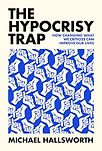
The Hypocrisy Trap: How Changing What We Criticize Can Improve Our Lives by Michael Hallsworth
Human behaviour—why we do the things we do—is always interesting to think about, but do you think understanding it actually helps us behave better?
One of the things that behavioral science points out is that we don’t always do what we intend, and that knowledge does not always translate into behavior. Speaking for myself, I’ve been working in the field of human behavior for the past 20 years, and I still do things that I regret and that I can’t quite explain to myself.
There are some marginal improvements, though. Some things do stick in your mind that you learn to adjust for. For me, one example might be the ‘fundamental attribution error.’ This is our tendency to underestimate the power of the situation when we’re thinking about people’s behavior, and to overestimate their character. We might think that people do things because they are lazy or angry, for example, and we tend to downplay the fact that it may be the situation that is driving those behaviors. We might also behave like that, given a different context. That’s an example that has changed my view of other people over time.
But there are many things that I know in theory, and the conditions in which I’m making choices just override those theoretical ideas.
So the answer is yes, up to a point. It can make a bit of a difference. Certainly, some of the books I’m recommending have made a difference to me. But it’s a tough ask.
That’s interesting, and a point which comes out in your book, The Hypocrisy Trap, as well. It’s not just about improving your own behavior—’I wish I did more of this and less of that’—it’s about having a better understanding of other people.
Absolutely. It’s trying to understand why people are doing things. That may help us be more forgiving. It can also help us try and come up with new ideas to improve the world, potentially. My work has always been a very applied space, whether policies or organizations doing things differently.
So it’s both about understanding why people do things just on its own terms, but also to do something with that knowledge.
I do feel there is a message of hope here. We have learned quite a bit about human behavior. There are some things that are relatively simple that we still don’t do, which would make a big difference.
Can you give an example of a simple thing that you wish we’d already done?
Some are around the way we run organizations, where there are various activities influenced by tradition or habit that we don’t think about much, like procurement, setting budgets and hiring people. We know you can improve the quality of hiring by comparing candidates side by side, rather than one by one. It helps you make better judgments about the relative importance of different candidates. Yet, quite often, we don’t do that when we’re hiring.
We know that the key to getting better value for your procurement is being able to make easy comparisons between different products to select the cheapest or best quality option. Again, we don’t set up our systems to do that: we just go to the same people again and again.
We set budgets based on existing budgets and very rarely examine why we are doing things, because it’s just easier to keep it like that. That’s status quo bias.
These are all core activities that millions of people are doing all the time, and we don’t even really think about whether they’re producing the best outcomes.
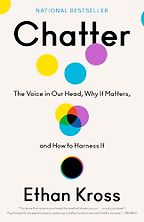
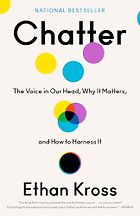
Let’s go through the books you’re recommending. First on your list is Chatter by Ethan Kross, which is about “the voice in our head and how to harness it.” Can you give me the lowdown on this book?
I put this on the list because it’s the best kind of self help book. The reason this book is so good is that Ethan Kross has done decades of empirical research on the voice inside our heads. These are the silent conversations we have with ourselves. It’s something we all do, so it’s widely relevant, and they really matter for our emotions, our performance, and our well being.
He makes a distinction between constructive self talk and what he calls ‘chatter,’ which is this repetitive, uncontrolled internal voice that distracts us, makes us feel anxious, and causes us to become socially isolated and reflect unproductively on how we’re thinking.
He offers various ways that you can control that inner voice, many of which are really feasible. So one thing he says you can do to stop the chatter is to create psychological distance, which can be as simple as talking to yourself in the second person and using your name. So stopping and saying something like, ‘Michael, you’re actually good at your job. You don’t need to worry about this.’ This presents you in a different light. It enables you to step back from your chatter, the situation that’s overwhelming you, and think about it as if it were someone else.
He also talks about changing your environment to prompt different internal monologues and using rituals to remove some of that unproductive inner voice. Another thing he talks about is temporal distancing or mental time travel and asking, ‘How will I feel about this in a week or a month or a year?’ It puts the issue in perspective and removes some of the immediate emotional intensity.
So this is a book based on research with stuff that you can actually do. Personally, it made a difference to me when I tried some of it out. Chatter is one of those rare self help books that is empirically grounded and genuinely useful.
Does the inner voice tend to be negative, things like, ‘I’m such a loser, how am I going to cope?’
It doesn’t have to be. He says it’s quite broad. It’s just the thoughts taking the form of words in your mind. So it’s like when you read something and you think internally, ‘That was really interesting. I must do something with that.’ It doesn’t have to be negative. It can be helpful.
But obviously, it can become a problem when it gets out of control, when your internal monologue gets away from you and almost takes on a life of its own. That’s when you get into ruminative thoughts and so on.
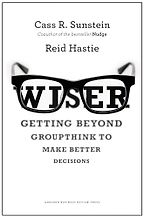
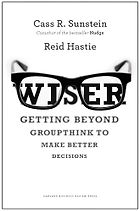
Let’s go on to Wiser: Getting Beyond Groupthink to Make Groups Smarter by Cass Sunstein and Reid Hastie. Tell me about that one.
This book is helpful because it’s about how groups work together and so many of our decisions are made in groups. They have their own peculiar dynamics, which, if you don’t know about them, can cause problems. I just found it a great, straightforward book that pulled together all the evidence about why groups sometimes make good decisions, and sometimes go wrong.
For example, one potential problem is information cascades. If one person speaks first and asserts something, then it’s easier to agree. So everyone just ends up agreeing with this one thing. It can be really random, who happened to speak first, or what they said, and it may not be the best idea, but it builds momentum. It becomes very hard to challenge it, because all the incentives are to agree.
They point out that often it’s leaders or people higher in the status hierarchy who speak first, so you don’t get a genuine discussion. This can have some really interesting consequences. For example, you might think that groups are a moderating influence and will come to more of a compromise than individuals. That’s not the case. Groups actually end up creating more extreme positions because of this snowball effect of everyone agreeing. They’ll go, ‘While we’re at it, why don’t we do this as well?’
This leads to other problems. For example, compared to individuals, groups are much more aggressive when it comes to other groups. Conflict between groups is generally nastier than conflict between individuals, partly because they become more extreme, and you’re bonding together in your opposition.
Another problem is that groups often spend a lot of time talking about information everybody knows. The most critical thing may only be known by one or two people, but it’s never discussed, because the incentives aren’t there.
Then they talk about things you can do to improve those group discussions, some of which are quite hard. They include monitoring who speaks first in the discussion, so leaders do not speak first, and incentivizing new information. Another option is giving people the chance to write down their thoughts before they are in a social situation, when they don’t have the pressure of listening to other people. They can think about what they actually believe, rather than being influenced by other people. Everyone can discuss their actual position later and combine all those individual thoughts in a group setting.
They also argue that groups can be wiser than individuals if you set them up correctly. So the way you create the meeting, the incentives, the way the agenda is set, how you do feedback, all really matter.
We’re all having meetings all the time and we’re not doing them very well. Wiser gives us some evidence-based ways of making them better. There are other books on this topic, but this one is very no-nonsense and gives you the data.
You’ve just written an excellent book about hypocrisy, The Hypocrisy Trap. What prompted you to write it?
There’s been a ton of new research in the last 10-15 years that really changes our view of hypocrisy. There are a couple of books about hypocrisy, but they do it in a different way, and there’s been nothing recently.
It was also a concept that I couldn’t get out of my head. I was reading an article in February 2020, and it just really took hold of me, because when I thought about it, I realized the concept is everywhere. It really drives some of our fury and our behavior. We’re using it in really varied ways, and in ways we don’t fully understand.
After looking at all these studies and thinking about it for months, if there was one thing you could tell people about hypocrisy, what would it be?
Hypocrisy is not something that exists in the world: it’s a judgment we make about the inconsistency of others that we don’t like. We are motivated to see hypocrisy all the time. It speaks to a deep sense of fairness in us. It triggers a sense that people are gaining something they don’t deserve. That sense of fairness has deep, evolutionary roots, but our criticisms of hypocrisy always end up bending back into hypocrisy themselves. This is the hypocrisy trap.
Whenever you’re calling hypocrisy out, your motives are mixed. You want to look good yourself by being the accuser. You claim that you’re doing it because someone else has violated some principles, but you often put standards on other people that you can’t live up to yourself. So it creates more hypocrisy, if the accusations get out of control.
The other danger is that we just use the concept all the time, so that it becomes meaningless, and people stop caring about it. They can say, ‘So what if I’m a hypocrite? I don’t care. I’m just going to do this anyway.’ And some of that moderating influence of hypocrisy that we depend upon gets trashed because we’ve overused it. I think that’s where we’re in danger of heading.
Is your fear mainly in the public political sphere, rather than domestically?
It’s in various places. I talk about companies. I talk about personal relationships. It can be problematic in all of them.
There are three things I suggest we should do. One is that we can try and be more consistent and act more in line with our intentions or our ambitions. That’s where some of the behavioral science comes in.
We also need to understand why people are accusing us of hypocrisy, what gets us in trouble, and ways of making it less likely that we get called out. That’s justified because some of the accusations are spurious and out of control.
The final thing is to try and change our views of hypocrisy and what level of consistency we think is even appropriate, because behavioral science would say that inconsistency is baked into social behavior. Indeed, in some cultures, hypocrisy is not such a big deal, because the idea that you’re behaving differently in different situations—you’re inconsistent because of the demands on you—is more accepted. I’m not saying we have to go that far, but I think we need to understand that there are some hypocrisies that we think are valuable and get us to a better place, and there are some that are toxic. Rather than just saying hypocrisy is bad, we need to distinguish between the different kinds.
The political examples in your book were really interesting, as that’s where accusations of hypocrisy come up a lot.
I think part of the problem for politics is that as a politician, you’re in an adversarial system where you’re forced to take a position on issues and, often, you have to take it quickly. These are often really complicated, complex issues, and so you may then have to revise that.
But any revision is jumped upon by opponents, because it’s an easy accusation to make. It is the easiest thing you can say about your opponent in politics, that they’re a hypocrite. Also, the reason people don’t like it is that they feel that politicians’ whole job is to state principles that they believe in. That therefore opens you up massively to violating those principles.
The truth is that in politics, you need both principles and pragmatism. We want people to get things done, as well as give a really clear statement of what they believe in. So we put inconsistent demands on politicians, and a lot of the anger we feel is just our own hypocrisy reflected back at us, because we’re making those inconsistent demands and we’re pretending we don’t. We flip between the two. ‘Just get something done. Be pragmatic about it. Why can no one get anything done?’ ‘Why don’t you stand up for what you believe in?’ We want both those things at once.
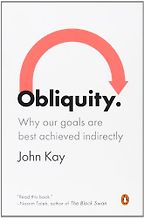
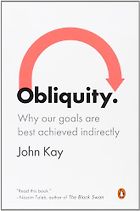
He argues that a lot of the time, our goals are best achieved indirectly. He starts the book by pointing out that the Panama Canal wasn’t built from east to west. The shortest route is an oblique one, and you have to think differently to get there.
I really like this book. It’s quite unique because it’s got an incredibly broad frame of reference—from literature, philosophy, business, politics, and psychology. He gives tons of examples in life and covers so much ground.
He says that the approach to solving problems that a lot of us use is that you have a big goal, which you break down into little bits. Then you come up with plans and goals and targets to achieve each of them in order to achieve your overall goal. That often doesn’t work. That rationalistic approach is a cause of many policy failures, because we don’t operate in a stable environment with full information about what we’re doing, and often there isn’t a linear relationship between causes and effects. In a complex system, a big effort can lead to no impact, and a very small effort can lead to a massive impact because of all the connections you can’t see.
I think that’s a very profound lesson for policy and organizations, and I’ve used it a lot since I read this book 15 years ago. It’s very concise. It covers the same ground as other books, but in much less time, and in a very well-written way. It’s very wise.
Can you give me an example of a practical impact it might have?
He talks about well-run businesses, and how focusing on purpose, not profit, will actually give you more profit and how maximizing shareholder value destroys shareholder value. To build a successful business, it’s about some general principles that you iterate or experiment towards.
He talks about how, in policy, you shouldn’t try to program exactly how a community will function, but to create the conditions so that people in that community can work it out themselves. Trying to program everything may backfire.
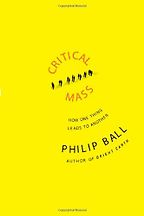
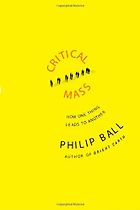
Let’s go on to Critical Mass by science writer Philip Ball. What’s this one about?
Critical Mass looks at human behavior from the perspective of physics. It’s one of these analogies that I found very impressive and convincing. He basically asks, ‘Can some of the patterns of human society, like markets or traffic or social media, be understood using physics and complexity theory?’
This is what’s called ‘social physics,’ the idea that while individual human beings are complex and unpredictable, the way groups interact can follow mathematical laws. He claims that in some cases, groups act like particles do in physics. Sometimes you get a ‘phase transition,’—like when a liquid turns into a gas—when a traffic jam suddenly develops, or a market suddenly crashes. He suggests similar patterns of movement occur.
That’s the ‘critical mass,’ and when you reach it, you end up with a transition to a completely different human behavior in society. He connects up the way birds flock together to the way stock markets work, and talks about attempts to understand human society through physics and chemistry.
He also says there are limits to doing this, because humans are reflective in a way that particles aren’t. We think about our behavior, and we have the capacity to understand what’s going on, to an extent. So you can explain human behavior as operating like particles in a dynamic system and that gets you some of the way—but it can be misleading. The metaphor has a limit. I found that a really sensible and helpful way of thinking about things, because too many popular science books try to just sell the metaphor completely.
And have you found his ideas helpful in a practical way?
Yes. It’s helpful in understanding how cities work, for example, and how effects in one part of a city can affect another part of the city.
In my own work, I’ve looked at how a lot of our assumptions around policy fall down because we assume we’re dealing with a straightforward linear system where we go from A to B. Work like this shows that when you’re dealing with societies, those assumptions do not hold true, so you do have to think differently. It gives you a different lens for thinking about behavior at scale. What if it was acting like a phase transition or like social physics?
So it’s not the whole answer, but I’ve found it really helpful for understanding how you manage a system that you can’t always influence directly, or that may behave in surprising ways.
Last but not least, you’ve chosen a philosophy book. Tell me why you chose Friedrich Nietzsche’s On the Genealogy of Morality.
I chose this book because sometimes you need to choose a book that blows you away and turns everything upside down. We all remember books we’ve read like that, which give you a completely different perspective on life or issues. This one did that for me. I’m not saying you have to agree with everything in it, but we need books that view human behavior from the opposite end of the telescope.
Nietzsche turns Western morality on its head. He’s trying to understand how we ended up with our accepted moralities. He argues that it came out of power struggles. Christian morality is a revolt by the weak against the strong, and it’s driven by a toxic resentment and hatred and envy of the strong. You can’t win by force, so you end up changing the rules of the game so that everything that’s strong becomes evil and everything that’s weak becomes good.
One reason this happens, he says, is that when you move to agriculture and live in a stable society, your natural aggression has no outlet. Instead, it turns inward against yourself and becomes guilt and internal self-torture—which he says is turned into a virtue by Christian and other forms of morality. You make a virtue of your own self-torture.
Do I believe that? Not really. Is it a complete reassessment of everything you take for granted? Yes, and it’s written in such an incredibly compelling way that it makes you see human behavior completely differently.
Have any of his claims held up?
I think books that go out and make really big, inventive, completely original claims are books that need to be in the discussion. It’s definitely true that internal conflicts can be very energy-sapping for us and can distract us from being more productive and doing things. And I do think that there’s something in the idea that civilization introduces contradictions that are a burden for us. Freud thought that as well. I mention Freud in my book. He thinks that society as a whole is hypocritical, and that’s just the price we pay for suppressing our instincts.
So I do think there’s some evidence for what he’s saying. There are also counter-arguments. For example—and maybe this is just something that’s evolved—but we also feel good when we’re altruistic, when we help other people out, we get that warm glow. I don’t see how that fits into Nietzsche’s worldview at all.
February 6, 2026. Updated: February 22, 2026
Five Books aims to keep its book recommendations and interviews up to date. If you are the interviewee and would like to update your choice of books (or even just what you say about them) please email us at [email protected]
Five Books interviews are expensive to produce. If you've enjoyed this interview, please support us by donating a small amount.
Michael Hallsworth
Michael Hallsworth is a leading figure in applying behavioral science to real-world challenges. For the last 20 years, he has been an official and an adviser for governments around the world. The coauthor of the book Behavioral Insights, he built a 250-person consultancy business and has held positions at Princeton University, Columbia University, Imperial College London, and the University of Pennsylvania.
Michael Hallsworth is a leading figure in applying behavioral science to real-world challenges. For the last 20 years, he has been an official and an adviser for governments around the world. The coauthor of the book Behavioral Insights, he built a 250-person consultancy business and has held positions at Princeton University, Columbia University, Imperial College London, and the University of Pennsylvania.