The ancient world is sometimes seen as a golden age of tolerance for same-sex love, later swept away by the rise of Christianity. The reality is more complicated, argues historian Harry Tanner, with acceptance and persecution ebbing and flowing in line with pressures on society. He recommends five books for a better understanding of same-sex love in ancient times, including the Biblical world.
We’re talking about same sex love in the ancient world. Why is this an important subject to study, or what does it illuminate?
Most of the arguments that are advanced against same-sex love, and indeed against all queer lives, are often rooted in ancient texts like the Bible. They may also be rooted in what are often described as ‘common sense’ views on gender or sex, which have ancient origins. They might be rooted in the idea that sex is naturally for procreation, or that marriage is traditionally between a man and a woman. These are very, very old views, and it is the job of historians to question those views.
For me, a historical understanding of ancient ideas and ancient texts loosened their power over my life. It helps to create distance between the past and the present. We don’t know the whole of the ancient world. We cannot know it as we know modern history. In a sense, we are putting a bit of ourselves into the study of the past.
So studying the ancient world tells you a lot about who we are as a society. It’s a way of safely reflecting and making sense of our own times. I say safely because sometimes modern history can be a bit scary. The world that we live in is quite terrifying. By looking back to a long time ago, to things that actually happened, by discussing them and thinking about what they mean to us, we can come to a different relationship with our own politics and our own present.
And, at the risk of generalising, has our present post-Christian society’s greater tolerance of same sex love recovered something from the ancient world?
In a number of countries, LGBT+ rights are facing a new menace, even in countries in the European Union. I don’t think you could look at them and conclude that we are going in a uniform direction. In the ancient world, as in the medieval world, there were periods of tolerance and there were periods of intolerance. Traditionally, we tend to associate this with Christianity. I don’t think that can fully explain it, because there have been Christian societies—I would single out Boston, Massachusetts, in the late 18th century, or maybe Renaissance Florence—when same sex acts have been tolerated and understood by that society. These were very Christian societies. There is some evidence of comparable tolerance in other societies as well, to some extent in Byzantium, for instance. We may be slightly more sceptical of that, but it’s not straightforward to say that the ancient world was pro-gay, and then Christianity emerged, and suddenly we were plunged into this LGBT+ Dark Age.
Tolerance of same-sex love rises and falls, and that should make us interested in what the real cause of that is, because it doesn’t appear to be religious intolerance. It goes up and down, but predictably, according to the ways that it has done throughout history. I would distance myself from saying that Christianity could be directly blamed for that.
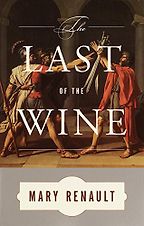
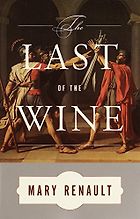
Let’s move on to the books. First up, you’ve chosen a historical novel, Last of the Wine by Mary Renault. Tell us a bit about it and why you’ve chosen it.
It’s beautifully written. It was recommended to me by a friend some years ago, and so I feel very sentimental about it. It’s also beautifully researched. If you want an example of a fiction writer who is deeply, deeply immersed in ancient literature and understands it very, very intimately, then this is a great book to go to. Some people might suggest that its depiction of same sex relations is maybe a little old-fashioned, even sentimental. But I think it’s just a wonderful read, and it’s a wonderful introduction to the ancient world in some beautifully written prose.
What is the love affair at the heart of it?
The love affair is between Lysis and Alexias. They’re studying philosophy. The background to all of this is the question of how far philosophy and same sex desire interact in the ancient world. Strangely, there is a suggestion in many of Plato’s works that he seems to understand desire only through the lens of homosexual desire. He doesn’t really talk about heterosexual desire in his works, and he talks an awful lot about desire. So there’s always been that question of what a love affair in those times might have looked like, and there’s a sentimentalism at the heart of all of that.
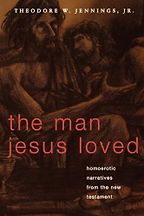
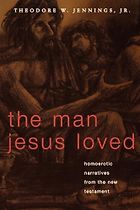
Next up is The Man Jesus Loved Theodore Jennings. Tell us about this one.
This is nonfiction and has received some interest in scholarly circles. It picks away at a very old question. He discusses how King James I of England (and VI of Scotland), as well as various Jacobean playwrights, suggested that Jesus might actually have had male lovers. It’s a controversial work, but it looks at the biblical evidence for this. There are bits I disagree with in terms of its interpretation, but it’s incredibly thought-provoking, particularly in its ability to get us to ask questions about the Greek text.
Even if one is not totally convinced by all of the arguments, one comes away from it thinking that if the authors of the Gospels had intended to give us the impression that Jesus was a deeply homophobic individual, they failed to do so.
It also raises lots of interesting questions about manuscripts. It discusses the secret Gospel of Mark, the manuscript that was found last century, which seems to describe Jesus falling in love with another man. It makes you question what we have been told about Jesus’s life, when, in fact, Jesus’s life, as it is described to us through the Gospels, is open to an enormous amount of interpretation. This book is not something that you can take as completely gospel, but I think it’s a fun one to throw out there—and certainly one that will get people thinking.
And who was the man Jesus loved? Presumably, it was one of his disciples.
The discussion around that is that it may have been John. It’s the phrase in Greek, ὅν ἠγάπα (hon egapa) or ‘the man whom he loved,’ which is repeated in the Gospel of John. It supposedly refers to an unknown individual who was supposed to take care of Jesus’s mother after he died. There is speculation by Jennings as to who that might be. There’s been speculation by other scholars as well. But there are other things, other discussions in there, such as those related to baptismal rites and Jesus’s role with other men, involving nakedness in gardens. There’s also a discussion about the young man and his Centurion, whom Jesus heals, which goes into quite how far Jesus might have been involved in potential queer subcultures and communities. As I say, it’s a very thought-provoking book, and not the kind of nonfiction book that you might usually pick up.
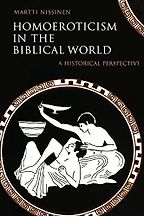
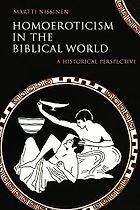
Next up is Martti Nissinen’s Homoeroticism in the Biblical World: A Historical Perspective.
I just love this book for its scope and its introduction of lots of interesting ideas, from the relationship of David and Jonathan, and its discussion of that, through to its broad coverage of Mesopotamia, Egypt and what is going on in the background to the Bible’s discussions on same sex desire. It’s very accessible. And if you want a background to some of the stuff you might be reading, or might have heard in church—if you’re part of that community—it’s a really, really fabulous book.
Is it focused specifically on the Bible, or is the focus broader, with the ‘biblical world’ just taken as a period of time?
It takes a historical perspective to the Bible itself and just gives us this really brilliant overview of all sorts of different societies within which the Bible was set. It’s a really great introduction to that world. If you want to understand more about the New Testament and the background to that, too, it starts, like The Man Jesus Loved, provoking all sorts of questions and overturning ways that we might traditionally have thought about things.
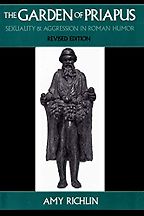
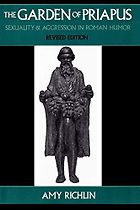
Next is The Garden of Priapus: Sexuality and Aggression in Roman Humor, by Amy Richlin.
This is fantastic for overturning our conception that the ancient Romans were all universally bisexual. It looks at the evidence that would actually suggest that the material we’ve interpreted as suggesting the Romans are bisexual is actually about domination and power, and displays of domination and power. It goes into detail, for example, on the graffiti in Pompeii where there are these profanities written about performing various sex acts on other men. If you want something that’s going to shake up a little bit how we’ve traditionally thought about the ancient world, this is a brilliant book by a very brilliant scholar.
Let’s turn to your last recommendation, the Poems of Theognis of Megara.
This is very special, because it’s probably the oldest queer love poetry that we have from ancient Greece, alongside Sappho. It comprises hundreds and hundreds of lines of poetry about all manner of topics, from friendship to love of other men, to the pain of unrequited love, and it does so in a very celebratory style. There’s also a certain tongue-in-cheek level of wit that can be a bit naughty at times. It’s very endearing to read. It’s also a powerful reminder that queer love has been there for as long as our race has, and certainly as long as our literature has existed, and that there is evidence of that.
Are all the poems addressed to male lovers, or a male lover, or are there some addressed to women?
Most of them are addressed to men, and then some of them are also addressed to a friend. To the best of my knowledge, there aren’t any addressed to women.
The poetry of Sappho is addressed to women, but it is slightly harder to read because it’s much more fragmented than Theognis of Megara. The poems of Theognis of Megara make for wonderful reading and allow one to dip into some very ancient queer love poetry.
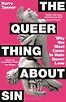
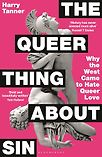
Finally, tell us a bit about your book, The Queer Thing About Sin. What does it add to this story?
I haven’t tried to write another book about sexuality in the ancient world: I wanted to write a book about its opposite, homophobia and queerphobia. It is something that is stalking all of our lives at the moment. It’s rearing its head in different parts of the West, and it almost feels like the tide of LGBT+ rights, which felt inexorable before, is being rolled back and is facing new challenges. And I think it was time for me, at least, to examine why that might be so.
The book looks into the long history of homophobia from the ancient world, and then, towards the end of the book, we move into the medieval world, with some later discussions of what’s been happening in the modern world as well. The book argues that throughout history, homophobia has been motivated by social crisis and financial instability, and happens because of the politics which emerges around self-control and restraint of finances and resources in response to crisis. It argues that we will see a similar pattern as instability increases in the modern world, in the rollback of LGBT+ rights.
For me, it is also a very personal book because, as I discuss in the introduction, as a teenager, I was an evangelical Christian. And what I always really wanted was a rational explanation for why the law codes exist—For example, in Leviticus 18:22: ‘Thou shalt not lie with mankind as with womankind. It is an abomination.’ If you look at the law codes of Leviticus or Deuteronomy, which banned certain foodstuffs, there’s usually a logic to it. It’s because there are parasites in pork or certain shellfish go off faster than others, for instance. As a teenager, I was grappling with this, at times in very difficult circumstances. People in my prayer group were encouraging me to engage in what would be described as conversion therapy, something I describe in the opening of the book.
I’ve wanted to look back since at providing a rational explanation for where this stuff comes from. Because I think if you can academically, historically and rationally understand something, you stand a very good chance of gaining some mastery over it, of making it make sense in your own life. That’s what I’ve sought to do in The Queer Thing About Sin, so that people can understand that if they hear a church pastor or someone they love attacking them for their sexuality, that is not a moral law. These were a series of thoughts that have been invented by human beings in response to social strife. If we understand that, we might be able to make sure that when social strife hits our shores once again, we don’t go down the same route.
Five Books aims to keep its book recommendations and interviews up to date. If you are the interviewee and would like to update your choice of books (or even just what you say about them) please email us at [email protected]
Five Books interviews are expensive to produce. If you've enjoyed this interview, please support us by donating a small amount.
Harry Tanner
Harry Tanner earned his PhD in Ancient Greek at the National University of Ireland, Galway. As a teenager, he was an evangelical Christian and came to believe homosexuality was a sin. After a period as an atheist, he is open once again to spirituality and religion, and lives a fulfilled gay life in London where he writes and teaches ancient languages and history.
Harry Tanner earned his PhD in Ancient Greek at the National University of Ireland, Galway. As a teenager, he was an evangelical Christian and came to believe homosexuality was a sin. After a period as an atheist, he is open once again to spirituality and religion, and lives a fulfilled gay life in London where he writes and teaches ancient languages and history.