The Best Sci-Fi & Fantasy Novels, as Chosen by Fans: the 2025 Hugo Awards
recommended by Sylvia Bishop
The Hugo Awards are an annual celebration of fantasy and sci fi work, chosen by fans. Our fantasy editor Sylvia Bishop introduces this year’s winners, with something for everyone to escape into – from the short story winner for a busy day, to the epic series for long winter evenings.
Before we dive in, could you tell us a little about the award?
The Hugos have been going since 1953, and are a cornerstone award in the speculative fiction world. Winners are chosen by members of Worldcon – or to give it its full title, the World Science Fiction Convention. Don’t be misled by the name; the award covers fantasy as well as sci fi (and increasingly we’re seeing works that blend the two). The prize for best novel went to a fantasy book this year.
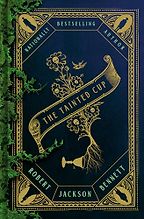
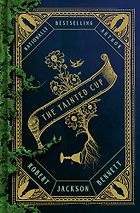
Well, maybe we should start there – this was The Tainted Cup, by Robert Jackson Bennett. Could you introduce us?
Yes! This book also won the World Fantasy Award, and has been very well received – the New York Times describes it as “a thoroughly satisfying delight from start to finish.” There is already a sequel and a third planned, so this is well worth getting stuck into.
It’s a murder mystery – the tense kind, where people keep on dying. It’s got the charm of a classic mystery, and in some ways a very conventional set up – our protagonist Din is a form of detective’s assistant, solid and reliable, while the detective herself is preternaturally brilliant, socially irreverent and thoroughly maddening.
But that’s where the familiar territory ends. These are fantastical murders in a fantastical realm, all highly original.
Tell us a bit about that setting.
It’s damp and it’s dangerous. We’re in an outer canton of a world defined by the monsters at sea, the obliquely terrifying “leviathans”; and by the fearsome sickness “contagion”. The further you are from the seawall, the safer you are from both. This canton is not safe.
It’s contagion that has kicked off the murder investigation. Spores took root in the victim, erupted into plant-life and sliced him open; and there is reason to believe that his infection was deliberate, an assassination. Din has been sent to investigate. He is an engraver, a person with an augmented memory, and will relay everything he sees to his superior Ana – who is something like a chief inspector. The world has its own (utterly convincing) political structure, so her actual title is Iudex.
That’s the remarkable feat of this book – it creates a totally convincing secondary world without ever slowing the pace of the mystery to do so. Meanwhile, the mystery itself is pleasingly twisty, and the characters sparkle, especially Ana. I’m not surprised to see this taking two awards this year.
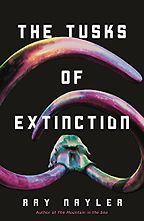
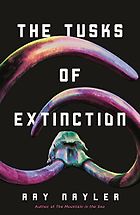
Let’s look at the novella winner next – The Tusks of Extinction by Ray Nayler.
This is another beautiful, unforgiving setting! The real world this time – we spend most of the book in Siberia. There are also some cutaways to Kenya. To understand the connection, you need to know the central premise: elephants are extinct now, but thanks to advances in genetics, mammoths are back.
It takes a little while of perspective-hopping for the reader to sort out how the elephant-defenders of Kenya are linked to the threatened mammoths of Siberia – which is a satisfying process in itself. You spend much of the book joining dots and appreciating links between past and present; as Locus magazine expresses it, “In its braiding of associations, the novella operates poetically”. That feels true to me.
So wait, we’ve brought back mammoths, but now they’re already threatened?
Yes. Mercenary ivory hunters and luxury game hunters both feature. There is bafflement from Nayler about both these types – we see them from the perspective of reluctant members of their parties, appalled and alienated by the experience. There is a feeling that the luxury hunt is inexplicable, and both are unspeakably tragic.
That’s reinforced by the fact that one of the perspectives we inhabit is mammoth. We see their slaughter through their compatriots’ eyes, as murder. The mammoth perspective is a particular delight – the most fantastical thing in this very plausible feeling world.
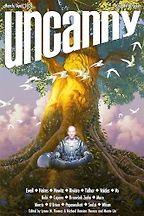
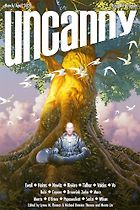
Great. For readers after something even shorter than the novella, there’s the short story winner… Tell us about Nghi Vo’s Stitched to Skin like Family Is, available in Uncanny Magazine Issue 57.
Oof, this gave me chills. It’s such a tight, delicate story, I don’t want to say too much and spoil it! I’ll try and give the flavour…
We’re in 1930s Illinois, with a seamstress who is hitchhiking her way to an unknown destination. We realise very early that she can hear voices when she holds fabric – she has a connection with it that is never explained, only demonstrated. We don’t know why she’s on her journey, only that she has a letter with a return address on it, and an undercurrent of quiet determination.
Hitchhikers and strange powers – an unsettling vibe?
Oh, yes. And you are right to be unsettled. But there are quietly beautiful elements, too; obliquely seen bonds of love, and a running thread about the hypothesis that some people might be kind.
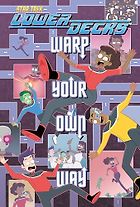
We’ve got two more choices to discuss. Shall we talk about the graphic story winner? This is from the Star Trek franchise, specifically from Lower Decks: Warp Your Own Way, by Ryan North and Chris Fenoglio.
Yes! This is as far as we can get from Vo’s quick, tense story: it’s a choose your own adventure, so there are multiple twisty ways to work your way through it. As you do, you start to notice that the endings have something in common – and realise there’s something deeper at work here. There’s a reason for the multiple-ending format.
Writer Ryan North has form with choose-your-own adventures, including Romeo and/or Juliet, and To Be Or Not To Be (a Hamlet take). It makes sense that he has written games, as well as his multiple comics and novels; this is a formally playful take on an already playful part of the Star Trek world.
You mean the wider Lower Decks world? Could you tell us about that?
Yes. Lower Decks is an animated series looking at the lives of the junior officers – hence the title. We’re following, in the words of Paramount+, “the support crew serving on one of Starfleet’s least important ships”.
As it sounds, this world is fun. Warp Your OwnWay finds a lot of humour in the world-weariness of its protagonist and the chipper optimism of her friends (one of whom supportively tells the other “Aw… I like your murder plan too! And you came up with it super fast.”). Some of the quicker dead ends take you on charming detours – I elected not to help a friend with their tribbles (essentially a biohazardous guinea pig), but I was delighted to see that they were in there.
There’s a Lower Decks comic miniseries too, also by North and Fenoglio. Fenoglio is a big hitter – he’s also worked on Star Wars, Batman, Goosebumps, and X-Files.
A power team.
Yes. As well as the Hugo, Warp Your Own Way also won the Aurora Award for Best Graphic Novel/Comic, and received rave reviews – “a clever, delightful book” from Strange Horizons, and “worth more than its weight in Latinum” from Comics Beat. Not one to miss for Star Trek fans – or fans of innovative storytelling.
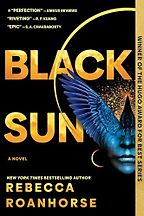
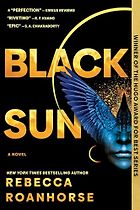
We’ve come to the final choice on this list. For people who really want something to get stuck into this winter, there’s the ‘best series’ winner: Rebecca Roanhorse’s Between Earth and Sky trilogy, which begins with Black Sun. That first book also won an Ignyte Award…
Yes, and both the first two were Locus finalists. There’s gorgeous writing here, and some real originality woven in with the classic feel of an epic fantasy.
We are in a world inspired by pre-Columbian Americas – an expansive world with convincing variety, and fractious inter-group relations. The worship of old gods has been banned, and the resulting godless culture is overseen by the Watchers, with the Sun Priest at their helm. There is a deep grievance held by worshippers of the Crow god, who suffered a massacre at the hands of the Watchers. That sums up the sides in the key conflict – although the world around these two camps is satisfyingly messy, with the marginalised semi-magical Teek people, other god-clans and magic users, and a criminal underworld all complicating the picture.
We hop perspectives. Broadly, on one side, a figure important to the Crow clan is moving closer to the Watchers’ city, while on the other side, the Sun Priest is trying to understand and handle the intrigue happening around her. Each chapter tells us how far we are from “the day of Convergence”, and as more is revealed to us, we slowly understand what we are creeping towards. The result is that we care about all parties, on opposing sides, and tensions run high.
Sounds complex.
It must have been complex to write, but Roanhorse pulls off a smooth reading experience nonetheless. We jump back and forth in time, too, and that doesn’t confuse or distract either. You can relax and enjoy the drip feed of information, as the picture grows ever clearer.
Not that all is clear at the end of the first book – it’s a culmination, but brings its own twists, and you’ll have to keep going to get all the answers you want!
Something satisfyingly rich to curl up with, then.
Definitely. Grimdark magazine called Black Sun “a rare and wonderful fantasy novel”; Locus magazine a “brilliant work of art”.
Really, all of these are a treat. It’s a wide-ranging list this year, with something for everyone.
December 18, 2025. Updated: March 27, 2026
Five Books aims to keep its book recommendations and interviews up to date. If you are the interviewee and would like to update your choice of books (or even just what you say about them) please email us at [email protected]