Thank you for putting together this excellent list of landmark environmental books. We’ll look at them in chronological order. The first books were published earlier than I might have expected, because people often talk about Rachel Carson’s Silent Spring as firing the starting pistol. Your books go back to the 1940s.
Yes. Environmental thinking goes back a long way, of course, but modern environmental thinking—for me—probably starts with, yes, Rachel Carson, but also Paul Ehrlich’s The Population Bomb, which I remember being very stimulated by in the late 1960s, early 1970s. Then I started looking around and discovered there was a book written twenty years earlier, which was even more doom-laden than Ehrlich’s.
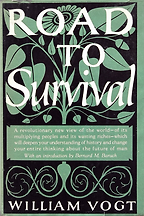
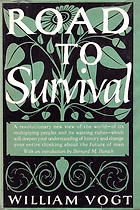
Paul is a pretty unreconstructed pessimist, but William Vogt’s Road to Survival, which we’ll discuss here, is even bleaker, and rather unpleasant in many ways because it employs some of the tropes of eugenics and seems to write-off whole nations—the Indians, the Chinese, and parts of Africa as well. For me, it’s become a supreme example of a rather unpleasant strain of environmentalism. I mean, I’ve been reporting on environmentalism for 40 years, but there are unpleasant strains.
That doom-mongering was misplaced, as we know now. When Paul Ehrlich wrote his book, India had suffered a series of major famines, but now—thanks to the Green Revolution and other technological changes—is able to feed itself despite having a population many times that of what it was half a century ago. Indeed, it exports rice around the world.
So, yes, absolutely we have huge environmental problems and issues to deal with, but as I argue in my new book, Despite It All—if I can mention that—is that there are solutions out there. We have to adopt them, because if we don’t we are in serious trouble. Or even more serious trouble. But they are there.
There are technical fixes for some of our problems, and there are political and social fixes for others. My argument now is that pessimism itself is a problem. Pessimism gets in the way of solutions because it basically says: We have no hope. It’s all over.
Many of these earlier tracts leaned heavily into that, and I find that distracting for people who might have a solutions-based agenda, and indeed for anybody who wants to live a reasonable life.
Absolutely. Looking at the books you’ve selected, it occurs to me that we could understand the environmental movement, or at least environmental literature, as being marked by a series of shocks. Your first book recommendation, John Hershey’s Hiroshima, is a good example.
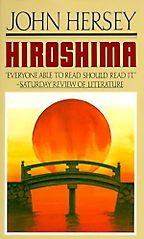
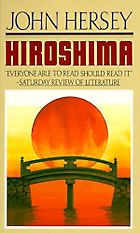
Well, I’m a journalist and for me this is one of the great works of journalism. I’m not alone in saying this; many others have called it the best piece of journalism in the twentieth century.
It describes the stories of six people who were in Hiroshima on the day that the Americans dropped the first atomic bomb, what happened to them, what they remember about those hours, and the repercussions on their lives in subsequent months. It happened in August 1945, and the book came out in 1946, so it’s pretty immediate reporting. Nobody else has done anything like that. I’ve read it again and again.
My father gave it to me when I was eleven, but I never read it. I don’t know why. It might have changed my politics in my teenage years quite a lot if I had. But finally I caught up with it many years later, and it’s a stunning piece of work.
Forty years later, he went back and visited the people again, so I have two editions—the original edition and a later edition, when he added a long afterword, nearly as long as the original book, in which he described how those six people’s lives had unfolded since then, which gives it a whole new dimension.
I’ve spent a bit of time looking at the repercussions of nuclear accidents and nuclear events of one sort or another, including the Hiroshima and Nagasaki bombs, and visited both those cities while writing my own book, to get my head around the long-term consequences.
It turns out that the radiation sickness business is not as bad as people thought it was. In other words, that people who survived the first year tended to survive, though not entirely. Which tells us, I think, a story about how lethal radiation is at high levels, but also how we are more tolerant than we think of the lower levels. That leads me to be a little bit sanguine about nuclear power more generally, in its peaceful form.
So, as a journalist as much as an environmentalist, I find this book extraordinary.
Do you see Hiroshima as marking a turning point in our attitude to the environment?
Yes. I mean, the book doesn’t explore that so much. It’s personal stories, personal reflections from individuals who were interviewed at great length. But I do think that Hiroshima was the first time we were aware that we could literally destroy the world, or at least a city and its population in one fell swoop.
I suppose one has to remember that some other acts of war during the Second World War actually killed more people; the firebombing of Tokyo and, I think, Berlin killed more than the blast over Hiroshima. But that was one bomb at one moment. Nothing has ever done so much damage in one go as that. So it changed our perspective on the damage humans could do to the planet and indeed to ourselves.
I’m a child of the Cold War. I remember being told by my father, at the time of the Cuban Missile Crisis, that if I were to see a mushroom cloud to dive under the desk at school. It felt that there really could be nuclear war that day, that there might be nuclear bombs coming out of the sky from Moscow towards us.
I was too young to understand exactly what a scary moment that was. But perhaps that sense of doom, or potential doom, has coloured a lot of environmental thinking since then, whether we are talking about climate change or species loss or whatever—the possibility of literal oblivion.
That’s a really interesting way of framing the almost eschatological tone that one finds in environmental writing from the second half of the twentieth century on. We certainly sense a pervasive doom in William Vogt’s book, Road to Survival, which came hot on the heels of Hiroshima, published in 1948. But is it a necessary function of environmental writing, do you think—to scare people into action?
I don’t know that it’s necessary. I do think we need optimists and pessimists, we really do. Pessimists alert us to the problems, and optimists come up with some solutions.
Paul Ehrlich was wrong to say, as he did in his 1968 book, that billions would be starving by the 1980s. In fact, hunger retreated during that time, and has not never been as bad as it was in the 1960s. There are lots of reasons for that, some political and some economical, but undoubtedly a large factor was the Green Revolution crops, whatever their faults. They are undoubted resource guzzlers, taking huge amounts of water and fertilizer and pesticides; nonetheless they more or less doubled crop yields on millions of acres of fields around the world, for small farmers as well as big farmers. So that was a technical fix of huge proportions.
Paul Ehrlich mentions this in his book as being a possibility that people, including American crop scientist Norman Borlaug, were talking about at the time, but he did not think they’d be able to deliver. He was wrong about that, and therefore wrong in his predictions.
Nonetheless, perhaps we needed Ehrlich and his ilk to warn us of the catastrophe that could face us, at a time when the world’s population was doubling every thirty years. How could we double food production in thirty years? It didn’t seem possible.
So we need the pessimists, although some of them—Vogt in particular—I think of as a malign influence, because of the political thinking that went behind what he was saying. We do need pessimists to, at the very least, warn us of the risks that we face. But we need optimists too, and I think we are short of optimism now, which is why I wrote Despite It All.
By saying ‘despite it all,’ I’m not denying any of the risks that we face, or the problems that we have. As I say, I’ve been writing about them for forty years, and climate change has just become a bigger and bigger issue throughout that time. It was just one among many environmental issues back in the 1980s and 1990s, and even a little later. But now it’s almost synonymous. When you talk about the environment today, you’re almost always talking about climate change. It’s not the only environmental issue, by any means, but wow is it important. It’s a problem we absolutely have to fix, there’s no way around it. But the good news is that the technology has come on at an extraordinary rate.
In 1992 when I went to the Earth Summit in Rio de Janeiro, where they signed the Convention on Climate Change. People signed without knowing quite how they were going to fix this problem, only that they had to do it. Then, wind power was literally a few turbines on a hill north of San Francisco. Solar power was just so expensive; it had been developed for satellites in space. Electric vehicles weren’t really on the horizon at all; they’d been discussed, but there was no technology being developed. All these things, plus battery storage, which is becoming much, much cheaper now, are helping to solve the problem. There’s push back in the US, quite a lot of it, but I think it’s just going to leave the US out of the loop as the rest of the world pushes on.
China, in particular, has moved from being an environmental villain to pushing forward solar and wind power at an extraordinary rate, both through investing in manufacturing and through research and development. It is now selling and indeed donating via its aid programs this technology around the world. In the last couple of years, some African countries have got the fastest take up of renewable energy anywhere in the world.
I remember writing, as recently as the Paris Climate Conference ten years ago, that whatever China did, India was a real problem, but India too is now investing hugely in solar power. It’s a good place to do it. And in the UK, where at the time of the Earth Summit we got two thirds of our energy from burning coal, we shut down our last coal-fired power station two years ago and we have been filling the North Sea with offshore wind turbines. It can be done, and it is being done.
So I have a message for the US, which is: Boy, you are losing out if you back off this one, because it’s the technology of the 21st-century. Not to engage in it is just crazy.
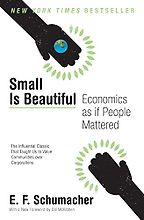
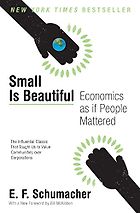
I agree. Until recently I was living in the Orkney Islands, where a good proportion of the population is already employed by the renewable energy industry. By small, agile, innovative companies, too. Perhaps that might bring us to E. F. Schumacher’s Small is Beautiful. It was first published in 1973.
Yes, Small is Beautiful was important for me as a lefty-political, as you’d say, in the early 1970s at university. It was one of the first books to suggest to me that there was another way. We were still in the Cold War, there was socialism one side and capitalism the other, and both doing whatever they were doing, and it seemed like a binary world. They were both employing large technologies in similar ways. Then along comes Small is Beautiful, which was literally talking about how things were better if they were smaller, how they were more efficient or economically better smaller. How we could rethink our manufacturing processes, sometimes using alternative technology, and use a whole new language. It was not directly environmentally framed, more socially framed, but it had huge environmental repercussions as well, in thinking about how we run our societies economically and socially and industrially.
This opened up a lot of thinking, and I think turned a generation of people who read that book into out-and-out environmentalists.
Do you see this as being part of the wider movement towards this notion of ‘sustainability’?
Undoubtedly. I think there are a lot of hardline environmentalists who—I don’t want to caricature them too much—would be really quite happy if humans disappeared off the planet, and left nature in full sway.
I’m not one of those. I’m a sustainable developer. I’m a humanist, if you like. I belive we can have humans in some level of harmony with nature, or we can relearn lessons from past civilisations and, indeed, indigenous communties still on the planet today, who are some of the best conservationists anywhere. So I believe we can have people on the planet, and that we shouldn’t be putting fences around forests and leaving them, or at least not all of them. Probably we want to do that with some of the best, but the best route to saving forests is actually to use them sustainably.
I think there is potential for us to have a ‘good Anthropocene’, for us to find ways to manage the planet in a way that doesn’t destroy it, but allows for eight, ten, twelve billion people, perhaps, to live decent lives on this planet. I think that’s what we should be aiming for. Whether we will achieve it is another matter, but—despite it all—it’s worth aiming for.
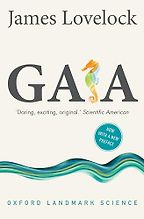
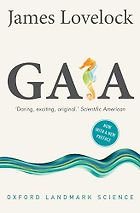
Your next book recommendation was first published only a few years later in 1979. This is Gaia: A New Look at Life on Earth by James Lovelock.
Yes, this was a really quite radical notion that he developed of seeing the planet not as a dead entity on which life lives, but something that lives in the largest sense: that the biosphere, if you like, actively manages the atmosphere. The atmosphere is not something that would exist in anything like its chemical form without bacteria, phytoplankton in the oceans, plants on the land. It’s a very dynamic chemical entity, which is constantly topped-up or changed chemically by living things.
So he developed this idea of ‘Gaia’—that the biosphere has evolved to manipulate the environment in ways that is conducive to it. Gaia was a Greek earth goddess. He used her name to try to sum up his idea. It does sound, almost, like a mystical notion, and I think for some people it is a spiritual thing: this sense of harmony within nature, or potential harmony.
Jim Lovelock wasn’t quite like that. He was an old-school scientist, looking at this from a very scientific perspective. I reported on it at New Scientist magazine as a piece of science, as much as anything else. But he undoubtedly also captured the imagination of a lot of environmental scientists who are, in many ways, quite driven by environmental concerns.
An awful lot of research has been developed to test his ideas. Can we measure how life is actively moderating, optimising, the amount of oxygen in the atmosphere? The amount of carbon dioxide in the atmosphere? The temperature? And some excellent results has come out of that. So whether you regard it as a literal truth or some kind of elaborate metaphor, it does seem to hold great power.
This book was James Lovelock’s first attempt at that. He wrote several other books in a similar vein, and only died a couple of years ago, having reached 100 years of age. I interviewed him quite a few times. He was a kind of mentor for me, I suppose, in my environmental thinking. And certainly the book has been hugely powerful for many people.
There’s a very good recent biography of him by the Guardian journalist Jonathan Watts.
He had an interesting path. The ideas for the Gaia hypothesis arose out of his work for NASA. He was a top-line scientists working for industrialists, for NASA. NASA was trying to work out how they could find life on Mars. He said, well, yes, okay, you could send satellites and touch down and look for signs of life. Or you could look to the atmosphere: look for what we see on Earth, which is the gas methane, or perhaps other gasses that only living forms could have produced. That was a whole new way of thinking: that you didn’t have to physically go to find a green man in order to demonstrate there was life on Mars. You could look for indirect things. Having thought up that idea, he and a number of collaborators were pushed to think about the Earth and how the Earth functions.
It’s been a hugely influential idea, certainly for me, but I think also more widely for the environmental science movement.
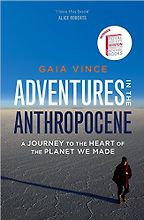
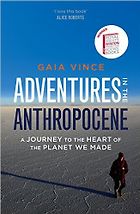
And our final author shares its name. This is Gaia Vince and her 2014 book Adventures in the Anthropocene. It made her the first woman to win the Royal Society Book Prize.
Gaia is a good science journalist who worked for Nature and various other journals before moving into writing her own books. I like Adventures in the Anthropocene because it is just that. She has a series of chapters on grasslands, mountains, oceans, coastlines, climate—the standard repertoire of environmental issues on a global scale—but she sums up, in a couple o fpages, the issues from a scientific point of view and then she goes out and talks to people. I think she spent two years in the field researching this book, going into deserts, for example, talking to people about how they live in these ecosystems, where they get their water from, and so on.
It’s kind of a political book, about how people use resources, and how their resources have been taken from them, how some people manage their environments while some people have lost them. In the rainforest, she finds indigenous communities are highly sophisticated managers of their forests. Similar things in the tundra, almost any ecosystem you care to name.
She wasn’t just talking about indigenous people, she was talking to regular people trying to make their way in mostly rural environments, and discussing sustainable living and how some people do it and how some people can’t, and what drives that.
As well as it being very good journalism—because she was out there in the field, getting quotes from real people—there are analyses of how they were living and descriptions of the geography of their environment. I’m a geographer, if you go a long way back, so I enjoyed all that. She did it in a really sophisticated way. She had the science right. She had a good go at the complexity of the politics and the social world, and the economics of how real people live their real lives.
For most people, the environment is an abstraction. What they care about is how they live their lives, how they plough their fields, where they can get water from. I try to link scientific abstraction to real stories about real people in my own journalism, and I wish I’d written this book in many ways. So it’s a book I’m very happy to recommend to anyone.
And I suppose where it has brought you is to this place of measured optimism or hope. Is that how you would characterise it?
Yes. There is no certainty. We could be overwhelmed by really nasty tipping points in climate change, which mean there is no way back. Then we’d have to recognise that we were inhabiting a very different world, that we couldn’t go back to where we were even in the late 20th century. As a science journalist, I recognise that as a real prospect. But it does seem to me that we can reduce the risk of doing that quite a lot.
We have to lose our addiction to carbon fuels, is what it comes down to. Almost everything that has happened since the Industrial Revolution up to the last 20 years has been founded on burning fossil fuels, and we are now living with the consequences of that. Carbon stays in the atmosphere for centuries. Every ton more we put up is adding to global temperatures. The faster we deal with it, the better, and the lower the change of going over dangerous tipping points.
So: there are no certainties. But my hope lies in humanity’s ability to get its head around these issues and begin to address them. You know, thirty or forty years ago, people were beginning to think about how we might develop renewable fuels, and now they are coming to the fore at a huge scale.
We also have to think ahead about other crises—the nitrogen crisis is one that people talk about a fair bit, caused in part by the green revolution we were talking about earlier. Every solution creates another new problem. There’s a kind of ratchet effect, so we have to keep alert the whole time. But my hope is that we can stay ahead of the game, to some extent, keep coming up with solutions.
That also goes for how we manage the planet: we’re now talking about the ‘global commons’—the oceans and the atmosphere, which are commonly owned. The bad guys, if you like, have made money while releasing their pollution into the air. To hell what happens down the line! Similarly, we boil the oceans and over-fish. We have to find ways of collectively managing these resources before it is too late.
It’s a difficult question which is unresolved. But we have to find ways of managing the critical resources on this planet—the ones on which we all depend—in a way that doesn’t destroy them. It’s a work in progress, but I think we can do it.
Another reason for my optimism is that nature is very adaptable, very resilient. Give it the slightest chance and nature will come back. Across Europe and parts of North America we are abandoning more fields than we are creating. We are still destroying rainforests to grow crops in tropical areas. But, outside the tropics, we are abandoning more than we are taking. And nature is coming back.
Look at any city: nature finds a way, comes up through the paving stones. It turns out most of the bee species in the UK are living in urban environments. Toxic industrial sites can be amazing places for certain species. Every species has its own little niche that it likes. In a lot of these places, nature does do very well. So we need to create room for nature to come back. And as we change our ways of growing food crops, we probably will need less land, and that again creates room for nature.
This is about relearning a level of harmony between us and nature. I do believe we can do that. We’ll have to forget some of the things we’ve learned over the last two centuries, which have been really quite destructive. But I do believe we can right some of the mistakes we have made in the past.
And, finally, we are kind of solving the population issue now as well. Populations are gradually stabilising. The average woman fifty years ago was having five children, which is now about 2.2 and it’s going down. We are going to reach a population plateau. It’ll be about ten billion, probably, a couple more billion than we have now, but we can see the end of what used to be called the ‘population bomb.’ Again, that comes back to where I started with Paul Ehrlich.
At the time of that book, nobody could see an end to population growth. For the first half of the twentieth century, population had doubled every thirty years. And we didn’t realise that without draconian policies on reproduction that it might happen naturally. But now, because of medical advances, most children survive to adulthood, so we don’t need so many children, and lo and behold couples are making sensible choices by having one or two. The added by product has been the liberation of women from the tyranny of child-rearing and keeping a home.
One of my first international conferences was the World Population Conference in 1984, where all the talk was bout how to control population, what laws needed to be put in place. The UN Population Award went to the guy who ran China’s one-child policy, which was all about forced abortions and sterilisations. It was seen that everywhere in the world should be doing that. And, I might say, it was a conference run almost entirely by men. We’ve subsequently have female-dominated population conferences that discussed reproductive rights and access to contraception. So it’s a whole different world to where we were forty years ago.
All these things together give me optimism. Sometimes good things happen without you having to dictate it. I feel rather privilege to have seen those changes. We haven’t solved all the problems, by any means. We’ve made some worse. But I can see the beginning of the solutions. I wouldn’t put it stronger than that, but—despite it all—I’m optimistic.
Interview by Cal Flyn, Deputy Editor
April 14, 2026
Five Books aims to keep its book recommendations and interviews up to date. If you are the interviewee and would like to update your choice of books (or even just what you say about them) please email us at [email protected]
Five Books interviews are expensive to produce. If you've enjoyed this interview, please support us by donating a small amount.