The Rule of Law.
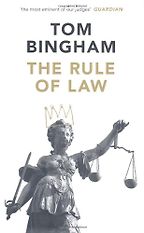
What’s interesting about The Rule of Law is that it’s written by someone who was until very recently the UK’s most senior judge, Lord Bingham. It’s comforting because it shows that the highest level of the judiciary is really interested in the liberty of the individual and freedom in all its various guises. It’s also got all sorts of fascinating little pieces in it. For example, he criticises the way in which the Americans put certain prisoners outside the reach of their courts in Guantanamo Bay and mentions that the executive in England was doing exactly the same thing, putting prisoners beyond the reach of the courts, more than 300 years ago. But then there was an act of parliament to stop it, the Habeas Corpus Amendment Act of 1689. The book is a general look at aspects of the law which effectively guarantee the freedom of the individual. The rule of law is one of the two great pillars of democracy, the other, obviously, being the vote. But it’s probably more important than the vote, because the vote is only once in a while, but the rule of law determines the rules which everyone, including the authorities, must follow on a daily basis and is the greatest guarantee of freedom. So, it’s a very important book
Why were people being put outside the jurisdiction of the courts 300 years ago in England?
That was the Earl of Clarendon, King Charles II’s chief minister, so he could lock up people he didn’t approve of, without them or their friends being able to use Habeas Corpus to force the government to explain why they were being held. Of course, this is an exact parallel with what has been done in the United States more than 300 years later
And why did Tom Bingham feel he had to write this book?
Probably because he thinks the rule of law so important. Serious lawyers see continual attempts by the executive to encroach on the rule of law. If you’re a minister it’s much easier to do things without being constantly challenged in the courts.
Nick Davies, Flat Earth News.
This to me is fascinating because it’s the first time that a top-quality journalist has done a complete exposé on the way in which the media distort what’s going on. He says in his preface that dog doesn’t eat dog. Usually, all institutions are open to criticism by the media except the media themselves. So this is the first time that somebody has actually done it to the media. It’s immensely interesting because he has done a great deal of research and he gives all sorts of examples.
Can you give me one?
Well, he starts off by setting out how the millennium bug was supposed to be a great danger and how the whole thing was really completely invented. How at one point Murdoch completely destroyed a political opponent in Australia with a story that simply wasn’t true. He says Murdoch may not have known it wasn’t true, but it wasn’t, and, of course, the now-discredited story of weapons of mass destruction in Iraq.
Does he say why they’re doing this? Why would it be in a newspaper’s interest to make stuff up?
That’s the interesting thing because he points out that conventional wisdom is that it’s either the proprietors dictating or pressure from advertisers and the need to sell newspapers, but I think what emerges from the book is that it’s a widespread disease and that journalists lose fairly early, or a lot of them do, the fundamental purpose of their job which is to tell the truth. And the point he makes is that if a journalist doesn’t tell the truth then he really ceases to be a journalist in any meaningful sense. And, in fact, failure to tell the truth and willingness to distort is so widespread.
I wonder if that is what journalists feel their job is. I think a lot of journalists probably feel that their job is to go off and have an exciting time and look at things and tell stories and entertain the readers.
Well, I think that’s probably right and it’s certainly what emerges from his book. I think the point he’s making is that the profession of journalism consists of informing the public about things about which they would not otherwise have known. That’s, of course, not necessarily the reason why people buy newspapers, but it is the basic task of journalism. But, as you say, not all journalists see it like that.
No. I think a lot of people think they are telling stories. People read the newspapers over breakfast not necessarily to be better informed but often to be entertained.
That’s absolutely right. But, of course, it does then raise the question of whether those same journalists couldn’t just sit and write fiction. The problem is that what they are doing is writing fiction dressed up as fact. I think that is the fundamental point. If they printed the story in a different colour when it was wholly or partly invented I think that would be less objectionable. I think what is objectionable is to dress up fiction as fact.
Peter Burden on the News of the World.
From my personal point of view this is fascinating because it confirms all sorts of things I have long suspected. For example, he cites two separate instances of couples who were exposed by the News of the World as swingers, that is, people who wanted to involve outsiders in their sex lives. They were perfectly ordinary people but in both cases the husband committed suicide because they found the embarrassment unbearable. It’s quite clear that this didn’t bother the paper in the slightest, and then on top of that he gives endless examples of where they’ve broken the law and done things they knew they shouldn’t do.
There’s also a wonderful story about their chief reporter Neville Thurlbeck who went to expose a harmless couple who offered naturist massage. Thurlbeck went for a naturist massage and wrote the story on the usual basis of ‘I made my excuses and left’, but, unknown to him, the naturists had taken the precaution of videoing the entire procedure. As Burden puts it, it was in reality more a case of ‘I made my excuses and came’. And they had it all on video. Burden then christened Thurlbeck ‘Onan the Barbarian’ and, of course, pictures were available. So, in order to stop other newspapers printing them, the News of the World themselves printed the pictures of Thurlbeck in the altogether with his bits pixelated.
The book is a really good read and describes how sinister the newspaper is and how they absolutely don’t care what sort of damage they do. He’s got a quote on the front from an assistant editor called Miskiw: ‘That is what we do. We go out and destroy other people’s lives.’ Obviously, there are one or two people around who think this should be stopped, myself included.
The people who committed suicide just happened to be swingers, did they? They weren’t people we’ve heard of?
No. They were complete nonentities. There was one little couple in France, for example, who were joined by four people from the News of the World who were not, apparently, connected, and the poor man who was doing it all, to try and get the party started, came down the stairs wearing nothing but a posing pouch and sort of gyrating. And of course, the poor man…
Obviously the suicides are terrible, but we’re enjoying talking about it as much as we might have enjoyed reading about it, so … tricky.
Absolutely. And that’s what’s so awful about invasion of privacy. Other people’s lives, and particularly other people’s sex lives, are interesting, but you have to weigh the suffering you cause to the people you expose against the minor pleasure you give to the reader of the newspaper. The newspaper is selling the privacy of those people and it doesn’t belong to them. They are effectively stealing their privacy, stealing their reputation and selling it.
So it could be copyrighted?
Well, I don’t know about that but the law says it should be kept private and you should be entitled to your privacy. And you see what they did in both those cases was illegal, but once something is out in the open, once it’s been published it doesn’t matter what the judge wants to do – you can’t make it private again and take it out of people’s minds. The other thing is that if you want to sue you’ve got to be rich. In my case the News of the World paid £60,000 damages but the costs were approximately £1 million which, because they lost, the News of the World had to pay. But that still leaves you out of pocket because the bill you get from your solicitors is always bigger than the amount of costs the other side has to pay you. I was left about £30,000 out of pocket.
And most people don’t have a spare £30,000.
This is the thing. First of all, if you sue, the whole thing is then gone through again in open court, so that which you wished to be private is published all over again, at the end of which, even if you win, you get a large bill.
Not very inviting.
True!
But what about the Duchess of York? Obviously, she was completely stitched up, but do we care very much?
Well, I don’t care myself, but I care for her. She was obviously drunk at the time, just watching the video, and there’s somebody, drunk, desperate for money, not terribly street-wise and you lure her into a situation like that which causes her appalling embarrassment, pain, suffering and so on. It’s really no different from watching bear-baiting or going to watch people hanged at Tyburn. Except maybe in this case you hang people who haven’t done anything. Why should she be made to suffer just for the entertainment of a few people? The fact of the matter is that in a civilised society you don’t have bear-baiting. Or, put another way, it’s far worse to have your reputation shattered, your privacy stolen, than it is to have the furniture from your house stolen. You can replace the furniture but you can never replace your privacy. If it were not for the fact that things had developed differently, theft of a person’s privacy would be just as serious as theft of their goods. At the moment people think it doesn’t really matter, but for the individual it matters more than his furniture would matter.
It is very confused, I suppose, by so many people now inviting invasion of privacy.
Well, if you sell or give away three of your sofas it doesn’t entitle someone to come in and take the others. The press have managed to create an atmosphere around this where it isn’t thought about in a rational way. The moment you see it as it really is, which is as the theft of something that belongs to someone else and is precious to them, namely their privacy, and then selling it for commercial gain, you quickly see it is actually worse from a moral point of view than stealing their goods. But it’s just not seen that way because it has become sort of customary. It’s only since the Human Rights Act of 1998 and a degree of recognition from the courts that this sort of thing might be stopped.
Tell me about Bounce.
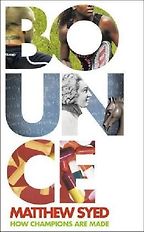
Bounce is fascinating. Matthew Syed was Britain’s number one table-tennis player for about 10 years and he’s now a top sports journalist on The Times. He writes extremely well. His thesis is that talent isn’t what matters, it’s all about hours and hours of training. The conventional view, and certainly my view before reading this book, is that some people are supremely gifted and therefore rise to the top of sport. But he says talent has got little, if anything, to do with success and it’s all to do with circumstances and the amount of practice they get. He gives example after example. To me the most fascinating example is of a Hungarian called Polgar in the 1960s who formed the same view. He advertised for a wife, found a wife and had three daughters. Then he thought: ‘What can I train them to do that has unquestionable standards and it’s not judged subjectively?’ He hit on chess. So, he set about making them interested in and practising chess and all three daughters became, successively, the best in the world – first female grandmaster, championships at the age of 14 and so on.
God, poor girls.
But you see, you cannot make people do something like that. You have to get them passionately, passionately interested.
Of course you can make them! You can put enormous pressure on as a parent.
Not according to this account. Polgar got his daughters interested to the point where all they wanted to do was play chess. In his own case, Syed explains how he became a top table-tennis player. His older brother liked playing table tennis, his parents bought a full-size table and put it in their garage. He then started playing hour after hour with his brother and, by chance, the primary school down the road had a coach who was one of Britain’s top table-tennis coaches. It ended up that half the top table-tennis players in Britain came from this one little street in Reading. Lots of parents, particularly parents who have failed at a sport, try to get their children to do it because they want to relive it through them. You see examples of that in motor-racing. You get these parents who take their child karting. Everybody knows now that that is eventually how you become a Formula One driver. Lewis Hamilton’s father made endless sacrifices to keep little Lewis running around on his kart. It’s that reliving. But it doesn’t work unless the child really wants to do it. With those Polgar sisters each was better than the last! And Syed also explains why a top grandmaster can play 20 very strong players simultaneously and win all 20 matches going from one board to the next. Apparently, when you’ve played enough games of chess, any combination of pieces on the board will be in one way or another familiar to you and you know what happens next instantly, rather than a normal person thinking: ‘Christ, what do I do now?’ But for me the significant thing is that this book has changed my thinking about the relationship between talent and practice.
And how on earth are we going to link that to privacy?
With difficulty. I think all one can say about me as an individual is that, given a degree of privacy, I now have the time to read the sort of books that fascinate me.
Tell me about Brainwash.
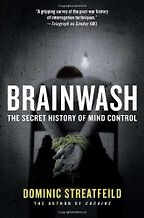
This is a review of all the different means of influencing people’s thinking, primarily without their consent. So, you’ve got things like hypnotism, interrogation, people putting pressure on in all sorts of different ways, the religious cults, the Moonies, the question of whether you could have a Manchurian Candidate. Streatfeild goes into it in enormous detail and has done a great deal of research, but it’s fascinating in that it puts so many things in context and it also makes one realise that obviously you can get anyone to say anything if you torture them, but you can also get anyone to say anything if you’ve got enough time and put enough pressure on them because everybody has a breaking point. That makes one very sceptical of anything anyone says when they’ve been in captivity.
How are we going to link this to privacy?
A very tenuous link would be to illustrate how you create a culture in which it’s all right to torture people morally, by exposing their private life, when no one would agree to them being tortured physically.
I suppose so. But people don’t seem to mind them being tortured physically as long as they are perceived to have done something bad enough.
Yes, but you see the problem with the privacy thing is that most of the things that people do are arguably quite harmless. For example, when I give these little talks, I always have a go at Paul Dacre, the editor of the Daily Mail, because he has twice written pieces saying that what I did was ‘unimaginable depravity’. So I wonder what he thinks is ordinary depravity, and I speculate that it’s leaving the light on during sex. And then you go on to what ‘imaginable depravity’ might be, the point being that what for one person is depraved is for another person their everyday sexual activity. If what a rather stuffy newspaper editor sees as unimaginable depravity takes place between consenting adults who are not just willing but enthusiastic, then what’s the harm? Is society entitled to say: ‘That’s not something I want to do myself, therefore it’s wrong?’ Or should society say: ‘As long as everybody agrees and they’re all grown-up and there’s no coercion and I don’t have to watch, it doesn’t involve me, then get on with it?’
Is there some other reason why they were going for you?
Me? I think it was Kelvin Mackenzie who summed it up quite well. He said: ‘If you’re an editor and someone puts that on your desk, you look up and say: “Ah, there is a God in Heaven after all”.’ I thought that was quite funny, except it isn’t funny, but it was quite funny.
That’s the trouble. The readers do think it’s funny. It is quite funny.
You’d probably never buy a copy of the News of the World but if you were sitting in a train and there was a copy on the seat opposite and the headline was something like ‘Madonna in Sex Games’, how many people would resist the temptation to pick it up?
None. But they stitched you up, didn’t they?
They only stitched me up in the sense that they paid somebody to carry a hidden camera. She was the long-time best friend of the main lady, Woman A, and it was unthinkable in that world – in all those funny sort of worlds – secrecy and not telling outsiders is absolutely fundamental. She did it because her husband pushed her into it. He was at the time working for MI5, but I don’t think it was necessarily anything to do with that organisation, but if there were people who were paying him to do it then they might have got to him via that organisation. I think if the News of the World were given the opportunity to write that about anybody, they would. If a top footballer liked dressing up as a woman and going to transvestite clubs and they could get a picture, they would. But, again, my view is that activity is private and by definition belongs to the person. If someone wants to have sex in public or make a porn video then it’s up to them. But if they don’t then it’s not up to the News of the World to do it for them.
August 26, 2010. Updated: November 28, 2020
Five Books aims to keep its book recommendations and interviews up to date. If you are the interviewee and would like to update your choice of books (or even just what you say about them) please email us at [email protected]
Five Books interviews are expensive to produce. If you've enjoyed this interview, please support us by donating a small amount.