With hindsight, it seems inevitable that the Allies would eventually defeat the Axis powers in World War II, but at the time it seemed anything but. Tim Bouverie, author of the prize-winning Allies at War: The Politics of Defeating Hitler, talks us through some of the best nonfiction books about the war and the alliances that led to Allied victory.
I love the approach you take in your book—and in the books you’ve chosen today—because they show World War Two a bit differently. By focusing on diaries and contemporary accounts, we don’t get that enormous distortion caused by hindsight. Was that what you had in mind for your book?
It’s definitely one of the biggest challenges about writing about any historical period, but the Second World War more than any other, because it’s so well known. We know not only how it ends, but also how the anti-Axis coalition was formed. We’re so used to the images of Churchill, Roosevelt and Stalin together at the Tehran Conference or at Yalta that their collaboration can seem inevitable.
By extensive use of first-hand accounts, one of the things I was trying to do was put back into the story the uncertainty and the concern felt by individuals. At the beginning of the war, the American and Soviet participation on the British and the French side was uncountenanced. It was the British and the French alliance which was meant to win the war. This was, after all, the alliance which had held the Germans for four years on the Western Front from 1914 to 1918.
By looking at some of the books which I’ve chosen for this interview, you can see that there was extreme doubt exercised by all the participants.
I’d forgotten—or perhaps never knew—that one of the first major British military actions in World War II was sinking French ships off the coast of Algeria.
Yes, the sinking of a significant proportion of the French fleet, the Force de Raid, off the coast of Algeria, is, I think, one of the most significant and little-understood episodes of the war. It was partly a military exercise, and yet it was also an exercise in grand political strategy.
It was a demonstration of Britain’s desire to continue the war no matter what and that it would not go down the road of France in seeking a compromise or an armistice. It was saying to the United States in particular that Britain was worthy of aid—because not much aid had been coming across the Atlantic before that.
Also, as others have pointed out, at a time when NATO is under pressure, your book is a good reminder that it’s never easy getting on with your allies.
No, it isn’t. My book is about how extremely difficult it is to work with allies, how infuriating allies can be, how rivalry naturally sits alongside alliance, how duplicity is practised, how long-term aims are often subordinated to short-term expediency or vice versa, and how national self-interest frequently compromises collective action. And yet, without allies, no one party could have won the Second World War. As Churchill continually had to remind his subordinates and colleagues, “There is only one thing worse than fighting with allies, and that is fighting without them.”
The only reason that Adolf Hitler, Benito Mussolini and the militaristic governments of the Japanese emperor were defeated in the end was because they were confronted by a superior coalition of nations and empires that combined their resources and coordinated their plans in order to thwart them. If that hadn’t happened, the Second World War could have ended very differently.
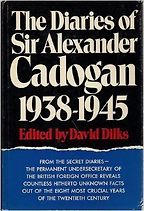
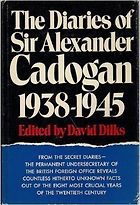
Let’s just go through the books you’ve chosen. First up, we have The Diaries of Sir Alexander Cadogan, who was in charge of what is now the Foreign and Commonwealth Office (FCO) during the war, is that right? Tell me how his diary fits in and why you chose it.
Yes, at the time, it was just the Foreign Office because we also had the Colonial Office and the Dominions Office.
Sir Alexander Cadogan was the permanent under-secretary at the Foreign Office. He was the most senior diplomat in Britain from early 1938 right through to the end of the war, which meant that he experienced and participated in the policy of appeasement in Munich, the tearing up of the Munich Agreement, the search for allies thereafter, the guarantee to Poland, negotiations with France, negotiations with the United States and negotiations with the Soviet Union. It’s an extraordinary day-by-day record, not only of the deliberations of these allies, but also of the Churchill government.
He’s highly critical of Churchill at times. He’s highly critical of Chamberlain at times. Indeed, he’s pretty irascible. When his diaries were published, a lot of his colleagues thought, ‘Goodness! Who knew that this mild-tempered man had such a crotchety bent and thought all of this about us?’
Like General Lord Alanbrooke, the Chief of the Imperial General Staff, Sir Alexander Cadogan kept a daily diary in spite of it being entirely against civil service and military regulations. It would have been an absolute gift to the enemy had these diaries been discovered, although, fortunately, they’ve turned out to be a wonderful gift for historians.
Cadogan’s diaries show the daily frustrations and complete uncertainty, and the moment they thought they might lose the war. In my book, I write about how the British almost got ejected from Iraq by a coup d’état. There were very few British soldiers in Iraq in the spring of 1941 and it looked at one moment as if they were going to be defeated. It was just after Britain had been beaten by the Germans in France and the Italians in North Africa, and Cadogan writes in his diary, “Are we now going to be beaten in Iraq? Is this what the British Empire has come to? I can’t believe it.” They weren’t, but it was a close-run thing.
It’s a wonderful diary. It’s very witty, it’s bad tempered, it’s very honest.
It’s essentially an unvarnished account of what’s going on, sharing what he’s thinking?
Yes, blow by blow. We see his concerns, his frustration with politicians, his low view of Roosevelt, and his fairly low view of Churchill as a negotiator. He’s got the weight of an empire and a war and Britain’s foreign relations on his shoulders. He’s got some ambassadors he trusts and some he doesn’t trust. It’s all there.
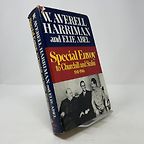
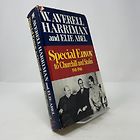
Let’s go on to a key American diplomat now. This is Special Envoy to Churchill and Stalin: 1941-1946 by businessman-turned-diplomat Averell Harriman. So Harriman was based in London, initially, for the Lend-Lease program, and then from 1943, he was in the Soviet Union. What genre of book is this?
This is a memoir which was largely ghostwritten by the collaborator who shares the credit with him on the cover, Elie Abel. The book is based on extensive use of Harriman’s notes after all the conferences he attended, which was most of them. It’s based on his notes after his meetings with Churchill, after his meetings with Roosevelt and after his meetings in the Kremlin with Stalin—which were many and extensive, even before he was American ambassador to Moscow.
Harriman had an uncanny knack for placing himself near the center of events, through charm, through his money, through determination. He ensured that he had a ringside seat at all of the most secret and important diplomatic events of the Second World War.
The book charts his changing perspective with regard to the Soviet Union, which he starts off being very much in favor of. He has the illusion—which most people had at that time—that he can do business with Stalin, that he can handle the Russians. And yet, by the end of the war, he’s increasingly of the view that there is nothing that the Kremlin and Stalin will understand other than American force and very, very strong-handed tactics.
That’s fascinating because I always think of the falling out with the Soviet Union as inevitable, that the Americans were always going to be too suspicious of the Soviets for relations to outlast the war. This paints a different picture. Harriman ends up being in favor of the Cold War, does he?
He’s not in favor of the Cold War, but his diary gives a unique insight into the coming of the Cold War—from a man who tried to do everything he could to take the Soviet-Western relationship from war into peace and maintain it.
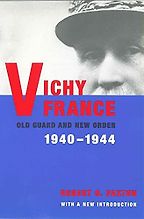
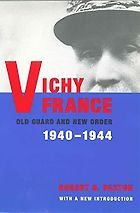
Let’s turn to France, in particular the part of the French government that collaborated with the Germans, often referred to as Vichy. The book you’re recommending is Vichy France: Old Guard and New Order 1940-1944. This book is by a historian, Robert Paxton, but it relies heavily on contemporary accounts. Tell me more.
This is a work of superlative scholarship. It’s a major revisionist work because, for a long time, it was held and argued by historians—particularly French ones—that collaboration came as a natural consequence of defeat. It was somehow forced on the French by the victors, and the French were highly reluctant in their collaboration with their new German masters.
What Paxton shows through extraordinarily extensive research is that collaboration was a choice. It was a choice made by the men of Vichy because they were certain that the Germans were going to win and so they believed that it was best to ingratiate themselves with the new power. Also, it was better to help the Germans win sooner rather than later because the sooner they won, the sooner the war would be over and a proper peace treaty could be agreed.
The Armistice of June 1940 was not a peace treaty. It was simply a halt in hostilities. The French wanted a peace treaty in order to remove the artificial demarcation line between occupied and unoccupied France. They wanted some 2 million French prisoners of war returned to their families. They wanted trade to open up. They wanted the quality of life to improve. They wanted guarantees about the continued integrity of Metropolitan France and the French Empire.
They also thought they might be able to get this while the war was going on. They thought that by collaborating with the Germans, they were doing the most patriotic thing for France. This was conclusively shown by Paxton in what remains easily one of the most important secondary books on the Second World War.
What I hadn’t appreciated until recently was the extent to which Vichy was led by somebody who’d been such a hero in World War One.
Yes, absolutely. Marshal Pétain was a national figure who continued to be revered, to an extent, even at the end of Vichy, despite his collaboration with the Germans. He was fairly senile at this time. He was not manipulated—he believed what he was doing—but the energy behind the policy of collaboration was brought by his two main prime ministers, Pierre Laval and Admiral Darlan.
Pétain just went along with what they were recommending?
That implies that he was against what they were doing. That is not true. Paxton shows Pétain was in favor of what his prime ministers were up to. I’m just saying he was an octogenarian, a man who had moments of senility. It was Laval and Darlan providing the energy and the force behind collaboration. Later, Pétain would claim that he had been playing a double game, collaborating with Germany while secretly keeping in touch with Britain and America. That is absolutely not the case, as is shown by the book by Robert Paxton.
The book produced what is now known as ‘the Paxtonian revolution,’ a revolution in historiography which showed an entirely different side to the Vichy regime, including Vichy’s participation in the Holocaust.
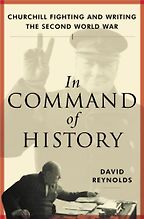
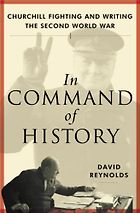
David Reynolds is one of Britain’s finest Churchill scholars, and this is a wonderful work of original history. Winston Churchill’s war memoirs are some of the most influential memoirs that have ever been written. They continue to shape how we see the Second World War and, arguably, how we see its lead protagonist, Winston Churchill.
What Reynolds does is show how Churchill, in writing these memoirs—with assistance from the government, from the cabinet office and a team of research assistants—manipulated the historical record to show himself in the best possible light. He showed himself as prescient as possible and edited out some uncomfortable and embarrassing details.
The book doesn’t render Churchill’s memoirs any less moving or valuable as a source, but it places them in their context. Reynolds has been quite simply forensic. He has gone through the drafts. He has seen what was put forward for inclusion, what debates there were about what Churchill should say, what he shouldn’t say, where he obfuscates, where he dissembles, where he over-claims and where he ignores certain important facts or counterfactuals.
Reynolds did an enormous amount of research, and this is a book which, unsurprisingly, won the Wolfson History Prize.
And does it bring out facts about Churchill that weren’t known, or is it more about the writing process?
It certainly brings out an awful lot of what Churchill did that wasn’t known about his doctoring of the record thereafter. It shows how he sought to make money from these books, and how he burnished his reputation through speaking tours in America. It brings out a huge amount on how the Churchillian legend, which was born in the war, was cemented. I expect it also brings out major corrections in what was considered the correct version of events, because people were so influenced by Churchill’s memoirs of what happened.
Still, h
e’s left us with some great quotations. He was a really good writer, even winning the Nobel Prize in Literature.
Oh, undoubtedly, and Reynolds also looks at that. There are certain phrases with which he is able to not just conjure an image, but also convey a very significant historical judgment.
During the Battle of France, Churchill visits the French foreign office and watches wheelbarrows of documents being pushed by French civil servants in the courtyard of the Quai D’Orsay to bonfires that are disfiguring the lawn. This description is so evocative and so powerful, it really is an epitaph for the French Third Republic.
Reynolds is very good at analyzing how Churchill’s language has affected our historical image of the past.
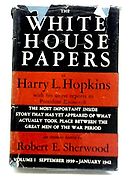
Finally, we’ve got The White House Papers of Harry Hopkins, who was an advisor to Roosevelt. Other than having a British tank named after him, I don’t know anything about him. Could you explain who he was and why you chose this book?
Franklin D. Roosevelt is one of the most complex figures in history. He seems so warm and charming on the surface, and yet he was so cold and manipulative underneath. During the Second World War, Harry Hopkins was the man who was closest to him and the closest thing that Roosevelt had to a friend and confidant.
The relationship waned somewhat after Hopkins got married in 1942, but before that, Hopkins lived in the White House with Roosevelt, and he was Roosevelt’s emissary to Churchill in January of 1941 and then to Stalin in the summer of 1941. He accompanied Roosevelt to Casablanca, Yalta, and most of the wartime conferences. He kept extensive notes about his meetings with Churchill, Roosevelt and Stalin. His papers probably remain the greatest source on the thinking of Franklin Roosevelt, because Roosevelt himself rarely committed himself to paper.
This isn’t a memoir. It isn’t a diary. It is a two-volume book put together by Robert Sherwood, who was himself a Roosevelt insider. He was a speech writer for Franklin Roosevelt, a supporter of the New Deal and a supporter of American intervention in the Second World War.
Sherwood went through all of Hopkins’s papers and used them to write this biography, which is extremely document-heavy. It uses an enormous amount of first-hand material, often just quoted in large chunks with all Hopkins’s thoughts, to paint the closest thing we have to an insider’s account of the Roosevelt White House at war.
And what is the overall picture that emerges, would you say?
One of the things that emerges is the talents of Franklin Roosevelt as a politician and as a thinker, but also his more manipulative side. It covers the differences Hopkins had with Roosevelt—although these are sugar-coated—and the extent to which Roosevelt was taken in and possibly played by Stalin, particularly towards the end of his life, and particularly at the Yalta Conference. All of that is there. There is also the humanity of Roosevelt, the charm, the extraordinary vitality of a man who had lost the use of his legs at an appallingly early stage of his life and yet gone on to win the presidency four times.
Did you come to think of Roosevelt as manipulative from reading this book?
It came from reading lots of things, but certainly during the course of my research, I came to think of Roosevelt as more and more cold and manipulative. I came to conclude that he’s ultimately a paradox in that everything that you can say about Franklin Roosevelt with any certainty, you can also say the exact opposite. Some of that comes across in the Hopkins book, and some of it comes across in the Harriman book as well.
Roosevelt was a manipulative and cynical politician, and yet he was also one of the great idealists of the 20th century. On the one hand, he was embattled Britain’s greatest friend during the Second World War, and, on the other hand, utterly determined to dismantle the British Empire and capture British trade. He was a clear-sighted realist about Stalin, and yet he was apparently, simultaneously, hugely naive about Stalin’s aims and also about his ability to alter Stalin’s behavior.
Thanks for choosing these five books. Were there absolutely tons of diaries and papers and memoirs that were useful for writing your book, Allies at War?
Yes, I think I read well over 300 books during the course of my research and there are at least 100 volumes of memoirs and diaries on which the book is based. I also went through at least 100 collections of private archives—unpublished material—in Britain and America as well.
The book took three years to research and then two-and-a-half years to write.
Five Books aims to keep its book recommendations and interviews up to date. If you are the interviewee and would like to update your choice of books (or even just what you say about them) please email us at [email protected]
Five Books interviews are expensive to produce. If you've enjoyed this interview, please support us by donating a small amount.
Tim Bouverie
Tim Bouverie is a historian and journalist. His latest book, Allies at War: The Politics of Defeating Hitler, won the 2026 Duff Cooper Prize. His first book Appeasing Hitler: Chamberlain, Churchill and the Road to War, was a Sunday Times bestseller and was shortlisted for the Orwell Prize. The book has been translated into eleven languages and is regarded as the first major narrative account of appeasement. Having studied history at Oxford, Tim worked on historical and political documentaries before joining Channel 4 News, where he worked for four and a half years as a political journalist alongside Michael Crick, covering two General Elections and the Scottish and EU referendums.
Tim Bouverie is a historian and journalist. His latest book, Allies at War: The Politics of Defeating Hitler, won the 2026 Duff Cooper Prize. His first book Appeasing Hitler: Chamberlain, Churchill and the Road to War, was a Sunday Times bestseller and was shortlisted for the Orwell Prize. The book has been translated into eleven languages and is regarded as the first major narrative account of appeasement. Having studied history at Oxford, Tim worked on historical and political documentaries before joining Channel 4 News, where he worked for four and a half years as a political journalist alongside Michael Crick, covering two General Elections and the Scottish and EU referendums.