Our political systems evolved in an era when information was much harder to come by. What challenges does our current reality of information overload pose for democracy? How do we even start thinking about these questions? Political scientist Henry Farrell proposes key books for building a curriculum on 'the politics of information,' starting with a beautifully written novel.
When I first got in touch, I asked you to choose books about your field, political science, but you felt that was too broad. Instead, we’re focusing on information systems. Before we get to the books, could you explain how this topic fits into political science and why you chose it? I get the sense that you feel it’s particularly important right now.
I should make it clear that information systems are not a standard political science topic. They’re something that I study as a political scientist, but as you can see from the list of books, there are a wide variety of different ways that you can approach them: from the point of view of novels, memoirs, or by thinking about them in a more abstract way.
The idea behind my choice is as follows: If we are to understand how politics and markets work at the moment, we need to pay attention to how algorithms work, and how the economy is being remade from the ground up by these new forms of information processing. We don’t know nearly as much as we ought to about the workings of these processes of information gathering, of information analysis, of information use, which leads to a very important new set of questions.
My starting point is an article by Ludwig Siegele, who is the Economist’s information technology editor. In the last Christmas issue of the Economist, he looked at various debates around these questions and asked a version of the following question: ‘We’ve got a bunch of people thinking about this in economics, in political science, in computational sciences, in statistical physics: how do we pull this together?’
What I have tried to do in pulling together this list is to provide a practical follow up to Ludwig’s essay. My starting point was ‘Okay, if we started thinking about the core of a curriculum for a course on this topic, what could we include?’ These would be the core books you would want as part of the discussion.
So are you teaching this course? Or is it all too new?
I’m planning it out, in part as a product of having been asked to do this interview. When I was prepping to speak with you, I had to start thinking about which five books I would choose and then of course I had to read them again. Once I read them through, the ideas started buzzing around my head about how I might want to put them together. What are the other texts that I want to draw on? So this is a course that, in a certain sense, you have helped midwife into being.
Wow. That is a huge compliment. Is it common for political scientists to decide what to study by looking at what seems relevant and in the news?
To some extent. If you think about international relations, it does a wonderful job at anticipating future trends, provided they’ve happened five years in the past. The logic behind that is that five years is about as much time as is needed for a PhD student to gear up a dissertation project explaining why his or her elders are completely wrong and why there is something new in the world that we need to study.
“The political systems that we have were built in a different era”
Political science, because it is interested in politics, has to be concerned with what is happening in the broader world. However, I’m afraid to say that, by and large, it tends to be a lagging rather than a leading indicator. It aspires towards being a science—in the sense of having some predictive capacities—but in practice, we political scientists tend to be much better at explaining what has happened than at predicting what is likely to happen in the future. Hence we are always trying to catch up with what is happening in the world at the moment.
But with this topic, you’re thinking it could make an important contribution to safeguarding democracy?
Very much so. If you were to think about the specific, underlying questions that have brought this into being, this is about the intersection between what you might call algorithmic capital or informational capital—Shoshana Zuboff calls it ‘surveillance capitalism’—and the kinds of political systems that we have.
The political systems that we have were built in a different era. They were built for an era where information was extraordinarily important, but where the capacities to process and disseminate information were very, very limited. We used to live in a world where if you wanted to get information out to a large number people you effectively had to buy a printing press, or own a newspaper or television station.
“If we are to understand how politics and markets work at the moment, we need to pay attention to how algorithms work, and how the economy is being remade from the ground up by these new forms of information processing”
Now we find ourselves in a different world, in which the scarce resource is not the capacity to publish, but the capacity to pay attention. One of the crucial questions we need to understand is how this world of information surfeit, of information overload, is stressing and straining our political system. There are many other questions. When the information economy is dominated by large platform companies, do they have new forms of power that haven’t been seen hitherto? How do these platform companies process information—through algorithms, through machine learning, through all these other different methodologies—and what are the political consequences?
So what I’m doing here in these five books and in the imaginary course is really asking, ‘How do we start to think more systematically about this?’ And the first book that really pulled this together for me is a novel by Francis Spufford. Francis’s novel looks at a very different era of information processing and asks how it worked and didn’t work. That, I think, gives us some useful lessons to understand what’s happening right now.
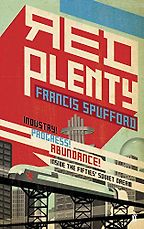
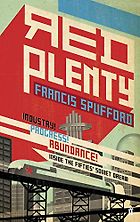
OK let’s start by talking about Francis Spufford’s novel. Can you explain what it’s about? It’s called Red Plenty (2010).
It’s a wonderful, gorgeous novel. It has endnotes, which is decidedly odd in a novel. It’s about the ‘socialist calculation debate’, which he says he chose deliberately as the most unpromising topic he could possibly write a novel about. The book lays out the debate over whether it was possible to replicate, using planning mechanisms, the benefits of a market, and describes the Soviet Union’s efforts to realise this in the post-war period, reaching a peak during the Khrushchev years. After that, economic planning underwent a gradual and then rapidly accelerating decline.
The book has a couple of characters who pop up here and again, but the narrative structure is really the story of a system. So it begins with a mathematician, Leonid Kantorovich, who has this wonderful insight when he’s sitting in a tram. It’s a beautifully designed scene describing how Kantorovich is stuffed into a tram with all these smelly, sweaty human beings.
He thinks about the ways these human beings can somehow magically coordinate themselves so that they all get on and off the tram at the same time; he’s also thinking about the hole that he has in his shoe, which is letting in water, and this extraordinary mathematical idea he has just had. This is the beginning of the notion of linear programming: of how you can take a complex system of variables that looks like it doesn’t have any obvious solution and figure out ways to optimise it. It’s this blending of on the one hand the sweaty reality of human beings, and on the other hand this beautiful, beautiful mathematical idea which seems to have profound consequences.
Get the weekly Five Books newsletter
The rest of the novel is really working that through, weaving back and forth between the efforts to plan and implement the economy and the systems that this gives rise to, and then the consequences of that for the lives of ordinary people: for a young woman academician, for a woman giving birth, for protesters who are shot because they are demonstrating against the rise in the price of meat which has been planned by these economists.
It’s looking at how an abstract system like that works out in reality, and how that reality feeds back into the system. It’s about how it is that the beautiful mathematical insights seem to recede further and further into the distance as the system trundles along and becomes its own thing—its own messy, unpleasant and inefficient human thing.
According to the Economist article you mentioned, Leonid Kantorovich was the only Soviet to win the Nobel prize in economics.
That’s absolutely correct.
So did this happen in real life?
It all happened, more or less. Spufford is quite clear in the footnotes about what he’s doing. Part of the reason he added them is to say, ‘With this incident here, I telescoped this and that thing together’ or ‘This person is not a real person but has something in common with Raissa Berg, who was a famous geneticist.’ He’s using the tools of a novel to try and probe a social logic, which is an odd, contrary, wonderful thing to do. It’s the kind of thing that shouldn’t work, but does—gloriously.
Red Plenty has acquired kind of a cult following among social scientists. It really helps to set the scene for the debates that are happening at the moment. The ways in which information might or might not be used are in many ways recapitulating those that happened 60 or 70 years back, albeit with a different set of technologies and a different set of ways of applying them.
On the one hand, we have people in Communist China, like Jack Ma, suggesting that we may not need markets anymore; we may be at the point where planning is actually going to work because we’ve got machine learning. Machine learning is going to provide us with the sophisticated means to achieve what the planners were trying to achieve and where they failed. On the other hand, we’ve got the Silicon Valley model, which is trying to figure out ways to use machine learning techniques to turn raw information into patterned data that can then be turned towards a variety of commercial purposes, with the same kind of enthusiasm that the people like Kantorovich had. This sudden, ‘Oh my God, we have the mathematics to turn all of these complicated miseries of human life into a set of engineering problems that can be optimised, isn’t that wonderful?’ sounds very familiar if you’ve read Spufford’s book.
There’s no way central planning could work, however fast technologies are coming along. Or is there?
I don’t think we live in a world where it will ever work. One of the off-shoots of Red Plenty is a wonderful piece by a co-author of mine, Cosma Shalizi. He’s a statistical physicist and he goes into the math of Red Plenty and explains why it is, given what we understand about computational complexity, that this stuff simply doesn’t work. Another friend who’s an economist at Columbia, Suresh Naidu, is more optimistic, but hasn’t yet written up the reasons for his optimism.
Cosma also talks about how, even if you could somehow get the math to work, the ways in which human beings are likely to respond to these systems invariably mean that they’re going to screw up. There’s this wonderful bit in Red Plenty where there’s a discussion between an economist—who’s really disappointed that they’re not going to apply his beautiful new math—and a somewhat cynical party apparatchik who says, ‘All of this math relies upon the assumption that the producers in the factories are going to give you the information and tell you the truth. We know that’s not going to work. We know that’s not the way people are going to behave. Therefore, we need to have some scope in the system for human beings to respond and figure out ways around it.’
We still have the same thing today. There was a piece by Yuval Harari in the Atlantic about a year-and-a-half ago, saying that authoritarian capitalism is going to beat democracy because authoritarian countries like China are able to use all of these new technologies to run the economy far more efficiently and keep an eye on everyone.
“One of the crucial questions we need to understand is how this world . . . of information overload is stressing and straining our political system”
What commentators like Harari don’t get is the ways in which these systems are not only incapable of grasping the messiness of actual human social systems, but also able to actually exacerbate the flaws of central planning. For authoritarian countries, China in particular, you have these feedback loops between the categories that people are using to try and understand the world in the central committees, and the actual world they are trying to explain. We know how politics work in these systems. Very often, if you’re not implementing the thought of the beloved chairman, your superiors will decide that there’s something wrong with you and you’re obviously a problematic political element who needs to be eliminated. So the categories you use are likely to reflect the ideas of your superiors, even if you know that they’re wrong.
The technologist Maciej Ceglowski describes machine learning as “money laundering for bias.” That can have terrible consequences if machine learning reflects the categories of official thought, and then interprets the policy consequences in terms of these categories too, so that bias compounds bias. This then creates incentives for ever more distorted ways of understanding the world which are implemented through these algorithms and which then create these feedback loops which get worse and worse, and lead, perhaps, to human tragedy, but also to these authoritarian systems not working in the cool, clean, beautiful and efficient way that pundits like Harari expect.
There is a wonderful essay by Kieran Healy, a sociologist at Duke University. He notes that when we think about these vast systems of machine learning, we assume that they work as advertised, whether we evaluate them positively because of the wonderful things that they can do, or negatively because they’re creating new forms of authoritarianism and surveillance and control. In practice, we know they sort of work and also sort of don’t. We tend to overestimate the extent to which there’s a single overwhelming logic of efficiency that’s associated with them.
So basically, Xi Jinping should read Red Plenty?
Yes. I would also love Silicon Valley entrepreneurs to read Red Plenty en masse and to think to themselves, ‘Which aspects of this apply to how I think about the world, and what aspects of it do not?’ There are important and crucial differences, but there’s also a fundamental similarity between the optimism expressed by these young, excitable Soviet economists and central planners back in the 1950s and the optimism of Silicon Valley people today: that software is going to eat the world, and that this is a really good thing. I think it would be really useful for them to start wondering, ‘Okay, are there aspects of this which simply don’t work in the way we expect?’ And I think that Red Plenty really pokes at these questions in a very, very useful way.
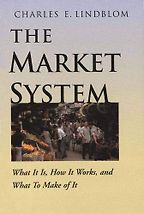
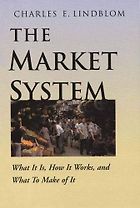
Let’s move on to the next book on your list, which gives a very clear-eyed analysis of the market system we currently live in but don’t tend to think about that much. It’s called The Market System (2001).
This is by Charles Lindblom, who is the only political scientist on my list. He taught for decades at Yale. This book, The Market System, also has an invisible twin that I’d have loved to have talked about too, a book called The Intelligence of Democracy. What he’s thinking about in these two books is how markets and democracies work as informational systems. He wrote The Market System towards the end of the 1990s; the other book was written in the 1960s. So he was thinking about these questions long before we had this huge explosion of information.
What he gets at extraordinarily well is how markets serve as this massive system of coordination, and indeed of cooperation, even though we tend to think about markets as being all about competition. Actually, he argues, there are only a few people who you are likely to be directly competing with in a market. For the most part, it’s a massive system of cooperation, in which all of these tasks—these needs that we have—get solved in a cooperative fashion. Decisions that might otherwise be extremely controversial about who gets what are solved in a way which creates some degree of social peace and acceptance. He’s really very interested in how it is that markets accomplish all of this in an entirely decentralised way.
Support Five Books
Five Books interviews are expensive to produce. If you're enjoying this interview, please support us by donating a small amount.
Lindblom is obviously building on Hayek—who has a famous pair of articles which talk about the incredible system of coordination markets provide through the price mechanism. Hayek’s articles are brilliant, but what I like about Lindblom is that while Hayek is trying to sell his own ideology, Lindblom is coming at it from a somewhat different political perspective. He is a left-of-centre liberal and he’s trying to give markets their due from the perspective of somebody whose politics wouldn’t necessarily put markets at the center. I think that gives a more balanced, more nuanced understanding of markets.
It comes across as quite open-ended. The last line of the book is a question: “What kind of society do you want?”
That’s right. The emphasis throughout the book is on the benefits that markets provide and he talks about those at great length. But he also makes clear that there are things that market simply aren’t very good at doing, and the problems that markets cause for democracy.
On the one hand, he suggests that under some circumstances, markets can actually be better at controlling elite actors than our democratic systems. Consumer power is a very real and very important thing. On the other hand, he points out how if we want to think about how to solve some problems through democracy—and some problems need to be solved through democracy—we have to take account of the systematic ways in which markets distort democracy. We have never had a democracy that has chosen to move away from the market system, which perhaps suggests that democracy is deeply entangled with markets. But it also suggests market elites tend to have a lot of power within democracy as well.
A lot of Lindblom’s other work is looking at the ways in which market actors, because they’re able to allocate where production happens—even if they aren’t lobbying directly or yelling at politicians to do this rather than that—have an enormous degree of structural power that it is impossible for politicians to ignore within a capitalist system. That poses some important stresses and strains for politics and for democratic politics in particular.
Can you explain a bit more about how this book fits into the overall argument you’re making about the politics of information?
Maybe one way to think about this is to steal in advance from Herbert Simon, who we’re going to talk about in a minute. As an economist, Simon has a very interesting way of thinking about the world. In a certain sense, you can see him as an intellectual descendant of the debates in Red Plenty. He mentions in passing in his book that one of his teachers was Oskar Lange, one of the major figures in the debate over how market mechanisms might be implemented in a socialist system. While Simon didn’t necessarily absorb Lange’s politics, he thinks about the world in terms similar to the ways in which the socialist calculation debate was conducted. In particular, he tries to think about the ways in which different forms of social organization might be better or worse as systems of information processing.
So the implicit story behind Lindblom’s project is how markets provide this extraordinary means of information processing (as Hayek and others pointed out). Lindblom has a line about how a market system is a system of social coordination by mutual adjustment among participants without a central coordinator. He talks about the incredible degree of predictability that this creates. It isn’t that I, as a producer of potatoes, have potatoes in my field and I just hang around at random, waiting for a buyer to come along. I know where to go in order to find buyers. The buyers of potatoes know where to find me as a seller and so on. The market entails all of these complex forms of social organization, which pull it along and turn it into something that actually works.
“We have never had a democracy which has chosen to move away from a market system”
But what I think is useful about Lindblom’s perspective, even if it’s mostly implicit, is that markets are not the only way of doing this. This, again, is where I think that Lindblom is more useful than Hayek. Hayek is pushing back against the socialists in the calculation debate. The articles he’s writing are written directly against the central planners and claim that there’s stuff that central planning simply can’t get. He’s absolutely right, but he tends to eulogize the market as a means of reducing everything down to the price mechanism. It serves as a summary statistic of everything that you need to know about a particular relationship. He’s right, but there are flaws and problems to markets too, as other economists such as Joseph Stiglitz have explained.
Hayek is a prophet, but Lindblom is a comparativist. Markets serve wonderfully for these extraordinary forms of coordination and cooperation, but there are other ways of organizing social relations. We need to think about the state. We need to think about the way that the state hierarchy sometimes works together with the market, and sometimes works against the market, while providing essential conditions for markets to work. We need to think about democracy and how democratic decision-making might also provide different ways of doing things.
There is a project implicit in Lindblom’s work, which has never really been carried out properly by political science or by other social sciences, to ask in a more systematic way: ‘Okay, if we think about these different systems of adjustment—markets, democracy, hierarchy, and so on—what are their respective advantages? What are their respective faults? What are their respective failure modes?’ That’s something that I think political scientists and social scientists more generally really need to be pushing towards: thinking more systematically about these things from a comparative perspective.
Can you give a specific example?
One thing Lindblom talks about in passing is the relationship between markets and spillovers and the environment. He has a somewhat complicated argument, but I think an interesting one. One of the problems of markets involves what economists talk about as positive and negative externalities: good things are going to be systemically undersupplied under many circumstances and bad things oversupplied, because they don’t go through the pricing mechanism. There are a lot of cute examples in economics textbooks: I have beautiful flowers in my garden and I obviously enjoy them, but passers-by enjoy them too. I probably undersupply flowers relative to the amount of social utility that people in general gain from them. Economists like to wonder whether we might reach a better equilibrium if there were some mechanism that could allow people who pass by my garden to perhaps give me a tip for the flowers. Externalities have consequences for the environment—pollution and so on.
On the one hand, Lindblom suggests that people often tend to overestimate the extent to which markets create problems that they can’t solve. He suggests that many such problems can be solved by a combination of market processes and the state. If you have some actor who has the authority to say ‘Get things done’, and if you have market processes that complement this form of state decision-making to reinforce it, you can actually deal with many of these problems pretty well.
“We have . . . a world in which our political imagination has been captured by markets as the obvious solution to big problems”
However, he also explains that there may be spillovers and externalities which are just too big to deal with. You might think about global scale environmental spillovers as an important example. He’s writing back in the 1990s, so he’s thinking about things like the ozone layer. Obviously, now we’d look at climate change instead. If we think about efforts to solve climate change, they have involved some degree of state-to-state coordination through international agreements. This hasn’t worked particularly well. They’ve also involved efforts to leverage markets in carbon emissions and so on—to try to to tackle the problem. It turns out that these work pretty badly too. The experience to date suggests that plausibly they might be one part of a bigger solution providing more finely tuned mechanisms of adjustment. However, the fundamental problem of climate change is not that we haven’t created sufficiently sophisticated markets, but that we don’t have any global analogy to the state to try and create the background conditions that would allow these markets to work.
What we have instead is a world in which our political imagination has been captured by markets as the obvious solution to big problems. Market mechanisms can solve some problems, but not others, and we need to think about how pressure and coercion might work at the global level. We have sanctions against states who export technologies to other countries we don’t like: why not for climate cheats? We need to think about the national limits to democracy and the blockages within national systems, and try to figure out how to make democratic politics work better when small, concentrated, relatively powerful fossil fuel and carbon interests have an interest in blocking action.
Ordinary people have diffuse interests in not having their children and their grandchildren live in a world where they are likely to drown, or expire from heat prostration. Because our imagination has been captured by the market, we find it very, very hard even to articulate these problems, let alone find useful ways to solve them. Here, exercising the kind of imagination that Lindblom is pressing towards would allow us to think better about the relative strengths and weaknesses of these different systems, and how they can combine together.
At the beginning of the book, he writes, “One can study economics for many years without understanding the market system.” It’s so true. We may be more left-wing or more right-wing, but we rarely reflect on how the entire market system operates because it’s too much a part of everything. I found the book really interesting to read.
It’s very nicely written. It’s slightly old-fashioned, I would say, in its courtly prose style. He introduces ideas and topics in a very careful, mildly pedantic but somewhat charming way. It would be a great book to teach in an undergraduate class, because it really gets students thinking about stuff that they take for granted. He says we tend to think about the market as this specific and limited set of economic questions, but instead the market is interwoven into our entire society and into everything we do. This is what he means to highlight by talking about ‘the market system’ and not just markets. We, like the proverbial fish, don’t particularly notice it because it’s the water that we swim in, inhale and exhale.
Let’s move on to the Herbert Simon book you’ve already touched on. It’s called The Sciences of the Artificial (1969). It’ a collection of lectures, I believe. Can you tell me a bit more about it?
Cosma Shalizi says somewhere that the first edition of the book has all the good parts. The edition that is readily available is the third edition and most of the final chapters consist of afterthoughts, harrumphs and other kinds of ‘I really should have said that then’s’ that aren’t particularly interesting. So the real insights—and they are real insights—are in the earlier to middle parts of the book.
If you think about Lindblom as trying to look at processes of problem solving in a practical way, Simon is trying to figure out how these questions might fit together from a more abstract, intellectual perspective. His fundamental insight is very nice and it’s a crucial and profound one. He argues that human beings are limited in their ability to process information and that this is something that standard economics tends to systematically ignore.
If you look at economics textbooks, they typically assume that we have complete information, understand everything about the environment that we are in, that we can map out ad infinitum what strategies other actors are going to play against us, and that we do not have any bandwidth limits on our ability to process information. Simon says this is nonsense. We know human beings simply can’t do that. We are flawed. Our individual capacity to understand the world is limited and so what we tend to do in ordinary life, he says, is go for good seeming solutions that are obvious to us rather than for optimal ones. This means that a lot of the actual processes of cognition, or computation that we do, have to be offloaded onto other social systems rather than our individual brains. If we want to think about markets, in Simon’s sense, we should think about how they work and don’t work as massive systems of distributed computation.
Returning briefly to Lindblom, this again suggests that markets do wonderful and extraordinary things. But if you think about markets in this more sophisticated way, then a lot of the very neat results that economists have—that Ken Arrow and other people came up with about how it is that market equilibria are going to be efficient in a variety of ways and that they’re going to be the best possible allocation—don’t really hold. We have no ex ante reason to consider markets inherently superior to hierarchical organizations, to democracy and so on.
“Machine learning can do extremely well as a complement”
Simon suggests that we need to start thinking about what he calls the ‘science of design.’ He says that we need to start looking at forms of organization—whether this be the market, or specific kinds of hierarchical designs—and think about how to build them so that they are best suited for the functions they’re supposed to serve in an inherently complex social environment. This gives birth to his various ideas about how to think about organizations, about democracy, and artificial intelligence, which is another way of trying to solve problems.
When he writes about artificial intelligence—and he is one of the first people who really thinks about AI systematically—he is obviously writing about very different approaches than the kinds of machine learning that are applied today. But his very broad design principles, and approach to understanding how they might or might not work for certain kinds of problem-solving, are very, very useful. They help to identify how these forms of mechanical cognition might also work together with more traditional forms of organization to help us solve problems. We know AI has a variety of specific flaws, and things that it does very well. There are still things that it does pretty badly compared to human beings and human brains, which also have a set of things that they tend to be very good at and a set of things that they tend to be remarkably bad at. So machine learning can do extremely well as a complement.
How does that tie into the general idea of information systems?
Herbert Simon’s perspective starts from the idea that the world is complex, in the mathematical sense of the term. It is a world composed of various subsystems which work together in ways that we’re never going to be able to fully understand or predict. The very best we can do is to arrive at reasonable approximations of them.
Simon wants us to think about different ways of trying to approach this world. We can think about approaches as what he calls ‘artefacts.’ An artefact, for him, is something that interacts with the outside world, but also has some kind of an internal logic for doing this. For example, a business organization might be an artefact. When you start looking at the world in this way, you can begin to see how it is that certain kinds of artefacts might have particular informational strengths or weaknesses. He talks about how you might want to design an organization in a particular way, so as to avoid certain kinds of bottlenecks in information sharing. We tend, for example, to imagine in the abstract that business organizations are strongly hierarchical, that there is a CEO who more or less orders that it will be so and that everybody along all the lines of command says, ‘yes it will be so.’ In practice, of course, all of us who work in real organizations know they are much more like the British sitcom The Office. People are feuding with each other to relieve their boredom and wasting time, and the boss doesn’t have much idea what is happening. Real organizations are messy, and they produce bottlenecks. Thinking about how to remake them so as to minimize bottlenecks is as much art as engineering, and some apparent inefficiencies can be crucial to the working of the organization.
“In practice, of course, all of us who work in real organizations know they are much more like the British sitcom The Office. ”
I had thought about other books. I thought about maybe bringing in some of Norbert Weiner’s work on cybernetics. He talks about feedback loops as the foundational concept for understanding information. That’s one ancestor of the Silicon Valley way of doing things—Simon’s work is another ancestor. If you look at how Simon thinks about the world, when he is really trying to design these systems, he’s doing what Silicon Valley wants to do, which is redefining complex relationships as information problems that you can reduce to make them tractable, and figure out what actually works and what doesn’t.
But what he also is very careful about—which I think people are less careful about today in Silicon Valley, and in places influenced by Silicon Valley—is to repeatedly emphasize that none of these problems are straightforward optimization problems. We’re never going to be able to get to a full optimum. We have to try and figure out ways to make sure that we do not get trapped in inefficient local optima when there are other, better ways of working forward. Simon, as I read him, is saying something like the following: ‘Yes, we can reduce this down. We can make this more mathematical; we can make this more abstract. But we are still living in an extremely messy world in which engineering solutions are going to be helpful much of the time, but they are also very often going to blind us to the actual complexity of the world that we live in, unless we are skeptical and careful.’
Herbert Simon also won the Nobel prize in economics. How do economics and political science work together? Do you have to be pretty on top of economics to be able to do political science?
Well, that depends. More and more so as time goes on, I think political science tends to view economics with a certain degree of envy. Economists have a high professional status that political scientists, by and large, do not. In the United States, for example, there is a Council of Economic Advisers, but despite occasional proposals by political scientists, there is no likelihood that a Council of Political Science Advisers will be appointed. If you look at organizations such as the World Bank and the IMF, they are mostly staffed by economists. Political science sometimes views itself as a younger sibling of economics, wanting to do everything that economists can do, but with all of the jealousies that tend to go along with that status. It’s sometimes a dysfunctional relationship.
Economists tend to be more mathematically and econometrically sophisticated than political scientists, but what political scientists tend to be better at than economists (albeit not all economists; there are some who are very good at this) is understanding that some problems are irreducibly political. This is not a world in which we are always going to be able to get to first-best solutions or even second-best solutions. This is a world in which people are often going to disagree, radically, on what the first-best solutions and what the second-best solutions ought to be. Whether we like it or not, we all find ourselves stuck with other people who not only have different material goals, but also very different value systems.
Here we might think about how these different value systems, these different perspectives, can offer valuable information about how to solve broader problems. And so political science, in an ideal sense, could start thinking about systems that can harness these quite fundamental and irreducible disagreements among human beings and apply them to social and political problems that might otherwise be pretty intractable. Not in a way that points towards some kind of optimum, not in a way that will ever point toward some kind of a utopia, but instead in a way that messily—but nonetheless usefully—conducts political behavior in ways that are both conducive towards social peace and political peace. This would be more like engineering design than most political scientists are comfortable with, albeit less like it than the work of economists. We would end up somewhere in Simon’s science of design, with varying degrees of quantitative sophistication across different political scientists (I myself am not at all sophisticated).
So are you trying to think of ways to redesign democracy?
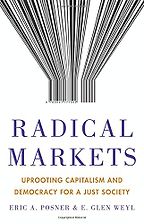
I’m not trying to redesign democracy. I’m trying to figure out a somewhat related question: how do we think about democracy from an experimental perspective? This is where the Posner and Weyl book, Radical Markets, is pretty interesting. There are lots of things in that book which are, as they say, radical. Some of them are likely to seem morally obnoxious to many. Some I imagine would never work in a thousand years, but what I like in that book is its sense of experimentalism—a sense of ‘okay, let’s take crazy ideas and push them as far as they can go.’
What I would like to see among political scientists thinking about democracy—not from the radical markets perspective, but from a radical democratic perspective—is more systematic attention to experimentation with different forms of democracy. How can we take advantage of some of these new forms of information processing, which allow for new possibilities, while also figuring out how to shore up democracy against floods of information, much of it bad or dubious, which might overwhelm democratic systems?
I’m thinking of the Winston Churchill quote, ‘No one pretends that democracy is perfect or all-wise. Indeed it has been said that democracy is the worst form of Government except for all those other forms that have been tried from time to time…’ There is a sense that democracy, whatever its merits, could maybe be improved on a bit.
Exactly. I’m originally from Ireland, and there are really interesting experiments taking place there with constitutional conventions. One of the reasons we’ve had the abortion referendum, marriage equality, all of these things, is because a constitutional convention was organized where a couple of hundred people were chosen at random to debate what kinds of changes to the constitution ought be proposed. They listened to experts and then decided, ‘here are the changes that we need to make.’
This had two advantages. First of all, it provided ordinary people with the ability to actually talk to experts, to get a variety of different perspectives, and to think in a more dialogical way about what they want and what they don’t want. Second, it meant that the ideas that came out of these processes had a certain amount of democratic legitimacy. They didn’t come from politicians, but from ordinary citizens, who had had the chance to think about them and debate them.
“Whether we like it or not, we all find ourselves stuck with other people who not only have different material goals, but also very different value systems”
When you have controversial proposals for changes such as abortion and marriage equality in a country which was strongly Catholic until a couple of decades ago—it is easier for politicians to embrace change if they know that ordinary people have debated it and have thought about it at great length and that these are the decisions they have arrived at. Politicians might otherwise be extremely nervous about touching hot button issues. This gives them the courage to put them forward, saying ‘these proposals were made by ordinary people who have thought this through, not us.’
I didn’t realise that was the reason, but it does seem as if Ireland is moving forward fast.
That’s my feeling as well. It used to be, back when I was growing up, that we looked to the United Kingdom as a beacon of modernity. Now it’s the other way around. It’s very strange.
Let’s focus on Radical Markets a bit more. Glen Weyl and Eric Posner are proposing “a new way of imagining the economy and politics.” Tell me a bit more about it.
There’s lots and lots and lots in this book that I do not agree with, but as I said, what I like about it enormously is its willingness to stir up grief. It’s not perfect at all. It’s one of those books where they make a big claim and then there’s a whole bunch of other stuff which is sort of related to the big claim and sort of not related, but for obvious marketing reasons they combine these semi-connected questions together and say it’s all part of one thing.
If there is a fundamental insight behind the book it’s more or less as follows: if we look at the last 50 or 60 years of economics, we’ve seen this huge push towards what is called ‘mechanism design.’ This is the idea that you can create these kinds of mechanisms that are going to reveal information and push towards socially optimal outcomes. Mechanism design people think that we can move away from much of the problematic nature of current politics to one where we’re far better able to figure out what it is that people want and to let them get there.
Weyl and Posner use this to come up with radical arguments. They say that the problem with a lot of free market economics is that it isn’t free market enough. We have property rights, but who needs static property rights in a truly dynamic market? We might instead have a perpetual auction in which property would always be allocated to whoever wanted it most.
“What I like in that book is its sense of experimentalism—a sense of ‘okay, let’s take crazy ideas and push them as far as they can go.’”
Quadratic voting is another idea that they propose. They suggest that we might be able to change electoral systems so that they reflect the strength of people’s preferences much more than they do at the moment.
They also have ideas about how to free up immigration through a variety of mechanisms. Posner and Weyl say that if you really want to maximize the material well-being of the world’s poor, you need to compromise on the rights to political equality. They suggest migration systems which would involve limiting the political rights of migrants, so allowing them to get to richer parts of the world more easily. Danielle Allen, a wonderful political theorist at Harvard, has made some very good arguments pushing back against these claims, but as Danielle says, the value of this book and this way of thinking is that it forces you to be clear about what it is that you value (and moreover, she and Weyl have worked together since). If you think equality is a fundamental part of human dignity, this book forces you to say more explicitly that this is so and here are the trade-offs that you are willing to face in order to achieve what you think is the appropriate way of doing things.
Some people will agree with Posner and Weyl some of the time. There are some ideas that are definitely worth agreeing with or at least pursuing experimentally. They talk about how their ideas should initially be implemented using small-scale experiments to see how they work.
But for me, like Danielle, much of the value of the book comes from how it forces people who disagree with them to sharpen their disagreements and to say more explicitly what their own foundations for arguing are. So when I read this book, I think, ‘Okay. These are people who are throwing out more radical ideas than most of us would dare. I would love to see people who are coming from a different, less pro-markets perspective begin to think in a similarly radical fashion.’ If we have the means to experiment on a wider scale, how do we experiment, on what basis do we experiment, in what kinds of ways could we think about the world radically differently than we think about it at the moment and what kinds of things might be revealed by doing that? That’s what the book presses you to think about.
So are you a fan of quadratic voting? Should it be tried?
It is interesting enough to try out. Roughly the idea is as follows: quadratic voting provides a means of registering people’s intensity of preferences in a way that our standard system of voting does not. So you and I vote and you are voting for candidate X who is associated with a bundle of different things. I’m voting for candidate Y who’s associated with a different bundle of things. You might have your preferences. You might feel really, really strongly about fox hunting, whereas I might feel really strongly about the safety of our water supply. But there is no way for me to sufficiently signal the intensity of my preferences or you to signal the intensity of yours. What they propose is a system which would make it much, much easier for you to vote on particular issues and, in a sense, to save up your important votes for the things that you absolutely care about.
This has benefits, if you think of voting as a system that is primarily designed to allow people to express their preferences and have those preferences aggregated into collective choices. You could alternatively say part of the benefit of our existing system of voting is that it forces candidates to persuade the majority, who don’t necessarily care all that much, that they should care. This kind of discussion has its own benefits. I recently re-read Doug North’s book on Institutions, Institutional Change and Economic Performance, which has a passage describing debates about slavery, where a large number of people in the mid-nineteenth century opposed it diffusely, while smaller groups were passionately in favor and passionately against. The implication of quadratic voting is that people who were strongly invested in slavery—because they had an economic and financial interest in it—might plausibly have prevailed over the majority who vaguely felt that ‘slavery is bad’ but weren’t necessarily prepared to invest their life’s worth in opposing it. Processes of persuasion are an important part of current democracy and might be lost if we go over to giving people who have very strong preferences their way. We might get stuck in Yeats’ “The Second Coming” equilibrium, where “The best lack all conviction, while the worst / Are full of passionate intensity.” And then we’d be in trouble.
The point that I’m making here is not that quadratic voting is necessarily bad. It’s that each of these systems has specific strengths and weaknesses and trying to figure out what those strengths and weaknesses are with respect to particular issues or problems is a process of exploration and experimentation. And again, this is something that we don’t have a strong sense of how to think about in a systematic way.
I do love this idea of thinking about a completely different way of doing things. It’s quite liberating, isn’t it? Although as I was reading Radical Markets, I was sitting on the sofa in my sitting room clutching the cushion and wondering, ‘Will I be allowed to keep my house?’
They suggest that people aren’t nearly as attached to things as they think. Most of the time, you will want to keep your house, and people won’t want to take it from you. But the way I would put it is that this kind of book is often less valuable as a set of practical proposals for reform, than as a set of proposals for interesting ideas to investigate and start pushing the envelope on. It also provides a mental astringent, a kind of, ‘Yikes! I really don’t like this. Why is it that I don’t like this? Why is this unsettling to me?’ It forces you to really think through what your values are and what your commitments are in a way that most books don’t.
This gets back to the dichotomy we talked about previously. If you think of human beings as pure and simple market actors then the logic of many of Posner and Weyl’s claims unfold pretty straightforwardly. If you think about human beings as being the messy and complicated bundles of drives and contradictions that we are, animals who grow attached to their homes and have irrational affections, then it doesn’t work nearly as well. But the book makes you think more specifically about those trade-offs.
Lastly, we’re at Anna Wiener’s book, Uncanny Valley. So she goes from being a lit grad working at a publishing house in New York to working for tech companies in Silicon Valley. Uncanny Valley is her memoir about that experience. You’ve already alluded to it, but explain a bit more how it fits in and why it’s your final book.
I was looking for a book that would talk about Silicon Valley and these new ways of information processing. I wanted to move from Red Plenty through into what’s happening in Silicon Valley at the moment and draw out both the tangencies and the overlaps. There’s a minor publishing industry on Silicon Valley, which has gone from books about how ‘Silicon Valley is awesome’ to books about ‘Silicon Valley is evil.’ I was looking for something a bit different. Initially I proposed the Zuboff book, but it’s 700+ pages, so I felt guilty imposing it. Also, like many authors, Zuboff depicts Silicon Valley as an all-devouring Moloch, a monstrosity of surveillance with a single logic. Books like that get at very, very important aspects of the politics of Silicon Valley, which I don’t want to discount, but there’s also something too totalizing about their understanding of how these technologies are reshaping the world.
What I really like about the Wiener book is that she uses her life story and the various situations that she finds herself in as a way of trying to describe this world that is emerging, but not necessarily to try and pin it down with a simple argument saying ‘this is this’ or ‘this is that.’ She starts as an underpaid publishing person in one of those miserable jobs that we all know about. Then she goes to a minor startup, and moves on through another startup, through to working for a major platform, GitHub. She never names any of the companies, but it’s often quite clear who she’s talking about, and one of the fun parts of the book for people who hang on the outside of this world is figuring out who is who.
Wiener uses her own personal experiences and those of people around her to capture how the logic of information and engineering, the Marc Andreessen “Why Software is Eating the World” logic actually intersects with the real world, with real people, with real lives. Also, she wants to get at the messiness of the people who are actually implementing this stuff, the complicated ways in which they try to deny to themselves that they are part of the surveillance industry and to capture the role of women.
There’s a great history of Silicon Valley that came out about a year ago, The Code, by Margaret O’Mara, which talks about the way in which women get systematically written out of the story. The stuff that they did was not considered core because many of them weren’t engineers. Wiener gives a very, very good sense of what it is to be on the receiving end of that. Silicon Valley is built around the idea that if you’re on the hard, cutting edge of mathematics and engineering you’re doing good stuff, but if you do anything softer and fuzzier your contribution is discounted. You’re somebody who is necessary, but in the way that the plumbing is necessary in a building. You don’t want to think about it more than you have to and you certainly don’t think about it as something that adds to the business’s value proposition.
Uncanny Valley is a very good book about the system of Silicon Valley. She has this bit at the end where she says, “I was looking for stories; I should have seen a system”, but I think that underestimates what she has accomplished. She’s doing what Spufford does in a very different way, which is why I think the books are comparable. She’s telling the story of the system filtered through the story of her own life, and this gives a sense of the system as something which is not totalizing. The book is wary and oblique, getting at the system from a variety of different perspectives, looking at the different ways in which it works and which it doesn’t quite work as advertised. She describes the primate hierarchies that are associated with it and she gives you a far better sense of how it actually unfolds, in this complex and messy way, than more deliberately big-picture books that are organized around a statement or thesis.
Basically you’re saying that if we want to understand the politics and economics of the society we live in today, we do need to understand Silicon Valley.
Yes, it’s very clearly extraordinarily important because of how it is reshaping the world. These companies have enormous clout and their actions have consequences. But they are not providing an engineering solution or an optimal world. They are half-accidentally creating an ecology with unexpected consequences and unanticipated evolutionary niches, occupied by strange new predator and prey relations. Within the technological possibilities that are being created, people find their own ways of doing stuff. I was reading Uncanny Valley together with William Gibson’s science fiction novel Agency. They make for an interesting pairing. They’re both about Silicon Valley; Gibson continually uses brandnames for effect, while Wiener, as I said, never mentions them on principle, referring to Facebook, for example, as ‘the network that everybody hates.’
Gibson has this great phrase from one of his early books ‘the street finds its own uses for things.’ That’s what I felt about Wiener’s book. You have these systems which are supposed to effectively replace hierarchy and standard ways of doing things with a simpler, cleaner, more efficient world, but it doesn’t work cleanly and efficiently. So GitHub is supposed to be a platform for people to collaborate on building software, but it works—like all of these Silicon Valley businesses—by using algorithms and other means to replace employees. So you’ve got Wiener and her team of four people who are supposed to be the moderators controlling the content that is put up by nine million users. Obviously that isn’t going to work.
What happens is that people begin to turn the system to their own uses. She describes how the creepier elements of the alt-right and neo-Nazis begin to colonize GitHub as a means of first of all, organizing protests against the perceived dominance of the man-hating-women in the technology industry and then as a platform to organize support for Trump. This is not something that the designers of the system ever expected. But when they create these open systems, which have a minimal degree of human oversight, people are of course going to start finding unexpected ways to use them. Some of these unexpected uses can be wonderful and extraordinary and transformative, but given the way human beings are, some are going to be self-interested and some downright creepy and nasty.
The story behind the story that Wiener tells, the story that she’s hinting at and pushing towards through her personal experiences, is the story of how we ended up in the world that we’re in today? What role does this Silicon Valley engineering mentality play in this? When Francis Spufford talks about why he wrote Red Plenty as a novel rather than non-fiction, he says that the novel form gives you negative capability in the Keatsian sense. It allows you to have your cake and eat it, laying out a variety of different perspectives and giving each of them the opportunity to make their case in an overlapping narrative. Red Plenty has room for both the people who are excited about planning and the Hayekian argument against their excitement. He’s able to use the framework of the novel to give each of these perspectives.
Get the weekly Five Books newsletter
Wiener is doing something similar with autobiography. She describes this character who she meets, who is very clearly Patrick Collison, one of the founders of Stripe. She describes her dialogues with him, presenting him as someone who is bright and smart and compassionate and believes in the Silicon Valley ethos and is fully committed to it. He ends up being one of the billionaire founders of this world. Wiener clearly comes at it from a different perspective but she tries to give both of these perspectives a space that they can play out in.
The result is a book that you can certainly disagree with and I’m sure plenty of people will disagree with. Still, it seems to me to present a much more recognizable version of the world that is being built than the more standard, ‘here is why Silicon Valley is the be-all and end-all of everything’ or ‘here is why we are all going to become puppet-slaves to the machine that is consuming us all.’
So the Anna Wiener book is a little like a modern version of Red Plenty, written as autobiography, because like Spufford she’s trying to talk about the collision between these abstract and delightful ideals of how information transforms everything and the real and complicated messy ways in which human beings actually work and live.
As individuals, what should we be thinking or doing about Silicon Valley?
We began this conversation by talking about political science and whether political scientists talk about information systems. I said basically no, not very much, but they should. I think political science and social science more generally ought to be entering these debates. We can’t leave it all to the engineers and the lawyers. In this interview, I’ve stolen liberally from work I’m doing with Marion Fourcade, who is a wonderful sociologist. Anything intelligent I say, she should get full credit for.
Her idea is that you can think about all this as classifications and categories and feedback loops. Machine learning processes involve feedback loops where they are supposed to optimize on something and they throw out stuff, based on their classifications of the situations that they’re dealing with. They measure how people respond and then they adjust the classifications and so on and so on. But we also have the actual feedback loops of people’s lives, of the way people use these systems in all of these unexpected ways. What we don’t have much understanding of is how this intersects with the feedback loops of democracy. In this new information architecture, we don’t have ways for people to really express collective voice, or have collective input into these platforms that shape how we organize the world.
So one of the interesting questions, then, is: can you start to think about ways we aren’t just interfacing with these systems as users, as consumers, as paid product—because our eyeballs are being sold to advertisers—are there ways in which we can participate by saying collectively, ‘No, we don’t like this. Yes, we do like that’? And how do you even begin to start building the structures that might allow this?
Now again, there are ways in which you might start to think about using some of these new forms of information system as ways to enhance democracy. Glen Weyl talks about this a lot. The politician Audrey Tang is doing work along these lines in Taiwan. There’s also a professor called Federica Carugati at Stanford who is thinking about stealing ideas from the way that democracy worked in classical Athens to try to build up towards councils of randomly chosen people who might be able to have direct input into algorithmic decision making, like that constitutional convention in Ireland. How this would all work is hard to say right now. We barely even have the vocabulary to begin to articulate the questions. That is really where I would like to see the conversation between political science and technology going.
Five Books aims to keep its book recommendations and interviews up to date. If you are the interviewee and would like to update your choice of books (or even just what you say about them) please email us at [email protected]
Henry Farrell is professor of political science and international affairs at George Washington University and co-leader of the project on the moral political economy of technology at Stanford University’s Center for Advanced Studies in the Behavioral Sciences. He was the 2019 winner of the Friedrich Schiedel Prize for Politics and Technology and is also Editor in Chief of the Monkey Cage blog at the Washington Post. He works on a variety of topics, including democracy, the politics of the Internet and international and comparative political economy.
Henry Farrell is professor of political science and international affairs at George Washington University and co-leader of the project on the moral political economy of technology at Stanford University’s Center for Advanced Studies in the Behavioral Sciences. He was the 2019 winner of the Friedrich Schiedel Prize for Politics and Technology and is also Editor in Chief of the Monkey Cage blog at the Washington Post. He works on a variety of topics, including democracy, the politics of the Internet and international and comparative political economy.