How did you get interested in exploring the 1980s as a setting for a novel?
Fallout is part of five novels that I’m planning. I’d already written one set in the 1950s, which is about the first CND march to Aldermaston from Trafalgar Square. I was thinking about political novels—or political backdrops for a fictional, personal story—and the big events that really drew my attention. The one set in the 1960s I’ve got planned. Then I was thinking about the 1980s and I just thought Greenham! Then I decided to write that one first, because it’s within easy reach of me.
Fallout opens in 1982, when I was 11. I didn’t have to do any of that research where you end up with a pastiche of an era rather than actually living it. I remember the 1980s and what an amazing era to write about! There was the music and the fashion and the women’s liberation of the 1960s that didn’t really happen—or at least it got purloined by the patriarchy. Suddenly, in the 1980s, you could have it all, but it was hard because you couldn’t be just one thing; you had to be all things. When you went out to work, it was about power dressing and looking like Maggie Thatcher, but at home, you still had to be in the kitchen. It was a lot harder for women. The liberation we have now didn’t really get a look in.
So that was ripe for fiction, as we’ll see with all these books set in the 1980s which we’ll go through. I just thought I’d enjoy myself.
Here in the UK, we grew up with Greenham Common on the news, but for our US readers, could you explain what it was?
Yes—and for anyone under 30, because even in the UK, I’ve only met one person under 30 who has heard of it.
Greenham Common was an area of common land that was taken over—without the say-so of the British public—by the Royal Air Force and became RAF Greenham Common. In 1980, after a deal between Thatcher and Reagan, they decided to site cruise missiles there. It was part of a strategy called, without irony, MAD—mutually assured destruction. The British government also embarked on a public information campaign called ‘Protect and Survive.’ They sent out leaflets—which were quite frankly insulting—with instructions about what to do in the event of a nuclear war, including blocking your windows and building a fallout shelter in your home. For us kids, it was pretty terrifying.
Four women from Wales were so outraged by this that they walked all the way from Cardiff to RAF Greenham Common to raise public awareness. When they got there, the guards let them in, thinking they were the cleaners. Nothing happened. They chained themselves to the fence. They stayed a year. Still, nothing happened; there was no media attention at all. Then they decided to hold an action called ‘Embrace the Base,’ which is when Fallout begins. Greenham women encircled the entire nine-mile perimeter fence of the base.
So when we say Greenham, what we mean is the peace camp and the women who proved that those bombs were unsafe and should be removed. It was an incredible action. It was 19 years of non-violent protest. It was women only. Many, many women were beaten up, locked up, put away in Holloway prison and taken away from their children. They were absolutely slandered and shamed in the press.
When Gorbachev and Reagan started peace talks, the Soviet leader cited Greenham women as part of the inspiration for doing it. Between 1989 and 1991, the missiles were removed, and in 1999, the fence was taken down and the land was recovered as common land.
And yet, it’s not taught in schools. It’s not on the British curriculum. It’s not in women’s history. It’s not on degree courses. So one of the reasons I wrote the book was my outrage. This should be up there with the suffragettes and the civil rights movement and apartheid and Gandhi—and yet, it has been forgotten.
Your novel, Fallout, is a great way to learn about it without turning to a history book. It’s also a good setting for a coming-of-age story for your main protagonist, isn’t it?
Yes, I was going to make her older, but then I thought, no, let’s make her 15, because then, if you don’t know anything about Greenham, you learn through the very black and white thinking of a 15 year old. Bridget runs away from home and joins the peace camp, not because she is remotely interested in politics—she just doesn’t want to go to netball. She’s bored, her parents are embarrassing, and Surbiton is boring. She arrives at Greenham insolent and insouciant, with no interest in politics at all, and her eyes are opened.
It was a gift for me as a writer that I could be teaching and providing information through the eyes of a teenager who starts off thinking it’s all stupid and doesn’t know how to spell patriarchy and ends up not only with her eyes opened and her political history informed, but then is able to help her mum, too. What Bridget has to do is bring those politics home and see where they impact in her personal life and in the family.
Tell me about the books you’re recommending today and how you chose them. Are they all political novels?
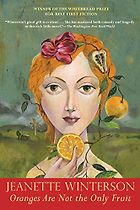
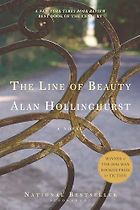
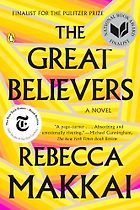
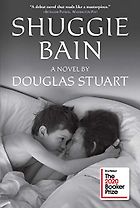
The Line of Beauty is probably the most successful political lens novel set in the 1980s. It’s a great piece of fiction set against the backdrop of Thatcherism, and so that one was overtly political. Money I just chose because the 80s were all about money, money, money. It was the time of Maggie and capitalist growth. Oranges Are Not the Only Fruit I chose because it’s a coming of age. The Great Believers was published a few years ago, but Rebecca Makkai was writing about the HIV crisis of the 1980s. There’s a known phenomenon that national trauma takes three decades to reach the surface and this book, I believe, is a perfect example of that. Finally, I chose Shuggie Bain because it’s such a great young person’s point of view of the 1980s and, again, a coming of age.
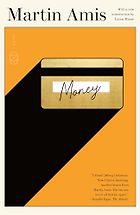
Let’s look at each of them individually, starting with Martin Amis and his novel, Money: A Suicide Note (1984), about a self-destructive character who works in the world of advertising.
What I normally do when I love an author is I’ll read everything of theirs. This was my Martin Amis phase, and I read them in order, which was a fascinating thing to do. When I got to Money, he’d really hit his stride, with that very direct writing. A lot of my female friends don’t like Martin Amis because they feel he’s a misogynist and he’s just too unapologetic but I adore him because of that. He is the male laid bare and the ability to write like that…I don’t know if it’s unconscious, but to write in such a revealing way about the male psyche is fascinating to read. That aspect really took over his writing, and after Money I think, from reviews, he became more conscious of it, how it got a lot of women’s backs up. Money is just about at that tipping point for me.
Money is a proper 360-degree landscape of the 1980s. With some novels set in the 1980s, you feel the author just Googled 1980s and what was popular. Money was published in 1984, so you can really be right bang there without being a tourist. It really captures that drug-fuelled and utterly shameless era. It’s a brilliant novel.
I could have chosen Bonfire of the Vanities instead, another 1980s state-of-the-nation novel that uses greed as its spine but it’s set in the US, and I wanted to be more UK-focused.
Let’s go on to Oranges Are Not the Only Fruit (1985) by Jeanette Winterson. This is a novel, but people say it’s semi-autobiographical.
Yes, I hesitated over this one, and I had to look it up to see if it was listed as a novel or a memoir because in my memory, it was a memoir. For anyone who hasn’t read it, Jeanette Winterson grew up in a very religious sect of Christianity. Famously, her mother says to her, ‘Why be happy when you could be normal?’—which is one of my favourite lines and is the title of her actual memoir, which followed after Oranges Are Not the Only Fruit.
Jeannette Winterson is the kind of writer who writes really direct to the page. What she’s doing looks really simple because it has that sense of immediacy, but it’s a highly technical skill. You feel her voice is absolutely unadulterated, coming straight at you; there’s not a single word out of place.
Her family used to go to religious caravan festivals. The scene that remains in my mind is where they’re out in an enormous tent in some field. She’s having to continually abide by this sect, but she’s gay and can’t wait to get out. She is absolutely an alien in her own family, but she’s not relentlessly judging it. I think it’s one of the best semi-autobiographical novels you can get your hands on. It’s absolutely brilliant.
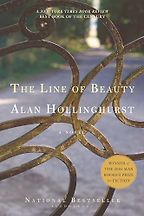
Let’s turn to The Line of Beauty by Alan Hollinghurst, which won the Booker Prize in 2004.
This book was his smash hit. It tells the story of a young man and his sexual awakening. It’s a love story and it’s super sexy. At the time, it was considered pretty wild. I don’t think there’d been a state-of-the-nation novel quite like it. It was a real commentary on Thatcher’s Britain and the sexual revolution that the young man was going through.
Hollinghurst writes it beautifully. It’s a very complete novel. He’s got a novelistic way of writing. You’re really in there, in the story with this young man. The Line of Beauty is the novel to go to if you want sexy, illicit Thatcher’s Britain writ large.
As I said, it takes a few decades for a national trauma to reach the surface. There’s my book, Fallout, and also a great film by Barbara Santi called Gentle, Angry Women, which came out last year. We are all talking about the early 1980s and the threat of nuclear war. I would have loved to put Milkman (2018) by Anna Burns on this list, but that’s set in the 1970s. She’s writing about the trauma of the Troubles in Northern Ireland.
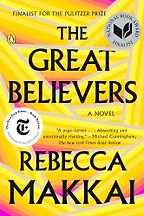
And then, as you mentioned, there was the trauma of a new disease appearing, AIDS. Tell me about Rebecca Makkai and her novel, The Great Believers.
This book is set in the United States. It’s a beautiful, tragic, perfectly written novel about the HIV crisis. It’s written from the point of view of a protagonist who witnesses a friend’s death, or various friends’ deaths. It’s delicately done. There’s nothing voyeuristic or trauma porn about it. If you were too young to remember the HIV crisis, there was a lot of scaremongering that went on at the time, and there was a lot of prejudice. It was called the gay plague on the news, without any sense that this was incorrect or not how we should be talking about one another. There was a sense that if you caught it, it was somehow your fault, and governments didn’t try and push against that. If you caught it, well, too bad. And that was how it was treated for a very, very long time. We know now, of course, that HIV is not interested in your gender or your sexual preferences—it’s just a vicious virus.
For those of us who were young at the time, we saw these horrific adverts on television, with a tombstone rocketing down. It scared us all to death and put us off having sex with anyone. And being friends with anybody who was gay suddenly became a life-threatening situation. The person who broke all of that was Princess Diana, who was seen in HIV wards, holding hands and hugging the men and women who were dying of it.
So Rebecca Makkai writes this very tender novel, and for anyone too young to remember it, it’s a brilliant way of learning about the national trauma of HIV in the 1980s.
Prejudice is a bit of a theme in these books, isn’t it? There was a real prejudice about the women at Greenham Common, for example, which comes out in your novel.
Yes, absolutely. There were some terrible newspaper headlines and absolutely unadulterated attempts to slander and shame any woman who decided she wanted to go and reclaim the land and stop the bombs.
I was writing an article for the Big Issue this morning and I was reminded of the methodology that the state and the police used to try and stop the Greenham women doing what they were doing. They shamed them for leaving their families, they shamed their sexuality, whatever it might be. Greenham really blew the doors off so many state-sponsored structures about who we are and how we should all be.
A lot of women I’ve spoken to said they could never go back. They tried to go back to their lives after Greenham, but they just couldn’t do it.
Do they talk about Greenham fondly, the ones you interviewed?
Some of them do. Some of them feel frustrated that they’re still out there protesting. I interviewed a woman the other day who had written to me because she didn’t have fond memories of Greenham. She said she felt a great pressure while she was there to be wilder than she wanted to be. Also, she couldn’t go back to her life afterwards. She tried to, but she couldn’t.
One of the things about Greenham that really strikes me is that because it was not an ideology, it was full of dispute and people arguing. There wasn’t a great agreement on anything, apart from ‘reclaim the land and get rid of the bombs.’ That was it. There was an enormous amount of class dispute, race dispute, gender dispute, sex dispute, but that was okay. Nobody got thrown out of Greenham for not conforming to some way of thinking or language. That, I think, is perhaps even more significant than the fact that they achieved what they did. It shows that we are capable of all living together in one place and disagreeing. That we are able to hold complex ideas and conflicting opinions in one place and not cancel each other is one of the greatest lessons of Greenham, and something that I bring up again and again. It’s also what’s missing now. If you spend enough hours with another person, you’ll find something you disagree on. It’s absolutely inevitable and that’s okay.
That’s another thing about the 1980s—we weren’t all defined by our politics. Now, if you’re whatever you are politically, it becomes your entire world. Whereas when I was a child, my dad was a Tory and my mum was a socialist. It was perfectly normal to have the entire range of the political spectrum at the kitchen table every night, and that was good. We were all trying to be kind individuals. We didn’t agree on how to run the world, but nobody wanted to cancel someone else just because they believed in the NHS or didn’t believe in the NHS.
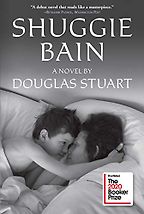
Let’s talk about your final book, Shuggie Bain (2020) by Douglas Stuart—another Booker Prize winner.
Yes, very deservedly. It’s set in a very poor area of Glasgow. It’s about a little boy called Shuggie Bain. One of the things I really loved about it is that it’s very hard to write a long book. You’ve got to be George Eliot or Charles Dickens, or Alexis Wright. Shuggie Bain is a good, big, meaty piece of fiction, and yet there’s not a minute where it feels like he was fattening it out. There was never a moment when I thought, ‘Yes, I’ve got it now.’
We’re with this boy as he grows, we’re with him as he moves house, we’re with his family. He goes off to play outside on these slag heaps, and there’s this constant feeling of, ‘Oh, he’s going to get injured, this vulnerable boy growing up learning how to be tough.’
I grew up in a materially very privileged family and the life and world of Shuggie Bain is totally outside of my reach. So to be in that world and to experience it through this little boy’s eyes and through Douglas Stuart’s eyes… because I suppose, with the best books, you feel they’re autobiographical as well. Maybe Douglas Stuart grew up in Honolulu and has nothing to do with Glasgow whatsoever, but I had the strong feeling that this was pulled from his own experiences. I could be wrong about that, but that’s what makes it such a brilliant book.
It’s got a great ending. We leave Shuggie when he’s a teenager. I’ve got a memory of him being at a bus stop, and he’s just making that next leap into adulthood.
Also, as with other great novels—Lord of the Flies does this as well—you forget Shuggie’s age. You’re so in the protagonist’s world, you forget he’s just a little boy. And then you get these great zoom shots when you pull back and see him through other people’s eyes, and he’s just a little kid playing on his bike or whatever it is. Your heart goes, ‘Oh my gosh, this tough little kid.’
There’s also a real visceral sense of the weather—the cold and the damp—and also the sharpness of the stones. Douglas Stuart does all of that absolutely beautifully as well.
It’s a really good juxtaposition because it’s the 1980s. It’s not the wildness of gay London. It’s not the moneyed world of Martin Amos. It’s the roughness of Glasgow, and the slag heaps up north, where money has not filtered through and these kids are just surviving and being loved. It’s brilliant.
Five Books aims to keep its book recommendations and interviews up to date. If you are the interviewee and would like to update your choice of books (or even just what you say about them) please email us at [email protected]
Five Books interviews are expensive to produce. If you've enjoyed this interview, please support us by donating a small amount.