What is the appeal of books featuring near-future dystopias?
For me, they’ve held an appeal since I was a child. One of the books I’m going to talk about is Z for Zachariah; I remember it lighting a flame in me. Dystopias put you in a world where characters (and thus, in some way you, as a reader) have to fight to survive. It makes all those structures of society that make life sanitised and safe suddenly disappear, and I think that’s something that can be particularly appealing to young people—the idea of suddenly, drastically having agency.
Also: whether young or old, we’re living at a time where the world is often stranger than fiction. A lot of what’s happening to us—climate change, the spectre of war, a pandemic—are worked out or grappled with through these novels. I think we can see in them a future that we don’t want to happen. They can also be quite stoic. When you think through what you might do in those circumstances, it affords you—or at least you hope it does—some level of preparedness.
That’s part of why I wrote a semi-dystopian novel in any case, and that’s why they are some of the books that I love and recommend most.
Yes, tell us a little bit about Dreamland, your own recent book which features a near-future dystopia.
Dreamland is set in a near-future Margate, an turbulent seaside town on the south-east coast of England. The main character Chance is born in the year the novel was published—so, 2021. We leapfrog to her being seven, then again to where she is 16. It’s a portrait of the nation through a very personal lens: Chance’s family are given a grant to leave London and move to the coast, just as sea levels are rising, and more extreme political ideas are taking centre-stage. And through it all, it’s a love story.
Thanks. Shall we talk about your book recommendations?
I’ll just say one thing quickly: I’ve said ‘near-future dystopia’, but I’m also interested in social realism. There are a lot of really good dystopian novels where something dramatic and not necessarily plausible happens overnight. That can be a wonderful way of elucidating an element of society. But here I’m more interested in novels that feel distinctly realistic. I mean, I’ll admit: one does feature zombies, but nevertheless somehow feels distinctly plausible within our current world.
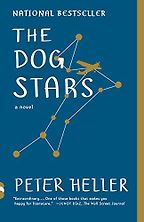
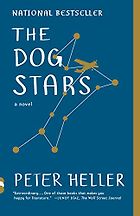
Ha, I love that distinction. First up, we have The Dog Stars by Peter Heller. It’s a post-pandemic novel. Could you tell us about why you admire it?
What I think is super interesting about this book is that it came out in 2012; six years after Cormac McCarthy’s The Road, which kind of re-defined and dominated the idea of the post-apocalyptic literary novel in the public imagination. This meant that novels in its wake, like The Dog Stars, were frequently talked about in comparison to The Road, like: ‘The Road… but with hope.’ So while The Dog Stars had enormous success—it was picked for Oprah’s book club, and so on—a lot of people who love dystopian novels still seem not to have heard of this one. I’ve recommended it so many times.
“Dystopias put you in a world where characters have to fight to survive. It makes all those structures of society that make life sanitised and safe suddenly disappear”
The main character is called Hig, and he’s lost everyone and everything he knows apart from his dog, his Cessna plane, and his dour gun-toting neighbour. The thing which frustrates me about the idea of it being dubbed ‘ The Road… but with hope!’, is that that suggests a sentimentality of some kind, and this book is decidedly unsentimental.
The narration is extraordinarily well done. Many post-apocalyptic books have a spareness and sparseness that can sometimes feel affected. This feels incredibly naturalistic, and yet manages to be very lyrical. One review I read talked about it having a haiku-like quality. It has these clipped sentences, in a way that feels hyper-realistic to how minds think. It’s effortlessly beautiful while being violent and harrowing.
This point about hope is interesting. I think sometimes that’s these appeal of these near-future dystopias. Something like: after the worst is over, comes the recovery. Would you agree with that?
Another frustration I can feel is that, often, the books without hope are considered stronger or more literary or realer—as if the books with hope have somehow been airbrushed. But I think the latter are actually more realistic.
Hope is not neat. It can be a dangerous thing, because we can hold onto hope long after we should, sometimes. Hope is a fundamentally human trait, which brings with it its own risks. To me, social realism must contain hope—and hope is not necessarily a form of soft-focus.
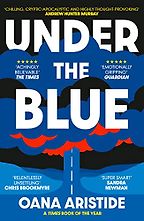
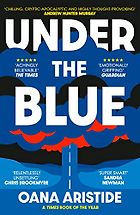
The next near-future dystopia that you want to recommend is Oana Aristides’ book Under the Blue. Would you give us an overview?
This came out around the same time as Dreamland, and I think it’s a brilliant novel. I’d been in a bit of a reading funk—my attention span felt really shot post-pandemic—and this was one of those books that I picked up and just blazed through. The whole day disappeared.
It’s the dual narrative of an artist called Harry who—thanks to a combination of grief and absorption in his painting—doesn’t realise that a pandemic is happening around him in London. He emerges from this ‘deep-dive’ into a devastated landscape, and, later, embarks on a cross-Europe road trip, as he tries to reach Africa with two fellow survivors, who are sisters.
Get the weekly Five Books newsletter
This narrative is interwoven with the story of two researchers in the Arctic Circle discussing an artificial intelligence thy have developed. They’ve been providing this AI with information about human history and culture, in order for the AI to predict the future. There’s a race against time, as these two stories happen simultaneously. There’s not a false note. It’s so well done. Beautifully written, filmic.
I’m not an AI scientist, but it feels very convincing to me. The discussion takes the form of instant messaging, kind of like a Gchat transcript, between these two researchers. And it feels very human, very sure-footed the whole way through.
I think another quality that unites all these books that I really love is how they find ways around exposition. Because there is no quicker, or more sure-fire, way to kill socially-realistic dystopia than with heavy-handed exposition. As a reader, you want to feel like you’re really in a world in which this has happened. Aristide’s really good at that too.
Another theme that runs through a lot of these books—that I guess that feels natural for writers tackling what the end of the world might look like, or the beginning of the end of the world—there’s a real questioning of: What does it mean to be human? What does it mean to make art as a human? That’s dealt with very head-on in Station Eleven too. These are the themes that emerge, and in the best examples, are dealt with so dextrously.
Just on that point about craft—I love novels that show the use of emails and Gchat and SMS. I guess these are the contemporary equivalent of epistolary novels. Those electronic methods of communication are so intertwined with the way we live now, how we think and relate to one another. It feels very natural to me that they should be represented in literature.
It can feel very natural. What I love about good dialogue is that it often cross-hatches and doesn’t quite make sense. That’s what real dialogue is like. With instant messaging, if you read the transcript, it’s always a bit off.
Yes, you’ll be interrupting each other, responding to previous points, or firing off messages part-written, in chunks, to avoid long gaps of ‘silence’.
Totally! And totally realistic. So again, I think that fits my theme—what I love in all these books is that there’s a texture of a life we know and realism. It’s that, which allows all the other things in the book feel entirely convincing.
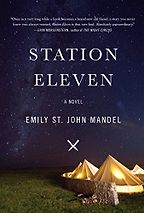
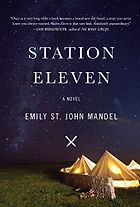
You mentioned Station Eleven a minute ago. Can we talk about that now? This is a novel by Emily St John Mandel, and it was a big international bestseller. It’s another post-pandemic book, a near-future dystopia that feels very recognisable. It is very concerned with the continuation of culture and art after disaster. I think it’s one of my favourite novels of all time.
An absolute classic of the genre, yes. One of the things that’s superb about this book is how it interweaves timelines and flashbacks. The contemporary world has a strong presence in it, which makes the near-future dystopia feel proximate and plausible. The meeting of post-apocalyptic and contemporary life makes you feel nostalgic for the world we’re in, and that’s a wonderful thing.
“Hope can be a dangerous thing, because we can hold onto hope long after we should”
The premise of Station Eleven, for those who haven’t read it, is that a travelling symphony is moving on a circuit through an obliterated North America, performing the works of Shakespeare. I saw Emily St John Mandel speaking about this book at Shakespeare & Company just after it came out in 2014, and she said that in initial versions of the book, she also wanted them to be performing sitcom scripts, like an episode of Friends or How I Met Your Mother, so it would be like a palimpsest archive of culture from Shakespeare to modern times. I think she made the right decision, but I think it’s a funny bit of metadata about this book.
One of the things that’s amazing about the novel is that you fall in love with Shakespeare all over again over the course of the book. It’s quite hard to coexist on the page with Shakespeare, but she pulls it off. As with all these books, they are superbly well written, but also read like thrillers. I don’t think there should be a division between ‘good’ literary fiction and big, readable, compulsive stories. Plot is a huge motors in dystopias, and I love that. These novels bring all these things together—beautiful writing, action—and show it’s possible for them to coexist.
For sure. I love a novel that ticks both those boxes—you can admire the writing, while the plot pulls you onwards. The perfect reading experience, in my opinion. But I was interested in what you said about the role of nostalgia in Station Eleven; there’s a museum of everyday objects like credit cards, stilettos, and all sorts of things that no longer have a function in the world post-collapse. Do you think that books featuring near-future dystopias are intended to created a sense of gratitude for what we have now?
I think that depends. Dystopia, by definition, is a society where people live in states of extreme inequality. And by that definition, there’s never been a time when the world hasn’t been dystopian; it’s decidedly dystopian right now.
One trope of dystopian novels is that people who have so much suddenly lose it, and they only realise how much they’ve had once they’ve lost it. And I do love those books, I’m recommending some of them. But in my own book Dreamland, I was more interested in the slow degradation of society. These are not characters who have been living in a static, middle-class ‘before time’. There’s not a lot of space or time for nostalgia, they’re just continuing to exist, with all the immense difficulty but also joy which that brings. It’s just life.
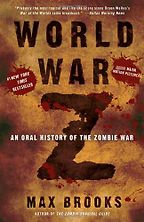
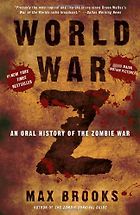
Yes. There’s a slow decline in your book—economically, and the increasing shrugging off of responsibility by the government. Shall we talk about World War Z: An Oral History of the Zombie War? I think this introduces us to a different sort of near-future dystopia, something a little more fantastical, although it’s played completely straight.
I’m going to say something stupid, because, yes, of course, it was a best-seller that was turned into a film starring Brad Pitt. So it’s hardly unknown. But when I started reading it I thought: why did nobody tell me how good this book is? Fundamentally, I think so many people think: ‘zombies are not for me.’ I’m one of them. But this book totally transcends that category.
The premise of the novel is that an agent of the United Nations Postwar Commission is compiling first person accounts—ten years after the event—of what was effectively another pandemic, a zombie pandemic that turned into a worldwide zombie war. The realism is extraordinary; it’s a wild feat of imagination. In all the other books I’ve recommended, you get a first-person narrator, or a defined cast of characters. The world-building in those books is already extremely impressive. But what’s so exceptional about World War Z is that it’s so incredibly diverse. The agent moves around the world, from China to Israel, speaking to characters of different countries from different social positions. Its geopolitics feels very accurate, and he imagines them with such complexity and density. It’s staggeringly well done.
It’s difficult to tell someone that a zombie book is ‘realistic’, but I know exactly what you mean. Some of what he suggested in World War Z feels quite similar to how real-life pandemic responses unfolded. Israel sealed its borders, for example. As, of course, did other countries. And there’s the race for a vaccine, seen through scientists’ eyes.
As I was saying before, dialogue is really hard to do. And this has perhaps sixty different voices. It’s polyphonic. Max Brooks is able to inhabit all these different characters. It’s an astounding piece of work. I feel quite evangelical about it.
In many ways, it doesn’t feel like a novel. It doesn’t really have a beginning, middle and end. You could read it over years if you wanted to.
Yes. I suppose that’s why the movie is necessarily a major departure from the book. The movie version is a thriller, with a plot to match. But those characters actually play only bit-parts in the original book. They feel like very separate cultural objects.
Entirely. The film is a kind of companion piece, a standalone drama with one or two stories from within the sprawling, richly imagined universe of the book. As a writer, I tip my hat to him. It’s mind boggling.
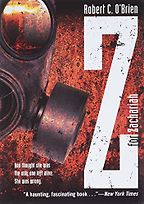
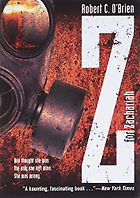
I think that brings us to your last near-future dystopia book recommendation, which is Z for Zachariah by Robert C O’Brien. It was completed by his wife and daughter posthumously.
So this was the book that kind of started it all for me. After I read it, I tied a rope to the radiator in my bedroom so I could escape out of the window, and I had a Karrimor rucksack ready to go at all times—
A bug-out bag!
Exactly. Except it had, like, a single pair of underwear and a can of beans in it. But there was this feeling that something might happen, and you need to be ready. I talked about that before—the teetering feeling of fear and hope and agency… catnip to a young teenager.
Z for Zachariah is an easy book to pitch. Nuclear war devastates everything, apart from the isolated valley where a teenage girl lives with her family. When her family leave to go and see what has happened in the local town, they do not come back, so she believes she’s now totally alone, maybe the last person on the planet. The book is written in the form of diary entries, and we join her as she watches a smoke trail get closer and closer over the landscape. As the smoke trail gets closer, she sees it’s a man in a hazmat suit. If A is for Adam, then Z is for Zachariah: this is the last man. And she’s, potentially, the last girl.
I started flicking through this book again just before we spoke and I felt like I wanted to be back in this world straight away. Often when you come to a book as a teenager, reading it again as an adult you can feel disappointed. But this is very well done. The sentences are simple, but it has this inevitability. It’s like a heartbeat getting faster. It’s a perfectly formed story with a real sense of pace and dread and fear. And, once again, it’s speaks to a broader sense of what it means to be alive. What does it mean to be the last person?
You said earlier that it’s quite similar to How I Live Now by Meg Rosoff, which you considered including in your list of five.
That book is very different in tone, but it’s similar in its brilliance, and that you have a female narrator in her teens. In How I Live Now, the narrator’s mum has died and her dad has sent her to England to stay with her cousins who are wild marauders who live in a large country house. War breaks out while she’s there. The interesting thing in this novel is that—unlike Ann in Z is for Zachariah who is quite self-contained and quite spartan throughout—the How I Live Now narrator has very teenage preoccupations and energy and spunk, and the war is happening at great remove from them until it suddenly intervenes.
As I was saying before, I think the best dystopias are really well-judged games of distraction. You’re not always told: this is what’s happening. It’s just happening around you. These two novels are really superb examples of something simultaneously calibrated to the YA audience, and the adult audience. And in the pared-down nature of the story—of it being one girl against these huge world events—something very illuminating and compelling happens. That’s what I’ve tried to do in my book too: there’s a 16-year-old narrator and it’s about her infinitely personal route through huge political and climatic events.
As a final question: do you think that people’s appetites for near-future dystopia books, or dystopic books in general, have changed over the pandemic period?
I think people have either leaned in or leaned out. Some people couldn’t think of anything they wanted to do less than watch something pandemic-related during the pandemic. But I was the opposite. I even watched Outbreak, which, frankly, is a terrible film. So I think it just depends.
Another thing about all these books is that they will be sure to satiate people who love dystopian novels, but I also think they are excellent enough to reel anyone in. Even those who ‘don’t do dystopia’. They are superb novels in and of themselves.
Interview by Cal Flyn, Deputy Editor
May 31, 2022. Updated: March 18, 2025
Five Books aims to keep its book recommendations and interviews up to date. If you are the interviewee and would like to update your choice of books (or even just what you say about them) please email us at [email protected]
Five Books interviews are expensive to produce. If you've enjoyed this interview, please support us by donating a small amount.