We’re looking at lesser-known works by great names of fantasy today. Why read the B-list?
Well, firstly, there is no magic guarantee that the best works fare best. You find gems by digging further. But also, for me, there’s a real delight in seeing what else came from the imagination of someone whose worlds you have lived inside – finding another story in their voice, familiar but different. They go from just being stories to being part of a person’s internal Lore, a whole imaginative web.
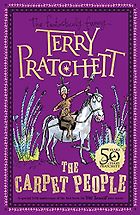
Your first choice is Terry Pratchett’s The Carpet People. Could you tell us about it?
This is Terry Pratchett’s first novel: astoundingly, he wrote it when he was seventeen. In the Author’s Note, Pratchett says of his younger self, “I thought fantasy was all battles and kings. Now I’m inclined to think that the real concerns of fantasy ought to be about not having battles, and doing without kings.” So when this book was reprinted after the success of Discworld, he did some re-writing – opening his Note with the intriguing announcement, “This book had two authors, and they were both the same person.”
Can you tell?
I don’t think so. It would be interesting to compare it with the original. This version is very Pratchett and really charming.
The central conceit is that a whole civilisation lives in the carpet. The people are miniscule: for a sense of scale, a one penny piece has formed a vast unscalable bronze edifice from which they mine all the metal used in the world. Great hairs grow everywhere, a part of their world as natural as trees, and fluff forms the other major landscape feature. Geography is defined by furnishings and changes in the carpet. If you have a patterned carpet to stare at, this book will stick with you.
Within this world, there are multiple peoples. Most are part of something very like the Roman Empire. Some others are loveable non-conformists. Some are very unlovable non-conformists, and they are the enemy to be battled. And there’s a wise elder race who see the future, although in true Pratchett fashion, this group are also gently mocked.
It’s still a story of battle and empire, then?
Loosely, yes. Don’t expect any great tactical shenanigans, though. It’s mostly a jaunt through the carpet with some fun characters, enjoying the invention of the world along the way. And a chance to see where it all began for Pratchett.
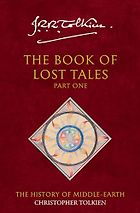
Well, speaking of where things all began, let’s talk about your second choice… There’s some early work in Tolkien’s The Book of Lost Tales: A History of Middle-earth, is that right?
Yes. The Book of Lost Tales itself is a work that Tolkien began in 1916-17, aged twenty-five, and is the first narrative work on the history of Valinor and Middle-earth. However, the subtitle – “A History of Middle-earth” – applies to a larger book series that also reproduces other work from throughout his life. The Book of Lost Tales takes up the first two volumes, but there’s more beyond that to explore.
The editor is his son Christopher Tolkien, and there couldn’t be a better guide to the texts. In his forward, he discusses the process behind The Silmarillion, where he needed to make choices between inconsistent and messy extant texts to bring everything into a single coherent narrative. In this series, he presents pieces as they were left, without making editorial choices. It’s one for real Tolkien fans who would like to get in the weeds of his lifetime’s creation themselves.
So is the reader left alone to make sense of them?
No, there’s always a commentary essay, but it comes after the text. Linguistic comments and changes to names are dealt with in annexes. The idea is that you can get at the text itself without interruption if you want, and also follow Christopher Tolkien’s editorial insights.
A treasure trove. Let’s turn to your third choice…
Another Inkling.
Ah, yes. Could you explain the Inklings for anyone who doesn’t know?
Yes, sure. The Inklings were a group of writers in Oxford who met to read and critique each other’s work – the Eagle and Child pub claims them particularly. The most famous members were Tolkien and C. S. Lewis.
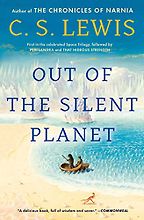
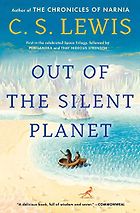
And it’s C. S. Lewis up next, with Out of the Silent Planet.
Yes. This is the first in the Space Trilogy, and as implied by both titles, this is technically Lewis trying his hand at sci fi. But it reads like fantasy. There is something mythic and luscious about his version of Mars, which is not Mars in any meaningful sense at all. We might as well have gone through a wardrobe.
Dr. Elwin Ransome is kidnapped and sent to Mars against his will. In keeping with elements of his fantasy, Lewis does not seem to think highly of those who want to cross worlds – Ransome’s kidnappers in this case. They are up to no good, out to line their pockets with limited respect for the life forms of Mars. Ransome, meanwhile, becomes engaged in a quest-like story to meet a great power on the planet.
So it feels like fantasy structurally, as well as in the world-building?
The fantasy feel strikes you immediately when you read it, and you don’t have to dig very far to confirm that it was very much Lewis’ intention; he wrote to one Roger Lancelyn Green, “I like the whole interplanetary ideas as a mythology,” and recommended Voyage to Arcturus by David Lindsay in the same letter as being “entirely on the imaginative and not at all on the scientific wing.” To Ruth Pitter, he wrote, “From [Voyage to Arcturus] I first learned what other planets in fiction are really good for: for spiritual adventures. Only they can satisfy the craving which sends our imaginations off the earth. Or putting it another way, in him I first saw the terrific results produced by the union of two kinds of fiction hitherto kept apart: the Novalis, G. Macdonald, James Stephens sort and the H. G. Wells, Jules Verne sort.” (Although, I should add, he abhorred the actual content of Lindsay’s philosophy).
His aim, then, is to move you, myth-style, and I think he has a fair amount of success. It’s beautiful in places, and also interesting to realise he was writing against the implicit morality he saw in much other space exploration writing.
Also, while we’re digging into the origins – Dr Ransome is a philologist and uses his specialism to learn the aliens’ language. There are definite shades of Tolkien there… We’re back at the Inklings again.
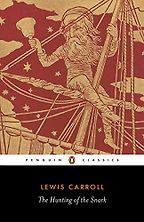
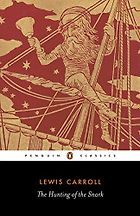
Let’s look at your fourth choice: Lewis Carroll’s nonsense narrative poem, The Hunting of the Snark.
This one’s only brief – you might want to consider a complete Carroll if you’re looking for a version to have on your bookshelf. But for me, the Snark is the standout of his non-Alice pieces.
I think you either like nonsense poetry or you don’t. For me, the poems were the best part of the Alice books. I can still recite all of The Jabberwocky by heart; The Mad Gardener’s Song is a family favourite; if I’m feeling indecisive, I sometimes hear myself think, “Will you, won’t you, will you, won’t you, will you join the dance?” And The Hunting of the Snark has that same sticky quality.
What can I tell you about the story? They’re hunting a Snark. ‘They’ being a baffling crew, particularly starring the bellman, a beaver, and a butcher with a special talent for beaver-butchering. And if you want to know how well the hunt is going, or what a snark is, this is not the poem for you.
Those questions are not nonsensical enough?
Exactly. Although in my view, Carroll is a master because he makes just enough sense. Meaningful things seem to be happening all the time – you just wouldn’t want anyone to quiz you on them afterwards.
I could have put Mervyn Peak’s nonsense poems in this spot – A Book of Nonsense, or the posthumous and comprehensive Complete Nonsense. These are fun, and Gormenghast fans might appreciate that Complete Nonsense offers some intertextual interest. But it’s Carroll’s poems that still rattle around my head days after reading them. I think he’s the front-runner.
If you read Snark, you will ever have these comforting words to recite in times of striving: “You may seek it with thimbles—and seek it with care; You may hunt it with forks and hope; You may threaten its life with a railway-share; You may charm it with smiles and soap.”
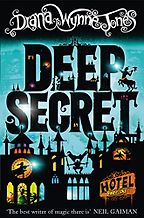
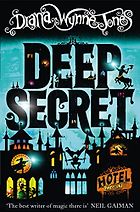
Words to live by. We’ve come to your last choice. Tell us about Deep Secret, by Diana Wynne Jones.
Yes. Exciting news for those of us who grew up on Wynne Jones: she wrote the occasional book for adults. And while her children’s books often have that ageless quality, it’s fun to see her in a specifically adult vein. It feels like meeting up with an old friend from school who has bafflingly become a grown-up in the intervening years.
Her life as a fantasy writer clearly infuses Deep Secret, adding to the feeling that you are on some level hanging out with real adult Diana: it is all set at a science fiction convention. One of our two narrators, Rupert Venables, is seeking out a new senior magid among the attendees, who are innocently going about their convention business. I like to imagine she started this in a convention hotel room…
So is this a little less fantastical than her younger fare?
Oh, not at all. The magic is very on brand. We’re in a magical multiverse. It contains Ayeward worlds and Nayward worlds, which can be crossed magically but at great peril. As ever with Wynne Jones, the workings for this feel both practical and under-explained – as though we are seeing them through the eyes of somebody down-to-earth, with no interest in constantly asking why things work.
There’s a second narrator, a convention attendee, which leads to some fun twisty storytelling. Wynne Jones’s other dual-narrative novel is The Merlin Conspiracy, which is back to her usual junior fiction – but it is, in fact, technically a sequel to Deep Secret. So for anyone who read Merlin when they were young, there’s an added appeal.
Five Books aims to keep its book recommendations and interviews up to date. If you are the interviewee and would like to update your choice of books (or even just what you say about them) please email us at [email protected]
Five Books interviews are expensive to produce. If you've enjoyed this interview, please support us by donating a small amount.