What was the Reformation?
That’s something that has changed a lot over time, and it’s probably become a more complicated question than it used to be. You could almost say that the Reformation used to be an event, and it’s now become a process—and a process of very long duration.
Even half a century ago, the Reformation was pretty straightforwardly something which happened in the mid-16th century and started with Martin Luther. It was primarily an event in Protestant church history. I think it’s also fair to say that it was overwhelmingly seen—in the language of 1066 and All That—as a Good Thing: the replacement of an inferior or even bad form of Christianity with a better one, and the start of a process of change leading to modernity and the world we know today.
A lot of that has changed. There are now quite a lot of scholars who don’t think we should even talk about ‘the’ Reformation with the definite article at all, and prefer the looser idea of ‘Reformations’ in the plural. I’m a little resistant to that, probably because I’ve been describing myself as a Reformation historian for many years. One of the authors that we’re going to be talking about, John Bossy, says that something important happened to Western Christianity in the 16th century, and the word ‘Reformation’ is as good a guide as any to helping us investigate what that was. I think that’s a helpful way to approach it.
“I often say to my students that one of the really important things you have to remember about Martin Luther is that he was not a Protestant. He was a late medieval Catholic”
What there’s no doubt about is that not just in the brief moment in the mid-16th century coinciding with the life of Martin Luther and his meteoric successes, but over a rather longer period through the 16th and 17th century, there were dramatic changes in many aspects of European life, in politics and society and in culture. Many of those are bound up in important ways with changes in the doctrine and the organisation of the church, and the split of what had been a much more culturally united Europe into rival confessional camps. That was principally into Catholic and Protestant, but within the Protestant world there were splinters as well. The creation of a more complex and plural Europe is clearly what comes out of the Reformation.
It’s perhaps not fair to ask this given how you just explained it, but why did it start in Germany?
It’s an absolutely fair question, and there are straightforward answers. Germany was a relatively urban and very politically fragmented society. There were a lot of printing presses that were fairly free of direct external control.
On the other hand, sometimes the cock-up theory of history is the most persuasive. It’s like asking why, four centuries later, the Communist revolution started in Russia, which seems a rather unlikely place for it to happen. If you are looking for areas of Europe where there appears to have been deep dissatisfaction with mediaeval Catholicism, Germany might well be one of the last places you would look. There isn’t really a native heresy movement in Germany—as there is, say, in Bohemia. It’s an orthodox society, and it looks to us now like a society where forms of traditional piety, pilgrimages, veneration of the saints, and devotions to the Mass were absolutely thriving.
“It’s been semi-jokingly said that the Reformation is a bitter, 200-year-long dispute about the exact meaning of each of those four words: this, is, my, and body. People were literally put to death for having the wrong views on that”
But here, I think, we may be coming to the crux of one of the really important ways in which our understanding of the Reformation has changed. We used to think of the Reformation as a reaction against, a rejection, a turning away from mediaeval Catholicism. In a sense, that’s true. But when you think about how things actually change and evolve and develop and appear over time, that doesn’t make a great deal of sense. I often say to my own students that one of the really important things you have to remember about Martin Luther is that he was not a Protestant. He was a late mediaeval Catholic.
The Reformation is really an aspect of late mediaeval Christianity and had deep roots in Catholic culture. It grew not necessarily out of dissatisfaction or rejection or anticlericalism or hostility to the institution of the church (though some of that is important) but out of some of the main devotional trends of mediaeval Christianity itself.
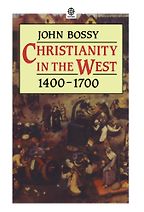
Let’s explore those themes in more detail as we go through the books you’ve chosen. The first one on your list you’ve already alluded to, John Bossy’s Christianity in the West 1400-1700 (1985).
In some ways, perhaps, this is a self-indulgent choice. The book has simply been a great favourite of mine for a long time. My own copy was bought hot off the press in 1985 as a 20-year-old undergraduate, and is covered in rather shocking bright green felt-tip underlinings. It was a book that completely changed the way I thought about the history of religion. A subject that had seemed rather dry was revealed as really exciting.
One thing I would say is that it’s a very deceptive book. Perhaps I was deceived when I originally bought it, because it looks like a student-friendly textbook. It’s less than 200 pages long, nice big print, hardly any footnotes, a brief bibliography at the end, and a title which is deceptively straightforward as well, Christianity in the West. So it looks like a primer, things you need to know.
In fact, it’s an extremely daring and iconoclastic book that ranges extraordinarily widely. Some of its claims are perhaps exaggerated, or we might think differently about them, as Bossy himself came to. But the kind of book that makes you think differently about an entire field is very rare and is absolutely to be treasured.
“In the Middle Ages, Christianity or ‘the Christianity’ signifies a body of people. By the time we get to the end of this process in the later 17th century, Christianity has become an ‘ism.’ It has become a body of doctrine”
In some ways, it’s a difficult book to describe because it’s so rich, and almost every sentence carries an important thesis. The argument is that Christianity in Western Europe is profoundly transformed over the course of the 16th and 17th centuries, not just as a result of the theology of Martin Luther, but as part of a much wider process of religious, cultural, political transformation, in which the Protestant Reformation and what we used to call the Counter-Reformation—and now tends to be called the Catholic Reformation—are not only rivals but are also, in many ways, working in parallel to transform people’s experience of Christianity.
That’s a really important development that other scholars have picked up over the past few decades as well. The Reformation is not the same thing as the Protestant Reformation, and indeed, if it were, it would be a less significant phenomenon, because only the northern third of Western Europe, in the end, really settled for Protestantism. Catholicism remains the majority faith. In John Bossy’s view, the Catholic Reformation is just as transformative of Christianity as the Protestant one.
John, who died in 2015, was a very elusive and subtle writer who used powerful metaphors. One of these is what he calls ‘moral arithmetic.’ The ordering principle of Christian morality shifts, over time, from being focused primarily on the seven deadly sins towards being fixed much more heavily on the Ten Commandments.
That sounds very obscure, but it supplies an insight into a broader process. In Bossy’s view, Christianity had, originally, been a means of ordering social relations. It was profoundly communitarian and collective, and was concerned with the seven deadly sins because they involved things like anger and envy that were socially disruptive. Christianity was a way of managing these social conflicts.
But towards the end of the Middles Ages, it started to become much more internalised, much more doctrinal. The thou-shalt-nots of the Ten Commandments are very much more about a Christian’s interior life, about their relationship directly with God, rather than with their neighbour. So it’s a profound set of not just spiritual but also political and cultural transformations that, in a sense, are summed up in that deceptively simple title, Christianity in the West.
Bossy is extraordinarily interested in the meaning of words, crucial terms like ‘charity’ or even ‘religion,’ which radically change their meanings over time. The key one, perhaps, is in the title: ‘Christianity.’ In the Middle Ages, Christianity or ‘the Christianity’ signifies a body of people. By the time we get to the end of this process in the later 17th century, Christianity has become an ‘ism.’ It has become a body of doctrine.
Still, the fact is that the Reformation led to religious wars between Catholics and Protestants across Europe—so the differences between the two can’t have been entirely negligible. People at the time certainly didn’t think so. What were the differences between Catholics and Protestants post-Reformation?
That’s an important question, and I think you’re absolutely right that some of the recent scholarship—and Bossy is not entirely free of this—that has seen the Reformation primarily as a process of social disciplining of populations and greater political centralization and cultural uniformity, has been tempted to iron out the differences. Of course, as a historian, it really is the differences that should interest us, because this was what was most important to people of the time.
There are many great doctrinal debates in the Reformation, aspects of which can seem strange—if not almost incomprehensible—to modern people. Perhaps the greatest one is what on earth Jesus meant when, at the Last Supper, he said, ‘This is my body,’ and then exhorted his disciples to ‘Do this in memory of me.’ It’s been semi-jokingly said that the Reformation is a bitter, 200-year-long dispute about the exact meaning of each of those four words: this, is, my, and body. People were literally put to death for having the wrong views on that.
The temptation is to say, ‘Oh my goodness. These ridiculous, barbaric people of the past. Thank goodness we’ve got over that!’ I think that is a dereliction of duty. One of the things I think all my chosen authors share is a willingness to seek to understand it rather than just dismiss it, and to enter imaginatively into that world which is, in some ways, like ours, but, in other ways, very different from it.
Yes, because as I think you say in one of your books, it looks like minor differences to us, but, for them, eternal salvation was at stake.
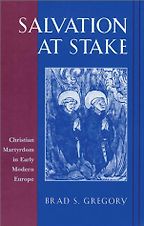
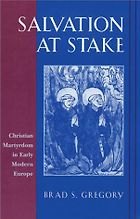
Absolutely. And that’s probably an opportunity to start talking about another of the books on the list, which is Brad Gregory’s book—with the perhaps slightly questionable pun in the title, Salvation at Stake (1999).
This is a very interesting and important book talking about the aspect of Reformation-era Christianity which is guaranteed to make modern people—and perhaps especially modern Christians—uncomfortable, which is the intolerance and the violence.
It’s a very, very grisly period. How many people died?
We don’t know exact numbers, but certainly more than 5,000 people were judicially sentenced to death for their religious beliefs. That’s not to mention the many thousands of others who were slain in religious conflicts or wars with a strong religious underpinning. Gregory, of course, does not endorse any of this, but he says that we have to take it seriously. This book was published in 1999, but I believe that post-2001, there’s an imperative to take it more seriously still. That provocative and challenging and difficult word, ‘martyrdom,’ has been in the news a lot.
“In earlier centuries, each religious tradition had rather celebrated its own martyrs and ignored the others”
So the subject of Gregory’s book is the phenomenon of martyrdom, of Christians who were put to death for their beliefs. That has always been an important feature of the scholarship. What strikes me as important and original about this book is that it attempts to look comparatively across the whole range of martyrs.
In earlier centuries, each religious tradition had rather celebrated its own martyrs and ignored the others. And people who died who didn’t have direct modern institutional successors tended to get rather neglected. Although an awful lot of our historical memory is of the mainstream Catholic and Protestant martyrs—the priests of England or Holland who were hanged or the Protestants who were burned in Mary’s reign—actually, the great majority of those who were put to death in this period were neither Catholics nor Protestants. They were that variety of really radical or spiritualist Christians who we lump together under the heading of ‘Anabaptist.’ Their ideas were equally offensive to the mainstream authorities in Protestant and Catholic territories.
Arguing about things that, today, we probably couldn’t even tell the difference between.
They’re arguing about things like the precise nature of the relationship between God the Father and God the Son, and the sort of flesh that Christ may have taken from his human mother or not. So, yes, things that clearly seem less important to us but come out of a profound reflection on Christian revelation. In the case of most of these radical Anabaptists, it comes from a reading of the Bible, which the Reformation had made more widely available in the—perhaps naïve—belief on the part of people like Luther that the meaning of the Bible was absolutely clear and straightforward and that no right-minded person could possibly divert from the authorised view of it. But, of course, once the Bible comes into the hands of ordinary people, really searching questions are asked about major Christian doctrines like the Trinity, which doesn’t appear in a very developed form in Scripture.
One of the things that this phenomenon and Gregory’s account of it puts to rest is the very pervasive idea that doctrine was just a matter for the clergy and intellectuals and the universities. Ordinary people just weren’t interested, got on with their lives, and did what they were told if they thought about it at all. That may be true of some, but there is a lot of evidence from across Europe that really humble people, without formal education, took the business of their salvation, of what God expected from them, remarkably seriously, to the point at which they were willing to die for it.
“One of the most important points about the Reformation is that although all sides are totalitarian and intolerant, no side was able to triumph completely and to totally eradicate its opposition. Not even the Spanish Inquisition was able to do that”
The willingness to die, of course, is only one aspect of martyrdom. As modern people, we can understand it, to some extent, though we might not want to do it ourselves. The other aspect is the willingness to kill. That’s more challenging. It goes against every modern assumption about the uncertain or relative nature of truth and the mutual obligations and duties within a liberal, civil society.
And, here, we do confront something about the Reformation, about why it is such an extraordinarily interesting and indeed violent period—because any notion of a relative or divisible truth is simply not there. There can only be one revelation, one true religion. For a couple of hundred years, you have this extraordinarily uncomfortable position where that is a universally shared assumption, but the reality on the ground is that unity and agreement about what that true religion was has completely broken down.
Here we can move away from the idea that these are just very arcane or irrelevant doctrinal questions, because early modern people were convinced that the health and coherent functioning of a society were absolutely dependent on unity in faith. People who challenged that were also challenging the basic ability of society to work and stick together. The radicals known as Anabaptists were particularly offensive on that score, because their reading of Scripture led them to believe, for example, that it was impermissible to take oaths. Not taking oaths means that you can’t take up civic office or serve on a jury. They also refused to undertake military service. So really quite fundamental political and social issues are tied up with their reading of the demands of Scripture.
One of the things I admire about Gregory’s book—and I think what it shares with Bossy and indeed with all the books on my list—is that it’s daring and provocative. Not necessarily in a polemical way—picking out particular earlier interpretations to attack, which is the game that historians usually play—but making us think, to use a cliché, outside the box.
Gregory’s particular bête noire is what he sees as reductionist approaches to the history of religion and to an apparently strange phenomenon like the willingness to die or the willingness to kill. In the hands of some modern scholars, it seems to require that we translate this into terms that are more explicable to us. They may be talking about the doctrine of the Eucharist, but really there are other agendas at work—psychological, political, economic—for which this is merely a cover.
That sort of approach has its roots in a classic, Marxist approach in which economic forces are everything and culture and ideology just a sort of icing on the cake. But it is also very prevalent in more recent, postmodern theories which are very concerned with hidden structures of power.
Gregory is saying something deceptively simple, which I have great sympathy with: We have to take these people at their word, even though we don’t necessarily share or empathise with or admire these beliefs. We have to accept that they were very serious about them and willing both to die and to kill for them.
In the end, part of the paradox of this intolerant world that he’s painting is that out of it grows a world which is much more recognisable to us. One of the most important points about the Reformation is that although all sides are totalitarian and intolerant, no side was able to triumph completely and to totally eradicate its opposition. Not even the Spanish Inquisition was able to do that.
So out of the Religious Wars of the early modern period comes a kind of truce, a very reluctant recognition that actually toleration, if not tolerance—those are slightly different things—of opposing viewpoints had to be accepted within societies for the sake of social peace. And although it’s far too simple to say that this leads very quickly or straightforwardly to secularisation, it does, nonetheless, lead to a relocating of religion out of the public sphere—and away from the essential symbolism and identity of the state—into a more social and private sphere.
For a long time, into very modern times really, rival religious groups reluctantly lived alongside each other, disliking each other to varying extents—but they stopped killing each other.
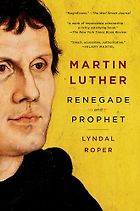
Let’s talk about Lyndal Roper’s Martin Luther biography now, because Luther is such a key figure. Who was he, and how does he fit into the story?
The reason people around the world—and particularly in Germany—are talking about the Reformation in 2017 is that it’s 500 years since Martin Luther posted his Ninety-five Theses attacking indulgences to the door of the Castle Church in Wittenberg. It’s a moment that we can commemorate, and it’s conventionally seen as the start of the Reformation. One could have a long argument about whether it is actually useful to think of it as the ‘start’ of the Reformation, or if the Reformation as a longer process of social, cultural and political transformation goes back some centuries beyond Luther.
Nonetheless, Luther is hugely important to this story. You can pose the counterfactual question, ‘Would there have been a Reformation without Martin Luther? The answer to that is, ‘Who knows?’ But, without Martin Luther, it would certainly have been a different kind of Reformation. He clearly is a very important figure.
He was a monk. What was he angry about?
At the risk of sounding pedantic, he was actually a friar. Like monks, friars are part of religious communities, but they had more pastoral functions. They were more likely to be preaching, hearing confessions and engaged with the outside world. In Luther’s case, that’s important—because he turns out to be such a brilliant communicator and preacher and writer. He’s not a completely cloistered figure.
Luther’s own personal story is an extraordinarily interesting one, which we don’t know as much about as we would like. Luther tells us quite a lot about his own life but in fragments revealed over many decades, which are not always consistent with each other.
What is clear is that Luther’s decision to become a friar is, itself, an act of rebellion. His family originally came from peasant stock, but by his generation was rather well-to-do. His father was an entrepreneur with a mining business in the eastern part of Germany known as Saxony. Luther is brought up in the mining town of Mansfeld at the beginning of the 16th century, and his father wanted his clever son to become a lawyer.
Luther defies his father and enters the church instead. He tells us this is as a result of a vow made to St. Anne, the mother of the Virgin Mary, during a terrifying thunderstorm—that if she saves his life then he will devote himself to God. That may well be true, but may also be an embroidered story used to justify this rebellion.
Luther tries hard to be a good friar, but it leads him into spiritual crisis. Luther is, I suppose, confronting the question all medieval Christians faced, which is ‘What do I need to do to be saved?’ There were answers to that—obey the teaching of the Church, be open to receiving God’s grace through the sacraments.
There was a rather touching motto among mediaeval theologians: ‘Facere quod in se est’ or ‘Do what lies within you.’ If you try your best to be a good Christian, that will be enough for God. God doesn’t demand from people more than they can actually give.
But this makes no sense to Luther. He becomes convinced of his own intrinsic sinfulness and unworthiness, even though, as far as we can tell, he was a good, pious and celibate friar. He becomes obsessed with the problem of righteousness or justification, what he needs to do to be acceptable in the eyes of God. He tries all the remedies that the Church suggests—frequent confession, charitable good works of various kinds—but cannot understand how God could possibly be willing to save someone as wretched and sinful as him.
And I suppose it was one of those coincidence moments, this extraordinary conjunction in Western Christianity of the internal spiritual crisis of an obscure friar in an obscure town in eastern Germany, with what becomes a very public debate about indulgences.
This probably isn’t the occasion to talk everybody through the complicated theology of indulgences. It was one aspect of the Church’s teaching on sin and penance which had, to some extent, been corrupted or monetized by the papacy and other institutional forces. The impression that was being received—not just by Luther but by a whole number of reputable theologians and preachers—is that the real moral demands on the Christian of penance were being undermined by what seemed like a ‘cheap’ offer of grace and forgiveness.
Basically, you could give the Church a bit of money in exchange for a place in heaven.
Inevitably it’s more complicated than that, but that’s certainly part of the perception. It’s actually not as a Protestant dissident, but as a serious-minded Catholic theologian that Luther takes up this quarrel. Although 1517 is seen as this great moment of revolution—and countless books will tell us this is when the Protestant Reformation started and Luther raises the standard of rebellion against Rome—that’s a fundamentally retrospective view.
In 1517, Luther is not denying the authority of the papacy. He is not denying the existence of purgatory, which later Protestants—including eventually himself—do come to reject. He’s not even rejecting the value of indulgences themselves.
He is objecting to the way that they’re being presented and preached in Germany. And although the tone is certainly combative, there is nothing at that moment which makes it look like a split in the church is inevitable or even likely.
In fact, although I’m in the camp that thinks that Luther didn’t post the Ninety-five Theses to the church door, even if he had, it wouldn’t have been a particularly revolutionary act. Theses were propositions for a public, academic debate and in a medieval university that was where you advertised them. The door of the Castle Church is basically the university notice board for the University of Wittenberg.
It’s through a whole series of lenses of hindsight that this comes to seem as a radical moment.
Of all the biographies of Luther, why did you choose this one?
Not just because it’s one of the more recent, nor because it’s by a woman, though that’s not irrelevant. Nearly all the serious English language biographies of Luther have been written by men. Many of them have also been inside accounts written by people who are themselves Lutherans or Protestants, or at least very politically or culturally sensitive to that point of view.
Lyndal Roper is a wonderful historian. She is Regius Professor of History here in Oxford and is not, so far as I understand, a Lutheran or a practising Christian. She is a self-declared feminist historian and an Australian. It’s an outsider’s view and properly critical, but also takes that imaginative leap and empathises with this strange world. It would be very easy to do a hatchet job on Luther from a modern, liberal outlook. Lyndal Roper does not do that.
It’s a very rounded, complex and fascinating portrait of Luther, who Roper herself says is a difficult hero. There are things in Luther that are very hard to get around for modern people. Certainly a strain of misogyny, which was pretty much par for the course in the early modern period. In fact, for a feminist historian, Roper makes rather less of that than one might expect.
Doesn’t she say she wants to focus on his inner development?
Yes. It had become almost an article of faith among historians that the last thing we should try and do is psychoanalyse or ‘get inside’ our subjects. An earlier biography of Luther from the late 1950s called Young Man Luther—by an American psychoanalyst called Erik Erikson—was a very Freudian reading of Luther’s development. It almost became a byword for how not to do a biography.
Roper is not afraid to try to get inside the mind of her subject. It’s bold, daring and imaginative. There are aspects of it we might not always agree with, but it’s exciting to see a historian use modern insights from psychology to understand a subject, and set them in their context. Roper takes very seriously the social, the cultural, and indeed the doctrinal context of Luther, although she is looking to understand Luther’s own psychological drives and his relationship with his father—the overbearing mine owner.
“The fall of the Berlin Wall and the reunification of Germany has had a real impact on Reformation scholarship”
The other thing that is interesting and important about Roper’s biography of Luther—which perhaps could not have been written 30 years ago—is that it doesn’t see Luther in the way that a number of earlier biographies had, as a kind of man for all ages, a lone hero, almost existing outside of time and place. It locates Luther. It locates him physically in those small towns in eastern Germany where he was brought up, and in the small university town of Wittenberg where he spent his entire career, first as a Catholic friar and then later as an evangelical, to use a slightly anachronistic word—a Protestant preacher and a minister. Interestingly, he lived in the same building throughout. The former Augustinian monastery is gifted to Luther and Mrs. Luther by the Elector of Saxony.
Before 1990, all of this was in the German Democratic Republic, a place where it was hard for historians to gain access to the archives. The fall of the Berlin Wall and the reunification of Germany has had a real impact on Reformation scholarship. It enabled Roper to locate Luther within that social context, and a whole web of relationships with friends and enemies. The enemies are, in some ways, as important as, or more important than, the friends.
Roper gets us round the paradox of Luther, which is that in 1517 he was really just a somewhat earnest Catholic friar protesting against abuses within the system and seeking to reform it—but in no way looking to tear up the entire book. How do we get, within a few years, to an open schism? Why did Luther’s theology radicalise so quickly? A lot of that is down to the way that he is energised by opposition. And Roper, I think, is very good at tracing how that works. Luther has really quite an extraordinary capacity for both friendship and hatred, and often people who had been friends become bitter rivals.
At the heart of the book is a rather sad story of the relationship between Luther and his former disciple and friend Andreas Von Karlstadt, who starts taking a politically more radical line than Luther’s. Luther sees this not only as a deviation from God’s word as he understands it, but as a personal betrayal.
His hatred for Karlstadt was even important for doctrinal questions. For example, Luther retains, in his version of the German communion service, the lifting up of the bread after its blessing. Nearly all Protestants were very uneasy about that because they thought that it would encourage worshipping of the bread, an ‘idolatrous’ practice that mediaeval Catholics had indulged in. But Luther retained it—principally because Karlstadt removed it. Only when Karlstadt is dead does Luther take that extra step himself.
I think Roper uses the word ‘stubborn.’
He’s extraordinarily stubborn. At one point she writes about his utter inability to see other people’s point of view, which makes him, in some ways, unattractive from a modern perspective. On the other hand, somebody who always does see other people’s point of view, who is by instinct a conciliator or a collaborator—like Luther’s younger friend and colleague Philip Melanchthon—could not have achieved what Luther achieved. This is where the stubbornness becomes more admirable. Who the hell does Luther think he is? He’s somebody who believes he’s right and has God’s word on his side.
After the posting of the Ninety-five Theses, the most famous moment in Luther’s career comes in April 1521 when he stands up at the Diet of Worms, the parliament of the Holy Roman Empire, in front of the most powerful man in the world, the Emperor Charles V, and the assembled princes and ecclesiastics of Germany. He is ordered to retract his writings and admit that he was wrong. Absolutely knowing that his life might be forfeit as a consequence, he gives this tremendous speech in which he may or may not have said ‘Here I stand. I can do no other.’ He does say that his conscience is captive to the word of God, and that it is not safe or right to act against one’s conscience.
There we recognise something modern and admirable in Luther—this sense of the sovereignty of an individual conscience. Perhaps less familiar to us is the idea that you can’t just believe whatever you like—your conscience needs to be captive to the word of God and not all consciences are equally valid. Nonetheless, the heroism that drives Luther to take on the most powerful forces in the world of his time is still admirable.
Another of Luther’s less attractive traits is his virulent anti-Semitism. This is something that a number of other Luther biographers have not necessarily sought to ignore or explain away, but the line has been that, ‘of course this is terrible, but he’s conventionally anti-Semitic in the way 16th century people were.’
Roper suggests, I think rather convincingly, that Luther’s hatred of the Jews goes beyond what was normal, even in the 16th century. Central to his religious identity is the idea that the Jews are standing in the way of the gospel movement, the evangelicals or Protestants being the new chosen people of God.
Luther is famous for writing what appears to be a rather tolerant and friendly pamphlet in 1523 with the title “That Jesus Christ Was Born a Jew”—in other words, recognising a kinship with the Jews. What Roper brings out is that, basically, Luther was offering the Jews a once-in-a-millennium opportunity to convert. His offer of friendship to the Jews is entirely conditional, and when it’s rebuffed, he reacts with that sense of hostility and betrayal that one sees in other aspects of his career.
If it was opposition that energized Luther, if the Pope at that time had said, ‘Oh, this Martin Luther guy is making some good points. Let’s take them on board,’ would the Reformation not have happened?
There are certainly scholars who think that. As I said earlier, I don’t think Luther publically posted his theses on October 31, 1517. But what we know for a fact is that, on that day, he wrote to his ecclesiastical superior, the Archbishop of Mainz. He says—in respectful but robust terms—that these indulgences are being preached in a terrible, commercialised, crude way. He requests that the archbishop do something about it but that he will hold off from opening a public debate.
Had Archbishop Albrecht of Mainz, or the other German Catholic bishops, reined it in, then it’s certainly conceivable that the furore that we have in Germany in the 1520s would not have taken that form.
Of course, this is extraordinarily hypothetical. Luther is a pious Catholic friar. Archbishop Albrecht is a career politician. His sense of religious vocation is probably a little bit underdeveloped, to put it mildly. He got the archbishopric at the age of 24. He’s the youngest son of one of the great German noble families.
I’m not sure there’s a realistic scenario in which all the great vested interests—ecclesiastical and economic—could have reformed indulgence selling in 1517. It’s tied up with all kinds of political and commercial interests, including huge debts that Archbishop Albrecht has to the Fugger Bank of Augsburg.
It’s a nice fantasy and often indeed a Catholic fantasy that Luther was potentially a great Catholic reformer. There’s been a stream of biographies—including a very recent one by the Catholic journalist Peter Stanford—saying that this is the great tragedy of the Reformation. It certainly has some merit, but I think it may be idealistic to imagine a scenario in which everybody would have jumped to it at that moment.
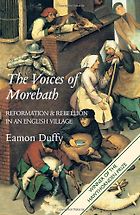
Let’s go on to Eamon Duffy’s The Voices of Morebath. This sounds fascinating. It’s about a village in Devon that has just one vicar from 1520 right through to 1574? Is that possible?
Here we’ve moved from the best-known aspect of the Reformation to the obscure, offshore island of England. It’s not about great events or great individuals. Duffy is best known for writing an important global view of the Reformation in England, The Stripping of the Altars, which appeared in 1992 and tells the whole story of the English Reformation in the 16th century as one of the imposition of Protestant reform and the destruction of a thriving religious culture.
I’m a huge fan of Stripping of the Altars, but I decided to choose the Morebath book because, in some ways, I think it’s more interesting. The story, briefly, is that this is a small, rural parish on the edge of Exmoor in North Devon. It’s not a wealthy or important or significant place on the way to anywhere, but we know about it because of the chance survival of its so-called ‘church book.’ This is what is often called elsewhere ‘the churchwarden’s accounts’—records of expenditure and income for the parish. Potentially rather dry sources, really.
What makes them very interesting here is that the accounts were kept by the vicar, a man called Sir Christopher Trychay. It’s probably important to explain straightaway that in mediaeval England, ‘Sir’ is the normal form of address for a priest who does not have an advanced university degree. They are not knights, but ordinary parish priests.
“It’s a kind of tragic story in that an unexpected event from outside—there doesn’t seem to have been any kind of native Protestantism in Morebath—hits this community almost like a meteor from outer space”
Sir Christopher himself keeps the accounts and writes in his own comments at various times over the course of a very long tenure—over 50 years—as vicar of this one parish. It’s a kind of microhistory—which is a jargon term historians use for zooming in on one particular place or one particular episode—but not a typical one. Although other historians have written histories of villages, they’ve tended only to do that when there’s been a whole range of different documents: tax records, lots of wills, all kinds of sources which can be put together to really flesh out the whole functioning of a community. There are other sources of evidence for Morebath, but in the end, it really comes down to this one source. In some ways, Eamon Duffy’s book is a virtuoso exercise in how a historian with the right reserves of imagination—and Duffy is one of the most imaginative historians of the Reformation working today—can wring meaning from a source like that and make it sing.
Although Morebath is a pretty unexceptional place, it would be wrong to say that it is ‘typical’ and tells us about how the Reformation was experienced elsewhere. Sometimes, we need to recognise that the search for typicality, for the global picture, is actually a misconceived one, and that where we have insight into individual lives that were lived, it’s part of our responsibility to the past and to the people of the past to try and enter those lives and imaginatively reconstruct them.
Can you give an example you like from the book?
It’s full of them. It gives us a wonderful insight into the character of Sir Christopher himself, who’s clearly a rather pedantic, fussy sort of figure, often chiding the parishioners for not coming up with the full dues that they’re supposed to be providing. Although Duffy is sometimes criticised for having a rose-tinted view of mediaeval Christianity, that’s a bit unfair. He absolutely recognises that Morebath is not a rural idyll. There are tensions and Sir Christopher does not always see eye-to-eye with his parishioners.
He is, nonetheless, a devoted and dutiful priest who takes his obligations to the smooth running of the parish seriously. And it might have been an unexceptional life except for the fact that his tenure of this parish coincides with the extraordinary revolution of the English Reformation, beginning in Henry VIII’s reign but then entering a much more radical phase under Henry’s son Edward VI.
There is a tragic element to this. One of Sir Christopher’s pet projects is to get the parish to acquire a new set of funeral vestments. Over many years, through small individual donations, he raises money for a new set of requiem vestments, which are finally ready right at the end of Henry VIII’s reign. Within a few months, under the new regime of Edward VI, the saying of Masses for the dead and the celebrating of traditional Catholic requiems is outlawed.
“Although people tend to think of the English Reformation as a rather peaceful process, tell that to the peasants of Devon and Cornwall, who were slaughtered in the thousands in the aftermath of a couple of very one-sided battles in 1549”
Another of Sir Christopher’s pet projects is the cult of St. Sidwell, a local Devon saint, very much venerated in Exeter, the local capital city. Promoting the cult of St. Sidwell is something that he does avidly—and indeed we can spot some success in this, because there’s evidence that some local families are starting to call their daughters ‘Sidwell.’ And then, in the middle of his tenure, the veneration of the saints is outlawed too.
The devotional and indeed much of the social and cultural life of this small parish had been based around the maintaining of lights—candles burning in front of the several statues of saints in the parish church. Groups of parishioners came together to form what were elsewhere termed guilds or fraternities, but in Morebath were called ‘stores.’ The purpose of these is to pay for the wax to keep these candles burning. The stores were also a kind of social club—there’s a young maiden’s store and a young men’s store. They’re responsible for raising money, usually through the sale of wool from sheep belonging to the church. The economy of the parish is based very heavily on sheep, and these stores organise fundraising and village fair-type events. The religious and social and cultural life of this community are very tightly bound together, so it’s a good reminder that we shouldn’t artificially separate the religious from the social or cultural side of the village.
It’s a kind of tragic story in that an unexpected event from outside—there doesn’t seem to have been any kind of native Protestantism in Morebath—hits this community almost like a meteor from outer space.
Duffy is generally thought of—along with Christopher Haigh and my predecessor at Warwick, Jack Scarisbrick—as a revisionist historian. In terms of the English Reformation, revisionism is associated with the idea of resistance and rejection of the Reformation.
Morebath’s story, as Duffy tells it here, is a different and slightly more interesting one, because the dates of Trychay’s tenure as vicar run across the entire Reformation period. He stays in his post under Henry, Edward, the Catholic Restoration of Mary I, and then the swing back to Protestantism under Queen Elizabeth. It’s a story of conformism, of obeying the rules, of doing what you’re told.
Often, conformism is regarded as a mere conformism, or the idea that people didn’t really care about the changes. Yet we know, from the evidence that Duffy brings together, that Trychay was a deeply pious Catholic of a traditional sort. He’s not a martyr, so he’s not one of Brad Gregory’s people. The great majority of people in that time, as in any other period, weren’t the stuff of martyrs. You could if you were being extraordinarily high-minded, see this as a kind of moral cowardice, but I think there are other ways of seeing it too.
For Christopher Trychay, serving his vocation as the pastor to the people of Morebath is central to his identity as a Christian priest. He and the parish find ways of navigating, of adapting, of coming to terms with the new religious world, and Trychay—who begins his career as a Catholic priest saying the mass in Latin—ends it as a Protestant minister reciting the services from the English Book of Common Prayer. There probably isn’t any dramatic conversion moment at any point in that story, but nonetheless it is a story of real and genuine change and of how individuals and communities come to terms with it.
But Morebath did take part in the Prayer Book Rebellion in 1549, didn’t it? So it’s not all about conformism.
No, it’s not, and that’s in some ways the central incident in the book. The church book of Morebath, these churchwarden’s accounts, have been known about for a long time. A partial edition was published in about 1900, and other scholars have used them. Duffy himself used them for The Stripping of the Altars.
In them, there is a reference to the arming and equipping of five young men of the parish in the summer of 1549. The assumption had always been that they were going to join the Royal Army, which was putting down the rebellion that had broken out in Devon and Cornwall in the early summer of that year, after the old Latin mass was replaced with a new English service book.
This was a step too far. We can cope with getting rid of the Pope, but we’re not having our Latin mass replaced by what the rebels called, in their demands, a service that sounds ‘like a Christmas game’— a sort of trivial, festive entertainment. The idea that everybody was desperate to have religious services in their own language, which is one of the clichés about the Reformation, is one we might want to rethink.
Once Duffy started looking at the accounts closely, he realised that this didn’t quite add up, and this couldn’t be the Royal Army, but must in fact have been the parish sending five of its young men off to join the rebel army. It’s an extraordinary find. Here in black and white is a record of treason, and part of the reason why historians have misinterpreted it is that there appears to have been some attempt to doctor and change the accounts to hide it. But, Duffy argues, the culture of financial accountability to the parishioners in Morebath is so strong that even this dangerous expenditure had to be formally recorded in the book.
It’s a sad story for this community. The 1549 rebellion is very bloodily put down, and the Reformation goes forward. Although people tend to think of the English Reformation as a rather peaceful process, tell that to the peasants of Devon and Cornwall, who were slaughtered in the thousands in the aftermath of a couple of very one-sided battles in 1549.
This is really the exception to Morebath’s story of conformity. It’s a moment of trauma and crisis, after which, perhaps, there is a gradual coming to terms.
Let’s move on to your last book. This is For the Sake of Simple Folk (1981) by Robert Scribner.
This is a book from the early 1980s, when that older, more ecclesiastical view of Reformation history was starting to change. It’s about the early Reformation in Germany, and although Luther appears in it, it’s not really about the grand narrative of Luther’s revolt.
It’s about how the Reformation was received, how the Reformation was understood, how a Lutheran movement was created, particularly in a society that was overwhelmingly illiterate. Particularly in the countryside, literacy rates were very low. If the Reformation was entirely about the printed word of the Bible and the ability of people to read it, it wasn’t going to get very far.
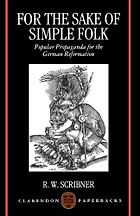
It’s a book about pictures, about the visual propaganda for the Reformation. This approach was truly innovative for the time, to take images away from the special discipline of art history and into mainstream history, and also to be interested in images that were not great art. Scribner’s pictures are woodcut illustrations advancing Protestant arguments and usually denigrating or attacking Catholic ones.
The pictures are often extraordinarily scatological—a group of devils sitting on top of the gallows shitting out monks and friars and popes into a big pile lying beneath it. There is lots of excrement and farting.
The idea that Scribner is presenting us with a rude rather than a decorous Reformation is rather appealing, but there’s also an important point to this. I think it goes back to something I was saying earlier about how it’s important to understand that the Reformation doesn’t come out of nowhere. Scribner, I think, would have described himself as a social or a cultural historian of religion, rather than a historian of theology. He’s principally interested in how religious ritual works within society. And the key question here is how these new, apparently very radical evangelical Protestant ideas from Luther and his followers clicked with people.
“The idea that the Reformation developed in ways its leaders didn’t necessarily want or expect is one of the most important things we need to understand about it”
Part of the explanation was that they found ways of rooting themselves within accepted cultural norms. A number of Scribner’s pictures, pictures of Luther at the very moment when he is raising the standard of rebellion against Rome, portray him as a Catholic friar, indeed almost as a Catholic saint. Luther’s followers are not just rejecting but drawing on the expectations of mediaeval Catholicism to advance the message. The way in which the image of the cross or the image of the crucified Christ appears to be almost ubiquitous in these Lutheran prints is very important. That’s clearly a symbol that is at the centre of mediaeval Catholic Christianity, but is kind of adopted or adapted or brought on board in this changed Lutheran version of it.
It’s also drawing on ideas that are rooted in popular culture about the human and the animal. So, for example, there are portrayals of popes and cardinals as wolves, or lions threatening the sheep of Christ.
There are ideas about carnival, the inversion of social norms in order to make points about truth and falsehood. These are deeply rooted in popular culture, in Germany particularly, where during carnival or Fasching celebrations the world is turned upside down for a day or two. That’s a very important theme in these pictures.
Five Books interviews are expensive to produce. If you're enjoying this interview, please support us by donating a small amount.
The book takes us a long way from the high-minded doctrinal debates into—almost literally—the blood and filth of the Reformation, but it’s very important in helping us to understand how something apparently so radical, so new, could make sense to people within that society.
There must have been quite a clever mind behind all that propaganda.
I’m not sure that it’s necessarily even a conscious strategy or a committee of people sitting down and thinking how to do this. There’s a whole range of authors behind these ephemeral and popular texts that are being produced. In some ways, you could say Luther’s message is perhaps rather misunderstood, and Luther himself wouldn’t always have approved—particularly of the idea that he himself was a saint. But the idea that the Reformation developed in ways its leaders didn’t necessarily want or expect is one of the most important things we need to understand about it.
Interview by Sophie Roell, Editor
October 16, 2017. Updated: February 8, 2026
Five Books aims to keep its book recommendations and interviews up to date. If you are the interviewee and would like to update your choice of books (or even just what you say about them) please email us at [email protected]