How would you define epic fantasy?
I feel like there ought to be an easy one-sentence description that would encompass the nature of epic fantasy. But by their nature, epics include a broad variety of material. That is a fundamental quality of epic: it is large (although we’re going to speak about one book that is an exception to that). The scope of epics, whether philosophical or in terms of material or the time elapsed over the course of the story, tends to be large.
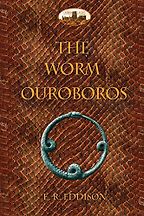
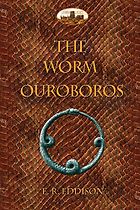
The first on your list is also the first chronologically, a classic from 1922: The Worm Ouroboros by E. R. Eddison. Could you tell us what that’s about, and why you love it?
This is a pre-Tolkien fantasy. It’s notable for a couple of reasons, one being that the book itself is written in faux-Jacobian English, which doesn’t have an exact historical precedent. When I first read it, it took me three tries to get through the darn thing, because I kept hammering my head against all the unusual vocabulary. But once I got used to it, then it was – I won’t say smooth sailing, but it was comprehensible sailing. I love the book for a number of reasons. One is that it is a complete story in one volume, which is unusual in the world of epics these days.
You need to know that it has a strange framing device: right at the beginning, there’s an Englishman who goes to sleep in a lotus room. His spirit is transported, and he gets to witness the activities of the rest of the book – and the author promptly forgets about him for the rest. So you can ignore that part. The other thing is that the names are absolutely ridiculous; they’re like something a ten-year-old boy would come up with when he’s dreaming about a big story. There are demons and witches and goblins, but they’re all just people.
But there’s a grandeur to the story. It’s unabashedly pagan. Tolkien and C. S. Lewis were both very religious in their own ways – Lewis was explicit about it, where Tolkien is implicit, but his beliefs informed so much of his approach to story. Eddison was completely off in a different direction. The philosophy he embraces, which is on display in the book itself, is that the way you achieve greatness is by pursuing beauty and perfection in all things that you do, including villainy. So if you are the villain, then you must strive to be the greatest villain that’s ever lived, because that is the point of your life: to achieve notoriety. That is how your name will live on. It’s your form of an afterlife, of immortality. Of course, that’s drawn right from Beowulf and a lot of the Nordic and Anglo-Saxon traditions. So it’s incredibly immoral in some ways. There are peasants who are just slaughtered by the thousands on the battlefield, and no one cares. No one cares that things are not moral in the normal, everyday sense: but there’s greatness to it.
The language is delightful. It’s just so scrumptious once you get into it. In fact, right near the beginning of the book, there’s a beautiful throne room that’s described in excruciating detail, and one of the details is a star sapphire. And I loved the idea of a giant star sapphire so much that I put an even bigger one into the Eragon series – and readers of that series, of course, will know what I’m speaking of.
It sounds like a truly high-level, grand epic…
Unlike Tolkien, Eddison embraces the full spectrum of human experience, in the sense that there is sex, there are adult relations. It’s not gratuitous or anything, but it’s mentioned that these things happen. And even amid all this grandeur and epic-ness, there are shades of grey and psychological complexity with the characters. There’s a turncoat traitor character who’s really quite well written, and adds a lot of depth to the story… So even though it’s bombastic and over the top, there is still a lot of beauty and subtlety in it.
I recommend this book to almost everyone, and almost no one ends up reading it because of the language.
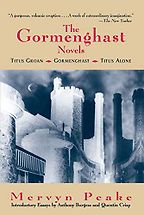
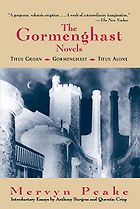
Let’s stick with the theme of ‘unlike Tolkien’ and talk about Mervyn Peake… Could you tell us about your next choice, the Gormenghast trilogy?
How do I describe Gormenghast? Let’s put it this way: if Edgar Allan Poe had written epic fantasy, he would have written Gormenghast.
I love these books. The first one is about the castle Gormenghast, where this ancient family lives, and the castle itself is almost endless. It seems to exist in its own little pocket dimension, and is fairly disconnected from the rest of the world.
Again, the language is gorgeous. It’s so Gothic – it’s like marzipan, it’s so rich, so overly described and wonderful. He goes into excessive but delightful detail, and all of the characters are grotesques in the best possible way. It’s like Peake has taken Dickens’ tendencies towards grotesquery, and just pushed that to eleven. I thoroughly enjoyed it because of the setting, the mood. The characters are memorable and the language is delightful.
I came to the series in an interesting way. I was on book tour for the self-published edition of Eragon – this would have been in 2002 or early 2003 – and I was in Galveston, Texas. I was in a used bookstore doing an event, and after I was done signing, I wandered around in the shelving, and found a copy of the third book in the series: Titus Alone. Now, I had never heard of these books. The internet was just starting to really gear up, and I’d been homeschooled, so I was fairly disconnected from the larger sphere of the fantasy tradition. I picked up this book, and started reading it completely out of context, with no idea of the previous two books… And it was so strange and eerie, it almost read like science fiction. In the third book, Titus, the main character, who is the heir to Castle Gormenghast, leaves his little pocket world. He goes out into the larger world.
Mervyn Peake had some psychological issues, which caused him problems later in life. He also fought in World War I and saw quite a bit of savagery, as people did who fought. And it comes out in that text, in the same way you see it with other authors who went through the experience of that generation. Everyone processed it differently, but Mervyn Peake, I think, was processing it through his writing and his illustrations. He started as a children’s book illustrator, of all things – so through the books, you’ll come across these pages of illustrations of all the characters, which adds so much to the flavour of the story.
So I recommend this if you’re looking for something that feels like a dark fever dream. People say that about books – ‘Oh, it reads like a fever dream’ – but Gormenghast really does.
Titus Alone is such an interesting place to start. Another interviewee has talked about how, by design, it makes you wish you were back in Gormenghast – how you’re as disappointed as Titus is.
And to be fair, the original version of Titus Alone that was published was an unfinished manuscript, which was chopped up by the publisher, and later on a more complete form of the manuscript was discovered, and that was released as part of an omnibus – which has a foreword by Michael Moorcock, I believe. It does not entirely bring the book up, perhaps, to the standard of the first two, but it does substantially improve it.
I’ve always said that if I could have picked one director to do a good Gormenghast adaptation, it would have been the guy who did Amelie, Jean-Pierre Jeunet. If you see some of his other movies, like Delicatessen and The City of Lost Children, they’re very much in the vein of Gormenghast. If you like those movies, I think you would like these books.
Peake and Tolkien were writing their epic fantasies at around the same time, but Peake saw himself as very much not doing the same thing as Tolkien. Could we talk a little bit about that contrast?
They’re not even in the same universe. Eddison and Tolkien you can compare, because they’re both writing a big epic quest story.
The morality is just completely different with Gormenghast. It feels like he decided to focus on a place, and make the place itself a character, even more than Middle-earth is a character within The Lord of the Rings. I’m not from the UK, but as an outsider, it does seem also as if Peake was very much interested and concerned with class structures and established aristocracy, in a way that Tolkien wasn’t interested in examining.
The biggest difference is that Peake pursued the grotesquery of his setting and his characters. And although there is a striking beauty to that at times – for example, there’s a fight scene lit by lightning, and the way it’s described is incredibly stark and startling and awesome; I wouldn’t be surprised if Cormac McCarthy had read Mervyn Peake – but he doesn’t focus on the beauty of things the way Tolkien does. He’s a much harsher soul than Tolkien. There’s a certain gentleness to Tolkien – a steel too, but a certain gentleness and goodness. Peake may have been a perfectly good person himself, but he focuses on different things in his writing. But it’s not depressing – it’s not grimdark in the modern sense.
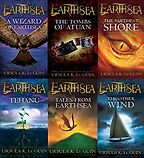
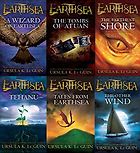
Well, a discussion of beauty seems like a good time to turn to Ursula K Le Guin. Your third choice is the Earthsea Cycle, starting with A Wizard of Earthsea. Could you introduce us?
I’ve always been enormously fond of these books (although to be fair, I’ve not read the follow-up books after the initial trilogy, which I’ve heard good things about, and they’re in my to-read pile.) The first novel is really a wonder, because it is an epic fantasy in a very small book.
Le Guin did something that we don’t see very much of in modern-day fiction, which is that she narrates her story. That’s actually a feature in a number of these books today, but especially Le Guin: she is telling you this story. Nowadays, the modern fashion is to delve deep inside the head of a character, and experience the story only through the eyes and feelings of one or more characters. We’ve lost that storyteller-narration to a large degree. Some people do it, of course, but it’s not as common as it used to be. Le Guin does it wonderfully, and it allows her to tell instead of show, at times, and thus tell an epic.
She very deliberately set out to write a story that contrasts itself with The Lord of the Rings and some of these other well-known fantasy stories. The danger that our main character, Ged, is facing is not the great evil Lord who’s sitting on Mount Doom. It’s not an invading army. The opposition, the evil, comes from within the main character himself, and he has to grapple with that on a thematic and philosophical level. This is something that is true of all of these stories, but she just made it explicit, and it’s a wonderful metaphor for adolescence and coming of age: you must master yourself to become a functioning adult. And that is what Ged does.
The setting is unique. It’s a world where the land masses are split up into all these tiny islands and archipelagos, and there are various interesting societies and magics throughout. It strikes hard. I’ve heard from a couple of modern readers that they had difficulty with the narration at first, until they understood what Le Guin was doing. But it is absolutely worth sticking with it, and I love it dearly.
And we meet new characters within Earthsea for the next books of the cycle, right?
The second one has a different main character, although Ged comes back in (he later becomes known as Sparrowhawk). It’s a great examination of religion and cultish thinking, really well done. And then The Farthest Shore is essentially grappling with death. It’s an examination of mortality, and is incredibly well done again, because Le Guin knew what she was doing. She had things to say. She had a philosophical position, which I think is true of all of these authors: Eddison, Peake, Le Guin and, of course, Tolkien. They all had something to say. They’re not preaching, but their belief systems are guiding their narrative choices.
As a trilogy, it’s not even that long with all three books combined. Yet it tells a complete story of starting as a child and becoming an adult who grapples with morality and mortality, with religion in there.
I remember when Harry Potter came out and was growing in popularity, people were pointing toward A Wizard of Earthsea and saying that Rowling was drawing from it – because a young man goes to a wizarding school. That is not what The Wizard of Earthsea is about! The “school” part lasts such a short time in the book. It’s not about a wizard going to a wizard school; it’s about a young man loosing an evil upon the world, and having to grapple with that, and understand that the evil came from within him.
I would also be remiss if I did not say that the magic system in The Wizard of Earthsea revolves around the concept of true names granting power over things, and I shamelessly drew from that for my own magic system. To be fair, it is from an older tradition in folklore and deep magic, but Le Guin was one of the ones who really got me thinking along those lines for my own books.
But then you also explore wordless magic, which I found exciting – the thought that crossed my mind was that this felt like Le Guin meeting Garth Nix’s bound and free magic…
Ah, I love that trilogy, Sabriel and Lirael. I think it ought to be talked about more these days.
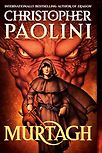
A list for another day, perhaps. But let’s follow that last thought, and talk about your latest book in the world of Eragon. You return to Alagaësia in Murtagh, but we move beyond the events of the Inheritance Cycle. How much of this did you already know would happen?
Murtagh came out in 2023, which was the 20th anniversary of the hardcover release of Eragon…
No!
I know, we’re all getting old. Murtagh is a standalone, although less of a standalone than you might think at the moment, because it is setting up some future stuff that’s going on in the world of Eragon – very large stuff that will become apparent with Tales from Alagaësia: Volume Two, which I’m currently finishing up, and then Murtagh II, which is next on the docket.
I really enjoyed coming back to the world of Eragon. For a long time, I thought I was done with it, even though there were things I had hoped to write about. That’s just life, and I needed to go out and try my hand at some other projects, which I had great fun doing. But eventually, I really wanted to come back to this world, and Murtagh was a good way to do it.
In the beginning of 2019, I published a short story collection in the world of Eragon, and one of those stories involved the character of Murtagh. And when I wrote that, it got me thinking. It felt like the start of a larger story, the inciting incident for a much bigger adventure. I knew that anniversary was coming up, so I thought, this is a good time to set my sights on that, and actually write this adventure.
As well as future events, we learn backstory – both new information, and scenes experienced in memory – was some of that already in your development of the earlier books?
Absolutely. With the Inheritance Cycle, I stuck very strongly with Eragon’s point of view. I do bounce around a bit in the later books with a couple of other characters, but I never used or showed Murtagh’s point of view. And that is a philosophy I have: I don’t like to show the antagonist’s point of view, because I feel like it spoils things. You can do it in a way that raises tension, because the reader knows something the main character doesn’t – but in general, I prefer not to do that. So I never showed Murtagh’s point of view, which was frustrating, because from a macro point of view, the Inheritance Cycle is the story of three brothers (or, essentially, brothers). There’s Eragon; there’s his cousin, Roran; and then there’s Eragon’s half-brother, Murtagh. And we never get to see what Murtagh is going through, which is just as epic as (and quite a bit more traumatic than) what Eragon is going through. Having a standalone book about that character allowed me to show readers some of what had been going on – and then, of course, push his character forward.
In fact, the reason I wrote that book, ultimately, is because Eragon’s main story is done. I told that story. I don’t need to go back and rehash it, or try to come up with some false challenge that he needs to overcome. His story finished, but Murtagh’s story didn’t. His personal issues were as yet unresolved, and also his place in the world was unsettled. So there was still a story there. And as soon as I began thinking about it in depth, it seemed worth delving into and devoting a good chunk of my life to.
This comes back to what you were saying earlier, about all these books implicitly being about defeating your own evil, even if they’re explicitly defeating an external one. Eragon has finished that journey.
There are good stories where the main character does not change: James Bond is an excellent example of this, or Poirot. The main character doesn’t really change, the world around them changes, and the character learns – the story is about the character learning more about the world, figuring out who murdered so and so, or what the evil plot is, and working to resolve the problem. And that can be an excellent and entertaining story.
Outside of that type, though, I think a good story needs to reflect the issues that the main characters are dealing with. And yes, you can be explicit with that, or you can hint at it. Le Guin made it very explicit, and I think did a great job with it, and it’s not preachy in the slightest. And with Murtagh, it was very similar. It was about looking at the things that he was dealing with and saying, ‘I have these issues that he’s dealing with, along with his dragon Thorn, and then the world itself has certain things going on that also need to be addressed. Can I pair the two together? Do they mesh well, and is there a story there?’ And when I found that the answer to that was yes, I said, ‘Okay, I’m going to write this.’
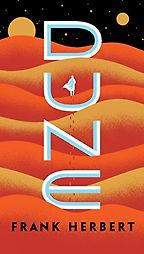
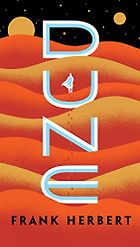
Let’s turn to your fourth choice now: Frank Herbert’s Dune. This is usually shelved as sci fi – tell us about why it’s on your list today.
I’m sure someone else has said this before me: in lots of ways, Dune reads like science fiction written as fantasy. I’m not saying it’s not science fiction, but it adheres to a lot of the tropes and structures of epic storytelling and epic fantasy. You have knife fights and you have shields; you have lots of things that you could put in a medieval-style setting, and it would make perfect sense. So Dune gets put in that same category in my brain, of epic fantasy/science fiction. You have lords and armies, and fighting over resources – it’s of a type.
And in fact, there are books that are the other way around. The Way of Kings by Brandon Sanderson, for example, is fantasy written almost like science fiction – because it’s on a different planet with a completely different ecosystem, and it’s all very well explained as you would in science fiction, even though there’s magic. Dune is the other way around: it’s a sci fi world that reads like fantasy, with archaisms and other tropes. It’s the story of a young man who is coming of age, acquiring his powers, dealing with tragedy, and having to face off against great opposition and prove himself as both a warrior and a leader.
Personally, I also like the writing style, although some people can’t stand it. I remember one time I picked up Seven Pillars of Wisdom by T. E. Lawrence, and it’s Frank Herbert’s writing style – which makes perfect sense, because Herbert was writing about the desert and desert peoples, and was drawing a lot from real-world traditions for his own setting. I like his style: it’s wonky and distinctive, like all of these writers, and it creates a unique sense of place.
From a technical world-building standpoint, something he does really well is evoke a much larger setting than he actually depicts. He’ll often mention something, a piece of technology or a piece of history, just as a throwaway line. This is something Jack Vance, the classic sci fi author, did a lot of as well. He’ll mention something, and then he won’t ever explain it any further. And when people talk about all the incredible world-building of the Dune universe and setting, ‘Oh, there’s this, and there’s that,’ and then you read the book – it’s not in there. It’s in the appendices, or it’s in the sequels. There’s a lesson there, I think, for modern writers, about finding the balance: not overloading the reader with exposition, while at the same time not confusing the reader. Herbert did a good job of walking that line.
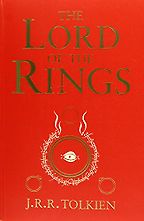
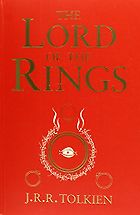
We’ve come to the final choice on your epic fantasy list: we saved it until last. Tell us about The Lord of the Rings trilogy by J. R. R. Tolkien.
You can’t talk about epic fantasy without talking about The Lord of the Rings, since a good chunk of modern epic fantasy wouldn’t exist without Tolkien, if not all of it.
For anyone who missed the memo – what’s it about?
So, both the first book and the series as a whole are about the characters, including the hobbit Frodo, the wizard Gandalf and all of their friends and allies, setting off to help destroy the “One Ring to rule them all”, the magic ring. And they experience various misadventures along the way. That’s the story – I’ve horrendously simplified it.
Of course, everything has been said about Tolkien, I can’t say anything new… If you’re coming to the books having only seen the movies, you may be in for a bit of a shock about how much walking there is, and how much description there is. If Tolkien were getting published nowadays, an editor would go in and drastically downsize quite a bit, especially in the first one or two hundred pages of the first book – downsizing the description of the landscape and the setting and so forth and so on. But that was a large part of the mood that Tolkien was attempting to convey. He had a very specific sense of place, and he was pursuing that, and there’s a gentleness and a beauty.
Of course, the setting of the series is Middle-earth, and it has a history that’s nearly as rich as the history of the real world. That was a deliberate effort on Tolkien’s part to essentially create a mythology for the modern-day UK, in a way that didn’t exist prior to Tolkien. I’d say it has expanded worldwide at this point. He did a wonderful job of it, and the characters are memorable. The story is, of course, deep and meaningful, because Tolkien was trying to say something about the nature of power and evil. When I think of the series, I think of so many wonderful scenes – whether or not there was danger involved, it’s about how evocative the mood and Middle-earth is. I’m not the first reader to say it would have been wonderful to visit Middle-earth.
On a technical level, because Tolkien was a linguist and was incredibly proficient with that, he was able to create a reality to his languages and his world that few authors can come close to. On a storytelling level, Tolkien also did something that is really rare to see: he wrote a series which is essentially one giant book published as three volumes, but each volume is shorter than the last. Off the top of my head, I can’t think of another author that’s done that. One of the difficulties with epics is that they tend to sprawl. The longer you spend with the world, the longer you spend with the characters, the more you learn about them, and the more things you think about in the world. And so there’s a temptation to keep adding more and more, and there’s a temptation to answer more and more questions. Tolkien corralled a lot of his world-building into the appendices, just like Frank Herbert did with Dune, even though there’s still a ton of world-building in the books themselves. You can read it or not as you like, but as is right and proper, with each book the pacing pushes faster and faster toward the end of the story, the final confrontation. He’s not going to spend ten pages at the beginning of book three telling you what a hobbit is; he did that back in the first book. And there’s no need to reiterate all of this extra description or world-building or exposition. I think it’s a really admirable thing, and all of us authors should pay a little more attention to that at times.
It must take a tight control over the plot to pull that off…
There is a difference between writers who plot heavily before writing, and writers who discover the world and the characters as they write. My understanding is that Tolkien was kind of in-between; he did a lot of discovery as he was writing, and had a lot of false starts along the way with The Fellowship of the Ring. But at the end, he was able to maintain control of that structure. The world-building is wonderful, but the point is the story itself and the characters, they stick with you.
The world itself feels incredibly real, and there’s a real sense of magic there. One of my great complaints with so many fantasy television shows and films is that they don’t usually succeed in evoking a sense of wonder and awe. That may be easier to do in a book than in film and television, where we can watch someone and say, ‘He’s got a New York accent and he’s supposed to be an elf from a thousand years ago’ or whatever. Fantasy is very hard. It’s hard to create that sense of another place and another time, especially if you’re going for high fantasy versus a more gritty, low-fantasy feeling. But The Lord of the Rings books do it in spades, and that is one of the things that is truly wonderful about them.
Thanks for this excellent list. Do you have any last thoughts to share before we wrap up?
I’ll end by referencing a quote that I used in the afterword for my science fiction epic, To Sleep in a Sea of Stars. I have a translation of The Aeneid sitting here somewhere in my office, translated by a professor named Rolfe Humphries. Virgil worked on The Aeneid for ages and ages, and felt that it was still terribly unfinished; it was supposed to be burned when he died, and fortunately for us, it wasn’t. And Rolfe Humphries made the point in his notes on his translation, talking both about The Aeneid and his own translation: you can have a perfect sentence, you can have a perfect couple of lines, a perfect stanza. You can have a small perfect something. But you can never have a perfect epic. It’s too little energy spread over too much material. All epics are flawed in one way or another. I really like that thought, actually, because all of the books we’ve discussed today have their own idiosyncrasies. They all have their own wonky little features, The Lord of the Rings being no exception. I think I love all of them because of that, not in spite of that. It’s what makes things unique and human, and in an era of AI, that’s all the more important.
Interview by Sylvia Bishop
January 23, 2026. Updated: March 27, 2026
Five Books aims to keep its book recommendations and interviews up to date. If you are the interviewee and would like to update your choice of books (or even just what you say about them) please email us at [email protected]
Five Books interviews are expensive to produce. If you've enjoyed this interview, please support us by donating a small amount.