Those who love historical fiction have plenty of choice among the list of past Booker Prize-winning novels. We asked Five Books deputy editor Cal Flyn to put together an overview of the Booker's past victors that will sweep you from Tudor England to 20th-century India by way of the 19th-century Australian outback.
The Booker Prize is the UK’s biggest book prize (and, arguably, its most prestigious). Any book that makes it onto a Booker longlist is doubtlessly literary in style and approach—but it may also be further categorised into one of the various sub-genres of fiction. We know historical fiction is very popular among our readers, so find below a list of notable, Booker Prize-winning historical novels. We hope it helps you find your next read—and perhaps your new favourite book.
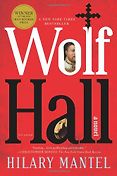
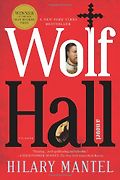
It’s the big one. If you love historical fiction and you haven’t read Hilary Mantel’s Cromwell trilogy, then it is time to right that wrong. She won two Booker Prizes, for the first and second books in the series: Wolf Hall and Bring Up the Bodies. In case you’ve been living under a rock: the books follow the rise and fall of Thomas Cromwell, a historical figure in 16th-century England, from a hardscrabble childhood as the son of a violent blacksmith to Lord High Chamberlain in the government of Henry VIII.
Wolf Hall follows the king’s scandalous affair with Anne Boleyn and, eventually, the annulment of his long marriage to Catherine of Aragon, as masterminded by Cromwell. But, as any Tudor buff knows, Boleyn’s tenure as Queen of England would not last long. The fallout, and Henry’s budding romance with the delicate Jane Seymour, forms the centrepiece to Bring Up the Bodies—which, as the title suggests, ends in disgrace and the ultimate betrayal.
And you can’t stop there. Though the final instalment, The Mirror & the Light, did not earn Mantel her forecast hat-trick of Booker Prizes, it is at least as brilliantly written as the first two, as we witness Cromwell’s final defeat. Expect intrigue, humour and a non-linear narrative.
If you have already read and loved Mantel’s Cromwell trilogy, you may be interested in our list of recommended books like Wolf Hall.
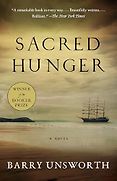
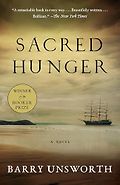
In this unsettling historical novel, a family of seafarers from 18th-century England embrace the greed and the horrors of the transatlantic slave trade. A father, son and nephew embark on a voyage from Liverpool to West Africa, where they buy slaves to transport to the American Colonies. When disease breaks out in the hold, the captain’s reckless and inhumane response sparks a mutiny.
Sacred Hunger—so named for the ‘hunger’ of colonial merchants, who believe that “money is sacred, as everyone knows”—is by no means a quick or light read, given its heavyweight subject matter and hefty (600-page) size. But it offers vivid insight into life and attitudes of the era, and brings a disturbing period in history to life by way of immersive, evocative description.
Sacred Hunger was the joint winner of the Booker Prize in 1992, alongside another work of historical fiction, Michael Ondaatje’s The English Patient, in which an aristocratic aviator, grievously burned in a plane crash, is tended by a nurse in a Tuscan monastery during the Second World War. The English Patient was adapted into a film directed by Anthony Minghella in 1996.
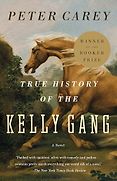
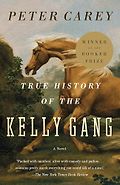
True History of the Kelly Gang by Peter Carey
Peter Carey took inspiration from the life of Australian folk hero Ned Kelly in this fictionalised autobiography, which won the Booker Prize in 2001. Kelly, the son of a transported convict, turns to banditry in colonial Australia, before he and his clan are ultimately cornered by armed police in a hut in the remote bush.
Written in vernacular language with minimal punctuation (“I lost my own father at 12 yr. of age and know what it is to be raised on lies and silences my dear daughter you are presently too young to understand a word I write but this history is for you”), this is a voice-heavy frontier novel that should appeal to those who enjoy literary Westerns with morally ambivalent protagonists. It was adapted into an Australian movie starring Russell Crowe in 2019.
You may also be interested in Carey’s earlier Booker Prize-winning novel, Oscar & Lucinda, a love story between a gambling seminarian and a genteel heiress, who meet on a ship bound for the Antipodes and end up attempting to transport a glass chapel through the Australian outback. It too was adapted for the screen, with Ralph Fiennes and Cate Blanchett in the starring roles.
Authors take very different approaches to historical fiction. Some, like Mantel, above, seek historical accuracy where possible—embroidering only in the gaps left in the historical record. Others take a very different and more fantastical approach.
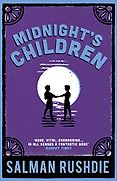
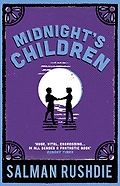
Salman Rushdie embraced magical realism in his multi-award-winning novel, Midnight’s Children. In it, babies born at the stroke of Indian independence gain magical powers—telepathy, prophecy, invisibility and more. The filmmaker and novelist Ruchir Joshi selected it when he recommended the best historical novels set in India, observing: “If he’d written a straight book, it wouldn’t have been so gripping. It’s gripping because of the magical realist elements, where he can freak out, take off, come back, play with language.” It is, he said, “fantastic… very, very inspiring.”
And if you’re open to supernatural elements, you should also read Lincoln in the Bardo, a wild ride of a novel set in the cemetery where Abraham Lincoln’s young son has been recently buried. It features rude ghosts, spectral humour and a polyphonic chorus of voices. Lincoln in the Bardo, which won in 2017, is both hilarious and heartbreaking, but you need to be ready for the text to take excitingly experimental form. It’s one of my favourite books of all time. I laugh just thinking of it.
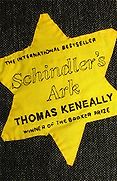
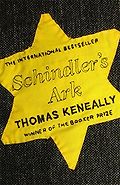
Keneally’s Booker Prize-winning novel, based on the true story of Oskar Schindler—an entrepreneur and Nazi party member who saved the lives of more than 1200 Jews during the Second World War, in assisting their escape from Hitler’s Germany. Keneally was convinced to take on the project after meeting a Holocaust survivor in Los Angeles. As he later recalled:
I met a Schindler survivor named Leopold Pfefferberg in his Beverly Hills luggage store in October 1980. Buying a briefcase to replace one which came unstuck, I was in there a long time while Mastercard investigated my bona fides… But Leopold had time to get talking, and ultimately led me out through the repair room, where Mischa, his wife, was working on orders, to a filing cabinet. It was full of Schindler material including testimonies of survivors, photographs of the period, documents, some of them produced by Oskar himself, copies of SS telegrams, and the famous list of Swangsarbeitslager Brinnlitz, Oskar’s second camp.
The book was famously adapted into the Oscar-winning film Schindler’s List by Steven Spielberg. For those who’d like to read more about the backstory to the book, and how it came to be, Keneally also wrote a memoir on the subject, Searching for Schindler.
More Booker-Prize-winning historical novels
December 28, 2025
Five Books aims to keep its book recommendations and interviews up to date. If you are the interviewee and would like to update your choice of books (or even just what you say about them) please email us at [email protected]
Cal Flyn is a writer, journalist, and the deputy editor of Five Books. Islands of Abandonment: Life in the Post-Human Landscape, her nonfiction book about how nature rebounds in abandoned places, was shortlisted for numerous awards including the Baillie Gifford Prize, the Ondaatje Prize, and the British Academy Book Prize. She writes regular round-ups of the most notable new fiction, which can be found here. Her Five Books interviews with other authors are here.
Cal Flyn is a writer, journalist, and the deputy editor of Five Books. Islands of Abandonment: Life in the Post-Human Landscape, her nonfiction book about how nature rebounds in abandoned places, was shortlisted for numerous awards including the Baillie Gifford Prize, the Ondaatje Prize, and the British Academy Book Prize. She writes regular round-ups of the most notable new fiction, which can be found here. Her Five Books interviews with other authors are here.