

Popular Science
Last updated: October 19, 2026


“Levitin is a researcher, a musician, and a scientist. So he’s an interesting person with a very varied perspective. A lot of this book is about how music influences the brain, and how music can be used to treat neurological issues. It’s not all classical music; there’s also music by Beyoncé and a whole bunch of other things. One of the real messages that comes from this is that there is no one-size-fits-all. Music as medicine is highly personal. Something that works for you might not work for your wife, your brother, your sister, your child. There are certain things about every person’s brain that work in particular logical and electrical shapes. So how this work depends on the individual.” Read more...
The Best Popular Science Books of 2025: The Royal Society Book Prize
Sandra Knapp, Biologist
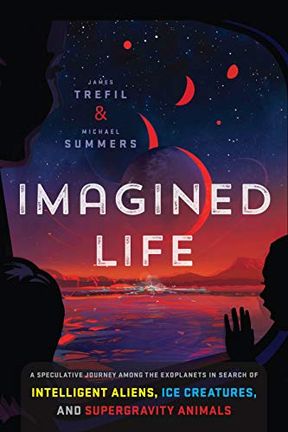
“It’s speculating about alternative biologies. The problem is that we have just one example of biology, the one that happened on Earth. Everything on Earth—from a fungal spore to a blue whale, to a redwood tree—is the same biological experiment. We don’t know what a different biological experiment would lead to, or what the creatures and life forms that emerge would look like. If you vary from the one example we know, you’re immediately in the realm of pure speculation. It’s a tricky business because we simply don’t know. I enjoyed the book. I did have a little asterisk in my head as I read it saying, ‘Wait a minute! We don’t know that that could happen or that it would be like that!’” Read more...
Chris Impey, Scientist
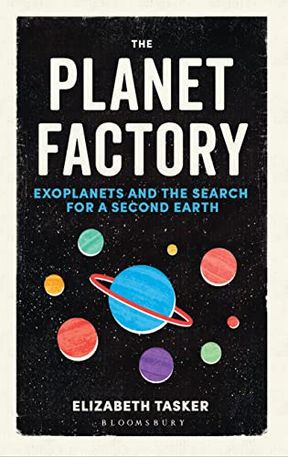
“She’s…interested in the quirks of the planets. I wouldn’t call it The Guinness Book of Records approach, but there’s a bit of that. She says, ‘Wow, there are oddball planets!’ Then she takes it beyond that, and asks, ‘How do they happen? How does nature make these strange planets? Why are they strange compared to the planets in our solar system? Is our solar system dull? Is it typical?’ These are important scientific questions, but she does have a lot of fun with the oddballs—the planet where it’s raining molten lava or diamonds or the planets that have been stretched into a pear shape because they’re so close to their star. She writes about all sorts of extreme planets that we’ve found.” Read more...
Chris Impey, Scientist
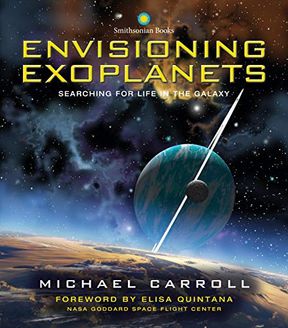
“Michael Carroll is an internationally reputed space artist, and he’s very knowledgeable. There are maybe 200 beautiful, full-color illustrations in the book. The important prefatory comment is that even though we have 5,300 exoplanets that we know of, we don’t have images of more than 100 of them. Most of them are found by these indirect methods of Doppler radial velocities, and the transit of eclipses. Only a very small fraction has had a picture taken of them and even those are just a few pixels or a dot. These illustrations are all visualization, imagination and projection from the basic data. Here’s the mass, here’s the size, we think it might have this in the atmosphere, what would it look like? He follows that through and says, ‘Here’s what I think it might look like.’ It’s nice to see something that, unfortunately, scientists can’t.” Read more...
Chris Impey, Scientist

A (Very) Short History of Life on Earth: 4.6 Billion Years in 12 Chapters
by Henry Gee
***Winner of the 2022 Royal Society Science Book Prize***
“I see this book almost as one long poem. The style might not be to everyone’s taste, but I think everybody would agree that it’s amazing. The use of language is breathtaking. You feel like you’re part of this extraordinary evolutionary process, both physical and biological. He stops it from just being drearily descriptive, and takes you on this wave of fantastic imagery—describing what was happening, so that you can see it.” Read more...
The Best Popular Science Books of 2022: The Royal Society Book Prize

“Pale Blue Dot is a contemplation on humanity, and our future. It asks who we are and where we came from, in order to understand where we are going. In particular, it examines the possibilities of space travel within our solar system and to other stars over the next few centuries. The thing I found most compelling about it was how it described the science of these endeavours in such evocative — indeed poetic — ways. I hadn’t realised it was even possible to write like this, combining clarity, accuracy and beauty, and it made a great impression on me.” Read more...
Toby Ord, Philosopher

Metazoa: Animal Life and the Birth of the Mind
by Peter Godfrey-Smith
***🏆 A Five Books Book of the Year ***
“What makes this such an interesting book for me is the combination of the first person and the more scientific and philosophical analysis. I’ve already mentioned that the author is a scuba diver. He’s brilliant at describing just what he sees, the patterns of behaviour of the animals he observes” Read more...
The Best Philosophy Books of 2020
Nigel Warburton, Philosopher

“Neil deGrasse Tyson is an astrophysicist at the American Museum of Natural History…We felt this book was just really nicely written. In the first sentence he writes, ‘in the beginning, nearly 14 billion years ago, the entire universe was smaller than the period that ends this sentence.’ He really has a good way of capturing the enormity of what you’re looking at. The book has nice little digressions too, where he talks about the physics. So there’s a little bit about Newton and the impact that had and then there’s things about the oblateness of the Earth—in other words, it isn’t exactly spherical—and that you’re a little bit lighter at the equator than you are at the poles.” Read more...
The Best Science Books for Kids: the 2020 Royal Society Young People’s Book Prize
Mike Kendall, Scientist

Transcendence: How Humans Evolved Through Fire, Language, Beauty, and Time
by Gaia Vince
***Shortlisted for the 2020 Royal Society Insight Investment Science Book Prize***
"I wrote this book to answer what, for me, is the biggest question: how did we become so different from all the other animals—able to alter our own destiny and that of the rest of life on earth?" —Gaia Vince.
Read our interview with Gaia Vince—whose last book, Adventures in the Anthropocene, won the 2015 Royal Society Science Book Prize—on the best books on the Anthropocene.

The World According to Physics
by Jim Al-Khalili
***Shortlisted for the 2020 Royal Society Insight Investment Science Book Prize***
"This book is an ode to physics. I first fell in love with physics when I was a teenager" —Jim Al-Khalili.
In The World According to Physics, theoretical physicist, author and broadcaster Jim Al-Khalili continues his mission to explain physics so that the rest of us can understand it, taking readers through the three 'pillars' of modern physics: relativity, quantum mechanics, and thermodynamics.
Read our updated interview with Jim Al-Khalili on the physics books that inspired him.

“It explains 14 billion years of the evolution of the universe, a sort of engineering experiment on the largest possible scale. It spans all scales of space and time, describing everything from the largest scales of the universe to the smallest scales of molecules and atoms. It’s a good book for putting everything in perspective.” Read more...
Ante Shoda, Scientist

“What I really liked about A Short History of Nearly Everything is that it gives an excellent account of a lot of the personalities and the interconnectedness of important discoveries in cosmology and elsewhere. He does such a great job of bringing together our understanding of cosmology, evolution, paleontology, and geology in a very, very fluid way.” Read more...
David Goldberg, Physicist

Sapiens: A Brief History of Humankind
by Yuval Noah Harari
Some academic historians have been quite critical of Sapiens by the Israeli historian Yuval Noah Harari, pointing out that some of the nuances of debates are lost in a popular history book. But that's also why it makes a good read and an effective audiobook. It not only gives Harari more scope to address the big questions, but also gives many people their first detailed introduction to the origins of human beings. There's a lot to think about after reading this book, even if you ultimately disagree with his interpretation.

“Kahneman developed research with Amos Tversky, who unfortunately died young—I think it would have been a co-written book otherwise. It’s a brilliant book that summarizes their psychological research on cognitive biases, or is patterns of thinking, which all of us are prone to, which aren’t reliable.” Read more...
The best books on Critical Thinking
Nigel Warburton, Philosopher

“Even if we’re not technically in a mass extinction event like the one that did in the dinosaurs, it’s clear we are in the midst of a crash in species diversity and population size that is so devastating as to influence the operation of the Earth system as we know it. We’ve heard this quite a lot over the years, but Kolbert’s book brought it home in a more intimate, and a more damning way. There’s a calmness, and a detachedness in her writing that makes it that much more powerful and affecting” Read more...
The best books on Global Challenges
Rowan Hooper, Journalist

“Richard Dawkins is very funny. One of the reasons for reading The God Delusion is that it will disabuse you of the idea – which is a common stereotype of atheists – that they are utterly humourless…Dawkins also explains a lot about why he disagrees with people who reconcile science and religion. I agree with him on this. I actually do think they are irreconcilable.” Read more...
Susan Jacoby, Journalist

“Kuhn was a famous American philosopher of science, and in this book he was writing about paradigm shifts: how the scientific community, and therefore eventually all of us, change our world views. He looks at where those revisionary revolutions in thought come from. Instead of it being a straightforward ladder of progress, you never know where knowledge is going to come from. It can come from left field, and the book is full of examples of that sort of paradigm shift.” Read more...
The best books on The History of Medicine and Addiction
Louise Foxcroft, Historian
“An educated person is someone who knows at least a little bit about the major disciplines in human endeavour. And in biology, this is what you need to know – not only historically but also contemporaneously, because Darwin was right, and still is right, about so many things.” Read more...
Jerry Coyne, Biologist

“This book changed the way I thought about my own writing and it changed the way I thought about the world. It really is one of the best books I have ever read.” Read more...
Tim Harford, Economist

“What would that be like? What would it be like to be unable to lay down any new memories, to think it’s 1945 all the time and everybody you meet is new? It’s fascinating to imagine, and I feel a lot of sympathy for the Mariner even though he doesn’t know how bad he has it.” Read more...
The best books on Philosophical Wonder
Eric Schwitzgebel, Philosopher
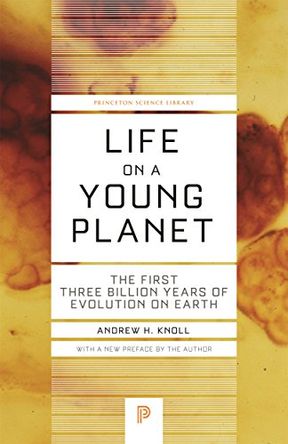
“One of the most impressive popular science books I’ve ever read was Stephen Jay Gould’s Wonderful Life. That was a lovely book about the development of complex life, the Cambrian explosion. Knoll’s book is in the same category. It’s very well written and has a broad sweep of 3 billion years of history. He’s a very preeminent geologist and paleontologist and his expertise covers a number of fields. He’s at the top of his game and he lays out the subject beautifully….He’s a good writer, and I like the fact he’s not hyperbolic. He avoids dramatic statements…He’s quite cautious. I appreciate that, because in his field we’re dealing with slender evidence.” Read more...
Chris Impey, Scientist

“I really picked this book because for me, and I think for lots of people, it was an entry point into thinking about applying evolutionary principles to human behaviour. In a very user-friendly way, it gives you some of the basic tools you can use to start thinking about it…The book was synthesising a bunch of ideas that had been developed by a variety of researchers, in particular William Hamilton and Robert Trivers, on how we can think about evolutionary processes to explain things like cooperation and altruism, which has been a long-running puzzle. It lays out a particular way of thinking where you think about genes from the genes’ eye view. You think about what is good for the gene, and that allows you to solve a bunch of puzzles about altruism, about why people would help those who have copies of those same genes…I put it on the list because it was inspirational to me, though I like to think we now have an enriched way of looking at things that goes beyond what we did in the 70s. “ Read more...

“I think that he is one of the most intelligent people to live in the 20th century. Yet at the same time, surprisingly, he is an amazingly good teacher. This is quite an unusual combination.” Read more...
The best books on Accessible Science
David Bainbridge, Biologist


The best books on The Strangeness of Life, recommended by Carl Zimmer
The science writer and award-winning blogger Carl Zimmer discusses the strangeness of life, from viruses to manipulative flatworms




Favourite Science Books, recommended by Mark Kurlansky
The bestselling author of Cod and Salt tells us about five science books he loves—from whales and snails to evolution and string theory—all of which make difficult subjects accessible
-
1
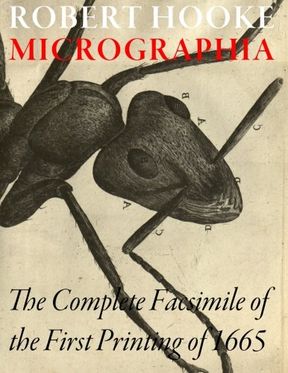
Micrographia: The Complete Facsimile of the First Printing of 1665
by Robert Hooke -
2
Stonehenge Decoded
by Gerald S Hawkins -
3
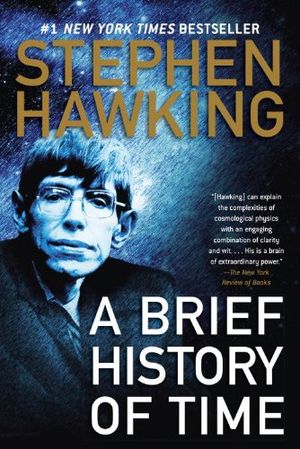
A Brief History of Time
by Stephen Hawking -
4
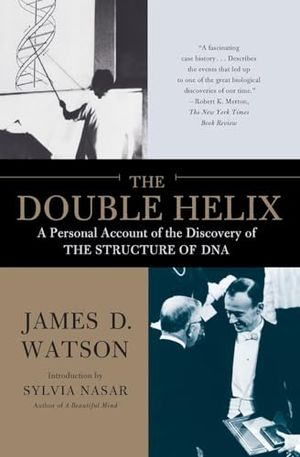
The Double Helix: A Personal Account of the Discovery of the Structure of DNA
by James Watson -
5
The Formation of Vegetable Mould through the Action of Worms with Observations on their Habits
by Charles Darwin
Favourite Popular Science Books, recommended by Adam Hart-Davis



Favourite Popular Science Books, recommended by Adam Hart-Davis
The scientist, author and broadcaster Adam Hart-Davis says clear, simple writing is the key to an accessible science book. He recommends his favourite popular science books, including a 17th-century bestseller and a lesser-known work by Charles Darwin.




The best books on Being Inspired by Science, recommended by Tom Clarke
The Science Correspondent for the Uk’s Channel 4 discusses the magical allure of science. He chooses five great books on subjects ranging from genetics to natural history and astro-physics
